On the afternoon of April 25, 1945, First Lieutenant Albert Katsubu stood on the west bank of the Elbe River near the German town of Torgau. Through field glasses still dusty from the road, he stared at figures moving on the eastern shore. They were Soviet soldiers, the men who had been fighting Hitler from the opposite direction since June 1941.
The two sides were only about 200 feet apart across dark water, and neither knew quite what to do next. Katsubu had no orders for this moment. The American High Command had issued only vague instructions about making contact with Soviet forces, assuming such a meeting would happen at higher levels between generals and politicians, with translators and ceremonies.
Instead, it was happening here, with a 24-year-old lieutenant from Chicago who spoke no Russian. What Katsubu did not know was that 60 miles to the north, Marshal Georgy Zhukov was watching the same convergence with emotions far more complex than simple military relief.
The Americans had arrived. The war in Europe was effectively over. And Zhukov, who had commanded more men in battle than any American general would ever see, was about to meet an army that had fought the Germans for less than four years and lost a fraction of what the Soviet Union had bled.
The question forming in Soviet command was simple and dangerous: What kind of soldiers were these Americans?
The Soviet Union had entered the Second World War in June 1941, when Hitler launched Operation Barbarossa. Within six months, the Wehrmacht had driven to the gates of Moscow, captured millions of Soviet soldiers, and inflicted casualties that would have broken any other nation in history. The Soviet response was not surrender. It was total war on a scale that made American mobilization look restrained.
By 1945, the Red Army had evolved into something unlike any force the Americans had encountered. These were soldiers who had fought across 2,000 miles of territory from Stalingrad to Berlin. They had endured winters that froze men solid in their foxholes and had seen entire cities reduced to rubble.
They had learned to fight the Wehrmacht not through superior tactics or equipment, but through sheer bloody-minded persistence and a willingness to accept casualties that would have been politically impossible in any Western democracy.
Soviet generals understood war differently than their Western counterparts. Lieutenant General Vasily Chuikov, defender of Stalingrad, had held that city through five months of house-to-house fighting where the average life expectancy of a Soviet soldier was 24 hours. Marshal Konstantin Rokossovsky had been purged by Stalin in 1937, tortured, had his teeth knocked out, and then reinstated to command armies because he was too competent to waste.
These were men who measured success not in casualties avoided but in objectives taken. When Soviet commanders received intelligence about American forces advancing from the west, their assessment was clinical. The Americans were fresh. They had entered the European war in June 1944, less than a year earlier.
They had faced the Wehrmacht after years of Allied bombing, after Soviet offensives had destroyed Germany's best divisions, after the industrial capacity that sustained German resistance had been crippled. The Americans had never experienced a winter like Stalingrad or a defeat like the encirclement at Kiev.
This was not disrespect. It was mathematics. The Soviet Union had fielded armies numbering millions, had fought battles involving thousands of tanks, and had sustained offensives across hundreds of miles despite catastrophic losses. American operations, by comparison, seemed small-scale and cautious.
The Battle of the Bulge, which shocked the American public with its 19,000 American dead, was a footnote by Eastern Front standards. The Soviet assault on Berlin alone would kill more Soviet soldiers than America lost in the entire European theater.
Marshal Zhukov embodied this perspective. He had commanded the defense of Moscow in 1941 when German forces were close enough that officers could see the Kremlin spires through binoculars. He had coordinated the encirclement at Stalingrad that destroyed the German Sixth Army. He had planned and executed Operation Bagration in 1944, which annihilated German Army Group Center and killed or captured 450,000 Wehrmacht soldiers in five weeks.
Now Zhukov was marching on Berlin, and the Americans were arriving from the west having never fought a battle of that magnitude. The question Soviet generals asked among themselves was not whether Americans were brave. Courage was universal. The question was whether Americans understood war the way the Soviets did, and whether they were willing to pay the price that victory actually cost.
The cultural gap between the Soviet and American armies was profound. American soldiers were citizen soldiers drafted from civilian life, trained for a specific conflict and expected to return to normality when the war ended. They received regular mail from home and had access to libraries, entertainment, and hot showers when logistics allowed. They expected their officers to care about their welfare and to spend lives carefully.
Soviet soldiers existed in a different reality. Political officers monitored their loyalty. Retreating without orders could result in execution. Soldiers advanced across minefields because command determined that casualties from mines were acceptable compared to the time required to clear them properly. The NKVD maintained blocking detachments behind Soviet lines whose job was to shoot anyone who fled.
This was not cruelty for its own sake. It was the product of a military culture forged in absolute necessity. The Soviet Union was fighting for survival. If the Red Army failed, the Soviet state would cease to exist. Millions of Soviet citizens were already dead from German occupation policies designed to depopulate the East for German settlement.
There was no fallback position, no ocean separating the battlefield from the homeland, no possibility of negotiated peace. American soldiers, Soviet generals believed, had never experienced that level of existential threat. The United States was prosperous and secure. Its cities were not burning. Its civilians were not starving.
American soldiers could fight knowing that even if they lost individual battles, America itself was safe. This shaped Soviet expectations about American combat performance. The Americans would be well equipped. Certainly, American industrial production was legendary. Soviet armies rolled forward on American-made trucks supplied through Lend-Lease. Soviet soldiers wore American boots, ate American rations, and used American radios. Soviet pilots flew American aircraft alongside their own designs.
But equipment was not experience. Equipment did not teach you how to hold a city when surrounded. It did not teach you how to attack when you knew most of your assault force would die before reaching German trenches. It did not teach you how to continue fighting after watching your entire battalion get annihilated and knowing you were next.
Soviet generals wondered if Americans who had so much equipment and so little suffering could match Soviet soldiers who had suffered everything and emerged harder for it.
The meeting at Torgau was not the first contact between American and Soviet forces. Small patrols had encountered each other for days as the two armies converged across central Germany. But Torgau became symbolic because it was photographed, because it was celebrated, because it produced images of American and Soviet soldiers embracing on a destroyed bridge that newspapers around the world printed as proof that the alliance was real.
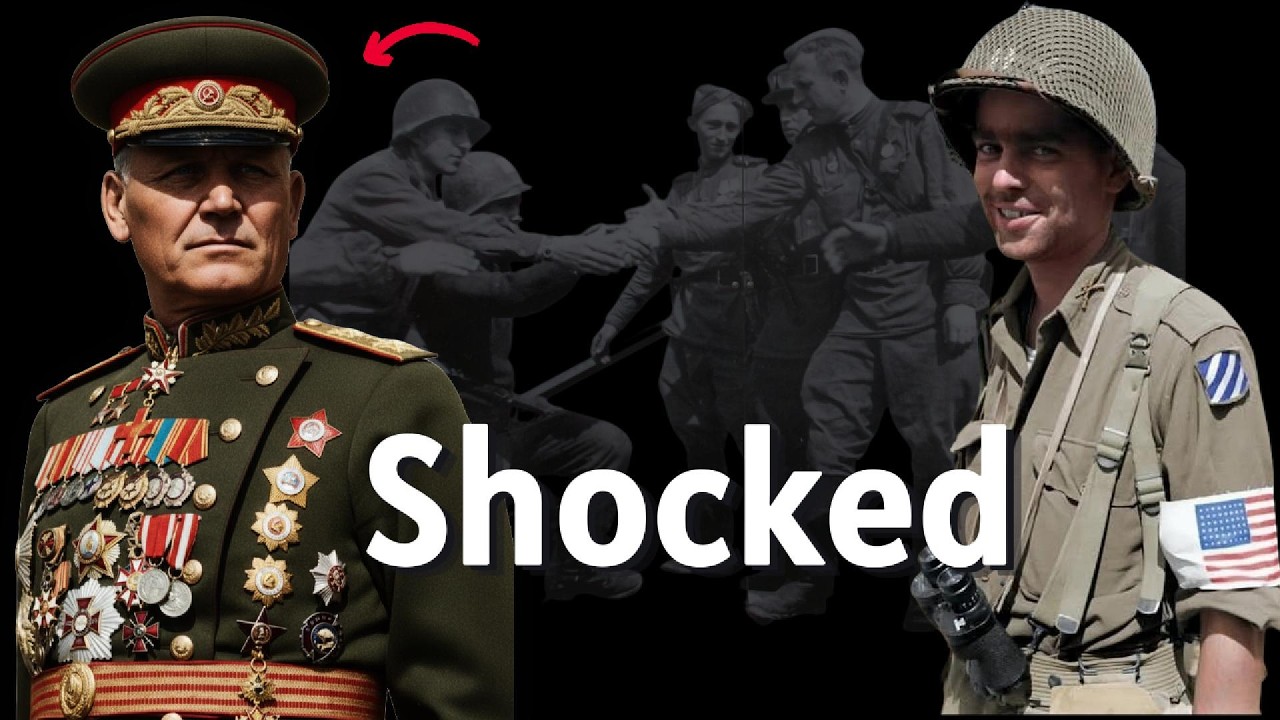
Lieutenant Katsubu had crossed the Elbe in a boat borrowed from terrified German civilians. He landed on the eastern shore and was immediately surrounded by Soviet troops who pointed weapons at him until someone found an officer who spoke enough German to communicate. Within hours, higher-ranking officers had arrived on both sides. Photographers documented Soviet and American soldiers shaking hands, sharing cigarettes, and drinking toasts to victory.
The official Soviet response was celebratory. Moscow radio announced the linkup as proof of Allied unity. Stalin sent congratulations. Political officers ensured that soldiers understood this was a great victory, a demonstration of international socialist solidarity against fascism. But in private conversations between Soviet commanders, the assessment was more complex.
Marshal Ivan Konev, whose forces were simultaneously assaulting Berlin, received reports about American positions and equipment. He noted the abundance of vehicles, the quality of uniforms, the apparent good health of American soldiers. He also noted that American advance rates were slower than Soviet norms, that American forces tended to pause for regrouping when Soviet doctrine emphasized relentless forward movement regardless of casualties.
Konev had a perspective Americans lacked. He had commanded armies that suffered 70 percent casualties in single operations and continued attacking. He had watched fresh divisions get ground down to nothing within weeks of entering combat. He measured success not in lives preserved but in territory taken and enemy formations destroyed. From that perspective, American caution looked inefficient.
Soviet junior officers who interacted with Americans at Torgau had different observations. They noted that American soldiers seemed younger, less hardened than Soviet veterans. American troops smiled more and seemed less exhausted by the war. They had better equipment, better food, better everything except perhaps the absolute determination that came from four years of desperate fighting.
One Soviet lieutenant, writing in his diary after the Torgau meeting, recorded his thoughts: "They are well-fed and optimistic. They have not seen what we have seen. I wonder if they understand what it took to get here." That single line captured the essential Soviet perspective.
The Americans had arrived. Their arrival mattered, but they had arrived late, comparatively fresh, against an enemy already broken by years of Soviet offensives. From the Soviet viewpoint, this was not a shared victory between equals. It was the Soviet Union doing most of the work while the Americans appeared at the end to claim credit.
This perspective was not entirely fair. American and British forces had tied down German divisions in Italy and France. Strategic bombing had devastated German industrial capacity. Lend-Lease had provided crucial supplies when Soviet production was crippled. The Western Allies had contributed significantly to Germany's defeat.
But contribution is not the same as sacrifice. And sacrifice was the metric by which Soviet generals measured everything. The Soviet Union had lost 27 million people, military and civilian combined, in four years of total war. The United States had lost 400,000 across all theaters. From a Soviet perspective, this was not comparable. The Americans had helped. They had not bled.
Marshal Zhukov finally met General Dwight Eisenhower on June 5, 1945, in Berlin. The meeting was cordial. Toasts were drunk. Medals were exchanged. Zhukov presented Eisenhower with a Soviet decoration. Eisenhower responded with American honors. Photographers captured both men smiling. Behind the ceremony, both generals were assessing each other with professional calculation.
Eisenhower commanded respect through his role as supreme Allied commander, but he was fundamentally a political general, a coalition manager who coordinated Allied operations rather than leading armies in battle personally. Zhukov was a field commander who had personally directed some of the largest military operations in history.
In private conversations with his staff, Zhukov acknowledged American organizational capability. The logistical system that sustained American armies across thousands of miles was impressive. The coordination between air and ground forces was sophisticated. American communications equipment was superior to Soviet equivalents.
But Zhukov also noted what he considered American limitations. American forces seemed heavily dependent on artillery and air support rather than infantry assault. American generals appeared risk-averse, unwilling to accept casualties that Zhukov would have considered acceptable for tactical advantage. American soldiers seemed to expect survival rather than merely hoping for it.
These observations were not criticisms in Zhukov's mind. They were simply facts about a different kind of army shaped by different circumstances. Americans fought the way wealthy nations fight, with maximum firepower and minimum casualties. Soviets fought the way desperate nations fight, with maximum determination and casualties be damned.
The difference mattered because Zhukov understood something that most Americans did not yet grasp. The alliance was temporary. When Germany surrendered, American and Soviet interests would diverge. The question was not whether the Americans could fight well. The question was whether they could sustain the kind of long-term commitment that competing with the Soviet Union would require.
Zhukov had his doubts. Americans seemed impatient, eager to win quickly and go home. They had no stomach for the grinding attrition that characterized Eastern Front warfare. They celebrated individual battles as major victories when Zhukov would have considered them minor tactical successes.
This was not American weakness. It was American strength turning into potential vulnerability. Nations that preserve their soldiers are nations that can fight longer wars. But nations that preserve their soldiers are also nations that can be deterred by casualties, that might choose to disengage rather than pay the price of victory.
Zhukov had fought an enemy that could not be deterred by casualties, that continued attacking even when defeat was certain. He wondered if Americans, who had never faced that level of fanaticism, understood what it meant.
Soviet junior officers and soldiers who fraternized with Americans at Torgau and other meeting points had more nuanced views. They liked the Americans personally. American soldiers were friendly, generous with cigarettes and chocolate, curious about the Soviet Union in ways that seemed genuine rather than hostile.
But Soviet soldiers also noticed gaps in American understanding. Americans asked questions about Soviet casualties that suggested they could not conceive of losses on that scale. They expressed horror at Soviet tactics that Soviet soldiers considered normal. They seemed shocked by the destruction in German cities when Soviet soldiers had seen worse in Stalingrad, in Sevastopol, in Minsk.
One Soviet sergeant, comparing notes with an American counterpart, was asked how many men in his original unit were still alive. The sergeant did a mental calculation and answered, "Three, counting me." The American sergeant stared in disbelief. His unit had sustained what he considered heavy casualties, losing perhaps 20 percent of its strength. The idea that 97 percent could be gone and the survivors still fighting seemed impossible.
This was the fundamental disconnect. American soldiers measured survival in individual terms. You fought, you survived, you went home. Soviet soldiers measured survival in collective terms. Your unit might be destroyed, but the Red Army continued, and you were reassigned to a new unit and continued fighting until you died or the war ended.
Soviet political officers observed American morale with particular interest. American soldiers seemed eager to finish the war and return to civilian life. They talked constantly about going home, about the lives they had left behind, about families waiting for them. Soviet soldiers had similar desires, but they did not express them openly. Hoping for survival could be interpreted as lack of commitment to the collective struggle.

The political officers reported these observations up the chain of command. Americans were soft in ways that might matter if the alliance collapsed. They were individualistic, focused on personal survival rather than collective victory. They had not been ideologically hardened by years of political indoctrination emphasizing sacrifice for the state.
But the political officers also reported something that concerned them. American soldiers believed in what they were fighting for with an intensity that Soviet soldiers, despite political training, often lacked. Americans genuinely seemed to think they were liberating Europe, bringing democracy and freedom to oppressed peoples.
Soviet soldiers were more cynical. They knew they were serving Stalin's interests, whether those interests aligned with liberation or not. This American idealism was potentially dangerous from a Soviet perspective. Idealistic soldiers are harder to control through fear. They fight for reasons beyond orders and discipline. They might resist if ordered to do things that violated their principles.
Soviet commanders filed these observations away. If the alliance held, American idealism was useful. If the alliance fractured, it might complicate Soviet objectives in ways that mere military capability could not.
The linkup at the Elbe marked the effective end of major combat operations in Europe. Germany was cut in half. Berlin was surrounded. Hitler was dead within days. Formal surrender came on May 8, 1945.
The celebrations were genuine. Soviet and American soldiers had achieved what had seemed impossible in 1941: the complete destruction of Nazi Germany. The apparatus of genocide had been dismantled. The concentration camps had been liberated. The threat of fascist domination of Europe had ended.
But beneath the celebrations, both sides were already positioning for what came next. American forces halted at the Elbe rather than racing for Berlin because Eisenhower had made a strategic decision that the city was not worth American casualties. Soviet forces took Berlin at enormous cost because Stalin wanted the political capital that capturing the German capital would provide.
Marshal Zhukov understood this dynamic. The Americans fought to win the war. The Soviets fought to win the peace that followed. Every decision about where to advance, where to stop, what objectives to prioritize was made with postwar power dynamics in mind.
From Zhukov's perspective, Americans were amateurs at this kind of calculation. They thought in terms of military objectives and casualty minimization. They did not think in terms of political leverage and territorial control. They would discover their mistake when the occupation zones were formalized and the Soviets controlled Eastern Europe while the Americans wondered how that had happened.
Soviet generals discussing American performance in the final weeks of the war reached consensus on several points. Americans were competent at logistics, adequate at conventional warfare, excellent at using firepower to minimize their own casualties. They were not particularly innovative tactically. They did not demonstrate the kind of ruthless calculation that Soviet commanders considered essential for high-level strategic thinking.
Most importantly, Americans seemed to believe the war was ending when in fact it was merely transitioning to a different phase. The Americans thought they were liberating Europe. The Soviets knew they were securing a buffer zone. That difference in understanding would define the next 45 years of history.
Lieutenant General Vasily Chuikov, who had defended Stalingrad and was now commanding Soviet forces in the final assault on Berlin, was asked after the war what he thought of American soldiers based on his observations and the reports he had received. His answer was characteristically blunt: "They are good at what they do, but they have never done what we do."
This was not quite a compliment and not quite an insult. It was an assessment from a man who had commanded troops through battles that killed tens of thousands in single days, who had held positions where retreat was forbidden regardless of circumstances, who measured success by whether objectives were taken regardless of cost.
From Chuikov's perspective, American soldiers had fought a limited war with limited objectives against an enemy already crippled by Soviet operations. They had demonstrated competence within those constraints. Whether they could have performed under the conditions the Red Army faced between 1941 and 1945 was unknowable because they had never been tested that way.
Other Soviet generals were more generous. Marshal Rokossovsky, who had endured Stalin's purges and emerged to command armies that destroyed German forces across Poland and into Germany, acknowledged that Americans had contributed materially to victory. Lend-Lease supplies had sustained Soviet offensives when Soviet production could not meet demand. American strategic bombing had crippled German industry and tied down resources Germany needed elsewhere.
But Rokossovsky also noted that contribution was not sacrifice. Americans had helped win the war. The Soviet Union had paid for victory in blood on a scale Americans could not comprehend.
This distinction mattered to Soviet commanders because it shaped how they viewed postwar relationships. Nations that had suffered equally might negotiate as equals. Nations where one had suffered enormously more than the other were not equals.
Whatever diplomatic protocols suggested, Soviet soldiers returned home to a nation that had been devastated. Entire cities needed rebuilding. Millions were dead. The agricultural system had been destroyed. Infrastructure was gone. And Stalin, rather than rewarding their sacrifice, resumed purges and political repression to ensure that veterans did not become a challenge to his authority.
American soldiers returned home to parades, to the GI Bill, to an economy booming from wartime production, to a society that had been enriched rather than destroyed by the war. They deserved their welcome. They had served honorably. But the disparity between their homecoming and what Soviet soldiers faced reinforced the Soviet narrative that the Americans had gotten off easy.
The official Soviet assessment of American military capability, compiled for Stalin and the Politburo in mid-1945, was balanced and calculating. American industrial capacity was acknowledged as superior. American technology in certain areas, particularly electronics and aviation, was noted as advanced. American organizational systems were recognized as efficient.
But the assessment also highlighted American vulnerabilities from a Soviet perspective. American forces were heavily dependent on logistical support that could be disrupted. American soldiers showed low tolerance for casualties compared to Soviet norms. American public opinion seemed volatile, likely to turn against prolonged conflicts that produced sustained losses.
Most critically, the assessment concluded that Americans had no experience with the kind of total war the Soviet Union had survived. If conflict between the Soviet Union and the United States emerged, Soviet generals believed they held psychological advantages that might offset American material superiority.
This assessment was built on fundamental misunderstanding. Soviet generals interpreted American casualty aversion as weakness when it was actually sophistication. American forces minimized casualties not because they lacked courage, but because they had developed systems that valued individual lives while maintaining combat effectiveness.

Soviet generals interpreted American optimism as naivety when it was actually confidence built on genuine capability. Americans believed they would win because they had resources, innovation, and systems that worked. Soviets believed they would win because they were willing to sacrifice more than any opponent could match.
Both perspectives were partially right and partially wrong. And the collision between them would define the Cold War.
Years later, when Marshal Zhukov wrote his memoirs, he devoted several pages to his impressions of American forces. He acknowledged their contributions. He praised Eisenhower's diplomatic skills. He noted the quality of American equipment. But he also returned to a theme that pervaded Soviet thinking about the West. Americans had arrived late, fought briefly, and suffered minimally compared to Soviet experiences.
From Zhukov's perspective, this was simply fact. The Soviet Union had engaged the bulk of German forces for four years. The Western Allies had fought a secondary campaign that became significant only in 1944.
This was not entirely accurate as historical assessment. American and British forces had tied down significant German resources in North Africa, Sicily, Italy, and finally Western Europe. Strategic bombing had destroyed German industrial capacity. The threat of Allied invasion had forced Germany to maintain forces in the west that might otherwise have gone east.
But accuracy mattered less than perception. Soviet generals believed they had won the war while the Americans had helped. That belief shaped Soviet foreign policy for decades. It produced a swagger in Soviet diplomacy that Americans found bewildering. It generated Soviet confidence that in any future conflict, Soviet willingness to absorb punishment would overcome American material advantages.
Soviet junior officers who had actually met Americans often had different views. They recognized that American soldiers were brave, capable, and fighting for genuine beliefs. They noticed American technological sophistication and organizational excellence. They understood that dismissing American military capability was dangerous.
But junior officers did not set policy. Senior commanders did, and senior commanders had survived Stalin's purges by being ruthlessly political. Telling Stalin that Americans might be formidable opponents was career-ending. Telling Stalin that Soviet sacrifice had won the war while Americans coasted to victory was safe.
The gap between what Soviet officers believed privately and what they reported officially created distortions that would persist for decades. Soviet military intelligence had accurate information about American capabilities. Soviet political requirements demanded that information be filtered through ideological narratives that minimized American achievements. This was a mistake, though not one the Soviets would realize for many years.
Underestimating American capabilities because they did not match Soviet methods was dangerous. The Americans did not fight like Soviets. They did not think like Soviets. But they won anyway, through different methods that were equally effective.
The meeting at Torgau produced iconic photographs that still define public memory of the end of World War II in Europe. American and Soviet soldiers embracing, toasts being drunk, smiles all around. The images suggested unity, shared sacrifice, common purpose.
Behind those images was a more complex reality. Soviet generals respected American capability while dismissing American experience. They acknowledged American contributions while minimizing American sacrifice. They celebrated the alliance while preparing for its dissolution.
This was not cynicism. It was realism born from four years of total war that had killed 27 million Soviet citizens and destroyed the Soviet Union's Western territories. The Americans had fought well. They had contributed to victory. But they had not suffered the way the Soviet Union had suffered, and that difference shaped everything.
Lieutenant Katsubu, the American lieutenant who made first contact at Torgau, was promoted and decorated. He returned to the United States and resumed civilian life, as most American veterans did. The Soviet lieutenant who met him that day almost certainly continued military service, as most Soviet veterans did, because the Soviet Union needed every trained soldier it could keep to occupy Eastern Europe and deter the West.
Their brief encounter across the Elbe represented two different kinds of military organizations, reaching the same objective through radically different paths. The Americans had mobilized a citizen army, equipped it superbly, and deployed it efficiently to contribute to victory while minimizing casualties. The Soviets had mobilized an entire society, accepted catastrophic losses, and ground down the Wehrmacht through sheer bloody determination.
Both approaches worked. Neither side fully understood the other, and the misunderstandings that began at the Elbe would shape the next half century of global conflict.
Marshal Zhukov died in 1974, celebrated in the Soviet Union as one of the great commanders of the war. His memoirs remained bestsellers. His reputation survived Stalin's death and Khrushchev's denunciations. He never fully reconciled his respect for American material capability with his dismissal of American military experience.
General Eisenhower became president of the United States. He maintained cordial relations with Zhukov when possible despite Cold War tensions. He understood that Zhukov was a serious soldier who had commanded armies under conditions Eisenhower had never faced. He also understood that Soviet and American military cultures were fundamentally incompatible.
The soldiers who met at Torgau mostly forgot each other's names within weeks. They returned to their respective countries and got on with their lives. Some wrote memoirs. Some gave interviews. Most simply lived quietly, carrying memories of a brief moment when the war seemed won and the future seemed hopeful.
But the generals remembered. The generals on both sides remembered that the meeting at the Elbe was not really an ending. It was a transition point between one conflict and another. The hot war with Germany was ending. The Cold War between former allies was beginning.
Soviet generals entered that new conflict confident that their experience in total war gave them advantages Americans could not match. They believed American society was soft, American soldiers were untested under real pressure, and American resolve would crack when confronted with Soviet willingness to sacrifice.
They were wrong about some of that and right about some of that, and it would take decades to sort out which was which. What Soviet generals said after watching American soldiers at the Elbe was less important than what they thought. And what they thought was simple. The Americans had arrived. They had contributed. But they had not suffered the way the Soviet Union had suffered. And that meant they did not truly understand war the way Soviet soldiers understood it.
That belief would shape Soviet strategy through the Cold War. It would lead to miscalculations about American resolve. It would generate conflicts from Berlin to Cuba to Vietnam. As the Soviets tested whether Americans would actually fight when the costs became real, the answer delivered over decades of Cold War confrontation was complicated.
Americans would fight, but not the way Soviets fought. Americans would sacrifice, but not the way Soviets sacrificed. Americans would win, but through methods that Soviet generals trained in different traditions often failed to anticipate.
The linkup at Torgau marked the end of one war and the beginning of another. Soviet generals who watched American forces arrive drew conclusions that seemed reasonable based on their experience. Those conclusions were incomplete. The Americans they dismissed as inexperienced would prove more formidable than expected, not because they matched Soviet methods, but because they found different methods that worked.
But that realization came later. At Torgau in April 1945, Soviet generals looked at their American counterparts and saw capable but untested allies who had arrived late to a war the Soviet Union had already won. It would take decades to discover how wrong that assessment was.