On the night of March 4, 1944, a 47-year-old man walked into the death chamber at Sing Sing Prison in Ossining, New York. His face was pale and his hands trembled. He had once controlled the largest criminal empire in America, ordered hundreds of murders, and made millions of dollars. Now he sat down in the electric chair known as Old Sparky and said nothing. No final words, no confession, just silence.
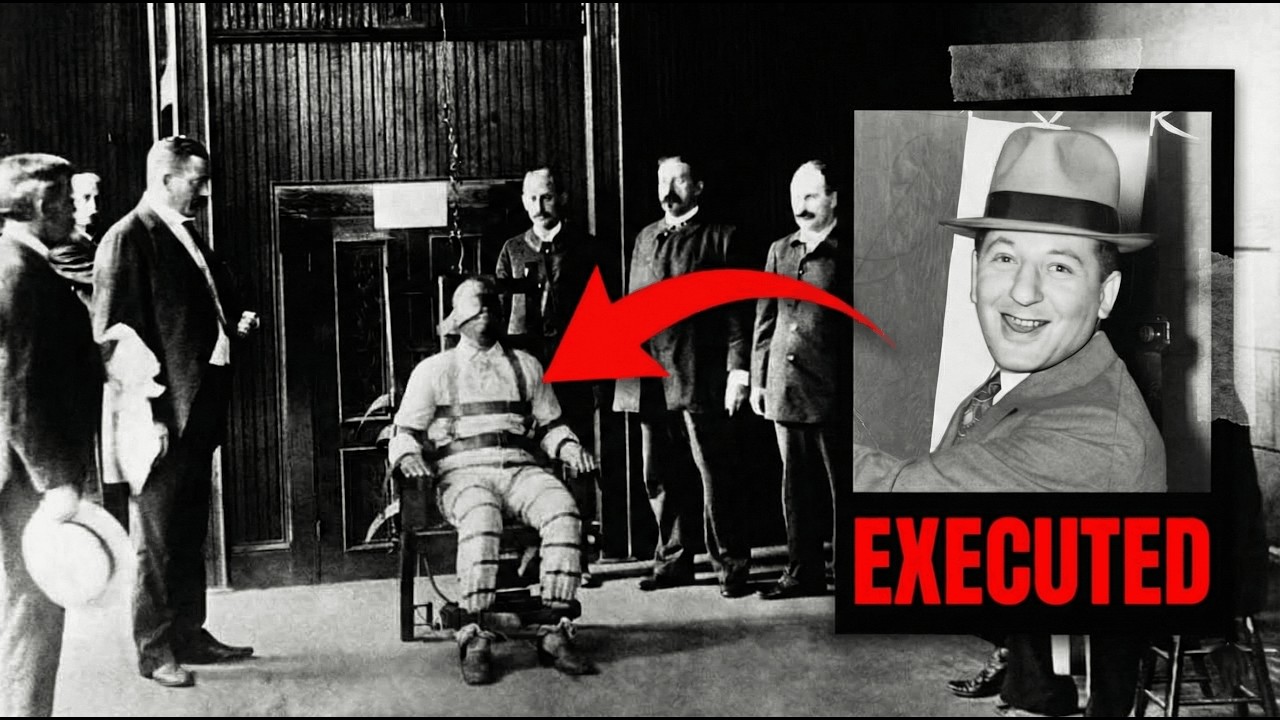
At 11:16 p.m., 2,000 volts surged through his body. Four minutes later, Louis Lepke Buchalter was dead. He became the only major American mob boss ever executed by the government for murder.
This was not a street thug caught with a gun. Lepke was a criminal genius who turned contract killing into a business model. He had accounting departments. He paid killers salaries. He ran protection rackets the way IBM ran office machines.
Before Lepke, the mafia was chaotic, disorganized, and territorial. After Lepke, it had Murder Incorporated, a killing service so efficient that mobsters across the country could order a hit like ordering a pizza. For a decade, this corporation of death operated in plain sight, eliminating anyone who threatened the underworld.
This is the story of how one quiet, unassuming Jewish gangster from the Lower East Side created the most lethal criminal organization in American history. Lepke did not build his empire through violence alone. He built it through brains. And when the empire collapsed, it was not because of cops. It was because one man decided to sing.
Louis Buchalter was born on February 6, 1897, into poverty on the Lower East Side of Manhattan. He was the child of Russian Jewish immigrants. His mother called him Lepke, a Yiddish nickname meaning Little Louie, and it stuck.
His father Barnett operated a small hardware store and worked as a machinist. The family struggled. Seven children were crammed into a tenement apartment where tuberculosis and typhoid killed neighbors every week.
But the Buchalters were not a typical immigrant family. Louis's half-brother became a rabbi. His brother Emanuel became a dentist. Another brother, Isidore, became a pharmacist. They represented the American dream. Louie represented something else.
At 12 years old, in 1909, his father died. His mother, Rose, sick with respiratory illness, moved to Arizona for her health, leaving Louis with his older sister, Sarah. But Sarah could not control him. By 15, Louie had dropped out of the Rabbi Jacob Joseph school, where he had been an honor student, and hit the streets.
On September 2, 1915, he was arrested for the first time, for burglary and assault. The case was discharged, but it was the beginning. By 1916, at age 19, Louie was living with an uncle in Bridgeport, Connecticut. On February 29, police arrested him for burglary. This time, he did not walk. He was sent to Cheshire Reformatory for juvenile offenders until July 12, 1917, a total of 16 months.
When he got out, he moved back to New York and teamed up with a childhood friend named Jacob "Gurrah" Shapiro. Gurrah was muscle: six feet tall, 220 pounds, a street brawler who loved hurting people. Louie was the opposite: five foot seven, thin, and soft-spoken. He preferred listening to talking. But together they had chemistry. Gurrah broke bones. Louie made plans.
By 1920, both men were back in prison. Louie got 30 months in Sing Sing for attempted burglary. Gurrah did time for assault. When they were released in 1922, they did not go straight. They went professional.
In the 1920s, New York's garment district was the heart of American fashion. Thousands of factories, tens of thousands of workers, unions everywhere. And unions meant leverage. Louis and Gurrah walked into their first garment factory in 1923 with a simple pitch: pay us $500 a week and your workers will not strike. Do not pay us and your factory burns down.
Factory owners paid. But Louie did not stop there. He went to the unions and made the same pitch in reverse: pay us and we will make sure the owners negotiate. Do not pay and your organizers disappear. Union leaders paid too. Louis was collecting from both sides, owners and workers, and nobody could touch him because everyone was afraid.
By 1927, Louis and Gurrah controlled every major garment union in Manhattan. Trucking, baking, fur dressing, leather goods. If it moved through New York, Louie got a cut. The newspapers called it racketeering. Louie called it business.
And business was spectacular. By 1935, law enforcement estimated Louie was grossing over $1 million a year, the equivalent of about $23 million today. He lived in a penthouse on Central Park West. He married Betty Wasserman in 1931, a British-born widow who gave him respectability. They adopted her child.
Louie went to synagogue. He took his gang members to hockey games and boxing matches. He paid them generously, with bonuses at Christmas and trips to Florida in the winter. His men loved him.
But in 1927, something happened that changed everything. Louis and Gurrah were arrested for the murder of Jacob Orgen, a rival labor racketeer known as Little Augie, and the attempted murder of a bootlegger named Jack Diamond. The evidence was strong. Witnesses placed them at the scene. But the charges were dropped.
Why? Because every witness suddenly refused to testify. Some disappeared. Some were found dead in alleys. Some just stopped talking. Louie learned a lesson that night. You cannot run a criminal empire if people talk. You need fear. You need enforcement. You need killers you can trust. You need Murder Incorporated.
The idea came from Lucky Luciano. In 1931, Luciano and Meyer Lansky were building the National Crime Syndicate, a coalition of Italian and Jewish mobsters who would divide territories, settle disputes, and eliminate the old-school gang wars that brought heat from the cops.
But they had a problem. How do you enforce the rules when every family has its own killers who are loyal to their bosses, not the syndicate? Luciano's solution was brilliant: create a separate squad of professional hitmen who only answered to the commission. No family loyalty, no personal grudges, just business.
He approached Louie in 1933 and offered him a deal. You run the enforcement arm. We will call it the Combination. Later, the press would call it Murder Incorporated.
Louie loved the concept. He partnered with Albert Anastasia, the underboss of the Mangano crime family, a stone-cold killer with dead eyes and a quick temper. Anastasia would be the Lord High Executioner, the man who took the orders from the commission. Louis would handle logistics, finances, and recruitment. Together, they built the most efficient killing machine in American history.
The headquarters was a candy store, Rosie Gold's place, at the corner of Saratoga and Livonia Avenue in Brownsville, Brooklyn. The killers hung out there every day playing cards, drinking coffee, waiting for assignments.
The roster read like a rogues' gallery of psychopaths. Harry Strauss, known as Pittsburgh Phil. Martin Goldstein, called Bugsy. Abe Reles, Kid Twist. Mendy Weiss. Louis Capone, no relation to Al. Frank Abbandando. These were not street punks. They were professionals.
And here is what made Murder Inc. terrifying. They were paid a salary, $125 a week as a retainer, every week, whether they worked or not. Then for each contract, they got a fee, $1,000 to $5,000 per hit, depending on the target. Their families received benefits and health care, and rent was covered if they went to prison. It was like working for General Electric, except the product was death.
Pittsburgh Phil was the star. Harry Strauss, 31 years old, born in the Russian Empire and raised in the Bronx, reportedly killed over 100 men. Some historians put the number at 500. He used guns, knives, ice picks, rope, baseball bats, whatever was available.
He never carried a weapon. Why? If the cops picked him up, they would find nothing. He would scout his murder location, find a tool on site, a tire iron, a sash cord, a shovel, and do the job. Then he would disappear.
His method was surgical. If the target needed to vanish, he would bury him alive. If it needed to look like an accident, he would stage a drowning. If it needed to send a message, he would use an ice pick, 32 stabs to the torso, the victim bleeding out slowly and screaming. Pittsburgh Phil loved his work. He bragged about it at Rosie Gold's. He kept a mental tally. Other killers feared him because he felt nothing. No remorse, no hesitation, just efficiency.
Murder Inc. was believed to be responsible for between 400 and 1,000 contract killings from 1929 to 1941. They operated in New York, New Jersey, Pennsylvania, Michigan, California, and Florida. A mob boss in Detroit had a problem? Call Lepke. A witness in Chicago needed silencing? Call Lepke. A rival in Los Angeles? Call Lepke. The killers would travel, do the job, and return home. No one connected the dots because no one understood the system.
But Louie did not just kill for the syndicate. He killed for himself. And that is where the trouble started.
By 1935, special prosecutor Thomas Dewey was tearing apart Louis's labor empire. Dewey, 33 years old, ambitious and ruthless, was destined to become governor of New York. He indicted Louie on labor racketeering, extortion, and conspiracy. Witnesses were lining up to testify. Louie panicked. His solution was simple: kill the witnesses.
On May 25, 1937, four Murder Inc. killers grabbed George Rudnick, a small-time hood who knew too much. They took him to a parking garage in Brooklyn. Pittsburgh Phil strangled him with a sash cord while two others stabbed him 37 times with an ice pick. They mutilated his face with a meat cleaver so the body could not be identified. Then they dumped him in a lot and set him on fire. Rudnick's crime was that he might talk to Dewey.
On October 1, 1937, they shot Max Rubin, a former associate of Louis who refused to leave town. Rubin survived but got the message. By 1937, Louis had ordered the murder of over 20 potential witnesses. But the killings created more problems. Every murder brought more investigators, more questions, more heat.
Then came Dutch Schultz. Arthur Flegenheimer, known as Dutch Schultz, was a beer baron and numbers racketeer who controlled Harlem. In October 1935, Dewey announced he was targeting Schultz next. Dutch, 53 years old, paranoid and volatile, walked into a commission meeting and declared, "I'm going to kill Dewey. He's destroying us."
Lucky Luciano said no. Killing a prosecutor would bring the entire federal government down on organized crime. Dutch said, "I don't care. I'm doing it anyway." And he walked out.
The commission met for six hours. The vote was unanimous. Dutch Schultz had to die. Louie got the contract. He assigned it to Mendy Weiss and Charles Workman, two Murder Inc. killers who specialized in high-profile hits.
On October 23, 1935, at 10:15 p.m., at the Palace Chop House in Newark, New Jersey, Dutch Schultz sat in a back room with three bodyguards: Otto Berman, Abe Landau, and Lulu Rosenkrantz. Weiss and Workman walked in with guns drawn. Workman found Dutch in the bathroom. He fired one shot from a .45 caliber pistol. The bullet tore through Dutch's abdomen.

Workman ran back to the dining room and opened fire. Berman, Landau, and Rosenkrantz were all dead within seconds. Weiss and the driver fled immediately. Workman, in the chaos, was left behind. He ran six blocks and escaped.
Dutch Schultz clung to life for 22 hours, delirious, rambling about buried money and betrayals. He died on October 24 at 8:35 p.m. The commission's message was clear: defy us and you die, even if you are Dutch Schultz.
Workman was eventually caught and tried in New Jersey in 1941. He pleaded no contest after his alibi witness recanted. He got life. He served 23 years and was released in 1964.
But Louis's biggest mistake was not killing Dutch Schultz. It was killing Joseph Rosen.
On September 13, 1936, at 7:30 a.m., at 725 Sutter Avenue in Brooklyn, Joseph Rosen, 46 years old, a former garment trucker whose union Louie had seized years earlier, opened his candy store for the morning shift. Pittsburgh Phil and three other killers were waiting inside. They fired 15 shots, some sources say 17 bullets. Rosen died instantly, his body slumped behind the counter, blood pooling on the tile floor. His wife found him an hour later.
Why kill a candy store owner? Because Louie believed Rosen was talking to Dewey. There was no proof, just paranoia. But Rosen had complained publicly about losing his trucking business. He was broke and desperate. Louie could not risk it. So he ordered the hit. And that murder, one killing among hundreds, would eventually send Louie to the electric chair.
By 1937, Louie was the most wanted man in America. On November 8, 1936, Louis and Gurrah were convicted of violating federal antitrust laws in the rabbit fur industry. They received two-year sentences. Both men posted bail and promptly disappeared.
On December 1, 1937, Louie was indicted for heroin smuggling, hiding drugs in the trunks of women traveling by ocean liner from China to New York. The Feds offered $5,000 for his capture. By July 1939, New York City offered $25,000.
For two years, Louie hid. Rumors put him in Poland, in Palestine, in South America. But he never left New York. He moved between safe houses in Brooklyn and the Bronx, disguised with glasses and wigs, paranoid and isolated. Meanwhile, Murder Inc. kept operating, but the heat was unbearable. The FBI had a massive manhunt. Every mobster in New York was under surveillance, and Louie knew it was only a matter of time.
Enter Walter Winchell, the gossip columnist and radio broadcaster, the most famous journalist in America. Winchell had connections everywhere: cops, mobsters, politicians. In August 1939, a mobster approached Winchell with a deal. Lepke wants to surrender, but only to J. Edgar Hoover, not to Dewey, not to New York cops, the Feds. Winchell called Hoover directly. Hoover agreed.
On August 24, 1939, at 10:15 p.m., in front of a drugstore on 28th Street and Fifth Avenue in Manhattan, a car pulled up. Louis Buchalter stepped out wearing a suit and fedora, looking exhausted. Winchell was waiting. So was J. Edgar Hoover. Louie walked up and said, "Mr. Hoover, I'm ready." Hoover handcuffed him personally. The FBI took him into custody. Winchell got his scoop.
And Louie believed he had made a deal. Plead guilty on federal charges, serve a few years, avoid Dewey and the murder charges. He was wrong.
On December 1, 1939, Louie pleaded guilty to narcotics trafficking. The judge gave him 14 years in Leavenworth Federal Penitentiary. But on April 5, 1940, New York State indicted him for labor extortion, carrying 30 years to life. And then came the murder charge.
On May 9, 1941, Louie was arraigned for the Joseph Rosen killing. Three other murders were added. The key witness was Abe Reles, Kid Twist, the canary who sang.
Abraham Reles, 34 years old, short, stocky, with a photographic memory for murder, was a founding member of Murder Inc. and one of Pittsburgh Phil's closest partners. He had killed at least 11 men personally, probably more. But in March 1940, facing a murder charge, Reles cracked. He went to Brooklyn District Attorney William O'Dwyer and offered everything: names, dates, locations, methods.
Reles had an eidetic memory. He could describe every murder in detail: who ordered it, who carried it out, where the body was dumped. He became the most valuable witness in organized crime history. With Reles's testimony, prosecutors indicted dozens of Murder Inc. members.
Pittsburgh Phil was executed in June 1941. Martin Goldstein was executed with him. Frank Abbandando and Harry Maione were executed in February 1942. Louie Capone and Mendy Weiss would die with Louie.
The convictions came fast. Reles testified in trial after trial, sending his former friends to the chair one by one. Louis's trial began in October 1941. The evidence was overwhelming. Reles testified that Louie personally ordered the Rosen hit. Albert Tannenbaum, another turncoat, corroborated. Rosen's wife and son testified. A school teacher who saw the killers flee also took the stand.
The jury deliberated four hours. On November 30, 1941, at 2:00 a.m., they returned a verdict of guilty. First-degree murder. Louis Buchalter, Mendy Weiss, and Louis Capone were all sentenced to death.

Louie's lawyers appealed. The New York Court of Appeals upheld the conviction in a four-to-three vote. The U.S. Supreme Court reviewed the case. On June 1, 1943, the Supreme Court upheld the conviction seven to zero. Every legal avenue was exhausted. Louie was finished.
But there was one problem. Louie was in federal prison serving his 14-year sentence. New York needed custody to execute him. For months, the federal government refused. Finally, on January 21, 1944, federal agents transported Louie to Sing Sing. He was placed in the death house. Execution was set for March 4.
Louie spent his final weeks writing letters and pleading for mercy. He offered to testify against Albert Anastasia, the man who had helped him build Murder Inc. He claimed he had information on political corruption, unsolved murders, and mob secrets. But Governor Thomas Dewey, the same Dewey who had prosecuted him, was now governor. Dewey rejected every appeal. He wanted Louie dead.
On the night of November 12, 1941, something strange had happened. Abe Reles, the canary, was being held at the Half Moon Hotel in Coney Island under police guard. He was scheduled to testify against Albert Anastasia in a few days. At 7:00 a.m., police found Reles's body on the ground six stories below his window. His neck was broken. He was dead on impact.
The official story was that Reles tried to escape by tying bed sheets together and climbing down. The sheets could not hold his weight. He fell. Nobody believed it. Reles was under 24-hour police protection. Six officers were in the hotel. How did he tie bed sheets, attach them to a radiator, and climb out the window without anyone noticing?
The theory was that Reles was pushed, murdered by corrupt cops on Anastasia's payroll. Without Reles, the Anastasia case collapsed. Anastasia walked, and the mob coined a phrase: "The canary could sing, but he couldn't fly."
On March 4, 1944, at Sing Sing Prison, Mendy Weiss walked into the death chamber first. He was 43 years old. He sat in the chair. The executioner strapped him in. The switch was pulled. 2,000 volts. He died in four minutes.
Louis Capone went next. He was 45 years old, no relation to Al Capone, but the name haunted him. He said nothing. The switch. Four minutes. Dead.
At 11:16 p.m., Louis Lepke Buchalter entered the chamber. He was 47. He wore a white shirt and dark trousers, no tie. His hands shook. His face was pale. The guards strapped him into the chair, the leather restraints tied across his chest, the electrode cap placed on his head. The prison chaplain stood nearby.
Someone asked if he had any final words. Louie looked up. He opened his mouth, then closed it. No words, just silence. The executioner pulled the switch. 2,000 volts surged through his body. His hands clenched, his body convulsed. Smoke rose from the electrode cap. At 11:20 p.m., the prison doctor checked for a pulse. Nothing. Louis Lepke Buchalter was dead.
Murder Inc. collapsed almost immediately. Without Louie, without Reles, without the structure, the organization fell apart. Albert Anastasia took over some operations, but he never rebuilt the Combination. By 1945, most of the killers were dead or in prison. Pittsburgh Phil was dead. Bugsy Goldstein was dead. Abbandando was dead. Maione was dead.
The survivors scattered. Some went legit. Some fled to other cities. A few kept killing, but as freelancers, not as part of an organization.
In 1957, Albert Anastasia was murdered, shot to death in a barber chair at the Park Sheraton Hotel in Manhattan. On October 25, at 10:20 a.m., two gunmen walked in, fired 10 shots, and walked out. Anastasia was 65. The Lord High Executioner was gone.
Shortly after, the mob held the Apalachin meeting in upstate New York to divide his rackets. The cops raided it. Sixty mobsters were arrested. The commission was exposed. Organized crime would never be the same.
Louie's wife, Betty, lived quietly until her death. She never remarried. She never spoke publicly about Louie. Their adopted child changed their name and disappeared into anonymity. Louie was buried at Mount Hebron Cemetery in Flushing, Queens. A simple headstone, no flowers, no visitors.
So what is the legacy? Louis Lepke Buchalter proved that organized crime could operate like a business: salaries, contracts, territories, hierarchies. Before Louie, the mob was chaotic. After Louie, it was corporate. He created the blueprint that the five families would use for the next 50 years.
But he also proved the limits of that model. You can build an empire on fear. But fear only lasts as long as nobody talks. And eventually somebody always talks. Abe Reles talked, and his testimony destroyed Murder Inc.
But here is the irony. Reles's death, whether he jumped, fell, or was pushed, sent a message even louder than his testimony. Snitches die even under police protection. Even with promises of safety, the mob's revenge is patient, and nobody forgets.
Louis Buchalter spent 15 years building the most efficient killing machine in American history. He made millions. He commanded respect. He sat with Lucky Luciano and Meyer Lansky and discussed the future of organized crime. But in the end, he died strapped to a chair, 2,000 volts stopping his heart, his empire in ruins. That is the real story of the mafia: not the power, not the money, but the inevitable grinding price.