NUREMBERG — At 1:11 a. m. on October 16, 1946, Joachim von Ribbentrop climbed thirteen wooden steps to a gallows erected in a converted prison gymnasium, and in the final seconds before the trapdoor fell, the man who had negotiated the pact that carved up Poland asked God to protect the nation he had helped lead into ruin.
His last words, recorded by journalists who were among the few permitted inside, were: “God protect Germany. God have mercy on my soul. My last wish is that German unity be maintained, that understanding between East and West be realized, and there be peace for the world.”
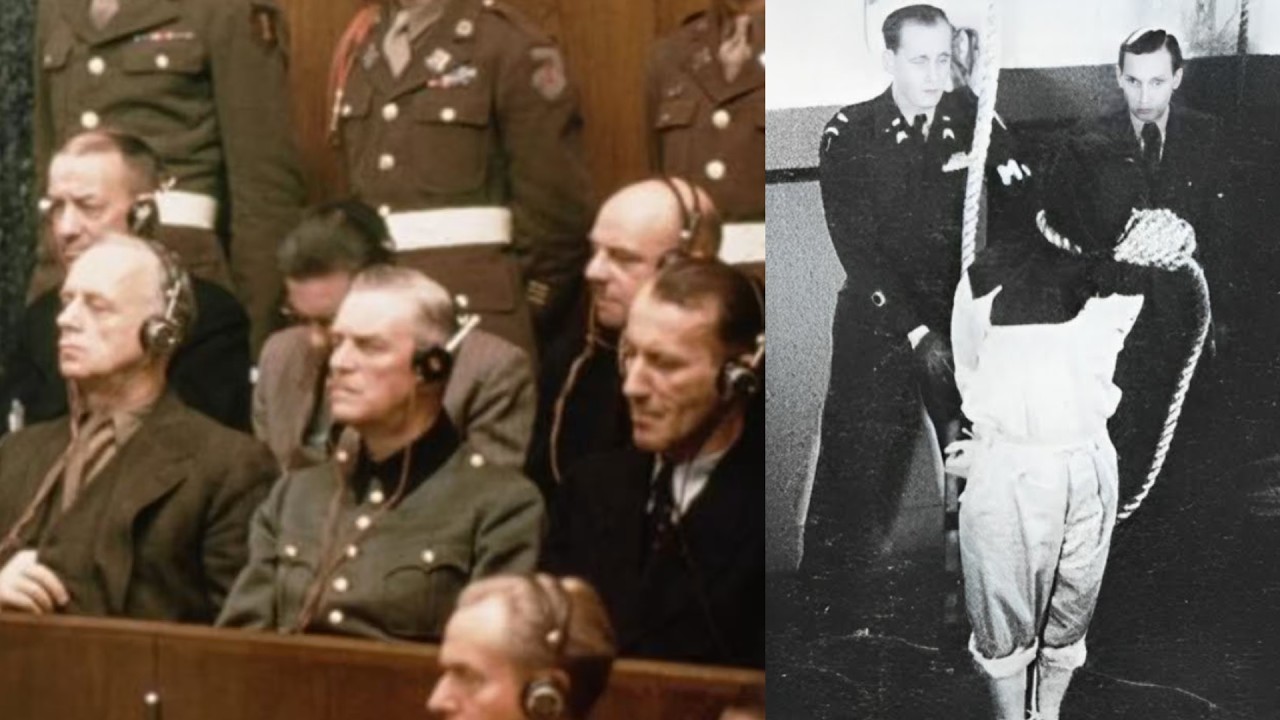 Ten men were hanged that night in a sequence that lasted less than ninety minutes, from Ribbentrop’s execution at 1:11 a. m. to Arthur Seyss-Inquart’s at 2:57 a.
m. The entire operation, including the removal of bodies, ran a little over three hours. The executions followed the order in which the sentences had been read on October 1, when the International Military Tribunal delivered its verdicts: twelve men sentenced to death, seven to prison terms, and three acquitted and released.
The road to that gymnasium was not inevitable. In the months after Germany’s surrender, British Prime Minister Winston Churchill favored identifying the top Nazis and shooting them without trial. Soviet leader Joseph Stalin, only half-joking, spoke of executing tens of thousands of German officers after a quick show trial.
It was the Americans who pushed for a proper international tribunal, with judges from four countries, real evidence, defense lawyers, and four charges ranging from conspiracy to crimes against humanity. Twenty-four men were indicted. Twenty-one stood trial.
Two of the twelve sentenced to death, Martin Bormann and Hermann Göring, were not hanged that night. Bormann was tried in absentia, and Göring took cyanide in his cell hours before his scheduled execution.
For nearly a year, the men on trial at Nuremberg had lawyers speaking for them, cross-examining witnesses, arguing over documents, and filing appeals. That ended on the morning of October 16, 1946. One after another, ten of them were taken from their cells, their hands bound, led through a door into the gymnasium, up the same thirteen steps, and asked one question: Did they have anything to say?
Whatever came out next was the first time in almost a year that the words were entirely their own.
The statements were written down from memory and quick notes, not from a recording. That is why slightly different versions of the same statements appear in different books. The accounts that follow stick closest to the reports journalists filed within hours of the hangings.
The American press slot went to Kingsbury Smith of the International News Service, whose dispatch became the main public account of the night. Very few journalists were allowed inside; the Allied Control Council limited their number and chose them more or less by lottery.
Wilhelm Keitel wanted to be remembered as a soldier, and his last words made sure of it. As chief of the armed forces high command, he was the highest-ranking military officer in Nazi Germany. His defense was simple: he had only followed orders from his head of state.
The paper trail said otherwise. He had signed the Commando Order, which directed that captured Allied commandos be shot instead of treated as prisoners, and the Night and Fog decree, which allowed resistance suspects in occupied territory to disappear without a trace. He was found guilty on all four counts.
Before sentencing, he wrote that he expected to feel more private remorse than anyone would ever know. That remorse did not show at the gallows. He spoke like an officer addressing troops: “I call on the almighty to be considerate of the German people.
Over 2 million German soldiers went to their death for their fatherland before me. I now follow my sons. All for Germany.”
He turned the execution into one more wartime death in a long line of them.
 Ernst Kaltenbrunner was a big man, over six feet tall, with a deep scar across one cheek. He was the highest-ranking SS officer at Nuremberg. From January 1943, he ran the Reich Security Main Office, which put him over the Gestapo, the criminal police, and the Security Service, and over the system that ran the concentration camps.
On the stand, he tried to put distance between himself and the camps. He said he knew almost nothing about the killings, that his signatures did not mean what the prosecutors claimed, that subordinates he never fully controlled were the real problem. The judges did not buy it.
They convicted him of war crimes and crimes against humanity. On the gallows, he stuck to the same line: “I served the German people and my fatherland with a willing heart. I did my duty according to its laws.
I am sorry that in her trying hour, she was not led only by soldiers. I regret that crimes were committed in which I had no part. Good luck, Germany.”
No apology to any victim. No admission that his own signature counted. He was still arguing the case.
Alfred Rosenberg wrote more pages defending Nazi ideology than almost anyone else. “The Myth of the 20th Century” tried to give racial theory a philosophical base. Hitler made him Reich Minister for the Occupied Eastern Territories, giving him authority over land where the mass killing of Jews and Soviet civilians was already underway.
He was found guilty on all four counts. At the gallows, the man who had written so much said almost nothing. Asked for last words, he answered with one word: “No.”
He is the only one of the ten who refused to speak. Perhaps he was exhausted. Perhaps he had nothing left.
Perhaps he simply did not care anymore. The silence was its own statement from a man who had spent a career talking.
Hans Frank’s path was the strangest. As Governor General of occupied Poland, he ran a regime brutal enough that Poles called him the butcher of Poland. Millions of Jews were forced into ghettos and then sent to Treblinka, Auschwitz, and the rest.
He lived well in a castle in Krakow while the people under him starved. After his arrest, something changed, or at least looked like it had. He returned to the Catholic faith of his childhood, prayed every day, and handed the prosecutors his own diaries, about forty volumes.
Those diaries became some of the strongest evidence against any defendant. On the stand, he said the line still quoted more than any other: “A thousand years will pass and still this guilt of Germany will not have been erased.” Later, he tried to walk it back a little, saying he spoke only for himself and those who agreed with him, not for the other men in the dock.
Whether the religious turn was real remorse or insurance for the next life is still argued. His last words were short: “I am thankful for the kind treatment which I received during this incarceration, and I pray God to receive me mercifully.” One witness said Frank was the only man who walked into the chamber looking almost as if he were smiling.
 Wilhelm Frick is less remembered than some of the others, which is odd given what he did. As Reich Minister of the Interior, he helped draft and enforce the Nuremberg Laws of 1935 that stripped German Jews of citizenship and set the legal base for everything that followed. He was a lawyer, not a ranter.
He turned persecution into statute. Convicted on three of the four counts, at the gallows he gave the shortest statement of the night: “Let live eternal Germany.” Four words.
No guilt, no God, no explanation. Just that, and it was done.
Julius Streicher held the least official power of the twelve sentenced to death. No general, no minister, no security chief. He published “Der Stürmer,” the paper that ran crude anti-Semitic cartoons and conspiracy theories for years.
He was convicted only of crimes against humanity. The court saw him as the man whose words helped create the climate that made the killing possible. How much responsibility a propagandist carries for violence he never committed himself is an awkward question.
The judges decided it was enough to hang him. He did not go quietly. He shouted “Heil Hitler” on the way up the steps, mentioned the Jewish holiday of Purim before the interpreter finished translating, and yelled that the men hanging him would be hanged themselves one day.
His last words, muffled under the hood, were apparently to his wife: “Adele, my dear wife.” Several witnesses said his hanging looked different from the others. That detail has kept arguments going for decades about whether the drop or the equipment went wrong.
No settled answer exists.
Fritz Sauckel ran the biggest forced labor program of the war. As General Plenipotentiary for Labor Deployment, he organized the roundup and transport of millions of civilians from occupied countries into Germany. Many of them died from overwork, starvation, and 𝓪𝓫𝓾𝓼𝓮.
The total moved under his program is usually put around five million. Convicted of war crimes and crimes against humanity, he never accepted the verdict. His last words were a flat denial: “I die innocently.
The verdict was wrong. God protect Germany and make Germany great again. Let Germany live and God protect my family.”
A man whose work rested on other people’s forced labor ended by asking for protection for his own household and his country. That pattern shows up more than once this night.
Alfred Jodl’s story did not finish on October 16, 1946. As chief of the operations staff, he helped plan major campaigns and signed orders the court ruled criminal, including ones linked to the killing of captured Soviet political officers. Guilty on all four counts, he was the ninth man hanged.
 His last words were short: “I salute you, my Germany.” Seven years later, in February 1953, a West German denazification court in Munich posthumously cleared him, saying that if he had still been alive, the case would not have justified a death sentence. His widow had pushed for it.
The Americans objected hard. Within months, the Bavarian government reversed the ruling and restored the original Nuremberg judgment. For a short time, Jodl was legally innocent years after he had been hanged.
That does not change what he signed during the war. But among these ten men, his is the case where the legal verdict itself stayed contested longest.
Arthur Seyss-Inquart’s career shows how the Nazi state swallowed its neighbors. In March 1938, he was made Chancellor of Austria for about forty-eight hours. Long enough to invite German troops in and give the annexation a legal face.
Then he became Hans Frank’s deputy in Poland and, in 1940, Reichskommissar for the occupied Netherlands. Under his administration, about 140,000 Dutch Jews were registered, confined, and deported to camps including Auschwitz and Sobibor. One of the families caught in that system was Anne Frank’s.
He also ordered the execution of hundreds of Dutch civilians as reprisals. Convicted of crimes against peace, war crimes, and crimes against humanity, he was the last man hanged, at 2:57 in the morning. His last words looked further ahead than most of the others: “I hope that this execution is the last act of the tragedy of the Second World War and that a lesson will be learned so that peace and understanding will be realized among the nations.
I believe in Germany.” One of the few statements that night that pointed outward instead of back at the speaker.
Photographs of the bodies were taken and later released. That decision caused friction even among the Allies. Robert Jackson, the American chief prosecutor, later wrote that he was uneasy about how the executions had been handled, especially the photographs, and that he was almost glad prosecutors had been kept out of the chamber.
Even people who believed these men deserved to die were uncomfortable turning their deaths into something to be looked at.
Put the ten statements side by side and a few things stand out. Eight of them mentioned God or asked for mercy. Several insisted they were innocent or that the verdict was wrong even after months of documents against them.
Only Hans Frank came close to admitting guilt, and even he had already qualified that admission in court. None of them apologized to the people their actions had harmed. No one named a victim.
Most talked about Germany, its unity, its future, its honor, as if the country were the party that mattered most. Rosenberg said nothing. Streicher’s end was noise more than words.
Ten men, ten ways of meeting the same rope, and almost none of them used the moment to face what they had done.