On 13 October 1943, the Gestapo in Paris finally caught up with a British wireless operator code named Madeline. For four months she had been the only Allied radio link left in the city. Every other operator was locked up or dead. She changed her appearance and safe houses constantly, vanishing whenever German direction-finding vans closed in on her signal. Then the Gestapo set a trap. They had a name, they had an address, and they were waiting.
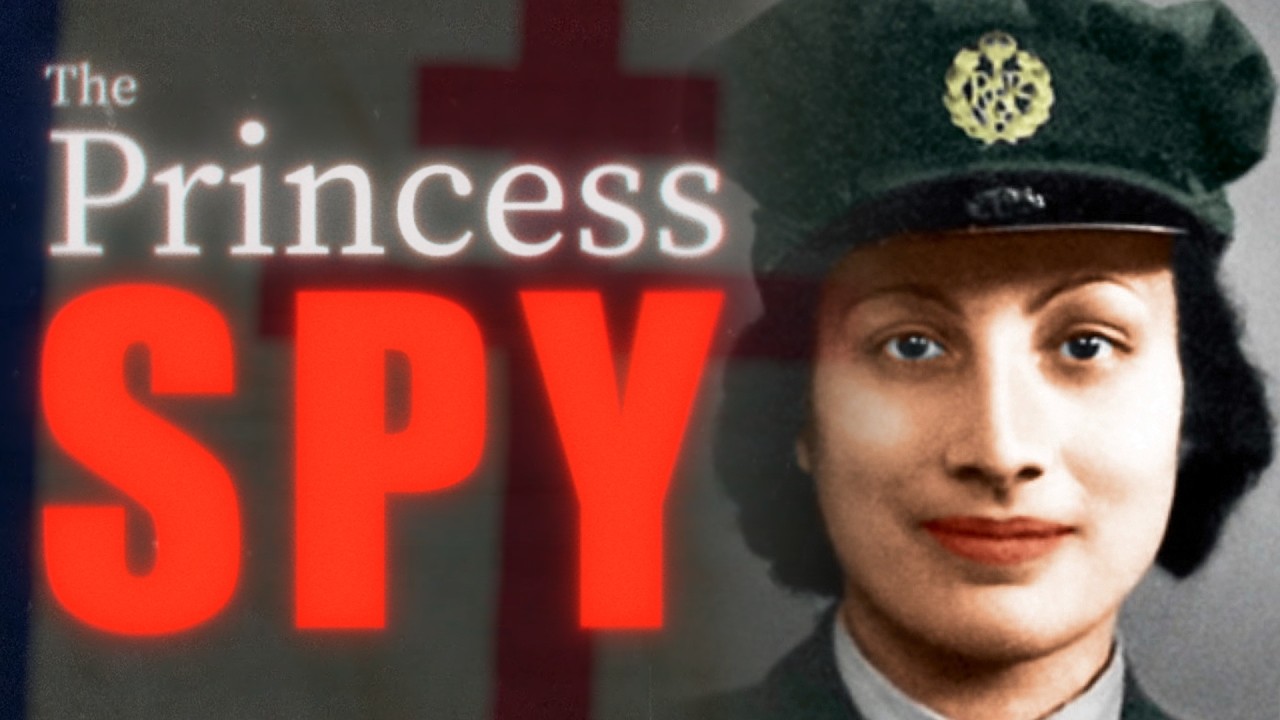
The woman they hunted was Noor Inayat Khan, later remembered as the spy princess. She was an unlikely secret agent: a pacifist and the daughter of a Sufi mystic descended from Indian Muslim royalty.
She was born on New Year's Day 1914 in a monastery near the Kremlin. Her father was Hazrat Inayat Khan, an Indian Sufi preacher and musician descended from Tipu Sultan, the 18th-century ruler of Mysore who became a symbol of Indian resistance to colonial rule. Her mother was an American from Albuquerque named Ora Ray Baker.
The family moved to London after the outbreak of World War I. Six years later they settled in Suresnes, on the outskirts of Paris, in a large house on a hill with views of the Eiffel Tower. Her father named it Fazal Manzil, the house of blessing. In summer it overflowed with Sufis from around the world. Inayat Khan's discipline was gentle; punishments meant running around the garden or periods of silence. Noor grew up in an atmosphere of music, meditation, and absolute non-violence.
Her father died when she was just 13. Noor, the eldest but still very much a child, was compelled to take over running the household while her mother retreated into grief. She cared for her two brothers, Vilayat and Hidayat, and her youngest sister, Claire.
Noor was a dreamer and remained one as she grew up. She studied harp at one of the finest music schools in Paris and went on to study child psychology at the Sorbonne. She published children's stories in Le Figaro, one of France's biggest newspapers, and the stories were broadcast on Radio Paris during the children's hour. In 1939 she released a book of short stories called 20 Jataka Tales, whose themes of loyalty and self-sacrifice centered on the previous lives of the Buddha. That summer she was planning to launch a children's newspaper called Belle Age, the beautiful age.
In September 1939, life changed dramatically for Noor, as it did for millions across the world. Their father had taught them to follow the teachings of Mahatma Gandhi and that violence was wrong. How do you reconcile that with what the Nazis were doing to Europe? Noor and her sister Claire had trained for their Red Cross nursing certificates when war broke out, but soon had to be evacuated from the hospital in the face of the German advance.
On the afternoon of 4 June 1940, Noor and her brother Vilayat sat in the living room of their family home watching Paris through the bay window. The Wehrmacht was advancing, and the city was about to fall under Nazi control. Vilayat asked his sister a pointed question: if an armed Nazi was about to execute hostages, would standing by in the name of pacifism make you an accomplice? They decided it would, and resolved to fight the Nazis in their own ways. Vilayat would join the armed services. Noor would volunteer for whatever role she could find as a woman.
The next day the Khan family packed their bags and fled Paris. The roads out of the city were a scene from a nightmare. Millions of people crawled southwards in cars, trucks, and pushcarts while Stuka dive bombers flew low over the columns, strafing civilians. The sight of burning vehicles and the smell of charred flesh and burnt rubber were all too common. These images were seared in her memory and hardened her resolve.
Once out of Paris, the family split up. Noor's brother Hidayat had a wife and children and chose to take his family to the south of France to join the French Resistance. Noor, Vilayat, their mother, and their sister Claire headed for the coast, trying to reach the safety of England.
At the port of Le Verdon near Bordeaux, they waited anxiously for a ship. Vilayat held British citizenship and managed to get the family onto a list for evacuation. But Noor and Claire left the group to track down their Red Cross nursing certificates, convinced they would need them in England if they were to make a difference. On the way to Saint-Nazaire Hospital, local police detained the sisters because Noor's passport showed she had been born in Moscow. She spent one uncomfortable and worrisome night in a cell.
By the time the two sisters returned, Vilayat had been told the last boat for British subjects was leaving in just 30 minutes. It was a small Belgian cargo vessel called the Kasongo. Vilayat had bought a motorcycle, which he used to ferry his mother and sisters to the harbor one by one. After three frantic trips, they all scrambled aboard just in time. As the French coast disappeared behind them on 19 June 1940, Noor shouted to the people on the shore, "We shall come back."
The family arrived in Falmouth. Staying first in Southampton, they were forced further inland by the threat of German bombing, and so moved between Oxford and London. Vilayat was prevented from joining the RAF after being hospitalized with paratyphoid fever. Noor visited him daily, and the siblings were heartened by news of Charles de Gaulle's escape to London and his call to the French to continue fighting. She began wearing the emblem of the Free French, a silver barred cross.
During the Blitz, Noor saw the sky above London lit up by fires and heard the constant drone of German planes overhead. She took a job at a maternity home for officers' wives near Slough, but could not stand the drudgery and wished to be nearer the war. Against her mother's wishes, she applied to the Women's Auxiliary Air Force. Her first application was rejected, with her Moscow birth again playing to her disadvantage. She wrote an angry letter to the Air Ministry pointing out that her passport identified her as a British protected person. She soon received an apology and her application was accepted.
After arriving at RAF Bomber Command in Abingdon, she trained as a wireless operator, and she was very good at it. She outperformed most of her colleagues in transmission speed. They called her Bang-Away Lulu for the heavy fist she used on the Morse key, hammering out code with a distinctive clatter that could be heard across the room. Her star did not shine so brightly in other areas. When it came to physical drills and weapons handling, she was clumsy and uncoordinated. But nobody in the unit could match her on the radio.
By late 1941, Noor felt she was ready to head to the front lines. She applied for an officer's commission, which she knew would open a pathway for intelligence work and access to get nearer the war. She had her interview in August 1942, but it went sideways. The board asked her about where her true allegiance lay and, of all things in those circumstances, her views on Indian independence. Noor could have lied. Instead, she told them that while the war against Germany continued, she would remain loyal to the crown, but once it was over she might feel obligated to support India's struggle for independence against Britain. This was at the time when the Quit India movement had just launched, and Indian independence was a hot-button issue. Noor's honesty could have ended her military career. Instead, it brought her to the attention of people who valued a different set of qualities.
On 10 November 1942, Noor reported to room 238 at the Hotel Victoria on Northumberland Avenue in London. She thought it was a routine War Office interview. Waiting for her was Captain Selwyn Jepson, chief recruitment officer for F section, the French branch of Churchill's Special Operations Executive. SOE's job was sabotage and subversion behind enemy lines and support for the French Resistance. In Churchill's words, they were to set Europe ablaze.
Jepson was looking for agents to give a face to that mission. He told Noor exactly what the work involved. There would be no protection under international law. If she were captured alive, she would likely be interrogated by the Gestapo and probably executed. Unlike some other military positions, there would be no public recognition and no financial rewards. She accepted immediately.
She was sent to Guildford for the first part of her SOE training. Opinions on her abilities were divided. Her instructors at Wanborough Manor said she seemed almost afraid to handle weapons and explosives, but her skills on the wireless carried her further. On the specialist signals course at Tame Park, the first woman selected for it, she reached 18 words per minute sending Morse and 22 receiving, the fastest of any trainee.
At the SOE finishing school at Beaulieu, they put her through a simulated Gestapo interrogation. Dragged from her bed in the middle of the night, she found herself being shouted at by angry men under bright lights. She lost her nerve and her voice, finding herself unable to speak. Noor was then sent on a mock spy mission to Bristol to test her skills operating undercover. She was to deliver covert messages, set up a network, and deal with police scrutiny. She picked excellent hiding places for messages and identified good safe houses, but during a staged police interrogation she volunteered far more information than she should have. These were the sort of mistakes that would be fatal in France.
After completing her intensive SOE training, instructor Colonel Frank Spooner wrote a damning assessment. He described her as not overburdened with brains, unstable, temperamental, and ultimately unfit for the field. But the SOE at the time was desperate for French-speaking wireless operators. Not only could Noor speak French, she was almost unmatched as an operator. Maurice Buckmaster, head of F section, decided to send her anyway.
Just as she was about to be deployed in May 1943, Noor finally realized the true gravity of her mission and that the prospects of her survival were slim. Two of her fellow agents wrote to Vera Atkins, the intelligence officer who managed F section's agents, and urged her not to send Noor to France. Atkins took Noor to lunch at a Mayfair restaurant and offered her a clean way out. If she backed out, there would be no adverse mark on her file. The only crime, Atkins told her, was to go out there and let her comrades down in the field. Noor steeled herself and refused to withdraw. She asked only for one thing: if she went missing, her mother was to be told bad news only if her death was confirmed beyond any doubt.

Before departing, Noor met Leo Marks, the SOE's head cryptographer. Marks had read her children's stories and used metaphors from them to teach her coding discipline. He gave her something essential to all radio operators working behind enemy lines: two security checks unique to her. The first was her true check, a deliberate pattern or code woven into every genuine message she sent back across the channel. Its presence told London the operator was free. The second was her bluff check, a decoy designed to be surrendered under interrogation or torture. If the Gestapo captured her and forced her to reveal her security procedure, she was to give up the bluff check and protect the true check. London would then receive messages containing the bluff but missing the true check, and would know the operator had been captured and was acting under duress. The whole system depended on one thing: the agent protecting the true check at all costs and never writing either of them down.
With her training complete and deployment to France imminent, Noor was officially awarded her honorary commission as an assistant section officer in the Women's Auxiliary Air Force. She was then discharged to allow her mission under the SOE to move forward.
On the night of 16 June 1943, Noor Inayat Khan climbed into a Lysander aircraft at Tangmere airfield and flew across the channel under a full moon. Vera Atkins was the last face she saw waving from the tarmac. She had pinned a silver bird brooch to Noor's lapel for luck. Unlike many other SOE operators, she did not have to parachute in; the plane landed her in a field near Angers in the Loire Valley. The man waiting to receive her was Henri Déricourt, the SOE's air movements officer in France. He was also, though London did not know it yet, working for the Germans.
Her equipment, including heavy radio gear, was dropped separately by parachute a few nights later. On the way down, the package hit a tree, damaging her radio sets. She was no good in France without her radio. The signals staff back in London started to worry when they did not receive a first check-in from Noor. Eventually, when Noor met up with fellow radio operator Gilbert Norman, he was able to report back to London that Noor was safe. London breathed a sigh of relief.
But Noor had arrived at the worst possible moment for the French Resistance. Within a week, the Prosper circuit collapsed. Prosper was the largest SOE network in France, the one Noor was supposed to support. SOE circuits in France ran on a simple structure: an organizer to lead operations, a courier to carry messages between members, and a wireless operator as the only link back to London. But the Prosper circuit had grown too rapidly and was compromised. Its leader, Francis Suttill, was arrested, as were Gilbert Norman, the radio operator, and Andre Borrel, the courier.
Noor was now the only F section wireless operator in the entire Paris area. London offered to pull her out, but she refused. She could not abandon her French comrades without any link to the outside world. Maurice Buckmaster accepted her decision and told her to be extremely careful. The average life expectancy of an SOE wireless operator in France was just six weeks. At that point, her odds were less than average.
For three and a half months, Noor Inayat Khan did the work of six operators. Her A Mark II transmitter was heavy, and she had to carry it between locations in a briefcase, moving constantly to stay ahead of the German direction-finding vans. Her radio signal could be pinpointed within 30 minutes, so she was always racing against time. She transmitted from all over the city, including the home of her childhood music teacher and the property next door to Fazal Manzil, her own family home, which by then was occupied by Germans. She moved from safe house to safe house, dyeing her hair so many times that it became coarse and damaged.
Twice she should have been caught. On the metro, two German soldiers stopped her and demanded to know what was in her conspicuous briefcase, which of course contained her radio transmitter. She told them it was cinema equipment, opened the case a crack, pointed at the vacuum tubes, and confused them enough that they waved her through. Another time, she was hanging her aerial from a tree outside her flat when a German officer from the building next door walked over and asked if she needed help. Doing her best to hide her panic, she said yes. The officer then cheerfully helped her string the antenna up, assuming she wanted to listen to music programs on the radio.
Noor's dangerous work was not in vain. She helped coordinate the escape of as many as 50 Allied airmen shot down over France. She arranged pickups for agents needing a quick exit from France by Hudson aircraft. She transmitted details about German troop movements, supply depots, and the location of a Tiger tank gearbox production factory at Amiens. She worked with remaining local resistance figures to distribute arms and parachute-dropped funds. Working in impossibly dangerous conditions every day, she helped rebuild what was left of the network and transmitted for other circuits, including de Gaulle's Free French. She was keeping the entire Paris operation alive almost alone.
Her downfall, as was so often the case in intelligence work, came from inside her own circle. Renée Garry was the sister of Henri Garry, Noor's first contact in Paris and the leader of the Cinema circuit. She knew Noor from the time she had spent at her brother's apartment. Renée approached the Gestapo and offered to give them a British agent. Her motives have been debated ever since. Some claim it was jealousy over the affection of another SOE agent, but ultimately the price for her betrayal was 100,000 francs. Renée gave the Gestapo an accurate description of Noor and the address of the apartment she was staying at on the Rue des Petits Champs Élysées.
On 13 October 1943, Noor spotted a tail as she left her building. Two German officers were following her. She doubled back, lost them, and eventually returned home believing she was all clear. But waiting inside was Vincent Courtot, an operative of the brutal SD, the Sicherheitsdienst. A struggle ensued, and although Noor fought tooth and nail, she was simply no physical match for the much stronger man and his Gestapo backup.

After they dragged her out, the Germans searched her apartment and found a black notebook on the bedside table. Noor had kept meticulous records of every message she had sent and received, along with her security checks. This was a mistake fatal not only to her but to her entire network. During training she had been told to keep a temporary log of all her messages. Instead, she kept longhand unencrypted copies of everything she ever sent and received. A fellow operative had once seen the black book and warned Noor to destroy it immediately. She disregarded the warning. There was almost no need for the Gestapo to interrogate Noor; she had handed them all the information they needed. That little black notebook gave the Germans the opportunity for a Funkspiel, or radio game, which would further devastate SOE operations in France.
At the Gestapo's Paris headquarters, Noor did not plan to stick around as a prisoner. Within hours of arriving, she asked for a bath. The guards left the door slightly ajar. Noor protested that she needed to undress and refused to be watched. The moment the door was shut, she was out the bathroom window and onto a narrow gutter five stories above the street. She began edging along the ledge. Ernst Vogt, the Gestapo's head guard, spotted her from the adjacent lavatory. He waited until she was close, then said quietly, "Madeleine, don't be silly. You will kill yourself. Think of your mother. Give me your hand." She hesitated, then took it and climbed back inside. She got off lightly on that occasion, without a beating.
Her second escape attempt was more elaborate. Noor had been communicating with two prisoners in adjoining cells, Captain John Starr and Colonel Leon Faye, by tapping Morse code through the walls and passing notes under the door of a shared lavatory. Starr had managed to steal a screwdriver, and over several nights they passed the tool between cells and loosened the bars of their skylights. On the night of 25 November, Starr made noise in his cell to cover Noor and Faye removing their bars. The three climbed onto the roof carrying knotted blankets they intended to use as makeshift ropes. But an RAF air raid caught them out in the open, meaning sirens, searchlights, and a cell check by the guards. When they were found on the roof, they were dragged back inside and beaten.
The Gestapo chief, Josef Kieffer, lined them up and demanded they sign a promise never to attempt escape again. Starr signed. Noor and Faye refused. Noor told her captors that it was her duty as a British officer to try. With that, her prospects of survival diminished even further. She was interrogated for hours by Kieffer and Vogt but gave them nothing but her cover name, Nora Baker. The intractable prisoner was classified by the Gestapo as Nacht und Nebel, meaning night and fog. This meant she was a prisoner who was to disappear without a trace.
Meanwhile, the Germans began their radio game. Trained wireless operators at the Gestapo headquarters in Paris took over Noor's captured set, transmitting to London as Madeleine. Because the Germans had her notebook, they had both security checks, the true and the bluff. They could replicate her messages perfectly. London had no way to detect the deception from the radio traffic alone, and so continued to communicate with who they thought was their agent, arranging to send supplies and more operatives directly into German hands.
On 27 November 1943, Noor arrived at Pforzheim prison in Germany. She was registered as a highly dangerous prisoner and kept in total isolation. Her hands and feet were shackled using a third connecting chain so she could not stand upright. She stayed this way for ten grueling months.
In January 1944, a group of French Resistance women arrived at Pforzheim. They realized someone was being kept in the adjacent isolation cell. They began scratching messages on the bottom of their metal food bowls with knitting needles and eventually were able to exchange short messages. A slow secret correspondence developed over the following months. Noor identified herself and gave her mother's London address so they could contact her family if they survived. On 14 July, Bastille Day, she scratched on a bowl, "Long live free France, for that keeps us together."
By September 1944, the Allies were advancing through France. The Gestapo started clearing their so-called night and fog prisoners. The French women found a final message scratched on a food bowl: "I am going."
On 12 September 1944, Noor was driven to Karlsruhe, where she met three other female SOE agents, Yolande Beekman, Eliane Plewman, and Madeleine Damerment. They were told they were headed to a labor camp. They boarded a train to Munich, and for a few hours they experienced something that must have felt almost normal. They sat together and were allowed to talk. They arrived at the Dachau railway station around midnight and walked through the darkness to the camp. In the early hours of 13 September 1944, SS officer Wilhelm Ruppert beat Noor, forced her to kneel, and shot her in the back of the head.
The war ended eight months later. Noor's family knew nothing except that she was missing. In July 1945, her brother Vilayat wrote to Vera Atkins, the F section intelligence officer who had managed Noor's deployment. He was desperate for news of her whereabouts and to know whether she was still alive. Atkins began tracing the missing women of the SOE. She initially believed Noor was among four agents executed at Natzweiler concentration camp in 1944, but later learned through one of the French women imprisoned at Pforzheim that Noor was last seen alive at the prison in September 1944. Investigators obtained the prison register and managed to trace the prisoner transfer to Dachau. It was thanks in large part to Vera Atkins that the Khan family finally learned of Noor's fate two years after the war ended.
France awarded her the Croix de Guerre with gold star. Britain awarded Noor the George Cross, the highest civilian honor. Ten days after the announcement, Noor's mother died. Her brother Vilayat believed she had held on just long enough to see her daughter's sacrifice recognized.
In November 1949, Renée Garry stood trial in France for her betrayal of Noor Inayat Khan. A key witness for the prosecution was Ernst Vogt, the man who had interrogated Noor after her arrest. The British, however, were nowhere to be seen. Not wanting the failures of the SOE to be aired in public in a French court, Garry was acquitted, the court not being prepared to convict on the strength only of the testimony of a Nazi. The man who executed Noor, Wilhelm Ruppert, was convicted of war crimes and hanged in May 1946. Vilayat said he could forgive the German soldiers who followed orders. He could never forgive the woman who sold his sister for money.
In Gordon Square Gardens in London, near the house where she lived as a child, there is a bronze bust of Noor Inayat Khan, the princess spy. The former Khan home in Paris has been turned into a commemorative museum space and event hall. Every Bastille Day, a military band plays outside her childhood home in Suresnes. Her harp still sits in Fazal Manzil alongside her father's instruments.