When Queen Mary of Teck came to stay, the finest chairs were carried to distant rooms and the best silver was hidden in attics. An entire aristocracy quietly stripped its houses bare before her arrival, because the woman who would become the most feared guest in England had a private appetite that no one in Britain was permitted to refuse. She would lift a small treasure, turn it in her gloved hand, and remark how well it would suit her own collection. Then she would wait.
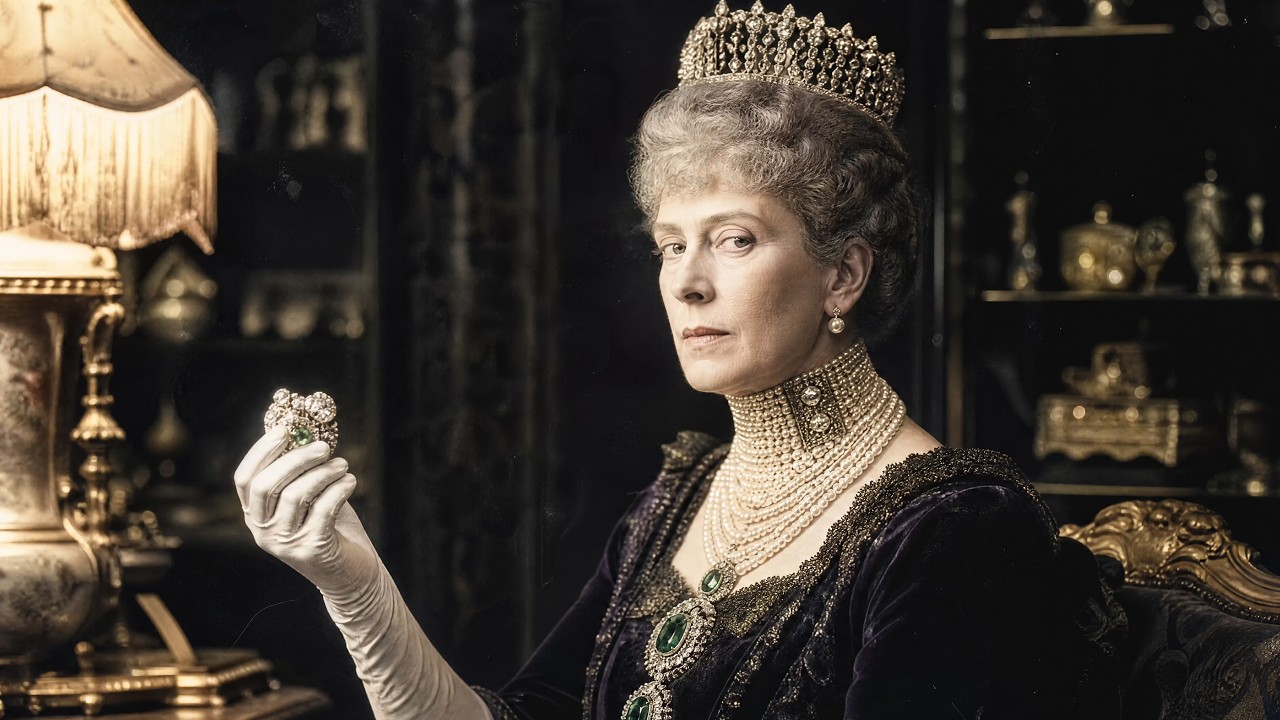
The silence that followed was always understood. Underneath the white gloves and impeccable manners, there was a pursuit that never rested. Yet the same woman had begun life as the poor relation of a family fleeing abroad from its debts. She would freeze out her own eldest son and bury another out of sight.
The story of how the debtor’s daughter became the queen who could never be told no runs through six reigns and two world wars. Mary was born on May 26, 1867, at Kensington Palace, in the very room where Queen Victoria had drawn her first breath 48 years earlier. She was christened Victoria Mary Augusta Louise Olga Pauline Claudine Agnes and called May by her family, a name that stayed with her beneath every title that followed. Her mother, Princess Mary Adelaide, was a granddaughter of King George III and a first cousin of Queen Victoria.
She was a large, laughing, generous woman adored by the London crowds, who privately called her “Fat Mary” and forgave her everything. Her father, Prince Francis, Duke of Teck, came from the royal house of Württemberg, but through a line the German courts marked with a poisonous word: morganatic. His father had married a Hungarian countess of lesser rank, which meant the whole Teck line carried a taint in the blood. In the marriage market of European royal houses, blood was the only currency that counted, and a morganatic strain was a debased coin.
May was grand enough to be curtsied to, but never grand enough to be wed. The deeper problem was money. Mary Adelaide could not hold a coin. She had voted a comfortable income by Parliament, yet she could not live within it, keeping a full table and sinking deeper each year beneath bills no one meant to pay.
Tradesmen waited months for their money. Richer relations were approached for loans. In 1883, when May was 16, the reckoning arrived. The debts grew past the point where London society could be politely fooled, and the Tecks fled England for the continent to live more cheaply in places where fewer people knew their faces.
For a girl raised at the elbow of the royal family, the shame was total and public. They drifted through Europe before settling in Florence. It was there, among the art and old money, that the great contradiction of May’s life was forged. She walked the cold churches and galleries, teaching herself to read a painting and weigh a piece of porcelain.
A lesser girl might have come away bitter and sour. May came away schooled, disciplined, fluent in three languages, and permanently hungry. The family crept back to England after roughly two years abroad. To the outer eye, May was still the sensible Teck girl, poor and proper.
Inside, she had learned that a beautiful object, once wholly yours, was a fortress. It could not be frittered away like an allowance. For a girl who had watched everything solid dissolve into debt, the gathering of beautiful objects became the gathering of the only security she trusted. In December 1891, Prince Albert Victor, second in line to the British throne, knelt and asked her to be his wife.
Queen Victoria had chosen May deliberately, reaching past richer and grander candidates across Europe because she believed character was worth more than pedigree when a shaky throne needed steadying. The man known as Eddie was gentle, vague, and idle, the perpetual subject of whispers his relations worked hard to smother. Victoria’s remedy was ancient: bind the weak heir to a wife of iron. May understood the bargain and accepted it whole, asking nothing warmer than the great position it carried.
Then, six weeks later, the entire bargain collapsed into a coffin. In the first days of January 1892, influenza reached Sandringham and turned to pneumonia. On January 14, Prince Albert Victor died at 28. May, formally engaged for barely six weeks, stood outside every possible role, a grieving girl in black with nowhere left to stand.
The family did not let a genuinely useful girl slip away over something as inconvenient as the death of the man she was meant to marry. They moved her along to the next brother. Prince George, Duke of York, was a different man entirely: precise, dutiful, shy, a naval officer who preferred his routine and his stamp collection to fashionable society. George proposed in May 1893, and they were married on July 6 at the Chapel Royal in St.
James’s Palace. What followed surprised everyone who expected two stiff, guarded people to make a cold arrangement work. George adored her quietly and completely. In an age when royal husbands kept mistresses as a matter of course, George wrote to May every day they were apart and never once took a mistress.
They shared a love of order. George collected postage stamps patiently across his life. Mary collected her beautiful objects with the same fixed attention. They were a pair of born catalogers, happiest when a thing was named, dated, and set in its proper place.
From there, the poor Teck relation climbed toward the throne. She became Duchess of York in 1893 and Princess of Wales in 1901 when Victoria died. On May 6, 1910, when Edward VII died and George became king, the girl whose family had once fled their creditors was crowned queen consort of the United Kingdom. At the Delhi Durbar of 1911, she was proclaimed queen empress of India.
The empire her husband ruled covered close to a quarter of the dry land on Earth, holding sway over some 400 million people. The royal residences ran to Windsor Castle, Buckingham Palace, Sandringham, Balmoral, and Holyrood. Under her hand lay the greatest horde of beautiful objects anywhere in existence. The girl who had once stood with empty hands in the cold galleries of Florence now had the rank to acquire nearly anything and no possibility of refusal.
She called collecting her “one great hobby” and pursued it with discipline. Across four decades, she added more than 2,000 objects to the royal collection. She combed through old inventories, treating every gap as a personal debt. When George IV’s long-lost accounts resurfaced in 1913, she went through them with a pencil, matching entries to objects a century after they had strayed.
When a piece had been formally lent out long ago and never returned, she wrote directly to the holders, asking in the politest possible terms for its immediate return. Piece by piece and letter by letter, the strayed property of the crown came home. It also taught the collecting class of England a lesson: when this queen decided a thing ought to be hers, the letters were very hard to refuse. Her range went far beyond jewels.
She collected enameled gold boxes, carved hardstone animals, miniatures, watches, and snuff boxes. She shopped the great dealers and kept meticulous catalogues. At auction, she bid anonymously so prices would not leap when dealers understood a queen was hunting. The gifts came in a steady tide, because courtiers learned exactly what pleased her.
One friend, Lady Mount Stephen, gave her more than a hundred boxes and small treasures over the years. The biographer James Pope-Hennessy judged that she would have made an admirable museum curator had she not been born to a crown. She paid over the odds when she truly wanted something, paying close to three times the estimate for the Cambridge emeralds. A woman simply out to grab things cheap does not open her purse that wide.
Those who watched her with jewels described frank hunger. A plain, physical want that the connoisseur’s manner barely contained. The curator and the taker were the same woman with the same gloved hand. The biographer Anne Edwards set out the technique plainly: if Mary saw something she thought ought to be in a royal residence, she requested a permanent loan.
The phrase was a masterpiece of the deniable. It was never a theft, because nothing was taken by force, and never quite a gift, because the word “loan” dressed it up. It was a direct request from the Queen Empress that the owner surrender a treasure for as long as she lived, which everyone understood to mean forever. The historian John Curtis Perry reached for a blunter word: “predatory.
” Princess Olga Romanoff, a great niece of the last tsar, called it “upmarket kleptomania” and described the aristocracy’s defense: they would say to one another, “Oh God, Queen Mary is coming to stay,” and put the good stuff up in the attic. The most famous story is the tale of the painted chairs. Mary admired a set said to be the work of Angelica Kauffmann and remarked how well they would suit her table. The elderly hostess resisted, and the queen, according to the tradition, simply stayed until 9 p.
m. until the exhausted woman gave way and the chairs were driven away. That story is a handed-down tradition rather than a court record, and too neat to be trusted whole. But it survives a century because it captures a genuine truth: when a queen admires your chairs, keeping them is not a real choice.
She never demanded anything. She had only to admire it clearly and at length and let the etiquette of her rank do the rest. Fairness demands the hardest rumor be met head on. The whisper that she was a common thief who pocketed whatever she was not freely handed has no documented incident behind it anywhere in the record.
Anne Edwards called that accusation “never substantiated and thoroughly untrue. ” When everything is weighed, there is no evidence that Queen Mary ever stole a single thing. When her own brother left the family emeralds to his mistress, the new queen moved within months to take them back. The emeralds came from a lottery in Frankfurt in 1818, when her grandmother won a box of roughly 40 cabochon emeralds.
They passed to Mary’s mother, who almost lost them through her own spending. Mary’s brother, Prince Francis of Teck, known as Frank, was charming, reckless, and hopeless with money, a compulsive gambler who carried on an open affair with a married woman, Francis Needham, Countess of Kilmore. Across the affair, Frank gave her a series of the family jewels, among them the Cambridge Emeralds. When Frank died suddenly in October 1910, the emeralds sat in the possession of his mistress.
Mary moved on two fronts at once. Through her brother’s executors, she bought the emeralds back from Lady Kilmore for £10,000 in 1910 money, a sum equal to a substantial country house with land, and close to three times what the stones were estimated to be worth. The debtor’s daughter, who counted every shilling, threw money at this problem without hesitation. To her, it was never just a purchase.
It was a recovery. She also had her brother’s will sealed by the court, closing the scandal away from public view. It worked so completely that the truth stayed buried for over a hundred years. The will stayed shut until 2024, and the sealing helped set a lasting precedent for sealing royal wills.
The emeralds themselves were reset to Mary’s taste and passed down to her granddaughter, Queen Elizabeth II, and in the present day they have been worn by Queen Camilla. The tiara that looked most like plunder turned out to carry a clean receipt. It belonged to Grand Duchess Maria Pavlovna, known as Grand Duchess Vladimir. When revolution came, her jewels were hidden behind a wall in her Petrograd palace.
Her son, Grand Duke Boris, disguised as a workman with a British art dealer, smuggled the jewels out of Russia. The old Grand Duchess died in exile in 1920. Through the 1920s, the shattered Russian aristocracy washed up across the West, selling heirlooms simply to eat. Prices collapsed under the flood of desperate sellers.
In 1921, her daughter Elena, Princess Nicholas of Greece, sold the Vladimir tiara to Queen Mary. The receipt shows a straightforward, willing sale by a rightful heir who badly needed money, and Mary paid it over. But one acquisition where a real, named person felt genuinely wronged involves another dead empress, Dowager Empress Marie, mother of the murdered Tsar Nicholas II and sister of Queen Alexandra. When she died in 1928, her jewels were locked in Buckingham Palace.
In 1929, her two surviving daughters chose pieces to keep and sold the rest through the jewelers Hennell, overseen by the Keeper of the Privy Purse. Queen Mary advanced the sisters money, bought a number of pieces for herself above market estimate, and the proceeds went into a trust fund for them. That is how it reads on paper. But Grand Duchess Olga complained to the end of her days that the sale cheated her of her fair share.
Sir Frederick Ponsonby insisted it was entirely fair. The surrounding facts cut both ways. The market had been flooded for a decade. A scrupulously fair sale would still have felt like robbery to a grieving woman watching her mother’s treasures go for a fraction of their former worth.
On the other hand, Mary carried a reputation for driving a hard bargain. The surviving record does not allow anyone to say for certain which version is true. What can be said is that Olga went to her grave believing a rich queen had cheated her out of her dead mother’s jewels, and the rich queen wore some of those jewels for the rest of her own life. The deepest mark against Mary came from her own children.
She saw her firstborn son twice every single day, yet it took nearly three years for her to notice the nanny was hurting him. The nanny was secretly pinching and twisting the young David’s arm just before each parental visit so he would be crying and fretful and quickly handed back to her. Mary was described as regarding her own offspring as though they belonged to someone else entirely. When George and Mary returned from a year-long royal tour in 1911, David later said it was the only occasion in his life his father ever embraced him.
Both David and his brother Henry said as grown men that they had no memory of ever being alone with their mother in their entire childhood. She kept the formal schedule of visits faithfully. When the parents were in India in 1905, the children were required to write on strict alternate weeks. In one letter, Mary told young David the right way to address her was “as the Queen and your grandmother as Queen Alexandra.
” Even the words a small boy used for his own mother came down as a matter of correct royal form. She was not a woman who felt nothing. David remembered her with tenderness for her soft voice, her cultivated mind, and her cozy room full of treasures. She comforted the children after their father’s harsh discipline.
But she loved them only in the guarded, dutiful, undemonstrative way she herself had been given, and love a child cannot feel is a very cold thing to grow up inside. Chips Channon, the diarist who watched the family at close quarters, caught the paradox in a single breath: “She was magnificent, humorous and worldly, and cold and hard. But what a grand queen. ” After her death, writing privately to his wife, the former king set down a single sentence: that his sadness at her passing was mixed with disbelief that any mother could have been so hard and so genuinely cruel toward her own eldest son, and for so many long years.
The coldness met the concealment most deeply in her youngest son, John. Born on July 12, 1905, he was a large, healthy, affectionate boy. Around his fourth year in 1909, the seizures began. John had epilepsy in an age with no treatment and deep, half-superstitious dread of the condition.
By 1916, John was moved to Wood Farm on the far side of the Sandringham estate with his devoted governess. He had a garden, a pony, and local companions. He was cared for with real kindness by the standards of his day. But no official portrait of him was taken after 1913.
He vanished from the public face of the family. A disabled prince was to be spared the public gaze, which meant in practice that the public was spared the sight of him. Epilepsy in those years was a thing of deep shame. Families of any rank hid an afflicted child away as a matter of course.
It was the ordinary cruelty of the whole class and century, not the invention of one cold woman. But Mary understood the machinery better than anyone alive, the same hands that sealed a brother’s will now arranged the quiet keeping of a living boy on a distant farm. John died at Wood Farm on January 18, 1919, after a severe seizure. He was 13.
He was buried three days later at Sandringham. Mary’s private diary called his death a great shock and wrote that for the poor little boy’s own restless soul, death had come as a great relief. She wrote that she would miss the dear child very much. His father called his death the greatest mercy possible.
These are the words of a mother of that century watching an incurable child suffer, finding in his end an end to his suffering. They should not be turned into a weapon against her. They reveal a woman whose whole world taught her that some things, and even some people, were simply best managed quietly, away from the light, for the good of the family and the crown. The moment her husband stopped breathing, she turned to her eldest son and curtsied.
George V died on January 20, 1936, after 26 years on the throne. In the first minute of her loss, the new widow did not reach for comfort. She curtsied to her son, now King Edward VIII, and gave him his new title. The institution came first.
David was in nearly every way the opposite of his mother: charming, restless, dangerously modern, impatient with the grinding duty of the family trade. For his whole life, his mother had never once raised the subject of his heart. Now his heart was about to break the monarchy open. The woman at the center of the storm was an American named Wallis Simpson.
She was twice divorced with two former husbands still living. The king was supreme governor of the Church of England, which did not countenance the remarriage of divorced persons while a former spouse still lived. To marry her and keep the throne was an impossibility under the rules as they stood. For Mary, that constitutional wall confirmed a moral wall.
A king did not put his private longing above his crown. That was the creed of her whole existence. Across the First World War, when thrones toppled across Europe, Mary and her husband had held the British monarchy upright by making it the opposite of the vanished courts. In 1917, they remade the dynasty’s name, casting off German titles to become the House of Windsor.
The doctrine that spared the British crown the fate of the Romanovs was the exact doctrine her son now proposed to shatter. To Mary, this was never merely a scandal about a marriage. It was a betrayal of the principle that had kept a crown on the family’s head at all. She had met Wallis Simpson exactly twice, formal encounters meaning nothing.
When her son declared his intention to marry her, Mary refused to receive Wallis Simpson in public or private, then or at any future day. She judged her, in her own words, “wholly unsuitable to be the wife of a king. ” She called her an “adventuress. ”
In the spring, Mary fretted in a single sentence that her son gave Mrs.
Simpson the most beautiful jewels and that she was afraid he might ask her to receive the woman. Even at the edge of the greatest crisis in a century, the collector noticed the jewels first. On December 11, 1936, Edward VIII signed away the throne to marry the woman his mother would not receive. He had reigned less than 11 months and never been crowned.
The crown passed to his shy, stammering younger brother, who became King George VI. Mary threw the entire weight of her will behind the son who had chosen to stay. Asked in later years whether her exiled son would ever come home, she answered: “Not until he comes to my funeral. ”
She meant every word.
The Duke of Windsor spent the rest of his days in exile, warmed only by his wife and frozen out by his mother. When he wrote pleading for acceptance, she answered with the creed of her life, telling him she had put her country before everything else for her entire life and could not change. The hand that closed upon the Cambridge Emeralds and would not open had closed upon her own forgiveness. To the son who obeyed, she gave her loyalty freely.
To the son who chose love over the crown, she gave a shut door. It was as though her love flowed only toward obedience and away from need. David had wanted too much from her his entire life, and wanting had always been the surest way to be refused by Queen Mary. When the Second World War came in 1939, her son urged her out of the capital.
On September 4, she left Sandringham for Badminton House in Gloucestershire, the seat of the Duke of Beaufort. She arrived with a household of some 55 servants and 70 pieces of luggage, her protection including four dispatch riders and a company of 120 men from the Gloucestershire Regiment. At 72, she found something she was allowed to seize without asking anyone’s leave. She declared war on ivy, forming what the household called her “ivy squad” to tear it down by the armful from the walls and trees.
By autumn 1940, it widened into a wooding squad clearing undergrowth. She handed cigarettes to the men at breaks and learned their birthdays so she could give each a present. Her zeal for salvage was fierce and less welcome. Her raiding parties kept accidentally sweeping up farmers’ good field tools along with the genuine junk, and the implements had to be returned afterward.
She stopped her car for servicemen trudging along the roads, and many foreign soldiers never knew the kind old lady was the queen herself. She kept wartime rationing strictly, so strictly her dinner guests left hungry after being served no more than half a snipe. When air raids came, she sat bolt upright in a reinforced room doing crosswords. In time she gave even that up and stayed in her own bed and let the bombers do their worst.
Two shadows fell across those years. In August 1942, her son Prince George, Duke of Kent, was killed in an air crash. The single night she spent away from Badminton during the whole war was for his funeral. All through the bombing she fretted for her old London home, Marlborough House, trembling for news that it had been hit.
When the war ended, she did not want to leave. On June 11, 1945, she made her goodbyes with tears streaming down her face. “Oh, I have been happy here,” she told the head gardener. “Here I have been anybody to everybody, and back in London I shall have to begin all over again being Queen Mary.
”
Marlborough House had survived. She returned in summer 1945 to take up the burden again. In 1952, her son George VI died before her. The crown passed to her granddaughter, a serious young woman in whose making Mary had taken a close hand, teaching her that duty must always come before the self.
She had been born a subject of Queen Victoria in a world of gaslight and horse-drawn carriages. She had lived to see the motorcar, the airplane, the wireless, two world wars, the fall of the continental thrones, and the beginning of the empire’s retreat. Through it all, she stood unchanged, the one fixed point the monarchy steadied itself against. Queen Mary died in her sleep at Marlborough House at 10:20 p.
m. on March 24, 1953, at 85, ten weeks before her granddaughter’s coronation. Her last command was of a piece with her whole existence: if she died first, the coronation was on no account to be postponed or dimmed for her sake. Even her own death was not to interrupt the smooth running of the machine she had served.
She lay in state in Westminster Hall, and the crowds filed past. She was buried beside George V at Windsor. Her estate was valued at just over £46,000, roughly £13. 7 million in present-day money, a great fortune kept whole by a woman who had begun life as the poor relation of a family running from its creditors.
The objects outlived her. The Cambridge Emeralds she clawed back from her brother’s mistress passed to Queen Elizabeth II and have been worn by Queen Camilla. The Vladimir tiara still sits among the most admired jewels in the royal collection. The story of the quiet drill before her visits, the good silver carried to the attic, the finest chairs hidden in a far room, has outlived every courtier who ever whispered it.
She was no thief, for nothing was ever proved stolen. She was no monster, for she loved in her own guarded way and grieved in her own iron one. She was the one person in the entire country whom the whole structure of society was built never to refuse, and she spent a long lifetime discovering exactly how much that would allow a determined person to hold. She was the most self-denying woman of her age.
She gave up warmth, closeness, the love of her children, and the forgiveness of her son, all laid without complaint upon the altar of the crown. And in a life stripped of every ordinary want, the collecting of beautiful objects was the one appetite she allowed herself to feel and feed, because it alone could be satisfied without asking her to put a person above the crown. The self-denial and the appetite were never two different things at war inside her. They were the same discipline seen from two sides.
A woman who has forbidden herself everything will pour her whole starved wanting into the one thing she is still allowed to hold, and she will hold it with a grip that frightens the whole world. Her son David had wanted too much from her all his life, and wanting was the surest way to be refused by Queen Mary. She loved the crown more than she ever loved any object she gathered, and the quiet, terrible suggestion of her whole life is that she loved it more than she ever loved any person too. She had been born the poor relation who belonged nowhere, and she made herself into the fixed center of the largest empire the earth had seen.
She did it by wanting fiercely and permitting herself nothing in the end but things. The one thing that ever slipped through her grasp was the thing that could never be seized, only freely given, and having never learned how to ask for it, she let it go, one after another, and called the losing of it duty.