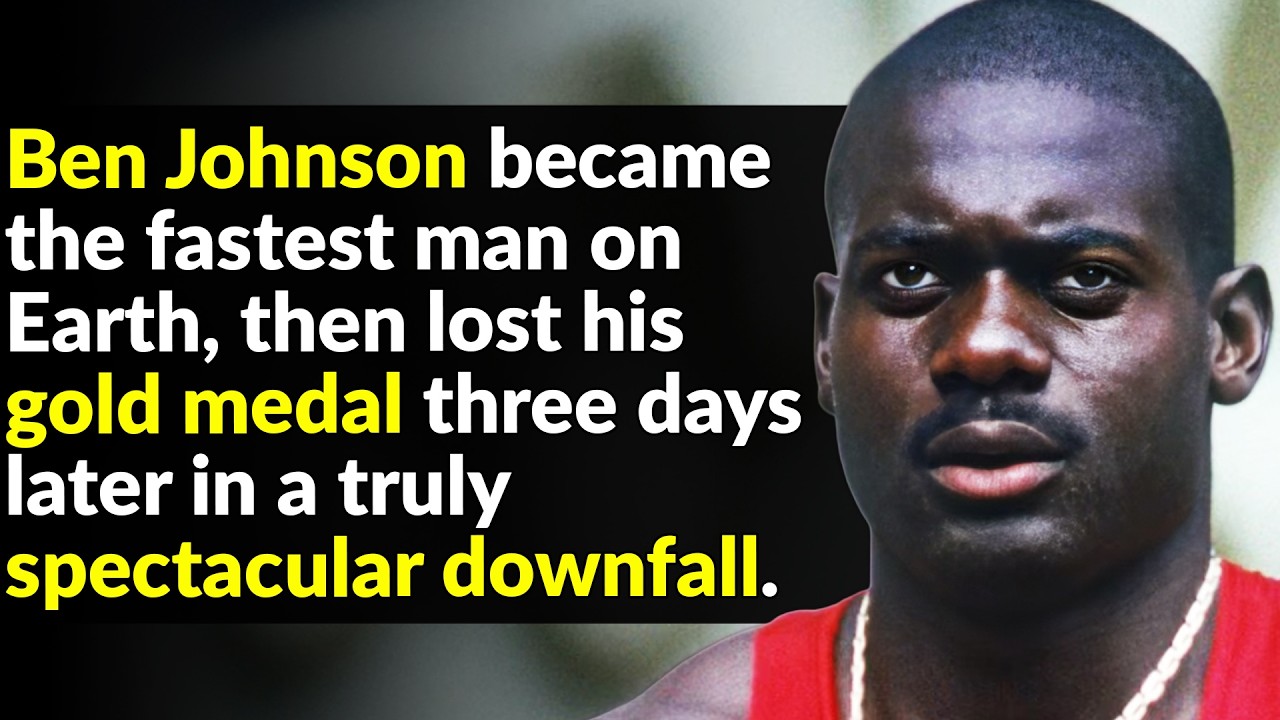
Ben Johnson was unbeatable at the 1988 Olympics, proving he was the fastest man on Earth. Three days later, the world was stunned when he was stripped of his gold medal after failing a drug test. But that was only the beginning of his dramatic and controversial downfall. Although he was known for representing Canada, Johnson was actually born in Falmouth, Jamaica, on December 30, 1961.
The future Olympic champion spent his formative years there, remaining on the island until he was fifteen years old. Johnson faced some early hardships that proved he was a fighter from the start. The Johnson family lived a modest life in Jamaica, which did not shield him from the dangers of life in the tropical islands. In his autobiography, he recounted a harrowing bout of malaria he suffered during his childhood, which significantly impacted his early years.
The next chapter of his life came with a major change of scenery. In 1976, Ben Johnson and his family immigrated to Toronto, Canada. But while Johnson’s parents were uprooting their lives for something better, their son struggled to fit in. Canada was predominantly a white society at the time, which created a lot of difficulty for a young Johnson and he suffered a great deal as a result of the challenges and discrimination that came with being a Black immigrant.
Things eventually got so bad that he made a desperate plea to his parents. He faced his parents and begged them to move the family back to Jamaica, fearing he would simply never fit into the repressive environment of white-majority Canada. But his parents refused gently, and Johnson eventually accepted his fate. Instead, he channeled his pain into passion.
The one thing Canada did offer a troubled Johnson was an outlet for his frustrations in the form of competitive sprinting. The future Olympic champion trained at York University where he joined the Scarborough Optimist track and field club, honing his skills as a runner. Displaying an obvious talent right away, his natural abilities caught the attention of a big name in the sport. At York University, coach Charlie Francis was quick to notice the undeniable talent of Johnson.
Francis was a sprint champion in his own right, having brought glory to Canada in the 1970s, including being part of the athletics team for the 1972 Munich Olympics. He also served as the country’s national coach for 9 years. Francis immediately realized there was something special about Johnson and began coaching him for the big leagues. After a few years of domestic competitive success, Johnson got his first taste of international achievement in 1982 at the Commonwealth Games in Brisbane, Australia.
There, he won not one but two silver medals, finishing second in the 100 meters and as part of the Canadian 100-meter relay team. With this success, the fire of ambition was lit inside a talented young athlete. But he would have to wait a while longer before he got his hands on more medals. The year 1983 saw a temporary regression in Ben Johnson’s performances during the World Championships in Helsinki.
He was eliminated in the semifinals, finishing sixth overall. Later that year, the Pan American Games brought more heartbreak for the young athlete as Johnson finished fifth in the 100-meter final. However, he never lost his drive. The following year, Ben Johnson competed in the 1984 Summer Olympics in Los Angeles.
By that time, he improved significantly and managed to make it to the 100-meter final. As the world watched with great anticipation, Johnson finally got his hands on an Olympic medal, finishing third in the final to take home the bronze. He finished behind American Carl Lewis, sparking a rivalry between the two athletes that would blaze for decades. At home, though, Johnson was king.
Despite his failure to win gold, Johnson was climbing the ranks in his home country. Desai Williams had held the Canadian 100-meter record at 10. 17 seconds. But on August 22, 1984, Johnson clocked 10.
12 seconds to become Canada’s number one sprinter. And you can bet he had his sights set on his international opponents as well. But soon, controversy would hit the track. Johnson’s rivalry with Carl Lewis defined an era of sprinting.
The two athletes pushed each other to new limits, capturing the world’s attention. At the 1987 World Championships in Rome, Johnson defeated Lewis in the 100 meters, setting a new world record of 9. 83 seconds. The victory was a statement, but it also heightened the tension between the two and their respective camps.
Johnson had become the face of Canadian athletics, but his meteoric rise was about to come crashing down. The 1988 Seoul Olympics were supposed to be the crowning moment of Johnson’s career. He was the favorite to win the 100 meters, and he delivered, setting a world record of 9. 79 seconds and finishing ahead of Lewis.
The victory was immediate and triumphant. Three days later, it all unraveled. Johnson tested positive for stanozolol, an anabolic steroid, and was stripped of his gold medal and his world record. The world was shocked, and Johnson’s career was left in ruins.
– The International Olympic Committee banned him from athletics for two years. In 1991, he attempted a comeback, but in 1993, he tested positive for a prohibited substance once more. He received a lifetime ban from the sport, ending his career in disgrace. The man who had once been hailed as the fastest man on Earth was now remembered, for many, as the face of doping in sports.
Johnson has always maintained his innocence, but the evidence was hard to dispute. His life after athletics has been complicated. He has tried his hand at coaching and has spoken publicly about his experiences.
However, the legacy of Ben Johnson remains one of the most cautionary tales in the history of sport.