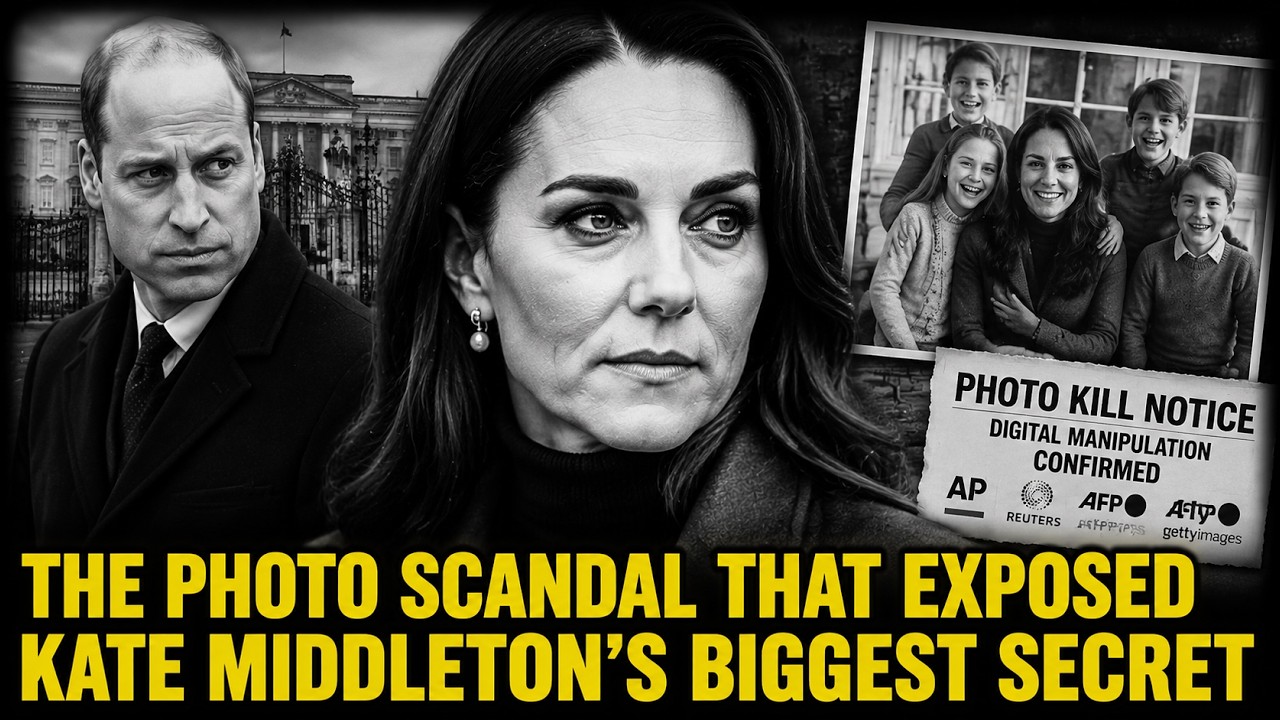
The photograph went out on a Sunday morning in March 2024, timed for Mothering Sunday in Britain. It showed Catherine, Princess of Wales, seated on a wooden garden chair surrounded by her three children, smiling in a soft cardigan.
It was the first image of her released since major abdominal surgery two months earlier had pulled her out of public life entirely. The palace had said almost nothing about her condition beyond a single vague line about recovery.
Within hours, photo agencies including the Associated Press, Reuters, Agence France-Presse, and Getty Images issued kill notices, pulling the image from circulation over what technical analysts identified as clear signs of digital manipulation. Catherine herself, using her own name and initials, posted an apology admitting she had personally edited the photograph.
The apology did not calm anything. If the Princess of Wales felt she needed to touch up a snapshot, and if a communications operation with decades of experience let it go out anyway, then whatever was happening inside Kensington Palace that winter was being managed with a level of care that looked, from the outside, indistinguishable from concealment.
The vacuum the photograph was meant to fill had already produced a viral hoax falsely claiming Catherine had died. Several major news organizations ran explicit debunking articles simply stating she was alive.
That single afternoon compresses something that has been true of this marriage since before it was a marriage at all. The public version of William and Catherine has always been the most carefully produced image in the modern royal operation.
That version is not false. Large parts of it are true and independently documented. But a true story and a complete story are not the same thing.
This is a story about a couple who weathered a breakup, an alleged rift with a neighbor, a rupture with a brother that spilled into two competing published accounts, and a health crisis so tightly controlled that the control itself became the story.
Members of the royal family have for generations had their own private shorthand for their method, referring to the institution among themselves as "the Firm," a term reportedly coined by William's great-grandfather George V and adopted since by everyone from the late Queen downward.
To understand why William built his adult life around this kind of control, it helps to start with the six days that preceded his mother's funeral. Diana died in the early hours of August 31, 1997, and the royal family remained at Balmoral rather than returning immediately to London, declining for several days to fly the flag at half mast over Buckingham Palace.
The pressure grew severe enough that the Queen returned to London, addressed the nation on television, and allowed the flag to fly at half mast for the first time in royal history for anyone other than the monarch. William and Harry were brought out at the Queen's own suggestion to walk among the crowds outside Balmoral and later Buckingham Palace.
William was 15 years old and days later walked behind his mother's coffin through the streets of London alongside his father, his brother, his grandfather Prince Philip, and his uncle Charles Spencer. He has said in a documentary marking the 20th anniversary of Diana's death that he felt he had no choice but to do it.
Catherine Elizabeth Middleton was born in January 1982 in Reading, Berkshire, into a family that had climbed into comfortable wealth within living memory. Her father, Michael Middleton, came from a line of solicitors and had worked as a flight dispatcher for British Airways. Her mother, Carole, had worked as an air stewardess before the two founded a mail order party supplies company called Party Pieces in the early 1980s.
Several biographers, including Katie Nicholl, have reported that Catherine was bullied during an earlier stage of her schooling at Downe House to the point that her parents moved her to a different school. The journalist and author Tina Brown described Catherine's temperament as approaching the project of becoming a senior royal with an almost military discipline.
Catherine went to Marlborough College and then in September 2001 to the University of St. Andrews in Scotland, initially to study art history. William arrived at the same university that same autumn, having chosen St. Andrews partly because it offered a degree of distance and ordinary student anonymity.
British royal culture has long drawn an informal distinction between the heir and everyone else, sometimes called the spare. William, as the direct heir behind only his father, received a level of protective institutional planning around his eventual marriage that Harry, born a spare, never received to the same degree.
The two lived in the same hall of residence in their first year and were friends before they were anything else. A famous charity fashion show in the spring of 2002 where Catherine walked a runway has become the flattened version of how they became a couple. The more accurate version describes something slower, a friendship that deepened across roughly two years of ordinary student life before it became public knowledge that they were together sometime in 2003.
In the summer of 2001, shortly before William began his first term, his father's press office negotiated an informal agreement with the Press Complaints Commission and the editors of Britain's major newspapers. The press agreed to leave William alone throughout his time as an ordinary student in exchange for a small number of organized photo calls. The agreement largely held for four full years.
Once the relationship became public, British tabloids treated Catherine with a mixture of fascination and open cruelty. She was given the nickname "Waity Katie," a phrase built around the implication that she was passively waiting for a marriage proposal.
On her 25th birthday in January 2007, a pack of paparazzi reportedly numbering close to 20 followed her onto a public bus, prompting her lawyers to send a formal complaint to the Press Complaints Commission. The family's solicitors, the London firm Harbottle and Lewis, waged a campaign on Catherine's behalf across roughly two years, using the Protection from Harassment Act to send cease and desist warnings to specific photo agencies.
Four months before that birthday, in April 2007, William and Catherine broke up. The split lasted a matter of weeks rather than months, and the two were seen together again by the middle of that same year. The single image that came to define the "Bad Boy William" period was a paparazzi photograph of William leaving Boujis nightclub in the early hours with a traffic cone-shaped party hat on his head.
Catherine was photographed attending Wimbledon that summer wearing sunglasses despite overcast weather, an image multiple outlets read as a woman trying to shield visibly reddened eyes from long lens cameras.
By the time William proposed in October 2010 during a private holiday in Kenya, using the sapphire and diamond engagement ring that had belonged to his mother, the machinery for managing this couple's public exposure had been built, tested, and refined across the better part of a decade.
William proposed at the Lewa Wildlife Conservancy in Kenya, staying at a remote log cabin called Rutundu on the slopes of Mount Kenya that had no internet access and almost no mobile signal. The couple sat on the secret for more than a month before Clarence House released a formal written announcement on November 16, 2010.
That evening, William and Catherine gave a single joint television interview to the broadcaster Tom Bradby, a family friend. It remains one of only a small handful of occasions on which either of them has spoken publicly at any length about their own relationship in personal rather than official terms.
The wedding on April 29, 2011, at Westminster Abbey was watched by an estimated global television audience in the hundreds of millions. The dress designed by Sarah Burton at Alexander McQueen was kept so completely secret before the ceremony that even bookmakers taking bets on the designer's identity had the wrong name.
For several days after the wedding, speculation over where the newly married couple had gone ran through the tabloids without any confirmation from Kensington Palace. It was eventually confirmed, well after they had returned, that they had spent 10 days on the private island of North Island in the Seychelles, arriving and departing without a single photograph taken by anyone outside their own traveling party.
Rather than settling into full-time royal duties in London, William took up a posting as a search and rescue helicopter pilot with the Royal Air Force on the island of Anglesey off the coast of North Wales. The couple rented an ordinary farmhouse there rather than moving into a palace apartment.
For roughly two and a half years, from shortly after the wedding until William's RAF posting ended in the autumn of 2013, Catherine did her own grocery shopping in the local supermarket. William flew rescue missions that had nothing whatsoever to do with the monarchy.
In September 2012, while William and Catherine were staying at a private chateau in Provence belonging to his cousin, a photographer using a long lens from a public road roughly half a mile away captured images of Catherine sunbathing topless beside a swimming pool. The French gossip magazine Closer published the photographs days later, and an Italian magazine called Chi followed.
William and Catherine's lawyers filed both criminal and civil complaints in France, and pursued the case through the French courts for the better part of five years. In September 2017, a French court convicted the photographer and the editor of Closer of invasion of privacy.
When Pippa Middleton married the financier James Matthews in May 2017 at a church near the Middleton family home in Berkshire, the private event required a security operation on a scale more typical of a state occasion, including a temporary no-fly zone over the venue enforced by the Civil Aviation Authority.
It was at Anmer Hall, a country house on the edge of the royal estate at Sandringham in Norfolk, that the most persistent and least resolved rumor of this entire marriage took root. Rose Hanbury, the Marchioness of Cholmondeley, is married to David Cholmondeley, the Marquess of Cholmondeley, whose family seat at Houghton Hall sits close enough to Anmer Hall that the two properties share a boundary.
Rose Hanbury, a former model who had appeared on the cover of British Vogue in the 1990s, and Catherine were by multiple contemporaneous accounts genuinely close for a period spanning several years. Then sometime around 2019 that friendship visibly ended, and almost immediately American outlets including Us Weekly and In Touch published claims sourced to unnamed friends alleging that the end of the friendship was connected to an affair between William and Rose.

The claims were specific enough to generate enormous circulation and vague enough in terms of actual sourcing that no outlet with a serious legal department in Britain would touch them. Kensington Palace's response across more than five years has been a single unwavering strategy: silence. No denial has ever been issued in William's name, and no confirmation either.
Running in parallel was the collapse of William's relationship with his brother, a rupture that produced two competing book-length first-person accounts of the same family. Harry's own title for his memoir, Spare, drew directly on the heir and spare framing, and he wrote plainly that the label was applied to him within his own family from early childhood.
Harry served two tours in Afghanistan, first in an undisclosed forward role in 2008 and again in 2012 and 2013 as an Apache attack helicopter pilot and gunner. William, as second in line, was never deployed to a combat zone, his own service channeled instead into search and rescue flying.
Harry served as best man at William and Catherine's wedding in 2011, and the two brothers spent the years immediately afterward presenting a united public front, including the launch of the Heads Together mental health campaign in 2016.
The approximate trigger for the rupture, as reported at the time and confirmed later by both sides in different forms, was a set of allegations in 2018 that Meghan, then engaged to Harry, had bullied members of her household staff during preparations for her wedding. Allegations were first reported publicly by the journalist Valentine Low in The Times in 2021.
Buckingham Palace launched an internal investigation into those claims, an investigation whose full findings have never been published. The handling of the dispute became one of several factors driving Harry and Meghan's household to be formally separated from William and Catherine's in the spring of 2019.
The Royal Foundation, originally established in 2009 as a joint charitable vehicle for William and Harry, was formally divided in June 2019, with Harry and Meghan launching their own separate organization.
That divide became fully public in January 2020 when Harry and Meghan announced through a statement posted directly to their own social media account their intention to step back as senior working members of the royal family and become financially independent. The announcement triggered an emergency meeting at Sandringham days later.
The single most serious allegation to enter the public record came from Harry himself in his memoir, Spare, published in January 2023. Harry wrote that during an argument in 2019 at Nottingham Cottage, a confrontation over Meghan escalated to the point that William grabbed him by the collar, knocked him to the floor, and in the process broke a dog bowl that cut into Harry's back.
Kensington Palace, asked directly to respond to the allegation both at the time of publication and in the months since, has declined to comment on it, choosing neither to confirm nor deny an account that Harry himself has stood behind in subsequent television interviews.
In interviews stretching back more than a decade, William has repeatedly connected his own protectiveness over his family's private life directly to watching his mother Diana hunted by photographers for the entirety of his childhood. He has also said that he did not properly process his own grief over Diana's death for close to two decades, crediting both the birth of his own children and specifically Catherine's encouragement for finally prompting him to speak with a grief counselor.
When Prince George was born in July 2013, Kensington Palace negotiated a specific set of guidelines with the Society of Editors and the major British newspaper groups. Under the agreement, the press committed not to photograph or approach the children in unofficial settings, including outside their schools, in exchange for a small number of arranged photo opportunities released on the family's own terms.
Catherine suffered from hyperemesis gravidarum, a severe form of pregnancy sickness requiring hospital treatment during all three pregnancies. In each case, the resulting hospital admission forced Kensington Palace to confirm the pregnancy publicly well before the 12-week mark most expectant parents wait for.
Catherine gave birth to all three children at the Lindo Wing of St Mary's Hospital in Paddington, the same private maternity unit where Diana had given birth to both William and Harry. Princess Charlotte's birth in May 2015 carried a small piece of legal significance: Parliament had passed the Succession to the Crown Act in 2013, ending centuries of male preference in the line of succession.
In March 2022, William and Catherine undertook an eight-day tour of Belize, Jamaica, and the Bahamas on behalf of the late Queen's Platinum Jubilee. Photographs from the tour, including one of the couple shaking hands with children through a chainlink fence, were widely read as tone-deaf given the tour's timing amid growing regional debate over reparations for slavery.
Jamaica's prime minister told the couple directly in a meeting captured by television cameras that the country intended to move toward becoming a republic. Rather than the customary silence, the household issued a statement acknowledging that the trip had prompted important and necessary conversations, and William himself said directly that he supported the right of any country to choose its own future.
Queen Elizabeth II died at Balmoral in September 2022. Within hours, William became Prince of Wales, and Catherine became Princess of Wales, titles that had not been held by anyone since Diana's death a quarter of a century earlier.

In the 10 days between the Queen's death and her funeral, William and Catherine appeared together with Harry and Meghan outside Windsor Castle to view the floral tributes left by mourners. William, walking a step behind his grandmother's coffin 25 years after walking behind his mother's, made the same journey once more.
Kensington Palace announced in the middle of January 2024 that Catherine had undergone planned abdominal surgery, describing the procedure only in vague terms and stating that she was expected to remain out of public duties until after Easter. Three weeks later, on February 5, Buckingham Palace announced separately that King Charles had been diagnosed with a form of cancer.
Through February and into March, that reading hardened into an increasingly elaborate set of online theories, ranging from claims of a secret marital collapse to outright baseless speculation about Catherine's whereabouts. A grainy photograph published by a British tabloid in early March, showing William and Catherine at a farm shop near Windsor, had close to the opposite effect of reassurance.
On March 22, Catherine released a personal video message filmed in the gardens of Windsor and addressed directly to camera in her own words. In it, she explained that the January surgery had initially been believed non-cancerous, that subsequent tests had found cancer was in fact present, and that she was now undergoing a course of preventative chemotherapy.
She said she was sharing the information in her own time and in her own way, in part because she and William had wanted to explain things to their children directly before the wider world found out. She never named the specific type or stage of the disease, a boundary she has maintained ever since.
Catherine attended Trooping the Colour in June 2024, her first major public appearance since the January surgery, arriving by carriage rather than on foot and departing before the full event concluded. In September, she released a further video statement announcing that she had completed her course of chemotherapy, describing the month since March as the hardest of her life. In January 2025, close to a year after the surgery that started the entire sequence, she confirmed that she was in remission.
Polling conducted by several British research firms across that period recorded a measurable, if temporary, dip in public confidence in the monarchy's communication practices during the height of the February and March speculation, followed by a sharp recovery and sympathy once Catherine's video statement was released.
The information war between Charles and Diana did not begin in their final years. Charles was 32 when he married Diana, who was 19, and multiple biographers have documented that Charles's relationship with Camilla Parker Bowles continued in some form throughout the marriage's early years. A private telephone call between Charles and Camilla from 1989 was intercepted, recorded, and eventually published by British tabloids in 1993.
Diana gave extensive private interviews and diary material to the journalist Andrew Morton in the years before the 1992 publication of his book Diana: Her True Story. William was 13 years old when the Morton book was published, old enough to understand what was happening to his parents in the pages of every newspaper in the country.
What tabloids treated as a shameful illicit affair in 1993 had become by the time Charles and Camilla married in a civil ceremony in April 2005 a low-key publicly accepted fact of royal life. By February 2022, the late Queen stated her own wish that Camilla be known as Queen when Charles eventually became king.
Successive surveys conducted by YouGov across the years between roughly 2019 and 2024 placed William and Catherine consistently among the two or three most popular working royals in Britain. In most years, they ranked above every other senior royal, including at various points the king himself.
Since Charles's accession in September 2022, William has held the title Duke of Cornwall alongside the income generated by the Duchy of Cornwall, a private estate of farmland, commercial property, and investments spanning tens of thousands of acres across England. The Duchy is not subject to corporation tax in the way an ordinary company would be, and William makes a voluntary income tax payment on his personal earnings from it rather than being legally required to disclose the full underlying accounts.
The cost of round-the-clock protection provided to William, Catherine, and their children by the Metropolitan Police's Specialist Royal Protection Command is funded by British taxpayers, and the government has for decades declined on security grounds to publish any breakdown of what that protection costs for any individual royal.
Harry and Meghan, once outside the institution's formal structures, made the opposite choice at every available turn, sitting for the Oprah interview, producing a multi-part Netflix documentary series in 2022, and publishing Spare. William and Catherine, across the same years and facing many of the same pressures, have done the reverse. Neither has ever sold their own account of any of the events covered here.
The couple has also never once pursued a defamation claim over any of the specific damaging allegations traced here, even though English defamation law is notoriously favorable to claimants. A family that has fought hard and publicly over stolen photographs has never once been willing to fight that same way over a story about what happened inside its own walls.
The honest answer to whether the secrets of this marriage are more guarded than people think is that the guarding has been real, consistent, and in most cases deliberate. But the secrets themselves are more mundane and more human than the version that circulates online.
There is no confirmed affair, only five years of an institution declining to say the word no when the easier answer would have been to say it plainly if it were true. No confirmed physical assault exists beyond one man's own published account of one incident, met with silence rather than either confirmation or denial for more than two years.
There is a marriage that broke up once briefly in its participants' early 20s under ordinary pressure, and then chose deliberately and at real cost to keep almost everything difficult that followed behind a wall. His parents' marriage lasted 15 years from wedding to formal separation and ended in acrimony. Andrew's marriage to Sarah Ferguson lasted a decade before divorce.
A marriage that has now passed its 15th anniversary with both partners still visibly choosing each other, having weathered a breakup, a persistent rumor, a sibling rupture, and a life-threatening diagnosis without turning any of it into the kind of mutually destructive public war that defined three of the last four senior royal marriages before it, is itself a form of quiet, unglamorous success.
The guardedness made that possible. It also for two months in early 2024 nearly cost them the public trust that same guardedness had spent two decades building. Both of those things are true, and neither one cancels the other out.