In March 1945, on the west bank of the Rhine, German observers watched the darkness and wrote down everything it told them. They logged hundreds of engines moving under blackout, the clatter of tank tracks on cobblestones, and truck convoys grinding through villages hour after hour.
Radio intercepts crackled with the traffic of two American divisions assembling for a crossing. The call signs, the map references, even the sending styles of the operators were familiar to German listeners who had tracked them for months.
By morning, aerial photographs confirmed the buildup. Tanks sat under camouflage nets. Artillery was parked in orchards. Bridging equipment was stacked near the water. The report went up the chain, and German reserves shifted toward the threat.
Every word of that report was wrong.
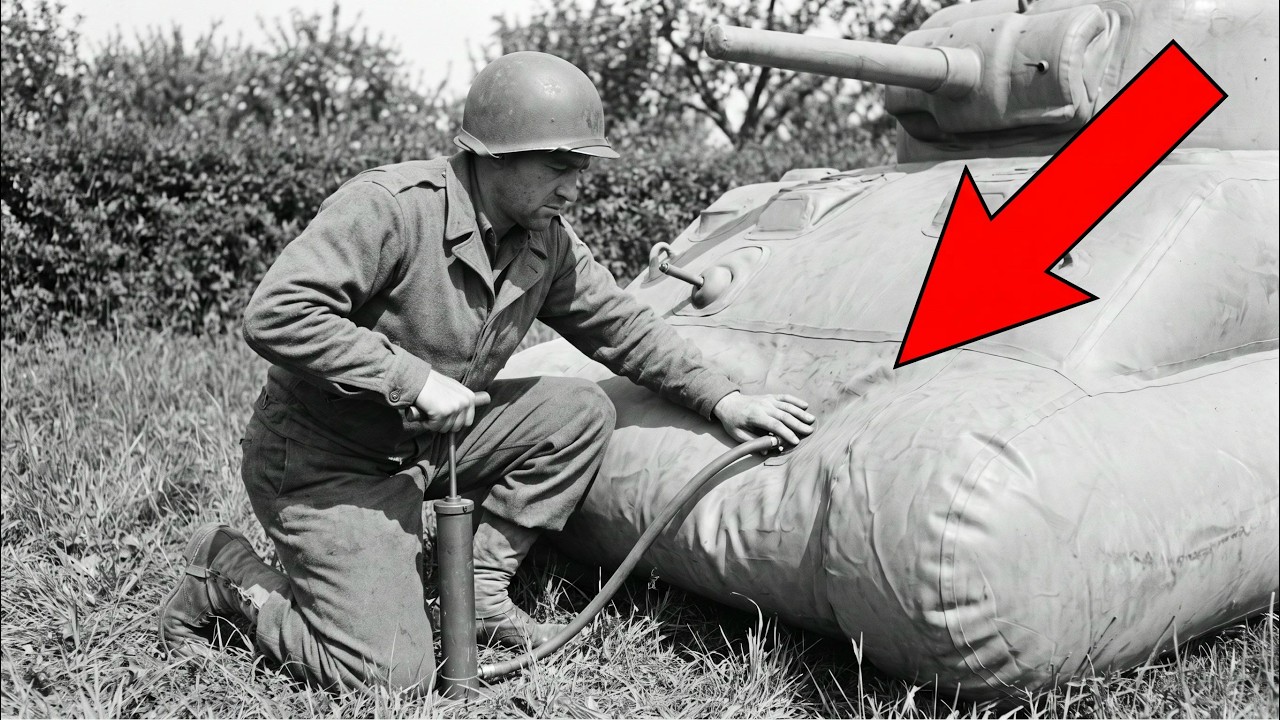
There were no divisions. The tanks in the orchards were rubber, inflated by hand in the dark. The convoy was a loudspeaker mounted on the back of a halftrack. The radio operators were performers imitating other men's hands on the key.
The entire American assembly across the river weighed less than a single real Sherman tank. The men running it were painters, sound engineers, and advertising men.
What the Germans filling in that log could not have known was that they had been fooled by the same unit more than 20 times since Normandy, up and down the Western Front. The deception on the Rhine that night was the final performance of the strangest unit the United States Army has ever fielded.
And here is the part that still astonishes. The men themselves were ordered to forget it. Their records were sealed. Their mouths were closed by oath. For more than 50 years, wives, children, and biographers never learned what these men had done in the war.
Not until 1996 did the files open. Not until this decade did Congress strike its highest civilian honor for the survivors.
This is the story of the Ghost Army, the fake army that fooled Hitler's generals with rubber, sound, and nerve, and of how 1,100 men impersonated 30,000 and got away with it over and over, a few hundred yards from people who would have killed them all.
The unit was born in January 1944, and it was recruited like no other formation in the army. The planners wanted deceivers, so they went looking for men who already lived by illusion. They found them in art schools, theater companies, advertising agencies, and radio stations.
The 23rd Headquarters Special Troops filled its ranks with painters, set designers, and soundmen. Among the young soldiers inflating rubber tanks were a future giant of American fashion named Bill Blass and a future giant of American painting named Ellsworth Kelly.
The unit scored among the highest in the army on intelligence tests, and it needed to, because its trade was played for lethal stakes.
Its arsenal came in four instruments. The Visual Company handled the inflatables: rubber Shermans, trucks, guns, and spotter planes that four men could carry and inflate in the dark. The fakes were so light that a strong crew could lift a 40-ton tank and turn it by hand.
They were parked under just enough camouflage netting to be found, with bulldozed track marks leading to every position, because German photo interpreters counted tread marks before they counted tanks.
The Sonic Company carried the war's strangest weapon. Huge amplified speakers mounted on halftracks played carefully mixed recordings of armored columns, bridging crews, and motor pools, audible up to 15 miles away. The sounds were sequenced so that a listening enemy heard a buildup unfold in real time.
The recordings themselves had been made at the armor school at Fort Knox: tanks idling, tanks turning, bridging crews shouting and hammering. Each sound was captured on wire and then mixed in the field like a broadcast tailored to the terrain, the distance, and the story being told that night. Sound, the unit learned, carried a conviction that photographs could not. Men believe their ears at night.
The radio company put phantom divisions on the air. Its operators trained to imitate the individual sending styles of real units, so that German intercept men who knew their enemies by touch, the way you know a friend's handwriting, recognized exactly who they were meant to recognize.
The last instrument had no equipment at all. The unit called it atmosphere, or special effects, and it meant theater: sewing the shoulder patches of the divisions being impersonated, painting their markings on bumpers, posting their military police at crossroads, and sending officers into liberated cafes wearing borrowed general stars to be seen, overheard, and reported.
If the enemy ever called the bluff, the answer would arrive as a real attack on 1,100 men armed with rubber.
The unit landed in Normandy within weeks of the invasion and learned its trade under fire. The learning produced the story every Ghost Army veteran told for the rest of his life.
One morning in France, two local men on bicycles slipped past the perimeter and stopped dead at the sight of four American soldiers picking up a Sherman tank and turning it around by hand. The security officer who caught them thought fast and offered the only explanation available. The Americans, he said gravely, are very strong. The Frenchmen pedaled away with the secret of the war's strangest unit filed under national admiration, and the Ghost Army tightened its perimeters and refined its craft.

Operation after operation followed up the map of France. Then came the week that tested everything.
In September 1944, at Bedenburgg on the Moselle front, Patton's Third Army had run so far and so fast that a hole gaped in the American line, miles of it, with almost nothing real to plug it. The Ghost Army was sent to be the plug.
For seven days, the unit stood in for an entire armored division. Rubber tanks sat in the tree lines. Speakers played the division's arrival night after night. Phantom radio nets chattered. Patches and bumper markings were all correct.
Across the line stood German forces that could have overrun the position in an afternoon had a single patrol pushed through the canvas. The men slept beside their inflatable tanks and understood the arithmetic perfectly. Deceptions were built to run two days before the enemy's suspicion caught up. This one ran a week.
The attack never came. The gap was quietly filled behind them, and the Ghost Army packed its division into trucks and vanished.
It was not bloodless work. The unit operated inside artillery range for most of a year. It took casualties doing it, and it buried men of its own. Sound engineers and painters were killed performing an armored division's presence with their own bodies as the proof.
Through the autumn and the terrible winter that followed, the unit kept performing at Metz and in the freezing chaos around the Bulge, conjuring divisions out of speakers and rubber while the real divisions they impersonated were rushed elsewhere. By the spring, the 23rd had run its illusions more than 20 times without once being unmasked in the field.
The masterpiece came at the Rhine in March 1945, the operation this story opened with. The American Ninth Army was preparing to cross, and the Ghost Army was ordered to build the crossing that would not happen, 10 miles from the one that would.
For days the full orchestra played. Two phantom divisions assembled. Sonic convoys rolled every night. Fake supply dumps and bridging sites appeared. Radio nets rehearsed a river assault. There were even phony aid stations and headquarters signs for any watching agent.
German commanders moved men and guns to meet the phantom crossing. When the real assault went in, it met defenses so thin that the leading wave suffered a fraction of the casualties the planners had braced for, and the army commander's staff put credit for it on the record.
Then came the proof that settles every argument about this unit. Captured German situation maps from those weeks were found plotted with the phantom American divisions drawn in exactly where the Ghost Army had performed them. Rubber tanks had been promoted to intelligence fact at enemy headquarters.

Army analysts later estimated the unit's deceptions may have saved on the order of 15,000 to 30,000 American lives, a figure impossible to certify and hard to dismiss. It was purchased by a thousand men whose heaviest weapon was a loudspeaker.
The final accounting reads like a stage bill. Operations performed: more than 20. Months in the line: nearly a year. Divisions impersonated: over a dozen, patches, radios, generals, and all. Times unmasked by the enemy in the field: zero.
Weight of a Sherman tank: 40 tons. Weight of theirs: about 90 pounds. Estimated lives saved: 15,000 to 30,000. Their own dead: a handful, buried under real flags.
No unit in the American army ever bought so much with so little. And no unit was ever thanked so late.
Then the curtain came down on the performers themselves. The war ended. The 23rd sailed home, and the United States Army classified the entire story, because tricks that worked once might be needed against the next enemy. The men signed their silence and kept it for half a century.
Bill Blass built one of the most famous names in American fashion, and his industry never knew he had spent 1944 inflating tanks under German guns. Ellsworth Kelly's paintings entered the world's great museums, cataloged by critics who had no idea his first canvases had been rubber and burlap on the Western Front.
Wives learned nothing. Children learned nothing. At reunions, the men of the Ghost Army were the only audience their own war stories would ever have, elderly artists trading memories of inflatable artillery and hotel function rooms, then going home and saying nothing.
The files finally opened in 1996, and even then the story crept out slowly, through a documentary and a campaign by the veterans' families, until Congress acted at last. In 2022, the Ghost Army was awarded the Congressional Gold Medal, the nation's highest civilian honor.
When the medal was presented in 2024, the last few survivors, men past their 100th birthdays, sat in the capital to receive it. Eighty years after they had inflated their first tank in the Normandy dark, one of them told reporters it had been worth the wait. The army they had served in kept their secret longer than most of them lived.
So the next time you see wartime footage of masked American armor, remember that somewhere on those fronts stood divisions that weighed nothing. Orchards full of rubber Shermans, radios worked by actors, and convoys made of sound, guarded by painters and designers sleeping a rifle shot from the enemy.
Hitler's generals plotted those phantoms onto their maps and moved real divisions to fight them. Congress eventually struck gold for the men who staged it all. The army was fake. The lives it saved were not, and neither, in the end, was the honor.