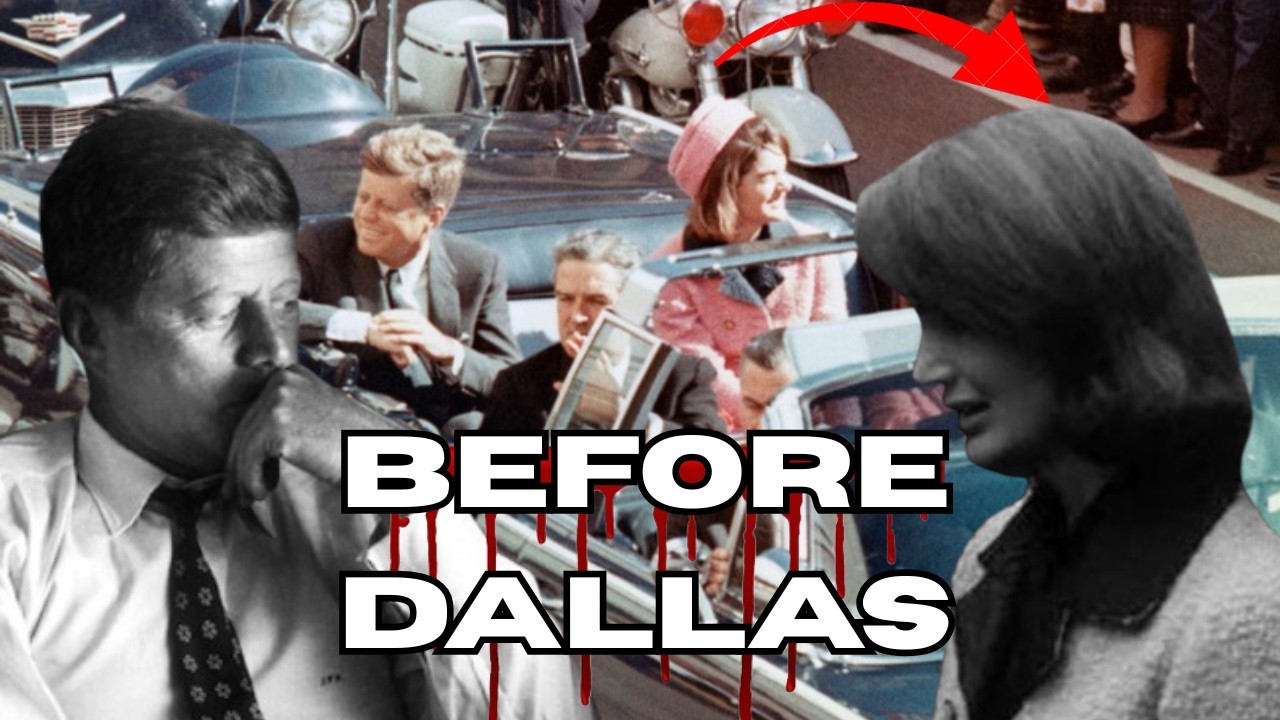
November 22, 1963, is seared into American memory: the motorcade, the shots, the pink suit, Jacqueline Kennedy cradling her husband in the back of a limousine. It is one of the most documented and replayed moments in modern history.
November 21 is almost never discussed.
It was a Thursday. John F. Kennedy woke up, kissed his wife, and boarded Air Force One for a two-day political swing through Texas. Aides who traveled with him described him as ebullient. His back, which had tormented him for years, was feeling unusually good.
Jackie was with him, making her first extended public appearance since the death of their infant son, Patrick, in August. The crowds across Texas were enormous and electric. By every visible measure, it was going to be a good trip.
But beneath that surface, Kennedy carried something he rarely spoke about out loud: a quiet, private reckoning with the possibility that someone might kill him. He had lived with that thought for years, and in the final 18 hours of his life, it came to the surface more than once.
To understand what Kennedy said on November 21, it helps to understand why he was in Texas at all.
In the fall of 1963, Kennedy and his political team had begun early planning for the 1964 presidential election. Texas was a problem. The Kennedy-Johnson ticket had barely carried the state in 1960, winning by a margin of less than 46,000 votes.
Now the Texas Democratic Party was in open warfare with itself. Governor John Connally, a conservative Democrat and LBJ loyalist, refused to cooperate with Senator Ralph Yarborough, a committed liberal who despised Connally. The two men had been feuding publicly for months.
During the trip itself, Yarborough refused, in full view of reporters, to ride in a motorcade car with Vice President Johnson. The Dallas Morning News ran the headline "Yarborough Snubs LBJ" on the morning of November 22.
Kennedy needed to close that breach before it became a liability in 1964. The Texas trip was explicitly designed to force a show of party unity.
But Kennedy was also walking into territory that had grown overtly hostile to his presidency. Just one month earlier, on October 24, UN Ambassador Adlai Stevenson had given a speech in Dallas. The crowd outside became a mob. Protesters screamed that he was a communist and a traitor. Someone struck him over the head with a protest sign.
Stevenson was shaken enough that he privately warned the White House. A Dallas woman named Nell Doyle wrote to White House Press Secretary Pierre Salinger to beg him not to send the president to Dallas, warning about what she called "this hoodlum mob" and recalling the fate of President McKinley.
The Dallas Morning News had a long record of editorial hostility toward Kennedy. On the very morning of November 22, the paper would run a full-page, black-bordered advertisement accusing Kennedy of being soft on communism.
Kennedy was fully aware of this atmosphere. Years later, aide Dave Powers recalled Kennedy expressing deep unease about going to Texas, saying something to the effect of, "God, I hate to go to Texas," and describing a vague, difficult-to-name feeling about the trip.
Powers' recollection comes from the memoir he co-wrote with Kenneth O'Donnell, gathered in the aftermath of the assassination. Historians treat it as retrospective memory rather than a contemporaneously documented remark. That said, it is consistent with everything else Kennedy said and did in those final days.
Powers had heard Kennedy make this kind of dark, half-joking remark before. Kennedy had a fatalistic streak that ran quietly through his private conversations. He had told Powers on earlier occasions things like, "Thank God nobody wanted to kill me today."
He was given the last rites of the Catholic Church on three separate occasions during his life: in 1947, when he fell gravely ill in England; in 1951, when he nearly succumbed to a high fever in Japan; and again in 1954 following back surgery.
He had lost his older brother Joe when his plane exploded over the English Channel in 1944. A sister died in a plane crash in 1948. His first daughter was stillborn in 1956. His son Patrick had lived for only 36 hours before dying in August 1963, less than three months before this trip.
Kennedy's favorite poem, which he had memorized as a young man and quoted repeatedly throughout his life, was Alan Seeger's "I Have a Rendezvous with Death." He knew it by heart. He had once told friends he did not expect to live past the age of 45.
He was 46 years old when Air Force One touched down in Texas on November 21, 1963.
The trip began in San Antonio. Air Force One landed at Kelly Air Force Base that afternoon. The crowds lining the motorcade route into the city were enormous and warm. Kennedy was visibly energized, working the crowds the way he always did, leaning into rope lines and reaching for hands.
At Brooks Air Force Base in San Antonio, Kennedy delivered a speech at the dedication of a new Aerospace Medical Health Center. The speech was about medicine, science, and the courage it took to push into the unknown. He referenced the American commitment to space exploration and human progress, and quoted the Irish playwright who wrote about reaching for the stars.
From San Antonio, the motorcade and planes moved to Houston. There, at the Rice Hotel, Kennedy and Jackie made a surprise appearance at a League of United Latin American Citizens banquet. LULAC's Viva Kennedy Clubs had been instrumental in organizing the Hispanic vote during the 1960 election. Jackie stepped to the microphone and addressed the crowd in Spanish. The room erupted.
That evening, the Kennedys attended a formal dinner at the Sam Houston Coliseum honoring Congressman Albert Thomas, the Houston Democrat whose influence had been central to bringing NASA's Manned Space Center to Houston. The dinner was a sellout. Tickets had sold out first at the Rice Hotel, then again after organizers moved to the larger Coliseum. When it became known that Jackie would attend, even those tickets vanished. The room held an estimated 3,300 people.
Kennedy's speech that night was generous and specific. He praised Thomas's vision and political courage in detail. He connected Houston's economic rise directly to Thomas's three decades of work in Congress. He spoke about the space program and about Texas's transformation from a primarily agricultural state into one of the 10 most industrialized states in the nation.
The speech, preserved in its entirety at the JFK Presidential Library, shows Kennedy at his most polished, charming, fluent, and substantive, clearly enjoying himself.
But underneath the warm surface of the evening, the political friction that had motivated the trip was playing out behind the scenes. Kennedy spent much of the day trying to get Yarborough to extend some form of civility toward Johnson. The senator resisted. Kennedy's aides worked the phones. The breach held.
After the Albert Thomas dinner, the presidential party motorcaded back to the airport. Air Force One lifted off for the short flight to Fort Worth. The day had been long: motorcades, speeches, receptions, handshakes in the thousands.
By the time Air Force One descended toward Carswell Air Force Base in Fort Worth, it was almost 11:00 at night. An estimated 5,500 people had gathered at the base to welcome the president. The base was not normally accessible to civilians, and it was near darkness, past 11:00, cold enough that people had needed coats.
As Air Force One approached, the president could have seen the Fort Worth skyline through the aircraft windows. More than 60 downtown buildings had been illuminated with amber floodlights specifically for the presidential visit. The lit skyline was visible in photographs taken by Fort Worth Press chief photographer Gene Gordon at Carswell that night.
The motorcade from the air base into downtown Fort Worth covered 15 miles. Despite the hour, people lined the streets. The Kennedys arrived at the Hotel Texas, a 14-story building on the corner of 8th and Main Streets in the heart of downtown Fort Worth, at approximately 11:35 p.m.
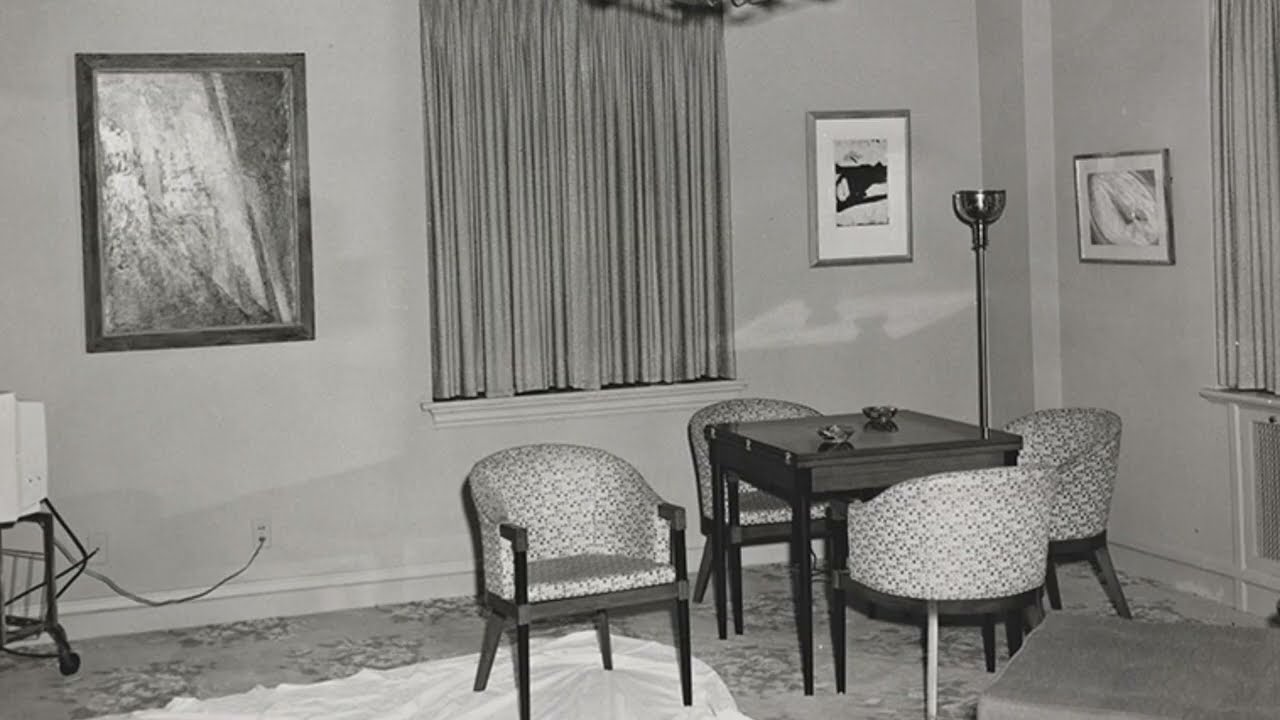
The hotel's best suite, the Will Rogers suite on the 13th floor, had been assigned to Vice President Johnson. The Secret Service, citing a single entrance preference for security reasons, had selected a smaller three-room suite on the eighth floor for the president and first lady: suite 850. It overlooked a Trailways bus station and a parking lot. By the standards of what the White House press corps had stayed in on other trips, it was modest.
What the Kennedys did not know, and could not have known arriving exhausted after midnight, was that suite 850 had been transformed.
Five days earlier, an art critic named Owen Day, who wrote for the Fort Worth Press, had read a newspaper article about the president's upcoming visit. The article was headlined "Sweet 850, it'll be famous." Day knew the suite. He had seen it. It was plain, functional, utterly ordinary, a room that would give no particular impression of Fort Worth to the leader of the free world.
Day reached out to Samuel Benton Cantey III, a prominent Fort Worth art patron and leader of the Fort Worth Art Association. What followed was an extraordinary logistical scramble.
Cantey contacted Ruth Carter Johnson, the daughter of legendary Texas newspaper publisher Amon G. Carter and the board president of the Amon Carter Museum of American Art. Johnson was a staunch Republican who had not voted for Kennedy. None of that mattered. She agreed immediately.
In the days that followed, Johnson and a small group of Fort Worth art collectors and institutions assembled 16 works of art, paintings and sculptures gathered from private collections, the Modern Art Museum of Fort Worth, and the Amon Carter itself, and had them transported to the Hotel Texas by courier and station wagon.
The organizers designed the installation deliberately, matching specific works to the documented tastes and interests of the president and the first lady. The parlor of suite 850 received Monet's portrait of the artist's granddaughter, Picasso's bronze sculpture "Angry Owl," Lyonel Feininger's "Manhattan II," and a study by Franz Kline, a mix designed to suggest cultural range and sophistication. Henry Moore's small bronze joined them. Charles Marion Russell's "Lost in a Snowstorm, We Are Friends" brought a note of the American West.
Jackie's bedroom was hung with Vincent van Gogh's "Road with Peasant Shouldering a Spade," an 1887 oil painting, and Maurice Prendergast's "Summer Day in the Park," chosen because her impressionist tastes were well documented.
Kennedy's bedroom received Thomas Eakins' monumental "Swimming," one of the most important American paintings of the 19th century, described by curators as depicting men at a moment between the old world and the new, swimmers caught between departure and arrival. The suite came with a printed catalog documenting each work.
The Kennedys walked into suite 850 just before midnight. They were exhausted. Kennedy's right hand was reportedly trembling with fatigue. His aides later noted he was fighting stomach cramps. Jackie would later say she thought the paintings on the walls must be reproductions. This was Texas, after all. Who would have left originals in a hotel room?
Neither of them read the catalog that night. Kennedy went to bed beneath the Eakins. Jackie slept under a van Gogh. They were, as one account put it, too tired to see what was right in front of them.
The next morning, the morning of November 22, Kennedy woke before 7:00 a.m. He had an early event: a speech in the parking lot across the street from the hotel, where the Fort Worth Chamber of Commerce had arranged an outdoor appearance for the public who couldn't get tickets to the indoor breakfast. Thousands were already gathering in a light rain.
At some point in the morning hours, before or after that first appearance, Kennedy had a conversation in suite 850 with Jackie and with Kenneth O'Donnell, his appointment secretary and one of his closest political aides. O'Donnell was part of what the press called Kennedy's Irish Mafia, the tight inner circle of Boston Irish advisers who had been with Kennedy since his Senate days. He was known for his political toughness and his absolute loyalty.
The conversation, as O'Donnell later recounted it in the memoir "Johnny, We Hardly Knew Ye," written with David Powers and published in 1972, centered on what Kennedy had noticed the previous night: the nighttime arrival in Fort Worth, the crowds pressing against the motorcade, the rain, the darkness, the jostle of bodies.
Kennedy told O'Donnell, "Last night would have been a hell of a night to assassinate a president." He was not joking. O'Donnell knew because Kennedy kept going. "I mean it," Kennedy said.
According to O'Donnell's account, drawing on William Manchester's comprehensive "Death of a President," which recorded the same exchange, Kennedy described what he had been thinking as the motorcade pushed through the wet, crowded Fort Worth streets the previous night. "There was the rain and the night, and we were all getting jostled. Suppose a man had a pistol in a briefcase."
Then, according to Manchester's account, which O'Donnell confirmed, Kennedy gestured vividly. He pointed his index finger at the wall, jerked his thumb twice to show the action of a hammer, pantomimed dropping the gun in the briefcase, and whirled into a tense crouch. "A man could drop the weapon," he said, "and melt away in the crowd. No one would ever find him."
He was calmly walking himself through an assassination scenario, not in paranoia, but in the detached, analytical way he processed risk. The JFK Presidential Library has confirmed that Kennedy had what it described as a fatalistic attitude about the possibility of an assassination, and that this attitude was a recurring feature of his private conversations, not a premonition on this particular morning.
O'Donnell later wrote that Kennedy acknowledged something specific in that conversation. The Secret Service could protect him from crowds; they were trained for that. But a shooter at a distance, a high window, a rooftop, a vantage point removed from the immediate scene, was a different matter. Kennedy said he understood there was nothing anyone could do to guarantee his safety from that kind of attack.

The exchange appears in two independent post-assassination accounts, O'Donnell's memoir and Manchester's "Death of a President," both based on recollections gathered after the fact rather than contemporaneous records. Historians note this distinction while still treating the exchange as credible, given that it aligns with Kennedy's documented fatalistic attitude about the possibility of assassination.
And then breakfast was served, and Kennedy put on his suit and went to work.
At 8:45 in the morning, Kennedy walked out of the Hotel Texas into the cold, wet air of downtown Fort Worth. A crowd of thousands had assembled in the parking lot across 8th Street. The platform was a flatbed truck. Kennedy wore no hat, no coat. The rain fell lightly.
His first words to the crowd, preserved in audio recordings held by the JFK Presidential Library, were, "There are no faint hearts in Fort Worth, and I appreciate your being here this morning." Then he paused, grinned, and said, "Mrs. Kennedy is organizing herself. It takes her longer, but of course she looks better than we do when she does it."
The crowd laughed. It was a vintage Kennedy moment: self-deprecating, warm, with impeccable timing. The people in that parking lot, many of whom had been standing in the rain waiting for him, responded the way people always responded to Kennedy in person. They lit up.
The speech that followed was a compressed version of the administration's core argument for its own existence: military strength, economic prosperity, and space exploration. Kennedy talked about Texas and its role in national defense. He talked about the defense contractor work done in Fort Worth, the TFX fighter aircraft program, which had significant work at General Dynamics in the city. He told the crowd that what they were building was part of what kept the country free.
"Here in this rain in Fort Worth," he said, "we are going forward."
These were the last words he delivered outdoors to an unrestricted public crowd. Within the hour, he would be speaking behind locked ballroom doors to the Fort Worth Chamber of Commerce. After that, the doors of the limousine.
Thousands of people pressed forward to shake his hand as he worked the rope line after the speech. This was the Kennedy they had waited for. He was tan, healthy-looking, fully present. Nothing in his bearing suggested a man who had woken up hours earlier in a hotel room talking about assassins and briefcases.
Inside the Hotel Texas ballroom, approximately 2,000 people had gathered for the Fort Worth Chamber of Commerce breakfast. Tickets had sold out twice, first at one venue, then again after organizers moved to the larger ballroom, and a third time when word spread that Jackie would attend. The room was packed with the city's civic, business, and labor leadership.
Vice President Johnson was there, along with Governor Connally, Senator Yarborough, and Congressman Jim Wright, Fort Worth's own representative, who had worked hard behind the scenes to make this event happen.
Kennedy walked in to sustained applause. Jackie was not yet in the room. He stepped to the podium and looked out at the crowd. His opening line: "Two years ago, I introduced myself in Paris by saying that I was the man who had accompanied Mrs. Kennedy to Paris. I am getting somewhat that same sensation as I travel around Texas."
He paused for the laughter, then added, "Nobody wonders what Lyndon and I wear."
It was the right joke for that room, that moment, that crowd. It acknowledged Jackie's magnetism without resentment, made a gentle jab at himself and the vice president both, and turned the air loose. Even the conservative businessmen who had not voted for Kennedy laughed. He had the gift, the particular ability to make people feel included in a private joke, to make a room of strangers feel like it was just them and him.
Jackie arrived minutes later. The room gave her a standing ovation. Kennedy watched her come in with visible pleasure.
The formal speech that followed covered military preparedness and national security, themes that resonated in Fort Worth, a city with significant defense industry employment. Kennedy spoke about what it cost to maintain American power in the world, about the burden it placed on the budget, and about why that burden was worth carrying. He was specific about Texas's role. He was specific about General Dynamics. He understood he was speaking to people whose livelihoods were connected to the defense programs he was defending.
"We are still the keystone in the arch of freedom," he told them. "We will continue to do our duty, and the people of Texas will be in the lead."
The speech was interrupted repeatedly by applause. By its end, the room was with him. The political friction of the Yarborough-Connally feud, the hostile Dallas newspaper, the ambient tension of the trip, none of it was visible inside that ballroom. He had done what he came to do.
After the breakfast, Kennedy returned briefly to suite 850. It was only now, in the daylight, in the quiet after the outdoor speech and the breakfast, that John and Jacqueline Kennedy actually saw what was on the walls of their hotel suite.
Jackie found the catalog first. She realized with a start that the paintings were not reproductions. They were originals. Van Gogh, Eakins, Monet, Picasso, a collection of genuine masterworks hanging in their hotel room, assembled overnight by people who had wanted to show them something beautiful.
Kennedy, according to accounts recorded in connection with the Hotel Texas Exhibition later assembled by the Dallas Museum of Art and the Amon Carter Museum, was moved by the gesture. He immediately asked to speak with Ruth Carter Johnson, the principal organizer of the installation. She was a Republican who had not voted for him. She had done this anyway, as a statement of civic hospitality, of what Fort Worth could offer, of what Americans could do for each other across political lines.
He called her. He thanked her with warmth and specificity, not a perfunctory acknowledgement but a genuine expression of gratitude. He told her how much the paintings meant to him and to Jackie, how beautiful the suite was, how much he appreciated the effort.
Then Jackie took the phone. According to the account preserved in the historical record of the Hotel Texas Exhibition, confirmed by multiple sources close to the organizers, Jackie told Johnson that she didn't want to leave. The words were simple and exact in their feeling. It was all too beautiful to let go of so quickly. She wished she could stay longer.
But the motorcade was forming. Dallas was 40 miles away. The schedule did not wait.
That phone call to a Republican art collector in Fort Worth about paintings that had hung in their hotel room for one night is widely believed to have been the last phone call Kennedy made before leaving for Dallas.
At some point before departing, civic leaders from Fort Worth presented the president with a 10-gallon cowboy hat, a local tradition. Kennedy declined to put it on. He smiled, held it up, acknowledged the gift, but told them he would wear it when he returned to the White House from the Oval Office steps. He never made it back.
As the Kennedys moved toward the motorcade and the waiting cars that would take them to Carswell Air Force Base for the 13-minute flight to Dallas, the art exhibition was already being dismantled. The van Gogh was coming down. The Eakins was being carefully lifted from the wall above the bed where Kennedy had slept. The people who had carried these paintings up in station wagons and by courier were now carrying them back out.
On the 13-minute flight from Fort Worth to Dallas Love Field, Kennedy made a remark that several accounts recorded. According to later recollections cited by historian Thurston Clarke in "JFK's Last 100 Days," Kennedy looked out at the morning. The rain had cleared. The sky was brightening. The weather in Dallas was going to be beautiful.
He said something to the effect of, "We're heading into nut country today." But he followed it with the observation that anyone truly determined to shoot the president from a window with a rifle could not be stopped. So why worry about it?
The remark was consistent with everything Kennedy had been saying and doing privately for years. He was not panicked. He was not asking to cancel the trip. He was, in his characteristically fatalistic way, simply naming the thing that was there.
The bubble top, the clear protective cover that could be mounted on the presidential limousine, had been considered for Dallas. After the morning breakfast, O'Donnell had informed the lead Secret Service agent that the bubble top should not be used if the weather was clear. The weather was clear.
The crowds that had been briefed to expect a slow motorcade through downtown Dallas were enormous. Estimates later placed the total at 200,000 people along the route. Dallas was going to be different from Fort Worth. Kennedy knew that. He had seen the hostile newspaper ad that morning. He had been thinking about it since the warnings about Adlai Stevenson. He knew that a section of Dallas harbored a particularly intense hostility toward his administration, toward him personally.
He went anyway. That was always what he did.
Air Force One touched down at Dallas Love Field at 11:38 a.m. on November 22. The Kennedys disembarked to find a large crowd pressed against the chain-link fence along the tarmac. The first lady received a bouquet of red roses, an unusual choice since the custom for presidential visits was yellow roses in Texas. The red ones had been selected deliberately, though the reason for the deviation from custom has been explained differently by different accounts. Jackie carried them with her to the waiting limousine.
The Kennedys walked the fence line shaking hands. These were friendly people reaching through the chain link to touch the president and first lady. Kennedy was relaxed and warm. He was good at this, always good at this. He moved down the line methodically, making eye contact, gripping hands, connecting.
Then they got into the limousine. Governor Connally and his wife Nellie sat in the jump seats directly in front of the Kennedys. The motorcade began to move.
For the next 35 minutes, the route through Dallas was everything the advance team had hoped. The crowds were not just large, they were enthusiastic. 200,000 people lining 10 miles of street, cheering, waving, pressing forward.
Connally later said he leaned back to the president near the end of the route and said, "You can't say Dallas doesn't love you." Kennedy reportedly smiled. Nellie Connally made a similar remark, captured later in her own account and confirmed by other passengers in the vehicle. She turned to Kennedy as the limousine moved through the canyon of cheering crowds and said something to the effect that he certainly could not say Dallas wasn't friendly.
Kennedy's response, preserved in Connally's testimony to the Warren Commission and in later accounts from those in the vehicle: "No, you can't."
Those appear to have been among the last words he spoke.
At 12:30 p.m., as the motorcade passed through Dealey Plaza, shots were fired from the Texas School Book Depository. Kennedy was struck twice. He was rushed to Parkland Memorial Hospital, where he was pronounced dead at 1:00 p.m.
The exhibition in suite 850 was long gone by then. The workers had finished dismantling it while Air Force One was still in the air. The van Gogh and the Eakins and the Picasso were already back in their owners' hands, wrapped on their way to storage and private collections and museum walls. Nobody left anything behind in suite 850 except the key.
That key, a standard hotel skeleton key stamped "Texas Fort Worth" on one face and "850" on the other, ended up in the collections of a manuscript dealer and was later documented as an artifact of the last night of the Kennedy presidency. It is a small, unremarkable object, a piece of metal that opened the door to the last room he slept in.
The art critic Owen Day, who had conceived the idea of decorating suite 850, later said that Kennedy's final phone call, the one to Ruth Carter Johnson about the paintings, mattered to him. Whether Kennedy made the call purely out of courtesy or because the art genuinely moved him, the fact was that he made it. He noticed. In the chaos of the last morning, with the schedule pressing and Dallas waiting, he stopped and called to say thank you.
The paintings themselves were reunited for the first time in 2013, 50 years after the assassination, in a formal exhibition organized by the Dallas Museum of Art and the Amon Carter Museum of American Art. Historians who studied the installation noted that the Eakins painting, the one hung above Kennedy's bed, depicted swimmers caught between two worlds, between an old era and a new one, between what had been and what was coming. Art historians writing about the Hotel Texas exhibition noted that Thomas Eakins had painted himself into the lower right corner of the canvas, swimming but still moving, still going forward.
November 21, 1963, was a day of enormous crowds, warm receptions, political headaches, and private darkness. Kennedy moved through five cities and 15 hours of public life. He shook thousands of hands. He gave speeches that were recorded and preserved. He told a room full of Texas businessmen that they were going forward in the rain.
He told his aide and his wife that the previous night would have been a perfect night to kill a president. He acted out the scenario with his hand. He slept under a van Gogh he was too tired to see. He called a Republican art collector to say thank you for the paintings, the last phone call of his life. He got on a plane and flew 40 miles to Dallas, knowing on some level exactly what kind of city he was flying into, because he had been thinking about it for years.
He was 46 years old, and he was going forward.
History remembers November 22 with overwhelming, almost architectural precision. Every minute is documented. Every second of the Zapruder film has been analyzed frame by frame. Every witness statement has been cross-referenced, disputed, studied, cataloged.
But November 21 is the day you actually see him. The dinner in Houston, the crowds in the Fort Worth rain, the paintings he didn't notice until morning, the dark remark in a hotel room, the phone call that was the last thing he did before heading to the motorcade. That's the day worth knowing. That's the Kennedy almost no one talks about: fully alive, fully himself, carrying everything he always carried, and still moving forward.