On January 21, 1986, a federal jury in Kansas City, Missouri, returned guilty verdicts on all eight counts against five of the most powerful mob figures in the American Midwest. The courtroom sat on the fourth floor of the Charles Evans Whittaker United States Courthouse, and the jury had deliberated for four days.
At the defense table sat Joseph "Joey Doves" Aiuppa, 78, acting boss of the Chicago Outfit, and his underboss Jackie "the Lackey" Cerone, 71. With them were Carl "Tuffy" DeLuna, second in command of the Kansas City mob, Milton "Meche" Rockman, 72, the Cleveland family's financial man, and Joey "the Clown" Lombardo, 56, a Chicago capo who ran the Outfit's connection to the Teamsters.
In one stroke, these men lost their freedom, their empires, and their decades-long stranglehold on Las Vegas. They also lost a skim operation that had funneled an estimated $200 million in untaxed cash out of four Las Vegas casinos over more than a decade.
What made this takedown different was who brought it down. It was not a rival family, and it was not a made man who turned rat. It was a casino executive named Carl Wesley Thomas, a man who wore suits, carried a briefcase, and looked like he belonged at a country club. The FBI did not have to flip him the hard way. They already had him on tape teaching the mob how to steal.
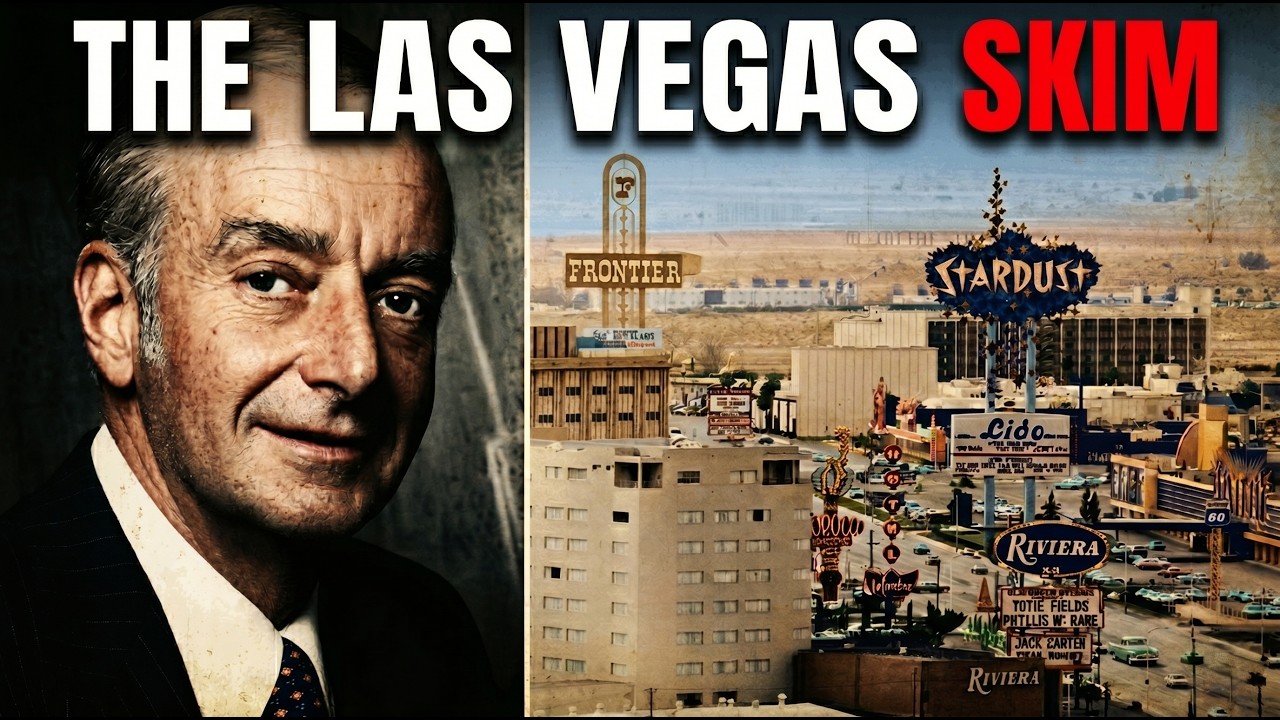
To understand how that happened, you have to understand Las Vegas in the early 1970s. On the surface, the Strip was neon lights, showgirls, and Frank Sinatra crooning at the Sands. Underneath, the entire city operated as a cash register for organized crime.
Casinos generated mountains of cash every day, and the mob wanted its cut before the government could tax a penny of it. The method was called the skim: taking money off the top before it ever hit the official books.
Pulling that off at scale across multiple casinos for years required three things. The operation needed a front man who looked clean, an operator who understood the gambling business inside and out, and someone on the casino floor who could physically move the money without triggering alarms.
The front man was Allen Glick, a 32-year-old San Diego real estate developer and decorated Vietnam War veteran. Glick held a Bronze Star and a law degree from Case Western Reserve, and on paper he was the perfect casino owner: clean record, no criminal history, military hero.
In 1974, Glick formed the Argent Corporation and set his sights on the Stardust, the biggest casino on the Las Vegas Strip. He needed money, and the mob had a bank: the Teamsters Central States Pension Fund.
For years, mob families had used their influence over Teamsters officials to direct pension fund loans to businesses they secretly controlled. The man who ran that pipeline was Allen Dorfman, a Chicago Outfit associate and consultant to the fund.
On August 23, 1974, Glick received a $62.75 million loan from the pension fund, the largest single loan the fund had ever approved. That money bought him control of the Stardust and Fremont casinos, and another $25 million came later for renovations. By the fall of 1974, Glick owned four casinos: the Stardust, the Fremont, the Hacienda, and the Marina.
But Glick was not really running anything. The Chicago Outfit had installed Frank "Lefty" Rosenthal as the man behind the curtain. Born June 12, 1929, Rosenthal was a professional sports gambler from Chicago's West Side who had been making book for the Outfit since the 1950s, running the biggest illegal bookmaking operation in the country out of a fake home improvement company in Cicero, Illinois.
The Outfit sent Rosenthal to Las Vegas to oversee its investment, but the Nevada Gaming Commission would not give him a license. His criminal record was too long and his mob associations too well documented. So Rosenthal kept changing his job title, serving as food and beverage director, entertainment director, and sports consultant, anything that did not require state licensing.
Behind those meaningless titles, he ran every aspect of all four casinos. He created the first sports book ever operated inside a casino, turning the Stardust into the center of the sports gambling universe. He hired the entertainment, approved the budgets, and answered to Chicago.
The man who made sure everyone else answered to Rosenthal was Tony Spilotro. Born May 19, 1938, Spilotro was the Chicago Outfit's enforcer in Las Vegas. They called him Tony the Ant because of his small frame, but there was nothing small about his reputation. He had been connected to multiple murders before he ever set foot in Nevada.
Spilotro's job was to protect the skim and keep everyone in line. If someone got out of pocket, Spilotro handled it. He also ran the Hole in the Wall Gang, a burglary crew that drilled through walls and ceilings to rob businesses across Las Vegas.
Between Rosenthal's brains and Spilotro's brutality, the Outfit had Vegas locked down. But the machine could not run without its mechanic, and that was Carl Thomas.
Carl Wesley Thomas Sr. was the kind of man you would never look at twice: quiet, professional, and accountant-like, because he basically was one. The Nevada Gaming Control Board considered him squeaky clean. Casino executives trusted him, and politicians invited him to dinners.
But Thomas had been stealing from casinos since 1969, when he first started skimming at the Circus Circus Casino under owner Jay Sarno. Allen Dorfman personally recruited him. As Thomas later testified, Dorfman told him there were obligations to fulfill from the Teamsters loans and wanted his help fulfilling them. Those obligations meant kickbacks to the mob.
Thomas figured out how to remove gambling money before it was counted, before it was taxed, and before anyone knew it existed. At the Stardust, the skim worked with remarkable precision.
Every day, coins from the slot machines at all four Argent casinos were collected and transported by armored car to the Stardust's hard count room. Nickels, dimes, quarters, and dollar tokens from the Fremont, Hacienda, and Marina all flowed into one central location.
The coins were poured through chutes into hoppers sitting on top of industrial scales. Those scales were supposed to weigh the coins precisely and calculate the exact dollar amount, but the Outfit hired a scale mechanic whose job was to recalibrate every scale in the count room to weigh 10 percent light.
When 4,000 quarters worth $1,000 sat in the hopper, the scale only registered $900. A thousand dollars in, $900 on the books, and the missing $100 vanished into the skim. Multiplied across millions of coins every day for years, the numbers were staggering.
It did not stop there. On the casino floor, change girls were told to deposit coins not at the official cashier's cage but into special locked coin cabinets placed against the walls. These cabinets were not registered with any gaming authority. They were ghost stations, and every dollar that went in went straight to Chicago.
Then there was the masterpiece: an extra change booth set up right on the Stardust floor. It looked identical to every other change booth in the casino, with the same counter, the same setup, and the same uniformed employee. Except this booth did not exist in any official record, and 100 percent of the money that passed through it went directly to the Chicago Outfit.
According to trial testimony, the slot skim alone at the Argent properties generated $15 million per year for five years. That is $75 million just from the slot machines, and just from one group of casinos.
Thomas was not only skimming for Chicago. The Kansas City mob had its own operation running at the Tropicana, and Thomas was the man they called in to set it up.
Joe Agosto, a Sicilian immigrant who had worked his way into the Tropicana's management under the title of entertainment director, was secretly running the casino for Kansas City boss Nick Civella. In April 1978, the Tropicana skim went live.
The method there was different. Thomas used fraudulent fill slips, fake paperwork that told the cashier to issue chips. Those chips were secretly passed to accomplices posing as regular casino patrons. The fake patrons walked to the cage, cashed the chips, pocketed real money, and walked out the front door.
Agosto then handed the cash to Carl Caruso, who drove it to Kansas City. From June through October of 1978, $40,000 a month made the trip from the Tropicana's counting room to the Kansas City mob's coffers.
In 1977, the FBI and the Department of Justice launched Operation Strawman, a full-scale investigation into mob infiltration of Las Vegas casinos. The feds knew the skim was happening. They just could not prove it, so they started planting bugs.
The first major breakthrough came from the Villa Capri, a pizzeria in Kansas City where outfit bosses held meetings. FBI agents planted a microphone at a dinner table in the back room and recorded mob captains openly discussing their hidden ownership of Vegas casinos and the exact mechanics of the skim. One of them bragged on tape, "We own the joint. We just don't sign the checks."

The real bombshell came from a residence in Kansas City known as the Marlowe house, owned by a relative of the Civella family. On a November night in 1978, Carl Thomas sat down in that house with Nick Civella, his brother Cork Civella, and underboss Tuffy DeLuna. Joe Agosto was there too.
For four hours, Thomas did something no one in the mob expected. He explained in detail every method he used to skim money from the Tropicana and the Argent casinos. He walked them through the rigged scales, the fake fill slips, the coin cabinet trick, and the ghost change booths.
He even described how he once got impatient and stuffed hundred-dollar bills into his trouser and coat pockets and walked out the front door. Because he was a casino executive, nobody stopped him.
Thomas told the Civella bosses, according to the actual transcript, "You skim off 40,000 a week in dollars, and grab the 40,000 C-notes, and nobody knows that. The guy that reads the scales is your guy. You got to have your guy reading the scales. I bought one of them myself. The scale cost me 15,000, but my guy reads it."
Nick Civella responded with words that would become infamous: "Sometimes the most obvious is the best way."
What none of them knew was that the FBI had bugged the Marlowe house. Every word, every detail, and every dollar amount was captured on tape across 112 pages of transcripts. They called them the Marlowe tapes, and they became the backbone of the biggest organized crime prosecution in Las Vegas history.
In June 1978, the FBI sent 50 agents into Las Vegas armed with 83 search warrants. They raided Argent properties, seized financial records, and pulled documents from counting rooms and executive offices. The noose was tightening, and the mob could feel it.
Then the bodies started dropping. On November 9, 1975, Tamara Rand, a California investor who had loaned Allen Glick $500,000 and demanded a 5 percent stake in Argent, was shot five times with a silencer-equipped .22 caliber gun at her home in San Diego.
On January 20, 1983, Allen Dorfman, the man who controlled the Teamsters pension fund pipeline, was shot in the parking lot of the Lincolnwood Hyatt in Lincolnwood, Illinois. It was a gangland execution three days before his sentencing on a bribery conviction, and three days before he might have decided to cooperate. The mob made sure he never got that chance.
On October 4, 1982, Frank Rosenthal finished dinner at Tony Roma's restaurant on East Sahara Avenue in Las Vegas and walked to his 1981 Cadillac Eldorado. When he turned the key, a bomb attached to the gasoline tank detonated and blew the car apart.
Rosenthal survived only because General Motors had installed a metal plate under the driver's seat to correct a balancing problem. That plate saved his life. Nobody was ever charged.
But the man who truly sealed the mob's fate did not get assassinated. He got arrested. In 1983, Carl Thomas was convicted of skimming $280,000 from the Tropicana and sentenced to 15 years in federal prison.
Facing that sentence, Thomas had a choice: do the full 15 years and keep his mouth shut, or cooperate. Thomas cooperated. The government granted him full immunity on the Stardust and Argent charges in exchange for his testimony, and his prison time was cut from 15 years to two.
In the winter of 1985, Carl Thomas took the witness stand in the Kansas City federal courtroom and did what the mob feared most. He talked.
Thomas was not the only one. Angelo Lonardo, the 74-year-old former boss of the Cleveland mob, had been sentenced to 103 years on a narcotics conviction. Facing the rest of his life behind bars, Lonardo became the highest-ranking Mafia member ever to become a government witness.
He told the jury that four crime families, Chicago, Milwaukee, Cleveland, and Kansas City, split the Stardust skim money monthly. The average take was $40,000 per family per month, but in good months it reached $65,000, and some months it hit $100,000 per family. Lonardo testified that he personally received up to $10,000 a month as his share.

He also revealed how the conspiracy worked. When the skim began in late 1974, only Kansas City, Milwaukee, and Cleveland shared the money. But a dispute erupted over distribution, and Chicago was called in to mediate. The result was that Chicago demanded its own cut, and just like that, the Outfit muscled its way into the biggest payday in organized crime history.
The trial lasted four months. The government played portions of the Marlowe tapes, and the jury heard Carl Thomas's own voice explaining how to steal from a casino. They heard mob bosses discussing payoffs, courier routes, and which Teamsters officials were on the take.
Former Teamsters president Roy Lee Williams took the stand and admitted that Nick Civella had paid him $1,500 a month for seven years to secure his vote approving the $62.75 million loan to Glick.
On January 21, 1986, the verdicts came down. Aiuppa got 28 and a half years. Cerone got 16 years. Lombardo, DeLuna, and Rockman were all convicted. Frank Balistrieri, the Milwaukee boss, had already pleaded guilty separately. In total, more than a dozen top mob figures from four cities went to federal prison.
But the mob was not done bleeding. Five months after the verdict, on June 14, 1986, Tony Spilotro and his brother Michael were lured to a basement in Bensenville, Illinois. Michael had been told he was being inducted into the Chicago Outfit. It was a lie.
When they arrived, the beating began. According to testimony that emerged years later, Tony realized what was happening and asked, "Can I say a prayer?" His request was denied. Both brothers were beaten to death, driven to a cornfield near Enos, Indiana, and buried. They were found eight days later.
Joe Agosto, the Kansas City mob's man inside the Tropicana, never made it to trial. He died of a heart attack on August 30, 1983, while in federal custody, and some cooperation he had already given was ruled inadmissible.
Allen Glick sold his casinos in December 1979 and returned to San Diego, living in fear of mob retaliation for the rest of his life. He was never charged.
Frank Rosenthal, despite being the operational mastermind, was never convicted of anything related to the skim. He fled to Florida after the car bombing and never returned to Las Vegas. He died on October 13, 2008. It was later revealed that Rosenthal had been a top-echelon FBI informant for years.
Carl Thomas, the man whose testimony destroyed the mob's Vegas empire, had his prison sentence cut to two years. He was placed in the Nevada Blackbook, permanently banned from entering any casino in the state. On November 4, 1993, Thomas was driving alone on a rural highway in Oregon, 11 miles south of Frenchglen, when his truck swerved off the road and rolled over. He was 60 years old. The official ruling was a traffic accident. Some people accepted that. Others did not.
The convictions in the Strawman cases did not just put mob bosses in prison. They fundamentally changed Las Vegas forever. By the late 1980s, the old mob-controlled casinos were being bought by corporations such as Hilton, Mirage Resorts, and Caesars. The Nevada Gaming Control Board, once easily manipulated, overhauled its entire oversight system. The skim stopped, and the days of wise guys running the Strip from back rooms were finished.
For the mob, Las Vegas was not just a business. It was the business. The skim was the most profitable organized crime operation in American history. Estimates of the total take across all casinos and all families over the full duration range into the hundreds of millions of dollars.
There was $75 million from the Stardust slots alone, plus tens of millions more from the Tropicana, the Fremont, the Hacienda, and the Marina, across table games and sports bets. It was currency that was never counted, never taxed, and never traced. All of it flowed from the Nevada desert to mob bosses in Chicago, Kansas City, Cleveland, and Milwaukee.
And all of it evaporated because one casino executive sat in a bugged house and explained every detail of the operation to men who did not know the FBI was listening. The mob did not fall because of gunfights or car chases. It fell because of microphones and mathematics.
The FBI did not need to break down doors. They just needed to record the right conversation at the right time, and they needed one man willing to testify about what was on those tapes.
Carl Thomas spent his career perfecting the art of invisible theft. He could make money disappear from a casino counting room like a magic trick, but he could not make himself disappear from the consequences. Neither could the men who sat at the table and divided that money. They paid in prison cells, in cornfield graves, in parking lot executions, in car bombs, in heart attacks, and in a single-vehicle accident on a lonely Oregon highway.
The Las Vegas Strip still glitters. The casinos are still packed, and the money still flows, but it flows differently now, through corporate accounts, shareholder reports, and SEC filings. The mob built Las Vegas into what it is, and then it lost Las Vegas because it trusted one man with too many secrets and not enough loyalty.