When Nicolae Ceaușescu ruled Romania, his power seemed unshakable. He did not settle for merely governing the country. He dreamed of building a dynasty.
His three children, Valentin, Zoia, and Nicu, grew up protected inside palaces. They became living symbols of an empire built on propaganda and fear.
While millions of Romanians faced hunger, rationing, and violence, the Ceaușescu children lived in luxury. Yet they also carried a dark burden that would follow them for the rest of their lives.
The Ceaușescu regime began in 1965, when Nicolae took command of Romania after Gheorghe Gheorghiu-Dej, who had led the country under rigid Soviet influence since the end of World War II. Although Nicolae presented himself as a reformer and a nationalist who promised greater autonomy for Romania, his government soon became one of the most repressive in Eastern Europe.
From the start, Nicolae did not govern alone. At his side was his wife, Elena Ceaușescu, who played a fundamental role in consolidating the regime. Married since 1946, the two remained together until their tragic end in 1989 during the Romanian Revolution.
Elena's influence grew gradually. She moved from a secondary figure to one of the most powerful women in the communist regime. She was promoted as a renowned intellectual and scientist, even though her credentials were largely fabricated by the state apparatus.
In his early years in power, Nicolae adopted a stance that set him apart from other Soviet bloc leaders. In 1968, he refused to support the Warsaw Pact invasion of Czechoslovakia, which earned him great international prestige and praise from several Western leaders.
He also sought to boost the Romanian economy through heavy investment in industry and ambitious infrastructure projects. To finance this growth, he relied on foreign loans. This initially brought a sense of progress, but over time it produced a devastating financial crisis.
The Ceaușescus' administration was marked by growing repression against any form of dissent. Elena took on major roles, including deputy prime minister, and was actively involved in radicalizing the regime. Her involvement was crucial to strengthening the Securitate, the secret police that monitored, intimidated, and eliminated opponents.
Under the couple's command, the Romanian population endured severe shortages of essential goods, extreme rationing, and absolute control over daily life. Meanwhile, the regime's elite enjoyed privileges and luxuries that were inaccessible to the people.
Beyond politics, the personal life of Nicolae and Elena also drew public attention. The couple had three children, Valentin, Zoia, and Nicu, all born before Nicolae rose to supreme power. Their lives were deeply shaped by the events that defined Romania under their father's rule.
Valentin Ceaușescu, the firstborn of Nicolae and Elena, was born in Bucharest on February 17, 1947, during a period of intense political change in Romania. At the time, his father had not yet reached supreme power but already held an important post as minister of agriculture, consolidating his influence within the Communist Party.
Unlike Nicolae and Elena, who devoted themselves entirely to government and to building an authoritarian regime, Valentin chose a path far from politics. He dedicated himself to science and academic research.
From an early age, he showed an aptitude for study and stood out at the Dr. Petru Groza school, one of the most respected in the country. In 1965, he entered the Faculty of Physics at the University of Bucharest, beginning his path in the scientific world.
Seeking further training, he moved to the United Kingdom in 1967 to study at the prestigious Imperial College London. During his years in London, he deepened his knowledge of physics and also became involved in sports, serving as a goalkeeper on a university team.
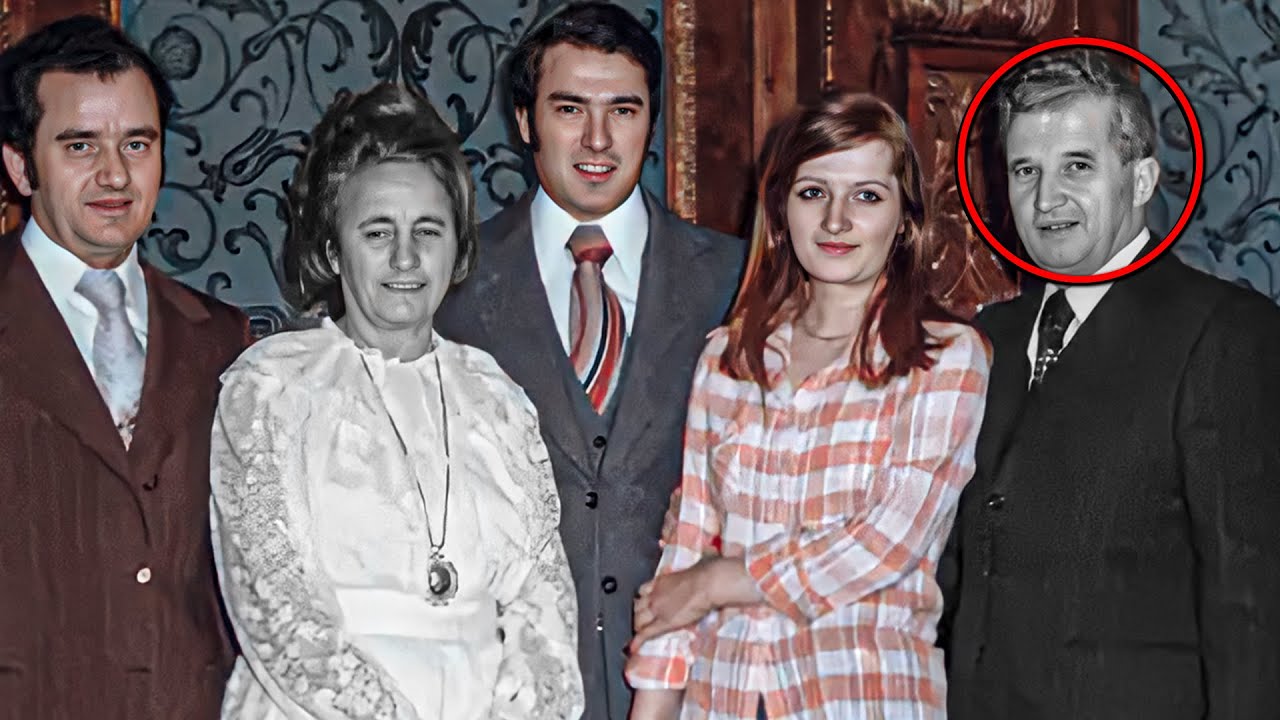
In 1970, he returned to Romania already graduated and began working as a physicist. He led a discreet life, far from the spotlight that surrounded his family.
Also in 1970, Valentin married Iordana Dana Borila, the daughter of Petre Borila, one of the leading members of the Romanian Communist Party. The union was not well received by the families, especially by Nicolae and Elena, who had political disagreements with Borila.
This disagreement created a tense environment between the two clans, and over the years their differences deepened. The marriage ended in 1988, shortly before the collapse of the communist regime.
From that relationship came Daniel Ceaușescu, who inherited his father's interest in science and became a physicist. After the revolution that overthrew Nicolae's government, Dana and Daniel emigrated to Israel and later settled in the United States.
When the Romanian Revolution broke out in December 1989, Valentin was detained along with other members of the Ceaușescu family. While his parents were subjected to a summary trial and later executed, he remained imprisoned for nine months without any formal charges.
During that period, he lost his extensive art collection, which included about 50 paintings by renowned Romanian artists, rare engravings by Francisco Goya, and a valuable library with hundreds of historical books. The government confiscated the assets, claiming they belonged to the state, and sent much of the collection to the National Museum of Art.
After years of legal dispute, Valentin managed to recover part of the paintings in 2009, when a court ruled in his favor and ordered the restitution of 40 of them.
After his release, Valentin avoided any involvement in politics and returned to his scientific career. He worked at the Horia Hulubei National Institute of Physics and Nuclear Engineering in Măgurele, where he devoted himself to nuclear physics research.
Keeping away from the spotlight, he chose a reserved life focused exclusively on his work. In 1995, he married again, this time to Roxana Duna, with whom he had a daughter, Alexandra, who pursued a career in architecture.
In 2016, Valentin retired and received a modest pension. Unlike the trajectory of his parents and siblings, he built a life marked by discretion and distance from politics. He currently lives quietly on a property belonging to his wife's family, avoiding any public exposure.
Valentin thus became a singular figure in the family's history, a member who, despite his surname, chose a path without ambitions for power.
Zoia Ceaușescu, the second child of Nicolae and Elena, was born on February 28, 1949, at a time when her family was beginning to consolidate its influence in the Romanian Communist Party. From childhood, she stood out as an exceptional student, showing great skill with numbers and a strong interest in mathematics.
This path set her apart from her parents and from the political environment around her. As a young woman, she studied at Secondary School No. 24, later renamed the Jean Monnet Secondary School in Bucharest.
In 1966, she completed high school and in the same year entered the Faculty of Mathematics at the University of Bucharest. Her academic talent did not go unnoticed, and over the years she became one of the most promising students in her course.
In 1977, she earned her doctorate with an innovative thesis titled "On Intertwined Dilations," under the guidance of the renowned mathematician Ciprian Foias. Her field, functional analysis, was a highly abstract and complex area focused on vector spaces and their theoretical and practical applications.

Zoia began her career as a researcher at the Institute of Mathematics of the Romanian Academy in 1974. However, her desire to pursue a purely scientific path was not well received by her parents, who expected their children to play more strategic roles within the regime.
As a consequence of that dissatisfaction and of Nicolae's authoritarian view of control over academic institutions, the institute was dissolved in 1975. Zoia was then transferred to the Institute for Scientific and Technical Creativity, where she founded and led a new mathematics department.
Despite the adversity, her work was recognized. In 1976, she received the prestigious Simion Stoilow Prize, one of the most important awards in Romanian mathematics.
Unlike her parents and her younger brother, Nicu, Zoia never became directly involved in politics. Her focus was always research and academic life, and she maintained a discreet stance even as the daughter of the country's leader.
In 1980, she married Mircea Oprean, an engineer and professor at the Polytechnic University of Bucharest. The couple led a reserved life, far from political events and the extravagances typical of the regime's elite.
The fall of Nicolae's government at the end of 1989 drastically changed Zoia's trajectory. During the Romanian Revolution, she was arrested along with her brothers Valentin and Nicu, accused of undermining the nation's economy.
Despite the seriousness of the accusations, there was no concrete evidence against her. After eight months of detention, she was released in August 1990. Freedom, however, did not bring the tranquility Zoia had expected.
Nicu Ceaușescu, the youngest son, was born on September 1, 1951. He grew up as the youngest child of the couple who ruled Romania with an iron hand.
Unlike his siblings who pursued academic careers, Nicu was raised with the expectation that he would succeed his father. From an early age, he was prepared to take control of the country.
While the Romanian population faced deprivation, food rationing, and a quality of life deteriorated by the regime, he lived a life of ostentation, surrounded by luxury and excess.
From his youth, Nicu showed little interest in his studies and an irresponsible attitude, but this did not stop him from advancing in his political career. After finishing high school at Lyceum No. 24, now called Jean Monnet, he entered the University of Bucharest to study physics.
His name, however, did not stand out in academia but in the structure of the Communist Party. His involvement in the Union of Communist Youth ensured his rapid rise, and he became the organization's first secretary.
Over the years, he held increasingly high positions. He was named minister for youth affairs and later elected to the Central Committee of the Romanian Communist Party.
In 1982, his position within the government grew even stronger when he was appointed to lead Sibiu County, a clearly strategic move by his parents to consolidate him as the regime's political heir.
Outside politics, Nicu was known for scandalous behavior. Surrounded by influential friends and controversial figures, he had relationships with celebrities, including gymnast Nadia Comăneci and soprano Daniela Vlădescu.

His fame, however, was marked by stories of abuse, alcoholism, and a life of excess. Ion Mihai Pacepa, a former Securitate officer who defected to the United States, reported that Nicu was protected by his father even in the face of serious crimes, including rapes and assaults.
His destructive behavior knew no limits. Reports indicate that he maintained a close relationship with Uday Hussein, the son of dictator Saddam Hussein, sharing extravagant parties in places such as Monaco and Switzerland, where they gambled large sums of money.
The collapse of the regime in December 1989 drastically changed his reality. On December 22, with the revolution underway and the government crumbling, Nicu was captured by revolutionaries.
His arrest was broadcast on state television, where he appeared handcuffed and visibly worn down. Accused of corruption, embezzlement of public money, and even of holding children as hostages, he faced a highly politicized trial.
There are reports that before his sentence was handed down, he was tortured in prison and forced to watch footage of his parents' execution.
Of the dictator's children, the only one who truly found relative peace and went on to live quietly was Valentin. After the 1989 revolution and the months she spent in prison, Zoia faced great difficulties in rebuilding her life.
Prevented from resuming her scientific career and deprived of much of her property, she and her husband, Mircea Oprean, spent years struggling against the hostility of the new government and society.
Her health began to deteriorate, worsened by stress and by her habit of chain-smoking. In 2000, she was diagnosed with lung cancer, a disease that advanced quickly and further weakened her already difficult condition.
In her final years, Zoia remained reclusive, avoiding public appearances and giving up the fight for the right to be reintegrated into academia. On November 20, 2006, she died at the age of 57. Her body was cremated at the Cenusa crematorium, an emblematic site in the Romanian capital.
Thus ended the trajectory of a woman who, despite her efforts to forge an independent path, was never fully able to break free from the legacy of her parents.
The fate of her younger brother, Nicu, was equally tragic. Sentenced to 20 years in prison for corruption and abuse of power, he remained incarcerated for only two years and was released in 1992 for medical reasons, with the intervention of lawyer Paula Iacob.
Life outside prison, however, brought no redemption. Without the privileges he had once enjoyed, Nicu sank even deeper into alcoholism, accelerating the progression of liver cirrhosis that was already weakening his body.
With his health in critical condition, he was transferred in 1996 to a hospital in Vienna, Austria, where he received intensive treatment. His condition, however, was irreversible, and on September 25 of the same year he died at the age of 45.
His body was repatriated to Romania and buried in the Ghencea cemetery, the same place where his parents were buried. Nicu's trajectory became a symbol of the downfall of the Romanian communist elite.
Raised to be the successor of an authoritarian regime, he never showed the preparation or ability to govern. The rise that had seemed inevitable collapsed along with the system that sustained it, and his life ended as a reflection of his family's decline, marked by excess, decadence, and a fate sealed by the weight of a past from which he could never escape.