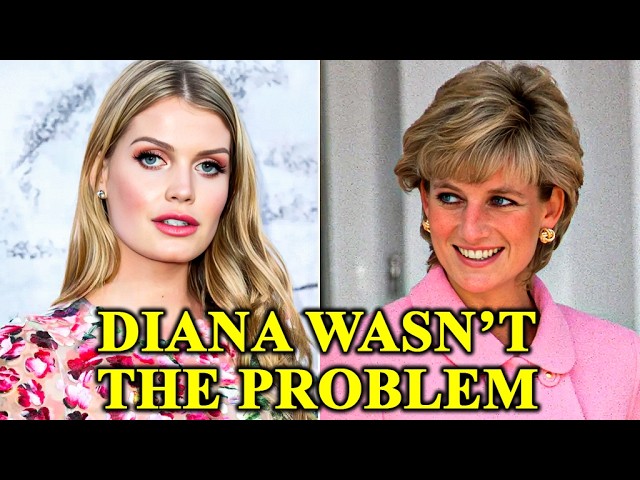
Lady Kitty Spencer could have built an entire career by claiming to remember secrets about Princess Diana. Publishers would have paid. Television producers would have cleared their schedules. She had the family name, the private connection, and a face that often reminded people of the woman they had never stopped mourning.
Yet when Kitty finally spoke about Diana, she refused to give the public the revelation it expected. She admitted that she had only a few memories of her aunt. They were precious. They were happy. And she intended to keep them that way.
It was a simple answer, but it exposed something uncomfortable. The world did not merely miss Diana. It felt entitled to her.
Lady Kitty Eleanor Spencer was born in London on December 28, 1990, into a family that had already spent centuries learning how to survive privilege, scandal, money, marriage, and the occasional relative who made all four more difficult at once.
Her father was Charles Spencer, the younger brother of Diana, Princess of Wales. Her mother was Victoria Lockwood, a successful model whose beauty had made her familiar to fashion editors before marriage connected her to one of Britain's most prominent aristocratic families.
Kitty entered the world with a title waiting for her, although not an inheritance. At that time, her father was still Viscount Althorp, the heir to the Spencer earldom. His father, John Spencer, was the 8th Earl Spencer and the owner of Althorp House in Northamptonshire.
The property had belonged to the Spencers for nearly five centuries. It contained grand rooms, historic paintings, valuable furniture, thousands of acres, and enough maintenance problems to make an ordinary mortgage seem restful.
Althorp looked like wealth because it was wealth. It also behaved like an enormous machine that consumed money whether anyone was enjoying it or not. The roof required attention. The grounds required staff. The artwork required security and conservation.
An ancestral home could make its owner appear richer than a banker while leaving him worried about the heating bill. Kitty was born into that contradiction. She belonged to a family with land, history, connections, and prestige. Yet nearly every privilege came with a condition attached.
The greatest condition concerned succession. Under the inheritance rules governing the Spencer title, the earldom and Althorp would pass through the male line. Kitty was Charles and Victoria's first child, but she could not become Countess Spencer in her own right.
If a son was born later, he would become the heir even if Kitty were older, more experienced, or better suited to managing the estate. The arrangement was not personal. That was how old families often defended arrangements that were extremely personal.
For the moment, however, Kitty was simply the first grandchild of the new generation, born at a time when the Spencer family appeared to have reached extraordinary heights. Her aunt Diana was the Princess of Wales, married to Prince Charles and mother to Prince William and Prince Harry.
William was 8 years old when Kitty was born. Harry was six. The young princes were already among the most photographed children in the world. To the public, Diana still occupied the center of a magnificent royal story.
She attended state occasions, opened hospitals, wore beautiful gowns, and appeared beside the future king. Her image traveled across newspapers and magazines from London to New York, Sydney, Toronto, and beyond.
Inside the marriage, the story was far less magnificent. By 1990, Diana and Charles were living emotionally separate lives. His attachment to Camilla Parker Bowles had not disappeared. Diana felt isolated, watched, and increasingly determined to establish an identity beyond the palace.
Their unhappiness was not yet fully public, but it had entered the dangerous stage in which almost everyone close to them knew, while millions of strangers were still expected to admire the photographs.
That was the family world into which Kitty arrived. Diana was no ordinary aunt. She could not appear at a christening, lunch, or family visit without attracting attention. A private afternoon could become a newspaper photograph by evening.
Yet within the Spencer family, she remained a sister, a daughter, and an aunt. She could laugh, tease, complain, and retreat from royal formality. The family knew parts of her that crowds could not see, but even they were losing control over which parts remained private.
Kitty later remembered very little in precise detail. She was only a small child during the years when Diana was alive, but she remembered warmth. She remembered happiness. She understood that those fragments belonged to a real relationship, not to the commercial industry that grew around Diana after her death.
The public often imagined that every relative of Diana possessed a locked room filled with untold stories. In reality, families do not experience one another as biographies. Children do not memorize conversations because an aunt might later become a historical icon.
They remember a voice, a smile, a feeling, or the excitement of someone entering the room. A child does not know when history is visiting for lunch.
Kitty's parents were still a young couple when she was born. Charles Spencer was 26. He had studied at Eton and Oxford and had worked in broadcasting and journalism. He was articulate, ambitious, and deeply aware of the responsibilities waiting for him at Althorp.
He was also a product of a difficult childhood. Charles and Diana had grown up in a family marked by separation. Their mother, Frances, left their father when the children were young. A painful custody battle followed.
John Spencer later married Raine, Countess of Dartmouth, a woman his children disliked so intensely that family gatherings sometimes acquired the atmosphere of a minor civil war conducted with excellent table manners.
Diana and Charles shared a close bond, but closeness did not mean simplicity. They had both known abandonment, family conflict, and the pressure of the Spencer name. Diana responded by seeking emotional reassurance. Charles often responded by defending the family legacy and his own sense of duty.
Victoria Lockwood came from a different environment. She had worked in fashion, where beauty was an asset but also a form of employment. She understood being looked at, judged, styled, and photographed.
Her marriage to Charles in 1989 had attracted considerable attention. The bride was striking. The groom was Diana's brother. And the setting offered the sort of aristocratic romance that magazines could describe without mentioning the future legal fees.
Within little more than a year, Victoria was a mother. She had married into an old family, entered a demanding social world, and became connected to the most famous woman in Britain. Kitty's arrival brought joy, but it also increased the pressure on a marriage that had not been given much time to settle.
In March 1992, John Spencer died. Charles became the ninth Earl Spencer at the age of 27. With the title came Althorp, its history, its assets, its expenses, and the responsibility of protecting the estate for the next generation.
Kitty was 15 months old when her father became an Earl. She became Lady Kitty Spencer, the daughter of an Earl and the eldest child in the family line, but she was still not the heir.
Charles now had to operate as the custodian of an estate that had survived wars, political upheaval, changing governments, and generations of Spencers with varying degrees of financial discipline. Althorp was not merely his home. It was a business, a historical property, and the physical symbol of the family name.
The inheritance arrived at the same moment that Diana's marriage began collapsing in public. In June 1992, Andrew Morton published "Diana: Her True Story." The book described Diana's loneliness, bulimia, unhappiness, and attempts to harm herself. It also revealed the destructive presence of Camilla Parker Bowles in the royal marriage.
Diana had secretly provided answers through recorded interviews passed to Morton by an intermediary. Her participation remained hidden at first, allowing the book to appear as an astonishingly informed account rather than a direct act of rebellion.
For the Spencers, the crisis was deeply personal. Diana was not simply a royal figure making headlines. She was Charles's sister and Kitty's aunt. Her sons were members of the royal family, but they were also children whose parents were fighting under the gaze of the world.
In July 1992, Victoria gave birth to twin daughters, Lady Eliza and Lady Amelia. Kitty, still not yet two, suddenly became the eldest of three girls. The sisters were close in age and would later appear together at family occasions, fashion events, and society weddings.
But their early childhood was not built around glamorous photographs. It was shaped by the ordinary chaos of several young children living inside an extraordinary family. There were nurseries, nannies, meals, illnesses, toys, and bedtime routines. There were also reporters outside gates, difficult telephone calls, and adults who knew that one member of the family could dominate tomorrow's front page without saying a word.
Children often learn the emotional rules of a household before they understand the events causing them. They notice when a parent becomes tense after a phone call. They notice when a name changes the mood.
Kitty grew up hearing the name Diana in two completely different ways. Inside the family, Diana was a person. Outside it, Diana was an international possession.
In December 1992, the separation of the Prince and Princess of Wales was announced in Parliament. Kitty was almost two. She could not understand what had happened, but her family's private troubles had officially become part of British public life.
Diana continued royal duties and charity work. She remained one of the most famous women in the world. She was still the mother of a future king. But she was now operating separately from her husband and trying to shape a life that did not depend on palace approval.
Her work became increasingly personal. She visited hospitals, shelters, and organizations supporting people who were often ignored or feared. She had already transformed public attitudes toward people with acquired immune deficiency syndrome by touching patients without gloves at a time when many still believed casual contact could spread the illness.
She also became connected to Centrepoint, a charity supporting homeless young people. Years later, that cause would become an important bridge between Diana, Prince William, and Kitty. William would become a patron. Kitty would serve as an ambassador.
But Kitty was too young to understand that legacy while Diana was alive. She knew the woman before she understood the cause. This is what later made questions about Diana so difficult for her.
Interviewers often wanted Kitty to speak with the authority of an adult witness. They saw the family connection and forgot the age difference. Kitty had been a baby when Diana's marriage began publicly disintegrating. She was five when the Panorama interview aired. She was six when Diana died.
What Kitty possessed was smaller and therefore more honest. She had memories of affection.
By 1993, the relationship between Charles and Victoria Spencer was deteriorating. Both were under strain. Victoria had struggled with an eating disorder and later faced serious problems involving alcohol and drugs. Charles carried the pressure of the estate, the family title, and his own emotional history.
In March 1994, Victoria gave birth to a son, Louis. Kitty was 3 years old. Louis's arrival changed the legal future of the family immediately. He became Viscount Althorp and the heir to the earldom.
Although Kitty was the eldest child, the title and estate would now pass to her younger brother. No one had to decide who was more capable. He was a baby. The old rules had already decided.
Kitty would later speak about the succession without bitterness. She understood that Althorp was tied to the earldom and expected to remain within the male line. Her response was graceful, but the arrangement still revealed the peculiar logic of aristocratic inheritance.
The system preserved Althorp intact by concentrating its future in one child. It avoided dividing the property, but it also meant that the daughters had to build lives elsewhere.
Charles and Victoria's marriage was coming apart, and the British press showed little interest in allowing the children to grow up quietly. The Spencer connection to Diana made privacy almost impossible.
Charles and Victoria began considering a move to South Africa. Cape Town offered distance from the British press, a different pace of life, and a place where the children might grow up without being constantly measured against royal relatives.
For Kitty, the move would become one of the defining decisions of her childhood. It placed an ocean between her daily life and the world that had made her surname famous. She would grow up with sunshine, outdoor space, school friends, and a degree of normality that would have been difficult in Britain.
By 1995, Diana's conflict with the royal family had reached a new level. She gave her interview to the Panorama program and spoke openly about her marriage, her mental health, and Charles's relationship with Camilla. Her statement that there had been three people in the marriage became one of the most famous remarks of the decade.
To Kitty, she was still Aunt Diana. That was the truth public debate repeatedly buried. A person could be a constitutional problem in one building and a beloved relative in another.
The Spencers moved to Cape Town near the end of 1995. Kitty was about to turn five. Her sisters were three. Louis was one. The relocation was supposed to offer protection and stability, but the marriage had already deteriorated too far.
Charles soon returned to Britain while Victoria and the children remained in South Africa. The family now existed across two continents. Kitty's father had Althorp, the title, and the obligations of the estate. Her mother had the children's daily lives in Cape Town.
In August 1996, the marriage of the Prince and Princess of Wales formally ended. Diana received a substantial financial settlement, reported to be around 17 million pounds, along with annual support for her private office. She lost the style of Royal Highness but remained Diana, Princess of Wales.
Kitty was 5 years old when the divorce was completed. She was living far away in Cape Town, surrounded by the breakdown of her own parents' marriage, while her aunt's divorce occupied television screens around the world.
On the final night of August 1997, the telephone rang in Cape Town with the kind of news that divides a life into before and after. Diana, Princess of Wales, had been critically injured in a car crash in Paris. Within hours, she was dead.
Lady Kitty Spencer was 6 years old. At that age, death is difficult enough to understand when it comes quietly. Diana's death came with television helicopters, newspaper banners, crowds outside palaces, flowers piled against gates, and adults speaking in voices that suggested the entire world had become unsafe overnight.
The crash happened shortly after midnight on August 31. Diana had been traveling through Paris with Dodi Fayed after leaving the Ritz Hotel. Their car entered the Pont de l'Alma tunnel at high speed while being followed by photographers. The driver, Henri Paul, lost control.
Dodi and Henri Paul died at the scene. Diana was taken to hospital, where doctors tried to save her, but her injuries were too severe. She was 36.
In Britain, the news spread before dawn. People woke to radio bulletins and stared at television screens in disbelief. Diana had seemed too visible to die. Her face had become part of the public landscape, familiar enough to create the illusion of permanence. Her death shattered that illusion.
For the Spencer family, there was no distance between the headline and the loss. The woman being mourned by strangers was their sister, daughter, aunt, and mother.
Charles Spencer was in South Africa when the news reached him. He had to make immediate decisions while grief was still too fresh to have shape. He traveled to Paris with his elder sisters, Lady Sarah McCorquodale and Lady Jane Fellowes, to bring Diana home.
In Cape Town, Kitty and her siblings were protected as much as possible from the press. Their mother, Victoria, had to explain that Aunt Diana would not be coming back.
Millions of people felt they knew Diana because they had watched her life unfold through photographs and interviews. Kitty knew her in the opposite way. She had experienced small private moments but lacked the adult knowledge that the public later demanded from her. The world knew the chronology. Kitty knew the feeling.
In London, grief quickly became anger. Crowds gathered outside Kensington Palace and Buckingham Palace. Flowers covered pavements. Some mourners blamed the photographers who had pursued her. Others blamed the royal family for the unhappiness that had defined her final years.
Queen Elizabeth II and the royal family were at Balmoral in Scotland with William and Harry. The Queen's first concern was the boys who had lost their mother at 15 and 12. Yet the public saw only silence and absence.
Charles Spencer was grieving, too, but he was also preparing to defend his sister's memory. He had long believed that Diana had been badly treated by parts of the royal establishment and press. Her death hardened that belief.
The funeral took place on September 6, 1997, at Westminster Abbey. More than a million people lined the streets of London. Hundreds of millions watched around the world. The coffin traveled from Kensington Palace on a gun carriage.
William and Harry walked behind it with Prince Charles, Prince Philip, and Charles Spencer. The sight of the two boys became one of the defining images of the day. They were expected to walk with solemn dignity before an audience larger than most adults could imagine.
Inside the Abbey, Charles Spencer delivered the speech that would define his place in Diana's story. He described Diana as the very essence of compassion, duty, style, and beauty. He spoke of her vulnerability and her instinctive connection with people in distress. He criticized the media pursuit that had followed her.
Most powerfully, he promised that Diana's blood family would protect William and Harry so that their souls would not be immersed by duty and tradition. The words struck the congregation with the force of an accusation. Applause rose from the crowds outside the Abbey.
The funeral ended, but the family still had to bury Diana. Her coffin was taken to Althorp, the house where she had spent part of her youth. She was laid to rest on an island in the middle of the Round Oval, an ornamental lake on the estate.
Diana's final resting place now lay at the center of Kitty's ancestral home. This changed Althorp permanently. Before 1997, it was known as the seat of the Spencer family, a historical estate filled with art and inherited memory. After Diana's burial, it became a place of pilgrimage.
For Charles, this created both responsibility and controversy. Maintaining Althorp was expensive. Managing the site of Diana's burial required security, staff, preservation, and careful control over public access. The estate opened an exhibition devoted to Diana and allowed visitors during the summer.
Admission charges helped support charitable work and the maintenance of the estate, but critics accused the family of profiting from her memory. The accusation was simple. The reality was not.
Kitty grew up watching that argument unfold around her family home. To outsiders, Althorp became Diana's resting place. To Kitty, it remained the house connected to her father, the Spencer history, her brother's future inheritance, and childhood visits from South Africa.
The death also intensified interest in Kitty and her sisters. Photographers and magazine editors noticed the Spencer girls as possible successors to Diana's beauty and glamour. Even as children, they were described in relation to their aunt.
The resemblance became more pronounced as Kitty grew older. She had fair hair, blue eyes, and features associated with the Spencer family. Each new photograph encouraged another comparison. People often meant it as praise. But resemblance to a dead icon is not a simple compliment. It can become an assignment.
For the moment, her mother kept the children's lives centered in Cape Town. South Africa gave them space that Britain could not. Kitty attended school, spent time outdoors, and lived among people who were less impressed by aristocratic titles.
Meanwhile, Charles and Victoria's marriage ended in a bitter divorce. The proceedings included painful allegations about both parents. Victoria's struggles with addiction and an eating disorder became public. Charles faced accusations about his own behavior during the marriage.
Kitty and her siblings were caught between two adults whose private failures were being examined in public. This was another lesson she would carry into adulthood. When a prominent family breaks apart, children do not merely experience the separation. They inherit the published versions of it.
Kitty remained close to her mother. Victoria's difficulties were serious, but she was also the parent who raised the children day-to-day in South Africa. The relationship between mother and daughter became central to Kitty's emotional life.
Kitty's younger sisters, Eliza and Amelia, became her closest companions. The twins shared the same unusual childhood divided between countries and shaped by a famous family tragedy. Louis occupied a different position. He was their younger brother and the future Earl Spencer.
Their closeness gave Kitty stability. She was the eldest, but only by a small margin. She did not grow up alone beneath a family name. She had siblings who understood the contradiction of being publicly privileged and privately unsettled.
As Kitty moved toward adolescence, she became increasingly aware of Diana's meaning beyond the family. Diana was no longer only remembered as a princess trapped in an unhappy marriage. Her image had expanded. She represented compassion, glamour, rebellion, motherhood, vulnerability, and resistance to rigid institutions.
Different people claimed different Dianas. Some remembered the shy young bride. Some remembered the wounded wife. Some remembered the humanitarian walking through an active minefield in Angola. Some remembered the glamorous woman photographed in evening gowns. Some remembered the mother embracing her sons.
Kitty had to find a way to live beside that legend without becoming part of its machinery. Her silence was not indifference. It was self-preservation.
As a teenager, she began developing her own identity. She was academically serious, sociable, and increasingly interested in psychology, politics, and history. These interests were not surprising. She had grown up inside a family where motives, institutions, reputation, and emotional damage were impossible to ignore.
Kitty completed her schooling in South Africa and later attended the University of Cape Town, where she studied psychology, politics, and English. The decision reflected a desire for substance as well as independence. She understood that beauty could open doors, but it did not guarantee control over what happened after entering.
During university, she remained connected to Britain and Althorp, but her daily life was still rooted in South Africa. She had friends, studies, and a social world that did not revolve entirely around Diana. This distance helped her form a self before the international fashion industry began asking whether she looked like her aunt.
At Althorp, her father continued managing the estate and the Diana Memorial. He also rebuilt his personal life. In 2001, Charles married Caroline Freud, the former wife of public relations executive Matthew Freud. The marriage produced two more children, Edmund and Lara.
Kitty now had younger half-siblings in Britain, while she and her full siblings remained based largely in South Africa. The Spencer family tree was becoming more complicated, but complication was hardly new territory. Charles and Caroline's marriage would later end, adding another public divorce to the family history.
As she approached adulthood, one question waited for her. Would Lady Kitty Spencer remain a private young woman with a famous name, or would she enter the world that had been waiting to photograph her since childhood?
The answer began quietly. She appeared in society magazines and attended selected public events. Editors noticed not only the Spencer resemblance but her confidence, height, and ease before a camera. The comparisons to Diana returned immediately.
After completing her degree at the University of Cape Town, Kitty continued her education in Europe. She studied art history and Italian in Florence, then later pursued work connected to luxury brand management in London.
These choices were revealing. Psychology taught her to examine people. Politics taught her to examine institutions. Art history taught her to examine beauty. Luxury management taught her what happened when beauty, history, and money were placed in the same shop window.
In 2009, when Kitty was 18, she appeared with her sisters Eliza and Amelia on the cover of a British society magazine. The image formally introduced the Spencer daughters as young women. The cover attracted attention because the sisters combined beauty with family mythology.
After university, she spent more time in London and became increasingly visible. She worked with charities, attended cultural events, and explored opportunities in fashion. She also faced the ordinary uncertainty of a young woman whose family name made every decision look more deliberate than it really was.
The pressure became stronger because Kitty did not inherit a fixed public role. William had a constitutional future. Harry had royal duties. Louis would inherit Althorp and the earldom. Kitty had to create her own position.
In 2015, Kitty signed with a major modeling agency. She was in her mid-20s, older than many women entering the industry. This did not make her a late arrival in any meaningful sense, but fashion has a peculiar relationship with age.
Kitty entered with advantages few models possessed. She already understood photographers. She had access to designers. Her name attracted publicity. She could move comfortably among wealthy clients because she had grown up around the kind of people luxury companies hoped would buy several versions of the same coat.
Yet the name also created suspicion. Critics could dismiss her success as the result of birth. Any campaign might be described as another example of aristocratic privilege. Her appearance could be evaluated against Diana rather than against the demands of the work.
She proved reliable, polished, and easy to present. She understood the ceremony of luxury fashion. She knew that a designer was not merely selling a dress. The designer was selling entry into a world where the wearer appeared richer, calmer, and less likely to have ever chased a bus.
Her body did not match the extremely thin shape long demanded by much of the fashion industry. She had a fuller, more traditionally feminine figure. This became part of her appeal and also exposed her to scrutiny.
Kitty had seen the damage caused by eating disorders within her own family. She understood that appearance could become dangerous when treated as a permanent examination. Her mother, Victoria, had lived within the modeling world and suffered severe personal struggles. Diana had also experienced bulimia during the most difficult years of her royal marriage.
For Kitty, body image was not an abstract cultural discussion. It belonged to family history. She did not present herself as a revolutionary. She did not attack the industry that employed her. But her presence carried a quieter message.
Her relationship with her father also continued to shape her public life. Charles Spencer remained a commanding figure. He was intelligent, articulate, and skilled at telling history. He had rebuilt Althorp as both a family estate and a public destination.
His marriage to Caroline Freud ended in 2007. The divorce was painful and public. Charles later formed another relationship and eventually married Karen Gordon in 2011. By then, Kitty had watched her father move through three marriages.
Her bond with Eliza and Amelia remained particularly important. The three sisters shared the same childhood, the same parents, and the same experience of being connected to Diana without having been old enough to know her as adults. Together, they could remember without explanation.
Her growing status attracted luxury brands. Among the most important was Dolce & Gabbana. The Italian fashion house specialized in dramatic femininity, rich decoration, religious imagery, laces, bows, flowers, crowns, and clothing that rarely entered a room quietly.
Its design suited Kitty. She had the presence to carry elaborate gowns without disappearing beneath them. She also possessed the aristocratic image that luxury brands could use without explanation.
She appeared in campaigns, walked in shows, and became closely associated with the house. The designers presented her not as a distant mannequin but as part of their extended fashion family.
Her public rise also allowed her to expand her charitable work. She became involved with Centrepoint, the organization that had been supported by Diana and later by Prince William. The charity worked with homeless young people, helping with housing, education, training, and support.
Her involvement with Centrepoint could easily have become a decorative role, another attractive guest attending a dinner. Instead, she spoke seriously about the work and used her public profile to support fundraising.
By 2017, Kitty had become a recognized figure in international fashion. She attended major events, worked with luxury houses, and appeared in magazines across Europe. Her life looked glamorous because much of it was glamorous.
Then in 2018, an invitation arrived that would place Kitty before one of the largest audiences of her life. Prince Harry was going to marry Meghan Markle at Windsor Castle. The wedding would unite the royal family, the Spencer relatives, Hollywood celebrities, political figures, and a global television audience.
On May 19, 2018, Lady Kitty Spencer stepped into the grounds of Windsor Castle wearing a deep green dress covered with hand-painted flowers, a matching hat, and a diamond necklace substantial enough to require its own security briefing.
She had come to watch her cousin Prince Harry marry Meghan Markle in St. George's Chapel. Yet before she reached her seat, photographs of her were already moving around the world.
The reaction was immediate. Viewers wanted to know who she was, who had designed the dress, why she looked familiar, and whether the resemblance to Princess Diana was real or simply the result of grief searching for a face.
The dress was dramatic without being unsuitable. Its fitted bodice was elegant, while the painted flowers across the skirt gave it the appearance of a formal English garden that had learned Italian.
The necklace came from Bulgari, the Roman jewelry house with which Kitty was developing an important relationship. It featured diamonds and colored stones arranged with the sort of confidence available only to jewelry that has never needed to ask the price of anything.
The entire appearance turned Kitty into one of the most discussed guests at the wedding. Her number of followers rose sharply. Fashion publications praised her. Newspapers introduced her to readers who had somehow reached 2018 without learning the names of Diana's nieces.
This was a breakthrough, but it came during a deeply emotional family occasion. Harry was marrying without his mother. Diana had once dreamed of seeing her sons become adults, choosing partners, and building homes of their own.
Lady Jane Fellowes gave a reading during the ceremony. The choice carried quiet meaning. Jane was Diana's elder sister and Harry's aunt. Her presence placed the Spencer family within the service without turning the wedding into a memorial.
Kitty handled the attention with ease. She did not offer interviews about Harry's childhood. She did not discuss Meghan. She did not claim that Diana would have approved of one detail or disliked another. She attended as a cousin.
Within days, Kitty's fashion value had risen. Designers knew that she could attract global attention without creating scandal. Luxury companies found the combination unusually attractive. Scandal may generate headlines, but it is troublesome when selling jewelry.
Bulgari named Kitty a brand ambassador. The partnership suited both sides. Bulgari possessed more than a century of Roman history, a reputation for bold colored stones, and clients who liked their elegance with a little evidence.
Kitty brought aristocratic lineage, international recognition, and an ease with jewelry that did not look newly learned. She did not wear magnificent pieces as though someone had handed them to her five minutes earlier with a warning not to breathe.
The arrangement also gave Kitty independent income and professional standing. The exact value of her contracts remained private, but international ambassador roles could be highly lucrative. Kitty was no longer merely benefiting from inherited status. Her image had become a commercial asset in its own right.
After the Windsor wedding, Kitty's schedule became busier. She appeared at fashion weeks, charity events, jewelry launches, private dinners, and society celebrations across Europe and the United States. She walked for Dolce & Gabbana and became a familiar presence at the designers' lavish events.
Still, every success reopened the old argument about privilege. Critics pointed out that an unknown young model from Cape Town would not have received the same opportunities. They were correct. Kitty's name, appearance, and connections opened doors. But open doors do not guarantee a lasting career.
Her growing fame also increased scrutiny of her private life. Photographers followed her outside restaurants and hotels. Society reporters studied the men standing near her at parties. Any wealthy bachelor appearing twice in the same room could become a possible romance.
In 2018, while her public career was accelerating, she began a relationship with Michael Lewis. He was a South African-born businessman who had spent decades in finance and fashion retail. He had studied at the University of Cape Town, later moved to Britain, and became chairman of a major clothing retail group.
He came from a prosperous business family and had built a substantial fortune through investments, retail holdings, and company leadership. He was also more than 30 years older than Kitty.
The age difference became the central feature of almost every article once the relationship was discovered. Michael was older than Kitty's father by several years. He had been married before and had three adult children.
Both had strong connections to South Africa. Both understood the fashion business. Both moved comfortably between London and international social circles. Both valued privacy. Michael possessed the calm and established life Kitty had repeatedly said she wanted.

Kitty had grown up surrounded by emotional instability. Her parents' marriage had collapsed. Her father's later marriages had also ended. Diana's royal marriage had become one of the most famous failures of the century. It was not surprising that Kitty might value steadiness more than romantic theater.
The comparison with Diana was unavoidable, but the differences were striking. Diana had become engaged to Prince Charles at 19 after a brief courtship. She entered a marriage shaped by royal duty, succession, public expectation, and the urgent requirement for heirs.
Kitty was approaching 30. She had an education, a career, independent public standing, and years of experience observing damaged marriages. She could choose without an institution arranging the consequences.
During interviews, Kitty spoke more comfortably about the future in general terms. She wanted a happy home, a happy marriage, and children. These ambitions sounded traditional, but in her family they were almost radical. The Spencer women had often possessed beautiful homes. Happiness inside them had proved less dependable.
In 2019, Kitty's public profile reached another level. She appeared in major magazines and campaigns, often described as a modern aristocrat balancing fashion with philanthropy. She remained firm when questions moved toward William, Harry, or their wives. She would not discuss her royal cousins out of respect.
By late 2019, Michael had decided to propose. Around Christmas, Kitty was seen wearing a large diamond ring. Reports soon spread that the couple were engaged. The engagement became public in January 2020. Kitty was 29. Michael was in his early 60s.
Michael was Jewish. Kitty had been raised within the Church of England tradition associated with her aristocratic family. Reports suggested that she was studying Judaism and considering conversion.
Wedding planning began. Given Kitty's relationship with Dolce & Gabbana, fashion would play a major role. Italy offered history, beauty, and distance from the British royal stage. Then, within weeks, the world closed.
In early 2020, the coronavirus spread across countries and continents. Flights stopped. Events were canceled. Fashion houses closed workshops. Weddings were postponed. Kitty and Michael's wedding plans had to wait.
The delay stripped away the spectacle before it could begin. There would be no immediate society celebration, no parade of couture, and no public conclusion to the engagement story. Instead, the couple entered the long uncertainty of lockdown.
At the same time, Harry and Meghan stepped back from royal duties and moved toward a new life outside Britain. Their decision caused a family crisis and revived the most painful questions surrounding Diana. Kitty offered no public judgment.
When the Italian workshops reopened, discussions with Dolce & Gabbana resumed. Sketches became fabrics. Fabrics became fittings. The wedding dress began to take shape with high lace, long sleeves, covered buttons, and the formality of another century.
The wedding finally took place on July 24, 2021, at Villa Aldobrandini in Frascati, a hill town outside Rome. The gardens descended in formal terraces, and the building itself appeared to have been designed by someone who considered modesty a temporary architectural error.
Kitty wore a high-neck lace gown created by Dolce & Gabbana. It had long sleeves, a fitted bodice, a full skirt, covered buttons, and a veil that flowed behind her through the Italian heat. The design drew inspiration from the Victorian period, but it did not feel like a costume.
Diana's wedding gown had been enormous, romantic, and instantly recognizable. It had reflected the expectations placed upon a 19-year-old bride entering the royal family. Kitty's gown carried a different message. She was not entering a public institution. She was not marrying to produce an heir for a monarchy.
Dolce & Gabbana created a complete wardrobe for the wedding celebrations, including a blue tulle gown decorated with flowers, a green and white dress, a gold embroidered design, and other elaborate pieces for the surrounding events.
The celebrations were glamorous, but one absence immediately attracted attention. Charles Spencer did not attend his eldest daughter's wedding. He had spoken shortly before the event about a painful shoulder injury, but the absence still produced speculation.
Kitty did not publicly attack her father. She was escorted by two of her brothers, Louis Spencer and Samuel Aitken. Louis was her younger full brother and the heir to Althorp. Samuel was her younger half-brother through her mother's later relationship.
Her mother, Victoria, was there. Her sisters, Eliza and Amelia, were there. Members of Michael's family attended, including his adult children. The wedding was not built around the absence. It was built around the marriage.
Still, the choice of Michael continued to provoke judgment. He was 62. Kitty was 30. The difference in age remained large enough to make strangers feel qualified to diagnose both of them.
Michael's fortune offered a level of security beyond what Kitty's modeling contracts could provide. Critics assumed this explained the marriage. The argument ignored Kitty's own background. She had grown up among wealth, titles, estates, jewelry, and people who treated a private aircraft as a scheduling preference.
More importantly, Kitty had seen enough inherited privilege to know that money did not guarantee peace. Althorp had not protected her parents' marriage. Royal palaces had not protected Diana's.
Before the wedding, Kitty studied Judaism and reportedly converted. The decision attracted attention because the Spencer family belonged historically to the Church of England world of British aristocracy. For Kitty, the conversion appeared to be a personal commitment rather than a decorative wedding detail.
After the wedding, Kitty's public life became quieter. She continued working with fashion and jewelry houses, but marriage shifted the balance between display and privacy. She no longer needed every appearance to build recognition. She had already established herself.
Her restraint became even more striking as the wider royal family entered one of its most public periods of conflict. Prince Harry and Meghan had moved to California. They gave a major television interview in 2021 and made serious claims about their treatment within the royal household.
Harry spoke about history repeating itself. He repeatedly connected his decisions to Diana, saying he feared losing Meghan in a similar way. Diana's memory had become part of an active dispute between her sons.
Kitty remained outside the quarrel. She could have spoken as Diana's niece, William and Harry's cousin, Charles Spencer's daughter, and a woman with her own experience of press intrusion. Any comment would have traveled instantly. She said nothing.
This silence was not cowardice. It was loyalty to a truth more complicated than either side's public case. Kitty knew Harry's fear of the press was not imaginary. Diana had been pursued relentlessly. She also knew that family disputes became more difficult to repair once broadcast.
By 2022, the Diana industry had entered a new phase. Films, television dramas, podcasts, books, documentaries, and anniversary specials retold her life for audiences too young to remember it. Diana had become both history and entertainment.
Kitty's resemblance made journalists seek her reaction. They wanted to know whether portrayals were accurate, whether Diana would approve, and whether the family watched. Kitty generally avoided becoming a reviewer of her aunt's reconstructed suffering.
In September 2022, Queen Elizabeth II died at Balmoral. Her death closed the reign that had contained Diana's entire royal life. Prince Charles became King Charles III. Camilla became Queen Consort.
For the Spencer family, the succession carried an unavoidable emotional charge. Diana would never become queen. Her former husband was king. Her elder son was now Prince of Wales. Her younger son was living in California and publicly estranged from much of the family.
The coronation of King Charles III took place on May 6, 2023, inside Westminster Abbey. Prince William knelt before his father and pledged his loyalty. Queen Camilla was crowned beside the man whose relationship with her had once helped destroy his first marriage.
Prince Harry attended without Meghan, sat several rows away from the senior royal family, and left Britain soon after the service. Lady Kitty Spencer did not place herself inside the spectacle.
Her absence from the public conversation was more powerful than an ordinary comment would have been. The coronation presented history as settled. Charles was king, Camilla was queen, William was Prince of Wales.
Yet Diana remained present precisely because she was missing. Her former husband had reached the position she had once been expected to share. Her elder son stood directly behind him as heir. Her younger son had returned briefly from exile within his own family.
For Kitty, the day brought together nearly every tension that had shaped her life. There was the royal family with its power, discipline, and carefully managed emotion. There was the Spencer family, linked to the ceremony by blood but separated from it by history.
There was Camilla, now wearing a crown after decades of being treated as the third person in Diana's marriage. There were William and Harry, both sons of Diana, divided by distance, loyalty, anger, and competing ideas of protection.
And there was Kitty watching from outside the royal machine, carrying the face and name that made strangers expect a verdict. She gave them none.
This was not because she had forgotten Diana. It was because remembering Diana did not give her the right to use a dead woman as a weapon against the living. Kitty had seen how easily family memory could become ammunition.
The choice also protected her marriage and young household. Michael Lewis had not married Kitty to become a supporting character in royal conflict. Their marriage gave Kitty a life that existed outside the family institutions of Althorp and Buckingham Palace.
When Kitty was younger, refusing to discuss Diana could be interpreted as caution. Now, it had become authority. She did not need the interview. She did not need to be invited into every royal debate. She did not need to prove her place in the Spencer story by revealing someone else's secrets.
For months, she appeared less frequently. Her public schedule became quieter. She continued selected fashion and charity work, but her private life moved beyond the reach of ordinary coverage.
On Mother's Day in Britain in March 2024, she finally revealed that she had a baby daughter. The child was named Athena. The announcement surprised almost everyone outside Kitty's closest circle.
Kitty had protected her pregnancy. She had protected the birth. She had protected the early months of her daughter's life. Only when she was ready did she allow the public to know that Athena existed.
It was a decision Diana would have understood. Diana's pregnancies had been matters of national importance. The birth of William was followed by crowds, official announcements, photographers, and constitutional relief. The monarchy had its heir.
Kitty had been six when she saw what fame did to a mother and her children. Now she had become a mother herself, and she made a different choice. Athena would enter the world as a loved child before she entered it as a Spencer descendant. The order mattered.
Athena had no constitutional role. She did not alter the succession to Althorp, which remained attached to Kitty's brother Louis. She did not become an heir to a throne. She was simply Kitty's daughter.
Motherhood also changed Kitty's relationship with Diana's memory. Until then, interviewers had asked what she remembered as a child. Now Kitty could consider Diana as a mother. The shift was significant.
A child remembers attention without understanding its cost. A mother understands the effort required to create warmth while living under pressure. Kitty could now recognize that Diana's happiest private moments with children may have taken place beside fear, exhaustion, and public scrutiny.
The name Athena carried its own sense of strength. In ancient tradition, Athena was associated with wisdom, courage, strategy, and protection. Kitty did not offer the public a long explanation of the choice, but the name suited the values visible in her life.
She had not escaped public attention through dramatic confrontation. She had managed it through strategy. She chose when to appear. She chose what to reveal. She chose whom to trust. She allowed the world selected images without handing over the private center.
This control was not coldness. It was care. Diana had often been described as emotionally open. Her willingness to show pain connected her with millions of people. It also left her vulnerable to those who saw intimacy as information.
Kitty admired Diana's compassion, but she did not copy every part of her approach. This was one of the deeper truths in the relationship between them. Love did not require imitation.
Kitty's announcement also shifted public attention toward Victoria Lockwood, now a grandmother. Victoria's early life as a model and her struggles during marriage had shaped Kitty profoundly. Their relationship had survived addiction, illness, divorce, family division, and years of public judgment.
Athena now connected three generations of women whose experiences with beauty and public attention had been very different. Victoria had entered fashion before social media. Diana had become the most photographed woman in the world without choosing a conventional career in fashion. Kitty had entered the industry deliberately, using public attention while guarding private boundaries.
Elsewhere, the Spencer family was entering another period of painful exposure. Charles Spencer had spent years researching and writing about his childhood at Maidwell Hall, the boarding school he entered when he was eight. In 2024, he published an account of the experience.
He described loneliness, brutality, and sexual abuse. He wrote about a system in which young children were separated from home, expected to endure fear quietly, and trained to believe that emotional suffering or none was part of becoming strong.
The revelations changed the public understanding of him. Charles had often appeared confident, forceful, and certain. Now he described the frightened child beneath that authority.
The story also cast new light on the Spencer siblings. Diana's emotional needs had often been discussed as though they appeared without history. Yet she and Charles grew up amid parental separation, custody conflict, emotional distance, and institutions that valued endurance over comfort.
Charles's revelations brought sympathy, but they also affected his marriage to Karen Spencer. During the period surrounding the publication and his emotional treatment, the relationship deteriorated. In 2024, Charles announced that the marriage was ending. It was his third divorce.
For Kitty, the development must have carried emotional weight, even though she did not turn it into public commentary. Her father's relationship history had shaped her childhood and adulthood. His absence from her wedding had already encouraged rumors of distance.
The contrast was striking. Charles responded to family history by excavating it. Kitty responded by creating something new. Neither path was simple.
Charles's memoir required him to revisit childhood trauma and expose institutions that had protected abusers. Speaking could help others understand the damage caused by such schools. Kitty's silence served a different purpose. It prevented her daughter from inheriting conflict before she was old enough to understand it.
Diana's life had been damaged by both kinds of secrecy. The palace had concealed emotional realities to protect its reputation. At the same time, newspapers invaded private areas of her life that had no public purpose.
Kitty appeared determined not to repeat that confusion. She supported truth when it served accountability. She protected privacy when it served love.
Her own public statements about Diana followed the same rule. She did not deny the pain in Diana's life. The unhappiness of the marriage, the press pursuit, and the isolation were part of history. But Kitty would not pretend those painful years erased the woman she had known.
Her few childhood memories were happy. That was not ignorance. It was a truth from a different room. Public memory often treats happiness as less important than scandal because happiness does not explain collapse. Yet a person is not defined only by the events that destroyed her.
Diana could be wounded and playful. She could be lonely and loving. She could be furious with the royal family, then spend an afternoon making a child feel special. Kitty's memory preserved this ordinary side.
Motherhood made that preservation more urgent. One day Athena would ask about the woman in the photographs. She would see Diana in books, films, television dramas, museum exhibitions, and family albums. She would hear strangers speak with certainty about someone they had never met.

Kitty was now the keeper of a smaller inheritance. Not the complete story, not the final judgment, but a feeling, a few happy memories, a lesson about attention, a warning about exposure, and a belief that compassion mattered after the cameras left.
For years the public had asked Kitty to reveal what Diana had told her. The more important question had changed. What would Kitty tell her own daughter?
Athena would inherit no personal memory of Diana. Everything would reach her through someone else. The monarchy would offer one version. The media would offer hundreds. The Spencer family would offer several, not all of them in agreement.
What Kitty would choose to pass on was not a verdict about Diana. It was a way of seeing her. The distinction mattered. A verdict closes a story. A family memory allows love and disappointment to occupy the same room without forcing either one to leave.
Diana had been failed by people. She had also failed people. She had been vulnerable, but she was not powerless. She had been manipulated, but she could also be strategic. She had suffered inside her marriage, yet she understood the value of publicity and learned how to direct it with extraordinary skill.
Kitty had never claimed to know every side of her. That was precisely why her account carried weight. She did not take a handful of childhood memories and inflate them into authority. She knew the limits of what she knew.
The public had spent decades demanding the truth about Diana, as though there were one final document hidden inside Althorp that would settle everything. There was no such document. There were only perspectives.
Prince William had the memories of an elder son who saw his mother suffer while being prepared for a future she would never witness. Prince Harry had the memories of a younger son who came to believe that the forces surrounding his mother later threatened his wife.
Charles Spencer had the memories of a younger brother who shared Diana's wounded childhood, defended her at her funeral, and lived with the consequences of words spoken before the world. Lady Sarah and Lady Jane had the memories of elder sisters who knew Diana before the palace, before the gowns, and before the public decided that every childhood photograph contained prophecy.
Kitty remembered an aunt. Her truth was not larger than the others. It was smaller. That was what made it difficult to corrupt.
After Athena's birth, Kitty had reason to think more carefully about childhood memory. She now understood how little a young child sees of an adult life. A daughter might remember being held while knowing nothing about the worry behind the smile.
Kitty's happy memories of Diana did not prove that Diana was happy. They proved that Diana could make a child feel happy while carrying pain of her own. That ability was one of Diana's most extraordinary qualities.
She could enter a hospital room after a difficult night and make the patient feel like the only person present. She could sit beside someone ignored by society and remove the distance between princess and stranger. She could kneel to speak with a child rather than forcing the child to look up.
These gestures were sometimes described as instinctive. They were, but they were also choices. Diana knew what it felt like to be overlooked inside an impressive household. She knew that grand surroundings did not guarantee emotional safety.
Althorp was beautiful, but its history contained abandonment, bitter marriages, inheritance inequalities, addiction, abuse, and children sent away in the name of discipline. Kensington Palace was beautiful, but Diana had often been lonely there. Balmoral was beautiful, but William and Harry learned of their mother's death while staying there.
Wealth could improve almost any practical problem. It could provide doctors, lawyers, tutors, travel, staff, and walls high enough to discourage ordinary curiosity. It could not guarantee tenderness.
This was one reason Kitty's work with homeless young people carried more meaning than the photograph suggested. The young people supported by Centrepoint often lacked the most basic form of security, a stable place to sleep. Their problems were materially different from those of the Spencer family. No honest person would pretend otherwise.
Yet Kitty understood that a home was more than property. A child could live in a historic house and still feel unwanted. A teenager could sleep in a small room and begin to recover if someone finally treated that room as hers.
That was the part of Diana's inheritance Kitty could carry without pretending to be Diana. She could lend her name to a cause, help raise money, listen to young people, and leave the organization stronger than she found it. The work did not require a tiara. It required attention.
Attention had been the most dangerous force in Diana's life, but she had also turned it into a tool. Kitty inherited the same opportunity on a smaller scale. Her career in fashion had taught her that visibility could be directed.
She could use the attention only to display dresses and jewelry. She could also move part of it toward work that mattered. She did both. There was no need to pretend fashion was charity.
Diana had understood this better than many of her critics. She used clothes deliberately. A glamorous appearance drew photographers. The photographs carried the name of the cause. The dress attracted the eye and the work entered the frame beside it.
Kitty followed a similar pattern without copying the performance. She understood that fashion was not merely frivolous because money was involved. Fashion employed designers, embroiderers, cutters, photographers, stylists, craftspeople, shop workers, and executives.
She also understood that appearances could deceive. Her mother had been a beautiful model while struggling with illness. Diana had smiled at public events while her marriage collapsed. Kitty herself could appear perfectly composed while living through family conflict that remained invisible.
This knowledge shaped the way Kitty approached marriage. Her union with Michael Lewis continued to attract speculation because the age difference remained impossible to ignore. Critics saw wealth, calculation, or dependence. Supporters saw maturity, stability, and affection. Only the couple knew the daily truth.
Kitty had grown up watching marriages explained by outsiders. Her parents' relationship had been reduced to allegations and court reports. Diana and Charles had become opposing characters in a national drama. Charles Spencer's later marriages had also been examined through public fragments.
Michael's fortune provided comfort and security. Denying that would have been absurd. Money affected where the couple lived, how they traveled, what support surrounded them, and how easily they could protect their child. But money alone could not explain why Kitty chose him.
She had known wealthy men throughout her life. Wealth was not a rare species in her social circle. What appeared to matter was steadiness. Michael had already built a career, raised children, and formed a settled identity. He did not require Kitty to sacrifice herself so that he could discover who he was.
Diana had been swept into a marriage in which nearly every important condition had been set by other people. Kitty entered hers after establishing a life of her own. The difference did not guarantee happiness. Nothing does. It did mean the choice belonged to her.
The same difference appeared in motherhood. Diana had given birth to children whose identities were immediately absorbed by the monarchy. William was not simply her baby. He was a future king. Harry was not simply her second son. He became the spare whose position would be discussed through comparison with his brother.
Kitty's daughter entered no constitutional calculation. Athena's birth did not move anyone down a line of succession. Parliament did not care. Palace officials did not prepare a statement. No crowd gathered outside a hospital because the future of the state depended upon the child's sex.
Kitty could experience motherhood before explaining it. That privacy was a form of wealth more precious than anything inherited from Althorp.
It also represented a quiet break with the Spencer habit of public upheaval. Kitty had not removed conflict from the family. No individual had that power. William and Harry remained divided. Charles Spencer's private life remained complicated. Althorp still carried obligations and old rules. Louis remained the heir while Kitty and her sisters built futures elsewhere.
But Kitty had created a protected center. Within it, a mother and child could exist without becoming evidence in anyone else's argument.
Her closeness to Eliza and Amelia remained visible. The sisters had grown from three small girls in Cape Town into women with independent lives, careers, relationships, and public identities. They shared the unusual experience of remembering Diana faintly while being compared with her constantly.
Eliza and Amelia had also spoken of their aunt with affection, describing the warmth and care they experienced as children. Their accounts resembled Kitty's because the sisters possessed memories from the same small world. None claimed secret political insight. They remembered kindness.
Kitty's brother Louis carried a different burden. As heir to Althorp, he would eventually inherit not only the estate but the role of preserving the place where Diana was buried. The responsibility would include land, buildings, history, finances, employees, public interest, and the emotional claims of people who regarded Diana's resting place as part of their own lives.
The old inheritance rule continued to divide duty by sex. Kitty had publicly accepted it, but acceptance did not make the system modern. She was the eldest child and had developed substantial experience in public representation, luxury business, charity, and international relationships. None of that changed the succession.
What first appeared unfair had shaped her independence. Had she been the heir, her life might have been tied to Northamptonshire, estate accounts, public openings, repairs, agricultural decisions, and the permanent duty of managing Diana's grave. Instead, she studied abroad, worked internationally, married into another family, and created a home beyond Althorp.
This was the complicated nature of inheritance. A person could lose the house and gain a life.
Diana's own inheritance had been equally complicated. She had received the Spencer name, beauty, social position, and access to the world in which a prince might notice her. She had also inherited emotional insecurity, family separation, and the belief that marriage might repair what childhood had broken.
The qualities that helped her become Princess of Wales also made the role dangerous. She was young enough to be shaped. She was vulnerable enough to seek approval. She was charismatic enough to overshadow the institution that expected to contain her.
Kitty had observed the result from childhood. She did not reject love, marriage, wealth, or public life because they had harmed Diana. She entered all four more slowly. That may have been the most practical tribute she could offer.
It is easy to demand wisdom from a woman after her life has ended. Diana was 19 when she became engaged. She did not possess the benefit of watching Diana's marriage fail. Kitty did. She had examples, warnings, education, financial options, and years in which to choose.
Diana's suffering became part of the knowledge available to the women who followed her. That was not justice. It was inheritance purchased at an appalling price.
The same was true for William and Harry. Both men made adult decisions under the influence of what happened to their mother. William embraced duty, stability, and controlled public life. Harry rejected the central royal role, moved abroad, and pursued legal battles against sections of the press.
The brothers appeared to have learned opposite lessons from the same death. William concluded that the institution had to be managed more carefully. Harry concluded that escape was necessary.
Kitty's answer sat between them. She remained connected without becoming captive. She used her title without allowing it to define every decision. She accepted public work while maintaining private boundaries. She neither declared war on the family nor surrendered her life to it.
This middle path was less dramatic and therefore less celebrated. It was also difficult. Public conflict offers clear allies. Quiet independence disappoints everyone equally.
Kitty refused to endorse the idea that loyalty required public agreement. She could love relatives who were not speaking to one another. She could understand Harry's fear without condemning William's duty. She could respect the monarchy without rewriting Diana's suffering.
When Kitty spoke about William's work with Centrepoint, pride came easily. The cause represented something constructive and connected directly to Diana's compassion. When asked about private royal relationships, she stepped back. She knew where her testimony was useful. She knew where it would become fuel.
The world had once viewed her mainly through resemblance. Then it viewed her through fashion, then marriage, then motherhood. Yet beneath each stage was the same question. Would Kitty allow other people to define her through Diana?
The answer was no, but it was never a rejection of Diana. Kitty did not need to escape her aunt's shadow by denying the light that created it. She could acknowledge the resemblance, honor the charity work, treasure the memories, and still insist upon becoming herself.
This was something Diana had wanted for her own sons. She wanted William and Harry to experience lives beyond their assigned positions. She wanted them to know ordinary people, choose relationships honestly, and feel loved as human beings rather than symbols.
Kitty's life fulfilled part of that hope in another branch of the family. She held a title, but she was not ruled by it. She came from Althorp, but she was not confined to it. She worked in fashion, but she understood that beauty could conceal pain. She married wealth, but she did not confuse wealth with happiness. She became a mother, then introduced her child only when she was ready. She remembered Diana, but she did not sell the memory.
That was the truth she had been speaking all along. There was no hidden confession in which Diana revealed a palace secret to a six-year-old niece. There was no final piece of evidence proving that one side had been entirely right.
Kitty's truth was less sensational. Diana had been real before she became a legend. She had entered family rooms without an audience. She had made children feel loved. She had possessed flaws that did not cancel her compassion. She had suffered in ways that did not erase her responsibility.
Kitty understood that protecting this complexity was more respectful than protecting a perfect image. Perfection had never helped Diana. It had placed her in a fairy tale, then punished her when the marriage failed to match it.
After her death, admirers built another impossible role around her. Diana became the perfect mother, perfect humanitarian, perfect victim, and perfect rebel. Even love turned her into something she could never have survived being.
Kitty's account returned her to human scale: an aunt with a warm presence, a woman whose actions inspired charity, a mother whose mistakes and courage shaped the next generation, a relative whose memory belonged partly to the family, even though history had claimed the rest.
One day Athena might visit Althorp and walk toward the lake. She might see flowers left by people born long after Diana died. She might enter rooms filled with portraits and learn that her uncle Louis would inherit the house because rules written by earlier generations still governed its future.
She would eventually understand that the family story was not a fairy tale. It contained privilege and neglect, loyalty and betrayal, beautiful weddings and painful divorces, inherited fortunes and inherited wounds. At its center stood a woman the world continued trying to possess.
Kitty would be able to tell Athena that Diana was not only the princess in the photographs. She was family. She laughed. She loved children. She could be difficult. She could be brave. She could enter a room carrying sadness and still make someone else feel less alone.
Kitty might tell her daughter only a little. That would be enough.
The public had mistaken silence for absence because it had become accustomed to relatives proving love through disclosure. Kitty proved hers through protection. She protected Diana from false memories. She protected William and Harry from another public judgment by a family member. She protected her marriage from becoming a continuation of old Spencer dramas. She protected Athena's earliest life from the cameras. And she protected herself from the expectation that resemblance required repetition.
Diana's life had shown what happened when a woman became available to everyone. Kitty's life showed what could happen when a woman decided that some things would remain her own. That was not secrecy. It was sovereignty.
The Spencer title would pass to Louis. The paintings, land, lake, and family records would remain under the care of another generation. Kitty's inheritance could not be measured in acres. It existed in choices.
The choice to work. The choice to remain quiet. The choice to speak only where her words could help. The choice to marry without asking the world's permission. The choice to become a mother in private. The choice to remember Diana with affection instead of using her as an argument.
This inheritance was not visible on an estate map. It was more difficult to lose.
Lady Kitty Spencer never offered the confession people expected because the confession would have required her to pretend. She did not remember a secret Diana. She remembered a happy one.
Not a woman who was happy in every part of her life, but a woman capable of creating happiness for a child despite everything surrounding her. That memory survived the palace battles, the books, the documentaries, the accusations, the coronation, the broken relationships, and the endless attempts to decide who Diana truly was.
A 6-year-old had not known the whole woman. No one had. But she had known something real. And after years of watching the world turn Diana into evidence, entertainment, sainthood, and scandal, Kitty chose not to add another performance. She kept the memory small enough to remain true.
In the end, that may have been the most honest thing anyone in the family ever said about Princess Diana.