On the morning of August 27, 1979, a 29-foot fishing boat called Shadow V moved through calm water off the coast of County Sligo, Ireland. On board were seven people: three generations of one family and a local teenager earning summer wages. The oldest was 83. The youngest were 14-year-old twin boys sitting side by side.
The man at the center was 79, wearing a flat cap and windbreaker, steering toward the lobster pots he had fished every August for decades. The castle watched from the headland behind them. The sea was green and quiet. No one on the boat knew that a radio-controlled bomb had been wired into the hull beneath their feet.
At 11:39, it detonated. The boat lifted from the water, broke apart, and collapsed into wreckage. The old man was killed. One of the twins was killed. The teenager was killed. The grandmother died the next day. The mother was pulled from the sea with both legs broken, not yet knowing which of her children had survived.
The man in the flat cap was Lord Mountbatten, great-grandson of Queen Victoria, last viceroy of India, and one of the most carefully protected public figures in 20th-century Britain. For 60 years, his family had managed every scandal, every private complication, and every inconvenient truth through a system of discretion, royal proximity, and institutional deference so effective that the British state itself helped maintain the silence.
This is the story of how that system was built across four generations, two world wars, and the collapse of an empire. It is a story about what that system concealed, who it protected, and what it cost the people inside it. It is the story of a dynasty that learned to turn scandal into silence and a family name into a fortress, until the one morning when no fortress was enough.
The death was public. The life behind it was not.
To understand what happened on that boat off the coast of County Sligo, you have to go back further than the war, further than India, further even than the marriage that made the Mountbattens a name the world recognized. You have to go back to a family that was not originally called Mountbatten at all, and to the moment when a young boy watched his father's world collapse, not because his father had failed, but because his father had been born in the wrong country.
The family that the 20th century would come to know as the Mountbattens began as the Battenbergs, a morganatic branch of the House of Hesse. That word, morganatic, matters because it determined everything that followed. It meant the marriage that produced the line was one in which a royal husband had wed a woman of lower rank, and the children, though legitimate, could not inherit their father's full titles or succession rights.
From the very beginning, the Battenbergs existed in a strange middle space: royal by blood, diminished by technicality, close enough to the great European thrones to feel their warmth, but never quite seated upon them. They carried the lineage without the full authority, which meant that what others simply inherited, the Battenbergs had to earn.
That tension between what the bloodline promised and what the world would actually grant ran through every generation that followed, long after the name itself had been discarded.
Dickie Mountbatten's father, Prince Louis of Battenberg, understood this better than anyone. Born in Graz in 1854, he came to England as a boy, entered the Royal Navy at 14, and spent the next four decades building one of the most distinguished naval careers of his era. He was naturalized British. He married Princess Victoria of Hesse, a granddaughter of Queen Victoria, which placed him firmly inside the royal web, not as an outsider accepted by charity, but as a kinsman who had also proved himself through decades of professional excellence.
He rose through command after command in the Mediterranean Fleet and the Atlantic Fleet, until in December 1911 he was appointed First Sea Lord, the professional head of the Royal Navy. It was, by any measure, the pinnacle. A Battenberg born in the Austrian Empire had reached the summit of British naval power through competence, loyalty, and four decades of unbroken service.
That achievement lasted less than three years. When war broke out in August 1914, the fact of Prince Louis's German birth became politically unbearable. It did not matter that he had served the crown for over 40 years. It did not matter that his sons were serving in the British forces, preparing to fight the very country whose blood ran in their veins. What mattered was his name, his accent, and the place where he had entered the world.
The press turned on him with the particular viciousness that wartime reserves for those who can be made to look like the enemy within. Public feeling curdled. Questions were asked in Parliament. By October, he had resigned, writing to Winston Churchill that the step was painful but that he felt driven to it by circumstances beyond his control. Churchill replied with genuine regret. But the resignation stood.
The most accomplished foreign-born officer in the history of the Royal Navy was out. The reason was not incompetence or disloyalty, but the simple, immovable fact of where he had been born.
That humiliation did not fade. It settled into the family like damp into stone. Prince Louis retreated into private life. His health declined. The man who had commanded fleets now occupied the diminished rooms of a retired officer whose public disgrace was common knowledge. He died in 1921, just 67 years old, having watched the institution he had served for a lifetime recoil from his origins.
The lesson his fall delivered was not subtle, and his younger son absorbed every syllable of it. Reputation was fragile. Service alone could not protect you. The public story had to be managed, curated, defended, or it would be written by people who did not care what was true.
Three years before Prince Louis's death, in 1917, George V asked all members of the royal family with German titles to relinquish them and adopt British surnames. The Battenbergs became the Mountbattens. Prince Louis became the first Marquess of Milford Haven. The name itself was a translation exercise, Battenberg rendered into English. But the act was something larger and more revealing.
It was the family's first public reinvention, carried out under pressure and in full view of a nation at war. You could not control what the world thought of your origins, but you could change the label, adjust the visible surface, present a new name, and hope that the substance beneath it would be judged on different terms.
That instinct, the belief that survival depended on managing how you were seen, would become the Mountbatten family code. It would serve them for decades. It would protect them through scandals that would have destroyed less skillful families. And it would fail them finally in the one situation where no amount of image management could make any difference at all.
The boy who absorbed all of this, who watched his father humiliated, who saw his family rename itself, who grew up in a household shaped by the knowledge that public legitimacy could vanish overnight, was Louis Francis Albert Victor Nicholas Mountbatten, born at Frogmore House on June 25, 1900. Known to everyone for the rest of his life as Dickie.
Dickie grew up inside a family that had already been publicly punished for what it was rather than what it had done. His father had been loyal, capable, and devoted to the British crown, and it had not been enough. The family had been forced to shed its identity, to swap one name for another, to make itself acceptable by making itself less visible.
That is the founding wound of the Mountbatten story. And the boy who inherited it would spend the next six decades trying to ensure it never happened again, not through modesty or withdrawal, but through relentless, almost theatrical self-advancement, obsessive cultivation of royal favor, and a lifelong insistence on being not merely present at the center of events, but remembered as indispensable to them.
But ambition needs fuel, and the position Dickie inherited, royal kinship, naval tradition, the new Mountbatten name, was long on prestige and desperately short on money. The fortune came from somewhere else entirely.
Edwina Cynthia Annette Ashley was born on November 28, 1901. She was the elder daughter of Wilfrid Ashley and his wife Maud, who was herself the daughter of Sir Ernest Cassel. Cassel was one of the towering financial figures of the Edwardian age, a German-born Jewish banker who had risen to become the personal financial adviser to Edward VII and had accumulated a fortune of almost incomprehensible scale.
When Cassel died in 1921, his estate was valued at roughly 7.3 million pounds gross, with approximately 2.9 million claimed in death duties. Edwina's trust interest from the residue amounted to about 1.6 million, a sum so vast that it is difficult to convey without context. Dickie Mountbatten's Royal Navy pay as a lieutenant was roughly 310 pounds a year. Edwina's inheritance was not merely large. It was a different order of reality.
In the early years of the marriage, the couple reportedly had about 60,000 pounds a year after tax and struggled to spend it. That imbalance between what he brought and what she brought would define the marriage in ways that neither of them could acknowledge publicly. He needed her money to sustain the life his ambitions required. She needed his name to convert her grandfather's wealth into the kind of social position that money alone in the Britain of the 1920s still could not quite purchase.
But money without emotional foundation produces a particular kind of life. Edwina's childhood was not the golden pastoral that the Cassel fortune might suggest. Her mother Maud died when Edwina was 10. Her father remarried. The emotional geography of her early years was shaped by maternal loss, by displacement, by the strange distortions of being raised as the granddaughter of one of the richest men in England before she had done anything at all to earn the attention that came with it.
She grew up at Brook House on Park Lane, the Cassel London residence, a place of immense opulence, staffed and polished and built to command admiration. She learned what it meant to be looked at, appraised, desired. What she did not learn, by most later accounts, was how to be held, not socially but emotionally. That absence would shape everything that came after. It would drive her restlessness, her appetite for experience, her search for connection in places her marriage could not provide, and eventually her transformation from a society ornament into something more complicated, more admirable, and more difficult to contain.
The second great property in the Mountbatten story is Broadlands, near Romsey in Hampshire, which came to Edwina through the Ashley and Mount Temple line. It carried older, deeper associations. Palmerston had lived there. The ground stretched across Hampshire parkland in the way that only centuries of landed ownership could arrange, and it would become the family seat around which the Mountbatten mythology crystallized.
Princess Elizabeth and Philip honeymooned at Broadlands in 1947. Charles and Diana did the same in 1981. The house was not merely a home. It was an instrument of proximity to the crown, a stage on which the family's relationship to the monarchy was physically enacted and repeatedly renewed. Even now, Broadlands remains in family hands, open for heritage tours, curated and maintained. The estate outlasted the empire. The house outlasted the people.
That is not an accident. It is the product of a family that understood from the very beginning that property endures in ways that reputation does not, and that the best defense against scandal is a roof that has sheltered kings.
And the family did develop a code, not written down, not spoken aloud, but legible in everything they did. It was not simple prudery. It was something more elite and more useful than that: a set of operating assumptions about how powerful people survive embarrassment.
The first assumption was that service confers moral credit, that a man who has commanded fleets and governed nations has earned the right to a private life that is not closely examined. The second was that proximity to the monarchy confers a kind of social immunity, that the friend and adviser of kings operates under different rules than ordinary subjects. The third, and the one that would matter most in the end, was that papers, memoirs, and official memory must be managed.
Dickie did not merely keep records. He curated them. He marked files. He sorted, annotated, and arranged his personal archive with the care of a man who understood that history is not what happened, but what survives in writing. That instinct was not paranoia. It was strategy. And it connected the Mountbattens to a tradition as old as the British establishment itself: the belief that embarrassment does not need to be prevented, only contained, kept within circles that know how to be discreet, filed in archives that know how to stay closed.
The historical world that shaped the family's ascent ran through late Victorian court integration, Edwardian high finance, the catastrophe of the Great War, the anti-German panic of 1914 to 1917, the interwar glamour machine, and then the second great conflict that would give Dickie his chance to rehabilitate the family name through service of an unimpeachable kind. The Mountbattens did not merely live through those changes. They repeatedly placed themselves at the dramatic center of them. That was not luck. It was design.
So the architecture of the match was clear long before the match was made. Dickie brought lineage, naval ambition, royal kinship, and the hunger of a man whose family had been publicly humiliated. Edwina brought a fortune, two great houses, and the practical means of grandeur. Both brought damage. Both brought need. And both understood, though they would never have said it in these terms, that the combination would produce something greater than either could build alone: a public identity of such scale and polish that it could absorb almost any private irregularity and survive.
But a dynasty is not an abstraction. It is made of people. And this story does not work unless you understand who they actually were, not the public versions, but the private ones, the ones who had to live inside the name.
Dickie Mountbatten was, by every account, a man of extraordinary energy and almost comical vanity. He was charming, industrious, physically courageous, and relentlessly attentive to rank, protocol, and his own placement in any room he entered. He cataloged his own achievements with an archivist's devotion. He collected honors the way other men collected first editions.
His wartime naval service was genuine: command of a destroyer flotilla, the sinking of HMS Kelly, later the supreme command of Allied forces in Southeast Asia. His bravery under fire was documented by men who had no reason to flatter him. But he was also a man who could not resist the temptation to embellish, to adjust, to place himself a fraction closer to the center of every story than the facts quite warranted. What he wanted was not merely success. It was centrality. To be in the room where history happened, and then to be remembered as the man without whom it could not have happened at all.
In family terms, he was the architect, the performer, and the archivist. He kept papers with a care that went beyond mere recordkeeping. At the University of Southampton, where his archive eventually came to rest, catalogers noted that he had organized material in retirement with a future biographer explicitly in mind. Certain files were marked as being of special interest. Certain items were separated into what later archivists would describe as black-box material. He was building his own monument while he was still alive to supervise the construction.
Edwina was something else. Where Dickie performed for the public, Edwina pushed against it. She was restless, emotionally hungry, sexually autonomous, and by the testimony of those who knew her well, almost impossible to contain within the bounds of conventional aristocratic wifehood. She did not want to be merely decorative, though she was beautiful enough to have lived that way without effort.
In the early years, she wanted the glamour, excitement, movement, the intoxication of being young and rich and desired in a world that still glittered. In the later years, she wanted usefulness of a different kind: real, physical, consequential engagement with suffering, the kind that put her in refugee camps and hospital wards and emergency relief operations rather than drawing rooms. The shift was genuine, but the restlessness beneath it never really changed.
Her daughters, in later accounts, described her as emotionally remote in their childhoods, difficult to access, often simply not there. Dickie, by contrast, was the parent who read to them, who explained things, who made himself available even when his own schedule was punishing. That reversal, the vain, ambitious father as the emotionally present one, the adventurous, magnetic mother as the one the children could not quite reach, is one of the story's most revealing private details. Glamour and intimacy were not the same thing in this household. They never had been.
Dickie's mother, Princess Victoria, the Marchioness of Milford Haven, survived until 1950. She carried the dynastic memory of Queen Victoria's bloodline and the emotional atmosphere of a family dispersed across Europe's shattered royal houses. A woman who had been born into a world of interconnected thrones and lived long enough to watch most of them fall.
Her presence in Dickie's life reinforced something that outsiders often found bewildering: his unshakable sense of himself as a figure of world-historical importance. He did not experience himself as a mere admiral or a successful courtier. He experienced himself as someone entitled by blood, by birth, by the sacrifices his family had already made, to play on the largest stage available. His mother's lineage was the source of that entitlement. His father's humiliation was its fuel.
The daughters arrived into a household already shaped by these forces. Patricia, the elder, was born on February 14, 1924. She would grow into the beautiful carrier of the line, the inheritor of titles specially arranged to pass through the female line because Dickie had no sons. She served in the Women's Royal Naval Service during the war, married John Knatchbull, the seventh Baron Brabourne, in 1946, and built a life organized around what was expected of her: service, discretion, continuity, the steady maintenance of a family enterprise that depended on someone being willing to hold the structure together while others pursued more glamorous callings.
Patricia chose duty, and duty chose her back, and the price of that exchange would be collected on a summer morning in County Sligo when she was 55 years old.
Pamela, the younger daughter, arrived under different circumstances. She was born prematurely in Barcelona on April 19, 1929, while Edwina was traveling, a detail that tells you something essential about Edwina's relationship to motherhood and to stillness in general. The baby came in a foreign city, away from the planned comforts, because the mother was in motion.
Pamela grew up to become one of the most valuable witnesses the family produced. She accompanied her parents to India in 1947. She saw Nehru, Gandhi, and the machinery of imperial withdrawal at close range. She served as bridesmaid and lady-in-waiting within the royal orbit. And later, in her memoirs and interviews, she became something none of the other Mountbattens quite managed to be: an honest narrator.
She spoke about Edwina's emotional remoteness with a candor that was startling for a woman of her class and generation. She wrote about the household's private textures, the distances, the absences, the elaborate social machinery that substituted for domestic warmth, with an observer's precision rather than a propagandist's polish. Her death on June 5, 2026, closed one of the last living channels back to the world this story inhabits.
The other names matter, too, because dynasty stories are told not by the principals but by the people who survive them. John Brabourne connected the family to another aristocratic line and later to the world of film production, a man who entered the Mountbatten orbit through marriage and found himself decades later lying wounded on an Irish coastline beside the bodies of people he loved.
Norton Knatchbull, born in 1947, became the third Earl Mountbatten of Burma and the man through whom Broadlands continued into the 21st century: the inheritor not of an empire but of a house, an archive, and the complicated business of being the son of a family that the public thought it knew.
Timothy Knatchbull survived the 1979 bombing as a child and later wrote an account of inherited violence so clear-eyed that it became one of the defining memoirs of its kind. Nicholas Knatchbull did not survive it. He was 14 years old. He was Timothy's twin. That detail, that one twin lived and the other did not, is the kind of fact that resists narrative containment. It simply sits there, immovable, long after the rest of the story has been told.
Amanda Knatchbull, later Ellingworth, was the granddaughter Dickie reportedly hoped might marry Prince Charles, binding the dynasty once more to the throne. After the bombing, Charles proposed. Amanda refused. That refusal is one of the cleanest examples in the entire Mountbatten story of a family member stepping back from the center rather than toward it, not out of indifference, but because proximity had already cost more than any title could repay.
These were the people. These were the threads that would weave together across six decades of public service, private complication, and carefully managed appearance. And in the summer of 1922, the two central threads, the ambitious naval prince with the wounded name and the restless heiress with the overwhelming fortune, came together in a wedding that looked to the watching world like the beginning of something golden.
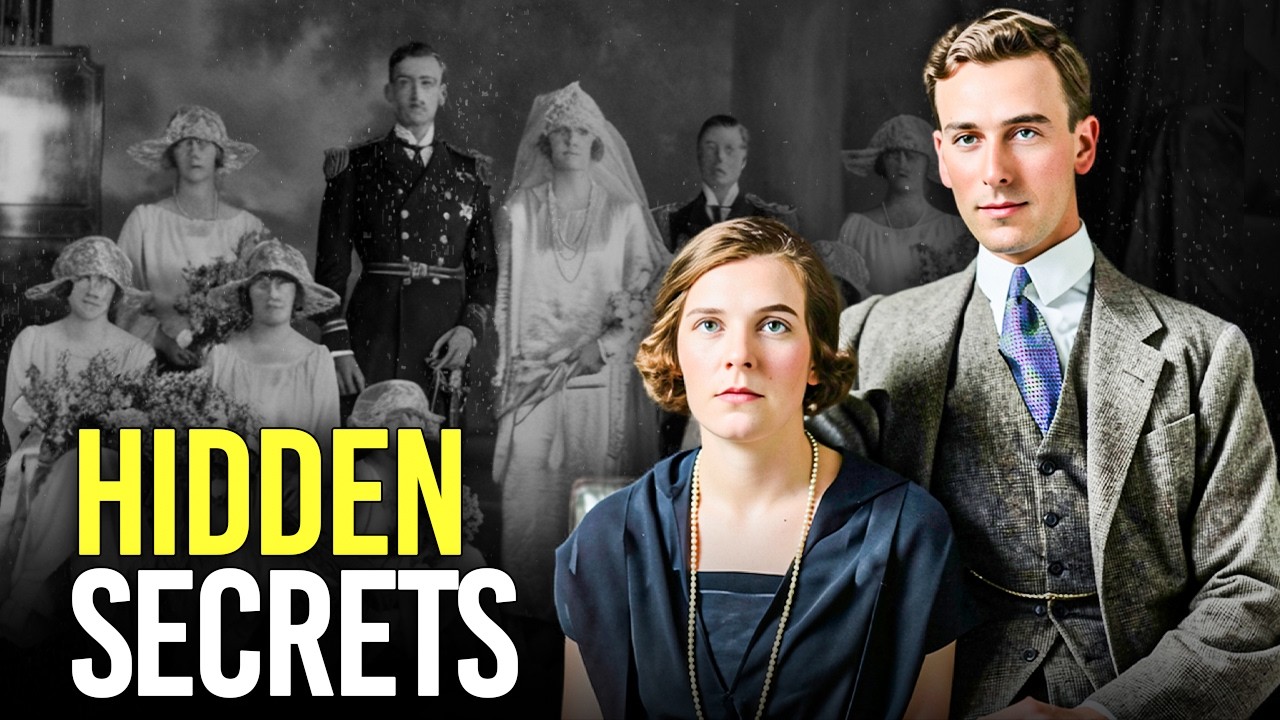
On July 18, 1922, at St. Margaret's, Westminster, with the Prince of Wales serving as best man and enormous crowds pressing against the barriers outside, Louis Mountbatten and Edwina Ashley were married in a ceremony that had everything the public could want from an aristocratic union. Uniforms, titles, beauty, youth, royalty in the pews, an heiress on the arm of a man whose royal blood was visible in the guest list.
The newspapers covered it as a fairy tale. The guest list read like a compression of the British establishment and half the surviving royal houses of Europe. The photographs show a couple who appear to have been designed for one another: he tall and striking in naval dress, she luminous and composed, both of them projecting the effortless confidence that only money and breeding in careful combination can produce.
What no photograph could capture was the calculation beneath the romance: his need for her fortune, her need for his position, and the unspoken agreement that the combination would create a public identity powerful enough to protect them both from whatever private complications might follow.
Brook House became their London stage, remodeled in sleek, almost naval style, a headquarters for entertaining on a scale that matched the fortune underwriting it. Broadlands became their country retreat. The world they entered as husband and wife was one of unbroken social confidence: servants, silver, court circular life, a calendar structured around a season, the great houses where influence was exercised over weekends rather than in offices.
The household took shape. Patricia arrived in 1924, Pamela in 1929. The family was now complete: a father whose ambition was already visible to anyone paying attention, a mother whose restlessness was already stirring beneath the polish, and two small daughters who would learn before they could articulate it that their parents' world was larger, busier, and more complicated than anything the nursery contained.
Staff raised the girls. Nannies managed the routines. The rhythm of the household was not organized around the children's needs but around the adults' calendar: naval postings, social obligations, European travel, the relentless machinery of a couple who understood that visibility was currency and that absence from the right rooms at the right moments could cost more than absence from the nursery ever would.
Edwina moved through her social and later humanitarian callings with an energy that left little space for the kind of slow daily attentiveness the children absorb as love. She was not cruel. She was elsewhere. The difference may not have mattered much to a small girl waiting in a Hampshire bedroom for a mother who had gone to London or to Paris or to wherever the next engagement required her to be.
Dickie, for all his vanity and his own relentless schedule, was more present: the parent who appeared, who engaged, who tried to explain the bewildering adult world that swirled around their childhoods. That pattern, his warmth compensating for her distance, would continue for decades, shaping how each daughter understood love, duty, and the cost of being a Mountbatten.
The public image by now was almost institutional in its completeness. The Mountbattens were not merely a couple. They were a brand, a joint enterprise in which lineage, fortune, naval service, royal proximity, and personal glamour had been fused into a single highly polished identity. The name that had been invented under duress in 1917 was now, barely a decade and a half later, synonymous with a particular kind of British success: connected, photogenic, useful, apparently unassailable.
They moved through a world that still believed in the natural authority of people like them, a world of weekend house parties where cabinet ministers and admirals and minor royalty gathered over silver and claret, where decisions about careers and marriages and appointments were made between courses, and where the ability to seem at ease was itself a form of power. The Mountbattens did not merely participate in that world. They excelled in it. They were among its most fluent performers.
And the family code held. Service conferring moral credit, royal proximity conferring social immunity, papers and memoirs and official memory being actively managed. Those three pillars supported the Mountbatten enterprise through every private complication the 1920s and 1930s could produce. The system was not designed to prevent transgression. It was designed to ensure that transgression never reached the one audience that mattered: the general public, the newspapers, the masses of ordinary people who still looked up at families like this and saw something close to grace.
But there was a cost to building a life on presentation, and the Mountbattens were already paying it. The marriage that gleamed in public was developing in private into something the crowds at St. Margaret's would not have recognized. The couple who smiled in photographs were learning to live parallel emotional lives. The house that dazzled guests held silences that the children would later describe with care and restraint, choosing their words the way people do when they love both parents and wish to be fair to each.
The fortune that funded everything also trapped them. Dickie needed Edwina's money to sustain the life his ambitions required, which meant the marriage could not simply be discarded when it stopped providing what either of them actually needed. And the name itself, Mountbatten, that careful English rendering of a German original, was a daily invisible reminder that everything the family possessed was at some fundamental level a construction: built well, built to endure, but built on the understanding that surfaces mattered more than whatever lay beneath them.
That understanding would hold for decades. It would carry the family through a world war, through the last act of the British Empire, through the corridors of Buckingham Palace and the refugee camps of Partition-era India. It would make them famous, useful, admired, and in certain very private rooms genuinely powerful. And it would shape the thing that no outsider could see and that the family itself could never quite admit: that the private cost of all that public perfection was already being paid, quietly and unevenly, by the people inside the house, especially the smallest ones.
The marriage worked. That is the first thing to understand about the 1920s and 1930s, because the temptation is to skip ahead to the dysfunction and treat the early years as mere prelude. They were not. The Mountbattens, for all the tensions already present beneath the surface, built something real: a household, a social position, a public identity of extraordinary reach. And the years in which they built it were not years of misery. They were years of movement, glamour, genuine accomplishment, and the particular confidence that comes from being young, rich, beautiful, and convinced that the world has been arranged for your benefit.
Dickie threw himself into the Royal Navy with the ambition that was already his defining characteristic. He was not content to serve quietly. He wanted visible command, dramatic postings, proximity to the men who made decisions. He rose steadily through signals courses, staff appointments, and command of a destroyer, and he did it with a combination of genuine competence and tireless self-promotion that his contemporaries found alternately impressive and exhausting. He was the officer who always had a plan, always had a connection, always knew which superior to flatter and which social occasion to attend. His naval record was real, but it was also curated, even then, by a man who understood that achievement without visibility was only half the job.
Edwina, meanwhile, was becoming the most talked-about hostess of her generation. Brook House on Park Lane, remodeled, expanded, furnished with the Cassel fortune's full force, became the headquarters of a social life that was reported in the press with a mixture of admiration and prurience. The parties were lavish. The guest lists were a compression of aristocratic, political, and artistic London. Edwina moved through it all with the energy of a woman who had been given everything except stillness, and did not intend to acquire it voluntarily.
She traveled extensively, restlessly, across Europe and beyond, and the public followed her movements with the fascination that the 1920s reserved for rich young women who appeared to be enjoying their money without apology.
What the public did not follow, because it could not yet see, was the shape the marriage was already taking in private. By all accounts, Dickie and Edwina had been physically and emotionally attracted to one another at the start. The early letters suggest warmth, excitement, the mutual intoxication of two people who believed they had found a partner equal to their ambitions. But the attraction did not produce the kind of domestic closeness that sustains a conventional marriage over decades.
Edwina was too restless for that, too hungry for novelty, too impatient with routine, too accustomed to the stimulation of new people and new places to settle into the repetitions of married life. Dickie was too consumed by his career, too focused on the next appointment, the next connection, the next step upward in the hierarchy that organized his sense of himself.
The household they built was brilliant but busy, filled with people and purpose and spectacle, and the children, Patricia growing up quietly, Pamela arriving in Barcelona because Edwina could not stop traveling even in the final months of pregnancy, inhabited its margins rather than its center.
What the couple discovered gradually, and without a single decisive crisis, was that they functioned better as partners in a public enterprise than as intimate companions. They were magnificent collaborators. They were inadequate spouses. The marriage became, by the late 1920s and into the 1930s, an arrangement, not in the sense of a cold contract, but in the way that many upper-class marriages of the era operated. Both partners understood that emotional and sexual needs would be met outside the household. And both understood that the household itself, with its name and its children and its social machinery, would continue regardless.
In the world of the English aristocracy, this was not aberrant. It was a system, one that had been operating in great houses and country estates for generations. What made it workable was not love or even tolerance, but something more structural: the shared understanding that the marriage served purposes larger than the happiness of the people inside it.
Edwina's affairs were numerous, varied, and within the circles that knew about them, openly acknowledged. She was drawn to men who offered what Dickie could not: emotional intensity, physical novelty, a sense of being wanted for herself rather than for her money or her husband's name. The names attached to these relationships shifted over the years, but the pattern was consistent. Edwina sought connection, found it, exhausted it, and moved on. She was not secretive in the way that a frightened woman might be. She was discreet in the way that a confident one was: discreet enough to keep the newspapers at bay, but not so discreet that her circle did not know exactly what was happening.
Dickie's response to this was complicated and revealing. He was not indifferent. Letters that surfaced later suggest hurt, frustration, and a kind of bewildered pride, the reaction of a man who loved his wife, could not quite hold her, and could not bring himself to make the scenes that might have forced a reckoning. He had his own attachments, his own emotional life outside the marriage, though the nature and extent of these remained more carefully guarded.
What is clear is that neither partner sought divorce. Divorce would have been socially devastating, financially complicated, and most importantly, incompatible with the public identity they had built together. The Mountbatten brand required two Mountbattens, and so the marriage endured, not as a lie exactly, but as a particular kind of aristocratic truth: a structure in which affection, loyalty, shared ambition, and mutual tolerance replaced the romantic intimacy that the outside world assumed was present.
The children lived inside this structure and absorbed its lessons. Patricia, the elder, learned discretion. She learned that one did not discuss what one saw at home, that loyalty to the family's public face was more important than honesty about its private one, and that duty to the name, to the household, to the expectations of one's class, was the thing that held everything together when feeling could not.
Pamela, the younger, learned something slightly different. She learned to watch. She became the family's observer, the daughter who noticed the absences, registered the emotional temperatures, cataloged the private textures of a household that was magnificent to look at and difficult to live inside. Both daughters later described, in carefully chosen words, a childhood in which they were loved but not prioritized, in which the adult world was simply too large, too important, and too consuming to leave much room for the small repetitive demands of children who needed presence more than they needed spectacle.
And then the war came, and the Mountbattens became genuinely important. Dickie's wartime career gave him something his peacetime ambitions could not: legitimate stature of the kind that could not be dismissed as mere social climbing. He commanded the 5th Destroyer Flotilla. His ship, HMS Kelly, was sunk off Crete in May 1941 in an action that killed over half the crew, a disaster he survived by swimming clear of the capsizing vessel while men died around him.
The story of Kelly's loss became, through Noël Coward's film In Which We Serve, one of the iconic narratives of wartime naval gallantry, which suited Dickie perfectly: real courage transformed into mythology, personal survival woven into a national story of sacrifice.
By 1943, he had been appointed Supreme Allied Commander, South East Asia, a position of genuine strategic authority that placed him alongside the war's major decision makers. He was responsible for vast operations across Burma, Malaya, and the surrounding theater, campaigns fought in brutal conditions against a determined Japanese enemy with resources that were always insufficient because the European theater took priority. His performance in that role was debated then and has been debated since. Some contemporaries found him brilliant and decisive. Others thought him reckless and too eager to claim credit for victories that belonged to his subordinates. But the appointment itself was beyond dispute. Dickie Mountbatten had arrived at the center of world events, which was exactly where he had always intended to be.
Edwina's war was different in texture but equally transformative. She could have spent the conflict as a society figure doing voluntary work at a comfortable distance from danger. She did not. She threw herself into relief operations with the same energy she had once directed at parties: St. John Ambulance, the Red Cross, prisoner-of-war repatriation, hospital inspections in conditions that were genuinely dangerous and physically demanding. She traveled to the Far East. She visited camps. She confronted suffering that was a long way from Park Lane.
The war gave Edwina what the marriage and the social round had not: a sense of usefulness that was proportional to her capabilities. She was not playing at philanthropy. She was doing work that mattered, and the seriousness of it began to change how the world saw her, and perhaps more importantly, how she saw herself.
The wars matter to the Mountbatten story because they deepen both halves of the couple beyond the caricatures that scandal can produce. They were not merely libertines living off inherited money. They were people who did real things in a real crisis. And the doing of those things gave them a moral authority that their private lives, examined closely, could not have sustained on their own.
That is the mechanism that must be made visible: public service as reputational armor. The more important they became to the war effort, the more the establishment needed them to remain respectable, and the more their private irregularities were absorbed into the general tolerance that powerful institutions extend to people they cannot afford to lose.
Then came India, and everything intensified. In March 1947, Dickie arrived in New Delhi as the last viceroy of India, charged with overseeing the transfer of power from British rule to independence. It was the role of a lifetime: theatrical, historical, world-shaping, and he occupied it with exactly the combination of energy, charm, and self-belief that had carried him to every previous appointment.
Edwina arrived with him, and Pamela too, the younger daughter, now 17, old enough to witness history at close range and young enough to be permanently shaped by it. The family was placed at the center of one of the 20th century's great political dramas: the end of the British Empire in the subcontinent, the creation of India and Pakistan, and the catastrophe of Partition, which would produce mass displacement, communal violence on an almost unimaginable scale, and a death toll that historians have estimated in the hundreds of thousands, though some accounts place it far higher.
The Mountbattens' performance in India has been debated ever since. Dickie's critics accused him of haste, of accelerating the timetable for withdrawal from June 1948 to August 1947, compressing a process that required years into a matter of months, and of prioritizing a clean British exit over the protection of the millions who would be caught in the violence that followed. His defenders argued that the situation on the ground was already disintegrating, that delay would have produced not peace but a slower, more protracted bloodbath, and that Dickie's speed, however brutal, prevented an even worse outcome.
What is not in dispute is the family's visibility. The Mountbattens in Delhi were the Mountbattens at their most operatic: the white uniforms, the viceregal receptions, the photographs that showed a couple presiding over the birth of new nations with the confidence of people who had been trained since childhood to stand at the front of any room they entered. Pamela, watching from just off stage, was absorbing a masterclass in how a family could place itself at the hinge of history and emerge looking not like participants in a disaster but like custodians of a dignified transition.
It was Edwina, though, who found her truest purpose in India's crisis. While Dickie managed the politics, Edwina threw herself into the human wreckage of Partition. She visited refugee camps. She toured hospitals overwhelmed by the injured and the displaced. She organized relief supplies, pressured officials, used her status to force doors that bureaucracy had closed. The scale of suffering she confronted was staggering: trains arriving in Delhi full of the dead, columns of refugees stretching to the horizon, communal violence that had turned neighbors into killers. And she met it not with the detachment of a vicereine performing charitable duty, but with a ferocity that impressed even those who had spent their lives working in disaster relief.
This was not the Edwina of the Park Lane parties. This was a woman who had finally found a crisis large enough to absorb her restlessness, and the seriousness with which she met it changed how the world understood her. It also gave the Mountbatten mythology its deepest layer of moral authority. Whatever one thought of the politics of Partition, Edwina's humanitarian work was real, costly, and sustained.
And it was in India, amid the violence and the ceremony and the political theater, that the private story developed its most famous chapter. Edwina's bond with Jawaharlal Nehru is one of those relationships that history has never quite resolved. What is documented is a close, emotionally intense connection that expressed itself in frequent meetings, long correspondence, and a mutual regard that was visible to everyone around them. Letters between them survive in archival collections and confirm a relationship of unusual depth.
Whether it was also sexual has been contested for decades. Pamela Hicks, who was there, insisted throughout her life that it was not, that it was a profound emotional and intellectual attachment but not a physical affair. Others, drawing on the intensity of the letters and the amount of time Edwina and Nehru spent together, have concluded otherwise. The ambiguity is itself the point. In a family built on the management of appearances, here was a relationship that existed in the space between what could be seen and what could be confirmed: visible enough to generate a lifetime of speculation, contained enough that no definitive proof has ever surfaced. It was the Mountbatten code made flesh, passion managed to the point of deniability.
What the Nehru attachment did to the marriage is harder to trace but easier to feel. Dickie appears to have known. He appears to have tolerated it as he had tolerated Edwina's earlier attachments, though the prominence of Nehru, a head of state, a world figure, made this one qualitatively different from a private affair with a London acquaintance. The couple's dynamic in the Indian period was one of parallel importance: Dickie running the political machinery of transition, Edwina throwing herself into refugee relief and medical work amid the violence of Partition, both of them serving the same historical moment but inhabiting different emotional worlds within it.
The family photographs from Delhi show a couple who look united, purposeful, equal. The private reality was more complex: not a disaster, not a betrayal in any simple sense, but a marriage in which two people had long since stopped expecting from one another what they sought from others.
And the children, as always, watched. Patricia was now in her 20s, married to John Brabourne, beginning to build a life of inherited duty that would define her. Pamela, barely 18 when the family arrived in India, was old enough to see everything, the political theater, the human suffering, the private emotional currents, and young enough to be marked by it permanently.
The family returned from India as legends: the last viceroy and vicereine, the couple who had presided over the birth of two nations. The public image was now armor-plated, burnished by service, by sacrifice, by the moral credit of having been present at one of history's hinge points. Whatever private complications existed, whatever gossip circulated in diplomatic pouches and drawing rooms, the Mountbatten name was now too large, too useful, too deeply embedded in the national story to be undermined by mere scandal.
That was the assumption, and for a while it held. But the private story had not disappeared. It had merely been absorbed into channels that the general public could not access: intelligence files, diplomatic networks, the whisper circuits of the transatlantic elite. And the most damaging of those channels, the one that would surface decades later as evidence that the Mountbattens' private world had been observed, recorded, and filed away by people who owed them no loyalty, was the FBI.
The existence of an FBI file on Louis Mountbatten is not by itself extraordinary. American intelligence agencies maintained files on hundreds of prominent foreign figures during and after the war. What makes the Mountbatten file significant is its content and what that content reveals about the limits of the family's protective machinery.
Secondary reporting on the file, which was opened during his wartime prominence and later released under American Freedom of Information provisions, describes elite informants characterizing the Mountbattens as persons of extremely low morals. The file recorded allegations about Dickie's sexuality and his personal conduct, allegations sourced from the kind of people who moved in transatlantic aristocratic and diplomatic circles and who spoke to American intelligence officers with a candor they would never have shown a British journalist.
The claims were not verified by the FBI. They were simply recorded, filed, and preserved in a system that operated entirely outside the Mountbattens' reach. The file is evidence that the private story was being processed by people the family could not control. It is not by itself proof that every allegation within it was true. And John Barratt, Mountbatten's long-serving private secretary, later denied the most damaging claims outright, insisting they were malicious gossip elevated to the false authority of intelligence.
That denial should be noted, because Barratt knew Mountbatten's daily life more intimately than almost anyone outside the family, and because his loyalty and his proximity give his counter real weight. But the denial does not erase the file's existence. And the file's existence tells us something more valuable than any single allegation: the Mountbattens believed their private world was contained. It was not. It was merely unprinted.
That distinction is the first real fracture in the family's mythology. Not a public scandal, not a newspaper exposure, but the quieter and more corrosive discovery that the apparatus of concealment had holes in it. The family's shield of rank, service, and royal proximity had worked brilliantly against the British press. It had worked within the closed world of the British establishment, where deference to people of the Mountbattens' class was an operating assumption. It had not worked against the Americans, who recorded what they heard without the inherited caution that British institutions brought to matters involving the crown's extended family.
There is a second dimension to this first fracture, and it concerns Dickie's relationship not with the outside world but with his own archive. By the 1950s, Mountbatten was already engaged in the activity that would occupy much of his later life: the organization, curation, and selective presentation of his personal papers. He was not merely keeping records. He was building a version of himself for posterity, and he was doing it with the same energy and attention to detail that he brought to his naval and political careers.
Files were sorted. Material was categorized. Certain items were marked as being of special sensitivity. The University of Southampton archive, where the papers eventually came to rest, has noted that he arranged material with an explicit eye to a future authorized biography: not a neutral historical resource, but a curated narrative with a specific purpose, to ensure that the story of Louis Mountbatten would be told after his death in the terms he had chosen.
That archival impulse is not merely a biographical detail. It is a character revelation of the first order. It tells you that Dickie understood, perhaps more clearly than anyone else in the family, that the Mountbatten story was vulnerable. That the private complications, the intelligence rumors, the marriage's unconventional structure, all of it would eventually be examined by people who owed him nothing. His response was not confession or reform. It was management. He would control the raw material from which the future story would be constructed. And in doing so, he would ensure that the version of events that reached the public was the version he had approved.
It was the Battenberg-to-Mountbatten instinct taken to its logical conclusion. If you cannot change what happened, you can at least change what is remembered.
The immediate consequences of this fracture were characteristically invisible. No scandal broke. No resignation was demanded. No confrontation occurred in public. The family continued as before: Dickie accumulating honors and appointments, the household functioning, the children building their own lives, the public image intact. But the fracture had changed the underlying reality in ways that would only become clear decades later. The Mountbattens were no longer merely a family managing their own narrative. They were a family whose narrative was also being managed by others: by institutions, by intelligence services, by the archival systems of foreign governments. And they did not control those systems. They did not even know with any certainty what those systems contained.
What they did know, though they would never have framed it in these terms, was that the protective machinery had to be maintained with even greater care. And so the 1950s became the decade in which the Mountbatten code was applied with its fullest rigor.
Dickie moved through the senior reaches of the Admiralty, becoming First Sea Lord in 1955, the same position from which his father had been forced to resign four decades earlier. That appointment was not merely professional. It was the completion of a generational arc: the son rehabilitating the father's name by reaching the summit that xenophobia had denied the older man. Dickie understood the symbolism perfectly, because he understood symbolism better than almost any public figure of his era. He ensured the moment was documented, commemorated, absorbed into the family's official story. The wound of 1914 was at last formally healed. The son had succeeded where the father had been destroyed.
Meanwhile, inside the household, the emotional architecture of the marriage was hardening into its final form. Dickie and Edwina were now in their 50s. The restlessness that had driven Edwina's earlier affairs had not diminished, but it had changed character: less about the intoxication of novelty, more about the search for something the marriage fundamentally could not provide. She continued her humanitarian work with undiminished energy, traveling extensively for St. John Ambulance and other relief organizations, throwing herself into causes with the same intensity she had brought to the refugee camps of Partition. The work gave her purpose. It did not give her peace.
Those who saw her in her later years described a woman who was perpetually in motion, as if stillness itself were an enemy, as if stopping long enough to examine what her life had actually become would have been more than she could bear.
Dickie's response to Edwina remained what it had always been: a mixture of pain, tolerance, and the calculation that keeping the marriage intact served purposes larger than either of their individual happinesses. The couple did not hate one another. By many accounts, they retained genuine affection, a shared sense of humor, and a mutual respect that survived decades of disappointment. But affection is not intimacy. And the household they maintained was built on the understanding that certain things were not discussed, certain rooms were not entered, and certain truths were better left in the filing cabinet than spoken aloud over dinner.
The children had by now absorbed this code completely. Patricia, married to John Brabourne and building her own household at New House in Kent, carried the family's habits of discretion into the next generation with the thoroughness of someone who had never known any other way. She did not rebel against the Mountbatten code. She embodied it. Her marriage was stable, her life was ordered, her relationship to the family name was one of stewardship rather than protest.
Pamela, still unmarried, still moving in the royal and aristocratic orbit, would marry the interior designer David Hicks in 1960, was developing the observer's eye that would later produce her memoirs. She saw more than Patricia allowed herself to acknowledge, and she remembered it with greater precision. Neither daughter challenged the family's operating assumptions. Neither daughter could afford to. The code was not merely a preference. It was the load-bearing structure that held the entire Mountbatten enterprise together. To question it would have been to question the foundation of everything: the name, the marriage, the properties, the public image, the relationship to the crown.
And so the code held, and the cracks were painted over, and the family moved into the late 1950s with its public reputation not merely intact but enhanced by the war and by India, even as the private reality grew more complicated and more carefully guarded with every year that passed.
There was, in all of this, a deeper irony that the family either could not see or chose not to acknowledge. The very mechanisms that protected them, the discretion, the archival control, the institutional deference, the assumption that people of their rank were entitled to a margin of private irregularity, were also the mechanisms that prevented them from ever confronting what was actually wrong. The marriage could not be fixed because it could not be honestly examined. The children's emotional needs could not be met because acknowledging those needs would have required admitting that the household was organized around adult ambition rather than family well-being. The archive could not be left to speak for itself because the truth it contained was more complicated than the legend it was meant to support.
Protection and concealment had become the same thing. And the family, cushioned by both, moved forward into the decades that would test them in ways no amount of management could prevent.
Edwina had one decade left to live. She would spend it in constant motion, traveling, working, seeking the usefulness that had become her substitute for happiness. Dickie had two decades left, and he would spend them ascending to the highest positions the British establishment could offer, even as the private questions that had trailed him since the war continued to circulate in the channels he could not reach. The children were building their own households now, carrying the family code into a new generation, learning to apply the same habits of discretion and presentation that their parents had perfected.
What was coming was not another affair, not another intelligence file, not another whispered assessment in a diplomatic pouch. What was coming was loss: permanent, physical, public, and devastating. And the family that had spent decades learning how to control the story was about to discover that some stories cannot be controlled at all.
On February 21, 1960, Edwina Mountbatten died in her sleep in Jesselton, North Borneo. She was 58 years old. She had been on an inspection tour for the St. John Ambulance Brigade and was still working, still traveling, still in motion right up to the end. The death was not violent, not scandalous, not the dramatic public fall that the family's enemies might have imagined. It was quiet, sudden, and far from home. She had gone to bed in a government guest house after a day of engagements. She did not wake up. The cause was never conclusively determined, though later accounts suggested a cardiac event.
What mattered for the family and for the story was the manner of departure. Edwina died doing the work that had given her life its deepest meaning, in a place that was geographically remote from everything the Mountbatten name conjured, Park Lane, Broadlands, Delhi, the corridors of the palace, but spiritually continuous with the woman she had become. She had spent her last decade seeking usefulness. She found it, and then she was gone.
The funeral arrangements told the viewer everything they needed to know about the two halves of Edwina's life. She had left instructions requesting burial at sea, and Dickie honored them. Her body was taken aboard HMS Wakeful and committed to the waters of the English Channel off Portsmouth. The ceremony was naval, spare, and dignified, the kind of send-off that suited the wife of a sailor and the daughter-in-law of a First Sea Lord more than it suited the granddaughter of a Cassel fortune or the hostess of Brook House.
But the most remarkable detail came from half a world away. Jawaharlal Nehru, Prime Minister of India, arranged for an Indian Navy frigate to put to sea and cast a wreath on the waters at the position where Edwina had been laid to rest. The gesture was extraordinary: a head of state deploying his nation's military to honor the wife of a foreign earl, a woman who had been in the official record nothing more than the vicereine of a colonial power.
It said, with the eloquence of naval ceremony and the unmistakable weight of state authority, what neither Nehru nor the Mountbattens could ever publicly confirm: that the bond between Edwina and the Indian leader had been something far deeper than diplomatic friendship, something that warranted mourning on a national scale, even if the precise nature of that something could never be named aloud. The wreath floated on the waters of the English Channel. The frigate withdrew. And the most famous unresolved question in the Mountbatten story was answered, as definitively as it ever would be, not by a confession or a document, but by a warship and a circle of flowers on the open sea.
For Dickie, Edwina's death was the end of a partnership that had shaped his entire adult life. They had not been faithful to one another. They had not, by conventional standards, been happy. But they had been bound by children, by ambition, by shared history, by the extraordinary machinery of a name they had built together. And the severing of that bond left him alone with the legacy in a way he had never been before.
He was now the sole custodian of the Mountbatten story, the sole author of its public version, the sole manager of the archive, the papers, the carefully arranged narrative of two lives that had been lived in so many ways for the benefit of an audience. Edwina could no longer contradict him. She could no longer complicate the picture with her restlessness, her inconvenient attachments, her refusal to be contained by the role he had imagined for her. She was gone, and the story was entirely his to tell.
For the daughters, the loss was different in texture. Both Patricia and Pamela had grown up at a distance from Edwina, the distance of nannies, boarding schools, a mother who was always elsewhere. They had loved her without fully knowing her, which is perhaps the most painful form of bereavement: grieving not just the person who died, but the relationship that was never quite built while there was still time.
Pamela would later write about her mother with a mixture of admiration and unresolved longing that was more revealing than any straightforward eulogy. She understood, by the time Edwina died, what her mother had been searching for. She did not pretend to have received it. That honesty, the willingness to love a parent while acknowledging what the parent could not give, would become one of Pamela's defining qualities. And it began in earnest with the loss of Edwina in the government guest house in North Borneo.
In the years after Edwina's death, Dickie began the process of consolidating the Mountbatten narrative into the form he wanted it to take. He spoke of Edwina publicly with affection and respect, emphasizing her humanitarian work, her courage, her transformation from society beauty to woman of substance. He did not deny the difficulties of the marriage. He was too intelligent for that, and too aware that the facts were already known within the circles that mattered. But he framed them in terms that preserved dignity on both sides. The marriage had always been unconventional, he implied. It had also been a partnership of exceptional people in exceptional circumstances. That framing, generous, dignified, carefully non-specific, became the authorized version, and it would hold for decades.
The 1960s were Dickie's decade of consolidation, and in some ways his decade of triumph. He had already become First Sea Lord, completing the generational rehabilitation of his father's disgrace. Now he went further, becoming Chief of the Defence Staff in 1959, the highest military position in the United Kingdom, responsible for overseeing the integration of all three services into a unified defense structure. The reorganization was controversial. It required the kind of political maneuvering, institutional persuasion, and occasional bureaucratic ruthlessness that suited Dickie's temperament perfectly. He held the post until 1965, shaping the architecture of Britain's military command at a moment when the country was adjusting, painfully and not always gracefully, to its diminished postwar role.
He was effective in the job: driven, energetic, willing to make enemies in pursuit of structural change. He was also characteristically theatrical about it, ensuring that his contributions were documented, that his influence was recorded for posterity, that the historical record would show Dickie Mountbatten as the architect of modern British defense rather than merely one of its administrators. Every appointment, every reform, every bureaucratic victory was absorbed into the growing archive at Broadlands. The monument was still under construction.

In retirement, which began in the mid-1960s, Dickie did not diminish. If anything, he expanded. He became, in the public imagination, a kind of national uncle: the last survivor of a generation that had fought the war, governed the empire, and served the crown with a grandeur that postwar Britain could no longer produce on its own. He was invited everywhere. He spoke everywhere. He lent his name and his presence to causes, organizations, and events with the ease of a man who had spent a lifetime understanding that his value at this stage was not what he could do, but who he was and what he represented.
The establishment did not merely tolerate his continued prominence. It actively required it. Dickie Mountbatten, with his titles, his decorations, his royal kinship, and his apparently inexhaustible supply of wartime anecdotes, was useful: a living connection to a world that was receding fast but that many people in positions of influence were not yet ready to let go of. He was continuity made flesh. He was the old order's favorite version of itself.
The most significant of his retirement roles was the one that brought him closest to the next generation of the royal family. Dickie became a mentor, an adviser, and in his own self-dramatizing way, a surrogate grandfather to Prince Charles. The relationship was real and affectionate, one of the few relationships in Dickie's life that appears to have been driven primarily by genuine feeling rather than by calculation, though calculation was never entirely absent.
Charles, who struggled with the emotional formality of his parents' court, who found his father's manner bruising and his mother's devotion to duty sometimes difficult to distinguish from emotional reserve, found in Dickie something he could not easily find elsewhere: warmth, encouragement, a willingness to listen to his doubts and confusions, and the authority of a man who had held great positions and could speak about duty, service, and the weight of expectation from direct and credible experience.
Dickie was effusive where Philip was brisk. He was expansive where the palace was cautious. He told stories. He offered counsel. He made Charles feel that his uncertainties were natural rather than shameful, which was a gift the formal machinery of the monarchy was not well designed to provide.
Dickie, for his part, found in Charles not just a young man in need of guidance, but a future king in need of shaping. And he fully intended to be the one who shaped him. That was not cynicism. It was the Mountbatten instinct at its most fundamental: the belief that proximity to the crown was the highest form of usefulness, and that usefulness to the crown was the family's deepest source of protection. The fact that he also hoped Charles might marry his granddaughter Amanda, binding the Mountbatten line to the throne once more, completing the dynastic project that had begun when his father married Queen Victoria's granddaughter, was not incidental to the relationship. It was part of its architecture.
Even in his 70s, the ambition that had driven Dickie since his father's fall was still at work, still seeking the next connection, the next consolidation, the next step toward the centrality that was his lifelong obsession. The throne was the ultimate destination. Amanda was the vehicle. Charles was the willing passenger. And Dickie, as always, saw himself as the navigator.
But the 1970s also brought a different kind of visibility, one that Dickie could not control and that sat uncomfortably with his carefully maintained public image. His name surfaced in the murky political mythology surrounding Harold Wilson's final years as prime minister. The story, in its fullest and most sensational versions, involved elements of the British establishment, military figures, intelligence officers, business leaders alarmed by what they perceived as the leftward drift of Wilson's government, who were alleged to have discussed the possibility of some kind of extra-parliamentary intervention.
The scenarios varied depending on who was telling the story: a military coup, a national government of unity, a palace-backed alternative administration, a quiet constitutional maneuver that would remove Wilson and install someone more acceptable. Mountbatten's name appeared in these accounts as a potential figurehead, not necessarily as an active conspirator who had drawn up plans and issued orders, but as the sort of man who might plausibly be asked to lead such an effort. He had the stature. He had the connections. He had the kind of public profile that could lend authority to an unconventional political arrangement.
The harder conspiracy versions of the story remain disputed, and the evidence for a concrete, actionable plot involving Mountbatten is thin. What is not thin is the cultural fact that his name was considered plausible in that role. That when frightened establishment figures looked around for someone who might restore order to what they perceived as a dangerously unstable political situation, Dickie Mountbatten was the man they thought of.
That tells us something essential about his place in the imagination of 1970s Britain. He was not just a retired admiral with a good war record and a royal uncle's charm. He had become something more potent and more troubling: a symbol of the old order's capacity to intervene, to override, to step in when the democratic process produced results that the people at the top found unacceptable. Whether he encouraged those conversations, entertained them with a mixture of vanity and caution, or dismissed them outright, accounts differ, and the truth may lie somewhere in the complicated middle ground between all three.
The mere association revealed how far the Mountbatten name had traveled from its origins as a piece of wartime anglicization. It had become a political instrument, and political instruments can be wielded by hands other than the ones that forged them.
That political thread, even in its most attenuated, least provable form, represents the second fracture in the Mountbatten story. Not because it demonstrates that Dickie plotted against a democratic government, the evidence for that is insufficient, but because it demonstrates that the name he had spent a lifetime building had become something larger and stranger than a personal reputation. It had become a political commodity, a token that could be deployed, discussed, and traded by people pursuing agendas that had nothing to do with the Mountbattens' domestic arrangements or their archive or their family code.
The first fracture, the FBI file, showed that the private story had leaked into intelligence channels beyond the family's control. The second fracture showed that the public image had leaked into political fantasy. The family's carefully managed identity was being used by others in ways the family itself could not supervise, for purposes the family had not intended. Dickie had spent his life building a name that meant authority, stability, and establishment power. He had succeeded so completely that the name could now be invoked by people he had never authorized, in conversations he could not monitor, for plans he might or might not have endorsed. The creation had outgrown the creator.
And while Dickie navigated his elder statesman years, the speeches, the ceremonies, the palace advisory role, the carefully managed archive at Broadlands, the next generation was quietly absorbing the consequences of everything the previous generation had built and everything it had concealed.
Patricia's arc was the one most faithful to the family's original design. She had inherited the title, the second Countess Mountbatten of Burma, by the special remainder Dickie had secured, and with it the responsibility of maintaining the line's continuity. Her marriage to John Brabourne was stable. Her household at New House in Kent was ordered. Her relationship to the Mountbatten name was one of custodianship rather than reinvention. She did not seek the spotlight. She did not challenge the family's assumptions. She raised her children, supported her husband's career in film production, and accepted her place in the structure with a discipline that was, depending on how you looked at it, either admirable or heartbreaking.
Patricia had learned from her parents that duty was more important than feeling, that the family's public face mattered more than any individual's private needs, and she lived accordingly. What she could not know, what no one in the family could know, was that duty would extract from her a price so extreme that no code of conduct, however deeply internalized, could have prepared her for it.
Pamela's trajectory was different. She had married David Hicks in 1960, entering a world of design, style, and social glamour that was adjacent to the Mountbatten orbit but not quite inside it. Hicks was talented, ambitious, and difficult, a man whose professional brilliance as an interior designer was acknowledged internationally but whose personal temperament made the private rooms of his own household less harmonious than the ones he designed for clients. The marriage gave Pamela children, including the designer and author India Hicks, and it gave her a life that was her own rather than merely an extension of her father's legend.
But she never fully left the Mountbatten world. She could not. The gravity of it was too strong: the royal connections, the family occasions, the ceremonial duties that the daughter of an earl and the goddaughter of a queen could not simply decline. She attended coronations and weddings and memorial services. She sat in the abbey pews where her family had sat for generations, and she carried the memory of Delhi, of Edwina, of the old household at Broadlands and Brook House, with a precision that sharpened rather than dimmed as the decades passed.
Where Patricia embodied the Mountbatten code, Pamela was quietly documenting it. She was becoming, without fully realizing it yet, the family's most valuable witness: the one who remembered not just the official events but the domestic textures, the small cruelties and kindnesses, the way a room felt when Edwina walked through it, or the expression on Dickie's face when a conversation turned toward subjects the family preferred to leave alone. She would eventually write memoirs that opened doors the family had kept carefully shut, but in the 1960s and 1970s that writing was still ahead of her. She was still gathering material, still watching, still holding the family's private history in a memory that was more faithful than any archive, because it recorded not just what happened but what it felt like.
Amanda, Patricia's daughter, occupied a peculiar position in the family's mythology: the position of the potential bride, the woman through whom the Mountbatten line might finally merge with the throne itself. She was the granddaughter Dickie had hoped would marry Prince Charles, the final triumphant union of Mountbatten blood with the crown, the completion of a dynastic project that had been running in one form or another since Prince Louis of Battenberg married Queen Victoria's granddaughter in the 19th century.
The courtship had existed in some form. Charles and Amanda had known each other since childhood, had spent time together in family settings, and Dickie's ambitions for the match were well understood within both the family and the court. Amanda was young, attractive, well bred, comfortable in royal company, everything on paper that the institution might have wanted for the heir to the throne. But the match had not been made before the summer of 1979. The timing had not been right. Charles had not been ready. Amanda had not pushed. And what happened that summer, and what happened on a single morning in County Sligo, would change everything about how Amanda understood the cost of proximity to power and to the Mountbatten name.
The grandchildren, Norton, Timothy, Nicholas, the Brabourne siblings, the Hicks children, were growing up in the long, strange shadow of a dynasty that was already, by the late 1970s, as much public property as private family. They inherited not just the name and the houses and the titles, but a set of expectations, a code of behavior, a relationship to public scrutiny and media attention, and a family history that was becoming, in the hands of biographers and journalists and television dramatists, something that belonged to the nation's story as much as to their own.
The children were learning, as Dickie and Edwina's daughters had learned before them, that being a Mountbatten meant living inside a narrative that other people were also telling, and that you could not always control which version of the story prevailed. They were the inheritors, and what they had inherited was not simple. It was a mixture of privilege and burden, of glamour and complication, of doors that opened easily and silences that could not be broken. They had been given a great deal. They would soon discover what it could cost.
At Broadlands, the archive grew. Dickie, now in his late 70s, was spending more and more of his time with the papers, ordering, arranging, annotating, marking items for special handling, revisiting decades of correspondence and official documents with the attention of a man who knew his time was limited and who was determined to leave the raw material of his legacy in the exact condition he wanted it found.
The archive was not merely a collection of documents. It was a second self, a parallel Mountbatten built from paper and careful curation, designed to survive the biological Mountbatten and carry the approved version of the story into a future that Dickie would not live to see. He had always understood that memory is not passive. It is built. It is managed. It is the product of choices about what to keep, what to discard, what to mark as sensitive, and what to leave open for inspection.
The archive at Broadlands was the physical embodiment of that understanding: the family code translated from social behavior into boxes, folders, and filing systems. It contained, among other things, material that later archivists would describe as black-box items, files of particular sensitivity, kept apart, handled differently, subject to restrictions that would outlast the man who had imposed them. Dickie was not merely preserving his past. He was engineering his future reputation, and doing it with the same meticulous energy he had brought to everything else in his life.
He also spent time each summer at Classiebawn Castle in County Sligo, on the west coast of Ireland. The castle had come to the family through the Ashley line, another piece of inherited property, another stage on which the Mountbatten household enacted its rituals of privilege and continuity. The building itself was a Victorian Gothic confection, turreted and prominent, set on a headland above the village of Mullaghmore, with views across Donegal Bay. It was not grand by the standards of Broadlands or Brook House. It was something more personal than that: a holiday house, a retreat, a place where the formalities of English aristocratic life could be relaxed and the family could gather in something resembling ordinary domestic comfort.
Dickie loved it. He fished from its harbors, walked its fields, entertained guests against the backdrop of the Atlantic. The routines were well established, repeated summer after summer, with the reliability of a household that took its pleasures seriously and did not see any reason to alter them.
What was different, and what Dickie appears to have either minimized or simply refused to accept, was the context in which those pleasures were now being taken. Ireland in the late 1970s was not a safe place for a man of his profile. The Troubles had been escalating for a decade. The Provisional IRA had carried out bombings, assassinations, and kidnappings across Northern Ireland and on the British mainland with increasing sophistication, brutality, and strategic purpose. The conflict was not abstract. It was immediate, violent, and deeply entangled with questions of British sovereignty, Irish nationalism, and the legacy of exactly the kind of imperial history that the Mountbatten name embodied.
Dickie was not merely a British aristocrat on holiday in a neutral country. He was the queen's cousin. He was a former Chief of the Defence Staff. He was a living, breathing, highly visible symbol of the British establishment and of the monarchy itself. His presence at Classiebawn year after year was not a secret. The castle was visible from the road. His movements were predictable. His habits were known. The boat, Shadow V, was moored in a public harbor at Mullaghmore village, where anyone, fisherman, tourist, bomber, could observe it, approach it, study its routines.
Security was minimal. That fact is almost impossible to reconcile with the scale of the threat. And yet the family accepted it. There were no armed guards, no military escorts, no comprehensive surveillance of the harbor or the boat. What protection existed was a matter of polite local arrangement: the Garda Síochána keeping a general eye, intelligence assessments filed through official channels, a vague understanding that someone important was in residence and that awareness should be heightened.
The warnings had been there. Irish police and British intelligence had both flagged the risks of Dickie's annual visits. Advice had been given, not publicly, not dramatically, but through the quiet channels that the establishment used when it wanted to communicate concern without issuing commands: that the trips to Sligo were not wise. Dickie listened to the warnings the way he listened to most unwelcome advice. He acknowledged them and then continued to do exactly what he had always done.
He was 79 years old. He had survived the sinking of his ship. He had governed India during Partition. He had navigated court politics, intelligence files, marital crises, and political conspiracies. The assumption, never articulated as a principle but visible in every choice he made that summer, was that the world would continue to accommodate him. That rank and history and the sheer accumulated weight of who he was would serve one more time as a shield against the dangers that ordinary people had to worry about, but that someone like Mountbatten could simply move through unharmed by the force of his own certainty.
That assumption was the final expression of the family code: the belief that the system would protect them, that position, service, and the management of appearances could contain any threat, even one that came not from a newspaper column or a diplomatic whisper, but from a radio-controlled bomb hidden in the bilge of a fishing boat.
The code had held for 60 years. It had absorbed affairs, intelligence files, political rumors, marital dysfunction, and the quiet emotional tragedies of children raised at a distance from their own parents. It had been tested by war, by empire's end, by the press, by American intelligence, and by the slow accumulation of private knowledge in the hands of people who owed the Mountbattens nothing. Every time it had held. Every time the name had survived. Every time the surface had been restored, the damage contained, the story rewritten in acceptable terms, the family had come to believe, with the deep conviction that only unbroken success can produce, that it would always be so.
It was August 1979. The family gathered at Classiebawn as they always did. Patricia and John Brabourne were there with their children. Dickie's mother-in-law, the Dowager Baroness Brabourne, 83 years old, frail but still participating in the household's summer migration, was there. The twin boys, Timothy and Nicholas, were 14. A local boy, Paul Maxwell, 15 years old, had been taken on as a crew member for the boat. The house was full. The weather was fine. The sea was calm.
The morning of August 27 arrived with the particular ordinariness that always precedes catastrophe, the kind of morning that seems in retrospect impossibly innocent, impossibly normal, as if the world itself had decided to offer one last stretch of ordinary time before taking it away forever.
Dickie decided to take the boat out. Shadow V, a small open fishing vessel, 29 feet long, wooden hulled, modest, unremarkable, was waiting at the harbor. The plan was simple: a short trip along the coast, some fishing, the familiar waters of Mullaghmore Head that Dickie had been navigating for decades. The family loaded aboard in the unhurried manner of a household on holiday. No urgency, no ceremony, just the comfortable routine of people who had done this many times before and expected to do it many times again.
The sea was green and quiet. The headland rose behind them. The castle watched from the shore. The village went about its morning. They cleared the harbor and headed out toward the lobster pots. And somewhere beneath the deck, in the place where the family could not see it and had never thought to look, the bomb was already waiting.
The bomb detonated at approximately 11:39 in the morning, when Shadow V was about 200 yards from the shore. The device, roughly 50 pounds of gelignite, hidden in the boat and triggered by remote control from the cliffs above, tore the vessel apart. The explosion was heard across the bay and beyond, a concussive crack that rolled over the water and echoed off the headland.
Witnesses on the shore, villagers, holidaymakers, people who had been going about an ordinary Monday morning, described seeing the boat lift bodily out of the water, break open from within, and collapse into a cloud of debris, smoke, and spray that hung over the surface before the wind began to pull it apart. Where there had been a small fishing vessel carrying a family on a summer outing, there was now a debris field: timber, rope, cushions, clothing, fragments of the hull, and among them, almost impossible to distinguish at first from the wreckage itself, human bodies. Some were moving. Some were not.
Lord Mountbatten was killed instantly, or very nearly so. He was 79 years old. His legs were almost severed by the blast. He was pulled from the water by nearby lobster fishermen who had raced toward the explosion in their own boats, but by the time they reached him, there was nothing to be done. He was dead.
The man who had spent a lifetime at the center of events, commanding fleets, governing an empire, advising the crown, curating his own legend with the meticulousness of an archivist and the vanity of a performer, ended face down in the water off a small Irish village, his body broken by a device he had been warned about and chose not to believe in. The gap between who he believed himself to be and what the world was willing to do to him had finally, irrevocably closed.
Nicholas Knatchbull was killed. He was 14. He was Timothy's twin. He had been on the boat because his family was on holiday and because that was what the family did in August. They went to Classiebawn. They took the boat out. They fished off Mullaghmore Head. He had no public role, no political significance, no place in the machinery of state or empire. He was a child. The bomb did not distinguish between the patriarch who symbolized the dynasty and the boy who happened to be sitting beside him. It simply destroyed everything in its radius.
Paul Maxwell was killed. He was 15. He was a local boy from Enniskillen who had taken a summer job crewing Shadow V, earning pocket money, helping with the ropes and the engine, doing the kind of seasonal work that teenagers in coastal villages had always done. He was not a Mountbatten. He was not an aristocrat. He was not part of the dynasty or its mythology. He was a boy from the town who had been in the wrong place because he was doing his job. His death is the detail that prevents the story from belonging entirely to the family. It belongs also to the people who lived beside them, served them, and shared, without choosing to, the consequences of their visibility.
The Dowager Baroness Brabourne, Dickie's mother-in-law, 83 years old, survived the initial blast but died in Sligo General Hospital the following day of her injuries. She had been brought along on the holiday because that was the family custom. The elderly were included, accommodated, given their place in the summer migration. Her death extended the toll beyond the moment of the explosion itself, stretching the catastrophe across two days and adding another generation to the count of the dead.
Four people killed. Three generations touched. The youngest was 14. The oldest was 83. The span of those ages tells you something about the nature of the attack that no political analysis can capture. It struck not a military target or a political figure in isolation, but a family, an entire living, breathing, multigenerational family, on a summer morning.
Patricia Knatchbull was pulled from the water alive but gravely injured. Both her legs were broken. She had internal injuries. She was in shock, the physical shock of the blast and the deeper, more devastating shock of a mother who did not yet know, in those first chaotic minutes, which of her children had survived and which had not.
She would learn in the hours that followed that her son Nicholas was dead, that her father was dead, that her mother-in-law was dying, that her husband John was critically wounded and might not survive, and that her son Timothy, Nicholas's twin, had been pulled from the wreckage, alive but injured, his eardrums ruptured, his body battered, his brother gone.
Patricia had spent her entire life embodying the Mountbatten code: discretion, duty, the steady maintenance of the family's public face. Now the code was meaningless. There was no public face to maintain. There was only injury, death, and the unbearable mathematics of a family that had gone out on a boat with seven people and come back with three of them dead and three of the survivors broken.
John Brabourne, the seventh Baron Brabourne, was critically injured. He would survive, but his recovery was long and painful, and the man who returned from it was not the man who had gone out on the water that morning. The bomb had not merely wounded his body. It had destroyed the household, killed his son, killed his father-in-law, killed his mother, shattered the structure within which his life as a husband, father, and aristocrat had been organized. He would carry the physical scars for the rest of his life. He died in 2005, having spent 26 years living in the aftermath of a single morning.
Timothy Knatchbull survived. He was 14. His twin brother did not. That fact, the irreducible, unanswerable fact of it, would define the rest of his life. He was pulled from the water injured, disoriented, his hearing damaged by the blast. He did not know in those first moments what had happened to Nicholas. He did not know who was alive and who was dead. He was a child, soaking and wounded, in an Irish bay, surrounded by the wreckage of a boat and the remains of a family outing that had been, minutes earlier, as ordinary and unremarkable as any other summer morning.
He would later write about that day with a clarity that is almost unbearable to read: the confusion, the pain, the slow arrival of understanding, the moment when the word dead attached itself to the people he loved and would not come loose again. His memoir, From a Clear Blue Sky, published decades later, is one of the most sustained accounts of inherited trauma in modern British writing. It is the book that the Mountbatten code was designed to prevent: a truthful record of what catastrophe actually feels like from the inside, written by someone who refuses to smooth the edges or maintain the surface.
Pamela was not on the boat. She was at Classiebawn or nearby, and she learned what had happened in the way that survivors of proximity always learn, through fragments, phone calls, the sudden arrival of information that reorganizes everything. She had not been on Shadow V because of the smallest of decisions, a different plan for the morning, a choice to stay behind, the kind of trivial domestic calculation that in retrospect acquires the weight of fate.
She would carry that nearness for the rest of her life. She had escaped the bomb by the width of a decision. Her father, her nephew, the local boy, her stepmother, they had not. Pamela's survival was not heroic. It was accidental. And the accident would haunt her in the particular way that near misses haunt the people who experience them: not with gratitude, or not only with gratitude, but with the persistent, unanswerable question of why she had been spared and they had not.
The rescue operation was chaotic, immediate, and desperately human. Local fishermen were the first responders, men in small boats who had heard the explosion and raced toward the debris field without knowing what they would find, without equipment, without training for mass casualty events, armed only with the instinct to help that coastal communities carry in their bones. They pulled bodies and survivors from the water with their hands. They hauled the wounded aboard their lobster boats. They brought them to shore, where the village of Mullaghmore, which had watched the Mountbattens come and go for summers beyond counting, which had absorbed the family's presence as part of the seasonal rhythm of the place, was suddenly transformed into something none of its residents had prepared for: the site of a bombing, a crime scene, a place where ambulances and police cars and military vehicles would converge within the hour.
The harbor that had been peaceful at breakfast was full of wreckage by noon. The castle on the headland, which had been the backdrop to decades of family holidays, now looked down on a catastrophe.
Medical teams arrived from Sligo. The injured were transported to Sligo General Hospital, where the staff, working with the resources of a small regional hospital, suddenly confronted with blast injuries of a severity they had never encountered, fought to stabilize Patricia, John Brabourne, and Timothy. Lady Brabourne, Dickie's mother-in-law, was also brought in. She clung to life through the day and into the night, but her injuries were too severe. She died the following morning, August 28, bringing the death toll to four.
The news traveled outward in concentric circles of increasing horror. Mullaghmore to Sligo, Sligo to Dublin, Dublin to London, London to Buckingham Palace, London to the world. The BBC broke the story within hours. The newspapers scrambled for details, for photographs, for anything that would convey the scale of what had happened to a figure whose name was known in every household in the country.
The name Mountbatten, so carefully managed for so many decades, so expertly maintained as a symbol of service, glamour, and establishment authority, was now attached to images of wreckage, body bags, and a shattered boat in an Irish bay. The family that had spent generations controlling the terms of its own visibility was suddenly visible in the worst possible way, exposed not by gossip or investigation, but by violence. And there was nothing, no code, no archive, no royal connection, no act of discretion, that could contain it. The explosion had done what decades of rumor, intelligence files, and private scandal had never managed. It had torn the surface open.
The Provisional IRA claimed responsibility. The statement was blunt and unapologetic. Thomas McMahon, a member of the South Armagh Brigade, was later arrested. He had been stopped at a guarded checkpoint before the explosion, and the forensic evidence linked him to the boat. He was tried, convicted of the murders, and sentenced to life imprisonment. He served 18 years before being released under the terms of the Good Friday Agreement in 1998.
The operation itself had been planned with cold, methodical efficiency. McMahon had slipped into the harbor the night before under cover of darkness, while Shadow V sat unguarded at its public mooring, the same mooring the family used every summer, the same boat, the same routine. The predictability that had made Classiebawn a place of comfort had also made it a place of vulnerability, and the IRA had exploited that vulnerability with a precision that exposed the absurdity of the family's minimal security arrangements.
The target had been chosen for maximum symbolic impact. Mountbatten was not killed because of anything he had personally done in Ireland. He had no operational role in Northern Ireland. He had made no policy that directly affected the conflict. He was killed because of what he represented: the British crown, the British establishment, the weight of British history on Irish soil, the entire apparatus of power and privilege that the republican movement was fighting to overthrow. He was, in the IRA's calculus, a symbol. And symbols, unlike people, do not have grandchildren on board.
The calculation was ruthless. It was also, from the perspective of the people who made it, effective. Mountbatten's assassination did more to bring the reality of the Northern Irish conflict into British living rooms than years of reporting from Belfast and Derry had managed.
On the same day, at Warrenpoint in County Down, the IRA carried out a double ambush that killed 18 British soldiers, the deadliest single attack on the British Army during the entire Troubles. The two events, Mullaghmore and Warrenpoint, were not coordinated in an operational sense, but they fell on the same date, and together they constituted the most devastating day of violence the conflict had produced. August 27, 1979, became a date that the British military, the Irish government, and the royal family would never forget.
The effect on British public opinion was profound and lasting. The assassination of Mountbatten, a member of the extended royal family, a war hero, a figure of enormous sentimental and symbolic significance to a generation that still remembered the war and the empire, brought the conflict home in a way that the daily accumulation of casualties in Northern Ireland, however grievous, had not. Dickie's death made the Troubles personal for millions of people who had previously been able to keep the violence at a comfortable distance. It was no longer something that happened to soldiers and civilians in places most British people had never visited. It was something that had happened to a man the nation felt it knew.
Prince Charles learned of the assassination while staying at Balmoral with the royal family. The man he had called his honorary grandfather, the mentor who had shaped his understanding of duty and public service, the elder who had guided him through the uncertainties and loneliness of young adulthood with a warmth that the formal machinery of the palace could not provide, was dead. Not merely dead, but murdered, killed by political violence in a way that mocked every assumption the family and the establishment had held about the safety that rank and royal proximity conferred.
Charles's grief was real, deep, and lasting. He would later describe Mountbatten's death as one of the defining losses of his life, a wound that altered his understanding of the world's capacity for cruelty and that never fully healed. He had lost not just a relative, but a compass: the one person in the older generation who had seemed to understand what it meant to be young, uncertain, and burdened by a future you had not chosen.

The assassination also sharpened something that had been present in Charles's personality before, but that now acquired a new and darker edge: the awareness that the people he loved were not safe, that the institution he served was a target, and that the privilege he had been born into carried costs that could be collected without warning and without mercy.
The proposal to Amanda, which came some months later, was shaped by that grief. It was in part an act of mourning, an attempt to honor Dickie's dearest dynastic wish, to bind the Mountbatten line to the throne as the old man had wanted, to salvage something meaningful from the wreckage of that August morning. Charles asked. Amanda refused.
She had lost her grandfather and her 14-year-old brother in the same explosion. She had watched her mother dragged from the sea with broken legs. She had stood in hospital corridors waiting to learn whether her father would live or die. She had seen, with a visceral clarity that no amount of royal pageantry could soften, what proximity to the center of the establishment could cost a family. And she chose, with a quietness and a firmness that were entirely her own, to step back rather than move closer.
That refusal was not a rejection of Charles. It was a rejection of the position itself, of the life that would follow, of the idea that more visibility, more centrality, more exposure to the forces that had already destroyed her family could possibly be endured. It was the moment when the next generation of Mountbattens said no to the dynastic project that had been running for a century, not out of rebellion, not out of anger, but out of the devastating, hard-won knowledge that the name itself was dangerous.
The funeral was held at Westminster Abbey on September 5, 1979. It was a full ceremonial occasion. The crown, the government, the military, the diplomatic corps, representatives from nations across the world, all assembled to honor a man who had served in every theater of 20th-century British public life. The coffin was carried on a gun carriage through the streets of London, draped in the Union flag, escorted by servicemen from the Navy, the Army, and the Royal Air Force, the three services Dickie had spent his final appointment attempting to unify. The streets were lined with mourners. The abbey was filled. The nation watched on television.
For many viewers, the funeral was an experience of collective grief that went beyond the death of a single individual. It felt like the burial of an era: the era of wartime heroism, of imperial grandeur, of a certain kind of British confidence that had been eroding for decades but that Mountbatten, by the sheer force of his personality and the length of his career, had somehow managed to embody right up to the end.
Inside the abbey, the family sat with their injuries. Patricia still recovering. John Brabourne still in hospital. Timothy bearing the invisible wound of his twin's death. The ceremony was in every respect a state event: majestic, precise, orchestrated with the expertise that the British establishment brings to its most important rituals of mourning. It was also, and this the story must not flinch from, a performance, a final act of the Mountbatten code. The family's grief was real and terrible. But the form in which that grief was expressed was public, managed, institutional, shaped by the same instinct for presentation that had governed the Mountbatten household for six decades. Even in death, the machinery of image management was at work. The tears were genuine. The ceremony was scripted. The two things were not incompatible. They never had been in this family. They never would be.
But beneath the ceremony, something had changed irreversibly. The old shield was broken. The assumption that rank and service and royal proximity could protect the Mountbattens from the consequences of the world they moved through, that assumption which had held since Prince Louis's fall in 1914 and had been reinforced by every subsequent survival, every absorbed scandal, every redirected embarrassment, was gone. It had been destroyed not by a newspaper investigation or an intelligence leak or a political crisis, but by 50 pounds of gelignite, detonated by remote control on a summer morning. The family code could manage gossip. It could contain affairs. It could curate archives and redirect press inquiries and maintain the polished surface of an aristocratic household through decades of private complication. It could not stop a bomb.
The months that followed the assassination were a period of fracture and slow, painful reconfiguration. Patricia, recovering from her injuries in a hospital bed in Sligo and later in London, became the second Countess Mountbatten of Burma, inheriting in the most terrible circumstances imaginable the title her father had held and the special remainder that he had secured to ensure the name would pass through the female line.
She was now the head of the family, the custodian of the Mountbatten name, the bearer of a legacy that had been defined in its final chapter not by glamour or imperial service or royal closeness, but by violence, grief, and the hollow survival of a household that had been blown apart on a summer morning.
She accepted the role because that was what she had been raised to do. She maintained the household at Broadlands. She oversaw the estate and its responsibilities. She carried herself in public with the composure that the Mountbatten code demanded, the same code that had governed her mother's behavior, her father's behavior, the behavior of every Mountbatten since the name was invented in 1917, even when the code itself had been rendered meaningless by the scale of what she had endured.
There is something in Patricia's postwar stoicism, her refusal to collapse publicly, her determination to continue the daily work of being a countess and a mother and a steward of a great house, her insistence on holding the structure together even after the structure had been blown apart by a force she had felt in her own body, that is both magnificent and deeply, quietly sad. She had been trained all her life for duty. Duty had delivered her to a hospital bed in Ireland, where she learned that her father was dead and her son was dead and her husband might not survive the night.
Timothy began the long, impossible process of living as a surviving twin. That phrase, surviving twin, contains an entire world of psychological complexity that cannot be resolved but must be acknowledged and sat with. He was 14 when Nicholas died beside him in the water. They had shared a womb, a birthday, a childhood, a bedroom, a place on the boat. They had been, in the way that twins are, two expressions of a single beginning. And now one of them was gone, and the other had to learn how to exist as a singular, where there had always been a pair.
Timothy would spend the rest of his life carrying that absence, not merely as grief, which changes shape over time, but as identity, which does not. He was the one who lived. Nicholas was the one who did not. Every birthday they should have shared was a reminder. Every milestone, the last day of school, the first job, the wedding, the birth of his own children, was a milestone that Nicholas would never reach. And the joy of reaching it was permanently shadowed by the knowledge that the person who should have been standing beside him was not.
Timothy's later memoir, From a Clear Blue Sky, published in 2009, 30 years after the bombing, is a sustained, unflinching account of what it means to inherit not wealth or title or social position, but the fact of someone else's death. It is the book that the Mountbatten code, with its emphasis on discretion, composure, and the management of appearances, would have preferred to prevent. Timothy refused to be managed. He refused to smooth the edges. He wrote about the explosion, the water, the confusion, the hospitals, the funerals, the years of grief, and the slow, halting process of rebuilding a life that had been shattered before it had properly begun.
The book is, among other things, proof that the Mountbatten story cannot be told only from the top down, from the perspective of patriarchs and vicereines and carefully curated archives. It must also be told from the perspective of the children who were caught in the blast zone of their elders' choices and who had to find their own way out of the wreckage.
John Brabourne recovered slowly, over months of hospitalization that tested every reserve he possessed. The injuries aged him visibly. The blast had done damage that surgery could repair but that the body would remember for the rest of his life. The loss hollowed him in ways that were harder to see but equally permanent. He had gone out on a boat with his wife, his children, his father-in-law, and his mother. He came back with his son dead, his mother dead, his father-in-law dead, his wife shattered, and the entire architecture of the life he had built, the house in Kent, the film career, the position in the Mountbatten orbit, the comfortable rhythms of an aristocratic family, permanently altered by violence.
He continued to work. He had a career in film production that predated the bombing and, in practical terms, survived it. But the man who emerged from that hospital was not the man who had gone out on the water that August morning. He and Patricia remained together, bound not by the easy contentment of an untroubled marriage, but by the fiercer, more complicated loyalty that shared catastrophe can produce, the understanding that separation would add another fracture to a structure already shattered beyond recognition. He died in 2005. His death was quiet. The obituaries mentioned the bombing. They always would. The bombing was the fact that had rewritten his life, and no amount of subsequent living could override it.
Pamela carried the nearness of her own escape into the decades that followed. She was not injured. She was not on the boat. But she was the daughter who had lost her father in the most violent way imaginable, the aunt who had lost a nephew, the woman who had stood, if not on the shore itself, then close enough to feel the shockwave of the news while the people she loved were destroyed in the water.
Her survival was not a triumph. It was a burden of a particular kind: the burden of witness, of proximity, of the question that survivors carry and can never satisfactorily answer. Why her and not them? Why the smallest of morning decisions, to stay behind, to choose a different activity, to let the others go ahead, had placed her on one side of an unbridgeable line while her father and her nephew were placed on the other. She would live with that question for 47 more years, carrying it through memoirs and interviews and royal occasions and the slow, dignified diminishment of old age, until her death in June 2026 finally released her from the weight of outliving the people she had been closest to.
The family had been broken in the most public way possible. And yet, and this is the part of the story that connects the tragedy back to everything that came before it, the instinct to manage, to contain, to present a composed face to the world, did not die with Dickie. It survived him. It survived the bomb. It survived the funerals and the hospitals and the years of recovery and the slow, grinding adjustment to a world in which the patriarch was gone and the next generation had to carry the weight alone.
The Mountbatten code was damaged but not destroyed. And in the decades that followed, the family would continue to deploy it through the handling of the estate, through the management of the archive, through the careful calibration of public appearances and private silences, even as the world around them changed in ways that made the old code increasingly difficult to sustain and increasingly unlikely to succeed.
What came next was not another bomb, not another death, but something in its own way equally threatening to the family's carefully maintained version of itself: the slow, persistent 21st-century process by which the private papers, the sealed files, and the hidden stories of the Mountbatten dynasty were prized open, not by violence, but by freedom of information requests, by biographers with lawyers, by a culture that had stopped believing that aristocratic families deserve the protection of silence, and by the simple passage of time, which erodes every shield, however carefully built.
The bomb destroyed the family's illusion of immunity. What came after destroyed its illusion of control over the story itself. The process was slow, undramatic, and conducted largely in lawyers' offices and reading rooms rather than on television screens or in the pages of tabloid newspapers. But it was, in its own quiet way, as devastating to the Mountbatten legend as the explosion off Mullaghmore had been to the Mountbatten household.
The private papers that Dickie had spent decades curating, the archive he had organized with a future biographer in mind, the files marked for special handling, the material separated into categories of sensitivity that were designed to ensure posterity received the version of events he had approved, became, after his death, the site of a second and very different kind of battle. Not a battle fought with gelignite and remote detonators, but one fought with freedom of information requests, legal challenges, archival access disputes, and the slow, grinding machinery of institutional resistance.
The Mountbatten archive, housed at the University of Southampton, is one of the most significant private paper collections in modern British history. It covers Dickie's entire career: the naval commands, the wartime leadership, the Indian viceroyalty, the defense reorganization, the royal advisory role. And it also contains personal material of a kind that public figures do not usually leave behind in organized form: press cuttings, private correspondence, material categorized under what archivists have described as black-box designations, items of special sensitivity that were separated from the main body of the collection and subjected to different access conditions.
The archive was purchased for the nation in a funding campaign that raised approximately 2.85 million pounds, with nearly 2 million coming from the National Heritage Memorial Fund. It was, on the surface, a triumph of public access, a major collection of 20th-century papers secured for researchers and historians to use. But the reality was more complicated, because not all of the material was released. Some remained closed under government direction. Some was held back under restrictions that had been put in place before Dickie's death and that continued to operate afterward, controlled by the interplay of official caution, family preference, and the particular reluctance that the British state brings to the handling of material that touches the monarchy.
That closure became, in the 21st century, a story in its own right: a story about the afterlife of aristocratic secrecy in an age of transparency. The biographer Andrew Lownie, researching what would become his 2019 book, The Mountbattens: Their Lives and Loves, encountered systematic resistance when attempting to access certain files. Documents relating to the Mountbattens' private lives, their marriages, their relationships with intelligence services, their connections to the royal family, material that had been deposited in a public archive and purchased with public money, were being withheld under restrictions that Lownie believed were unjustified.
His legal battle to obtain the material, fought through freedom of information channels over a period of years and involving the Cabinet Office, the intelligence services, the archival authorities, and a succession of tribunal hearings, became the most visible public contest between the principle of historical transparency and the practice of institutional protection that modern British archival history had produced.
Lownie's argument was simple and, to many observers, compelling. The papers were of legitimate historical interest. The individuals they concerned were dead. The material had already been the subject of extensive public discussion in biographies, memoirs, and television dramatizations. And the restrictions on access were being used not to protect national security in any meaningful contemporary sense, but to protect the reputations of people who could no longer be harmed by disclosure.
The establishment's argument, insofar as it was articulated through the bureaucratic language of exemption categories and sensitivity classifications, was that certain material remained sensitive, that its release could cause distress to living individuals connected to the family, and that the conventions governing material relating to the royal family's extended circle imposed a higher threshold of caution than might apply to ordinary public figures.
The specifics of what was withheld matter less than the fact that the withholding happened at all, and what that fact reveals about the continuity between Dickie's private habits of archival management and the public institutions that inherited responsibility for his papers after his death. The Mountbatten code had outlived the Mountbattens themselves. The instinct to manage, to contain, to ensure that the story reached the public only in approved form, had migrated cleanly and almost invisibly from the family household into the institutions of the state.
It was no longer Dickie sorting files in retirement at Broadlands, marking items for special treatment, arranging correspondence with the future biographer in mind. It was the Cabinet Office, the archival authorities, the entire apparatus of government, continuing the work of reputation management decades after the man whose reputation was being managed had been killed. The family's private habit of concealment had become public policy.
And that fact, and its seamless migration from personal instinct to institutional practice, is in many ways the most revealing single detail in the entire Mountbatten story. It tells you that the code was never merely personal. It was structural. The British establishment had absorbed the Mountbattens' methods because those methods served the establishment's own interests: the protection of the monarchy's extended circle, the maintenance of the assumption that people of a certain rank are entitled to a certain privacy, the preservation of the idea that service to the crown earns a right to archival discretion that ordinary citizens do not and cannot possess.
Lownie's book, when it finally appeared in 2019, paired the marriage's intimate irregularities with the story of archival restriction in a way that made the connection between private conduct and institutional protection impossible to ignore. The biography was meticulously researched, drawing on the material that had been accessible and on secondary sources that filled the gaps left by official closure. It traced the full arc of the marriage, the affairs, the arrangement, the emotional geometry of a household in which appearances were maintained while private lives were conducted separately. And it placed that story alongside the archival battles to produce a narrative in which the two threads reinforced each other. The private concealment and the institutional concealment were not separate phenomena. They were the same phenomenon operating at different scales.
Dickie had managed the story while he was alive. The state had managed it after he died. The mechanism had changed. The purpose had not.
The book was not, in the end, the most scandalous biography ever written about a British public figure. What it was, and what made it significant for the broader cultural conversation about secrecy and privilege, was a demonstration that the Mountbatten story was still being actively managed, not in the 1950s but in the 21st century, not by a vanity-driven earl sorting papers in his Hampshire study but by the institutions of the British state, and that the managing was being done not because the material posed any genuine security risk but because the conventions of class deference and royal adjacency still carried, even in the age of freedom of information legislation, a weight that could delay disclosure and frustrate inquiry.
For this story, Lownie's struggle is the final piece of the argument. The question of how elite families hid their darkest scandals has a Mountbatten answer: not by destroying evidence, not by bribing journalists, not by intimidating witnesses in back rooms, but by being so deeply embedded in the structure of British institutional life that the institutions themselves took on the work of concealment willingly, reflexively, as a matter of professional habit rather than conscious conspiracy. The family did not need to hide. The system hid for them. And the system continued hiding long after the family's need for hiding had been rendered irrelevant by death.
The cultural afterlife of the Mountbattens has been unusually rich, and it shapes what audiences already think they know. The family has been dramatized, memorialized, debated, and fictionalized in ways that few non-royal British dynasties can match.
On television, the most influential representation has been The Crown, which turned Mountbatten into a recurring figure across multiple seasons, played first by Greg Wise and later by Charles Dance, and captured with the selective brilliance of prestige television: his self-importance, his proximity to the royal core, his warmth toward Charles, and his violent death. For millions of viewers worldwide, The Crown is the Mountbatten story, or at least a version of it they carry in their minds. The series shaped a generation's understanding of the man more powerfully than any biography or documentary could, but it did so within the constraints of dramatic narrative. The marriage's full complexities were compressed into a handful of scenes. The archival battle was entirely absent. The FBI file went unmentioned. And the open structure of the marriage was handled with the delicacy that a program dependent on royal cooperation could afford.
What The Crown gave its audience was a Mountbatten who was charismatic, flawed, and ultimately tragic, a man you could admire and pity in roughly equal measure. What it could not give them, because no dramatic series has the running time or the structural freedom for it, was the systemic picture: the ecology of protection, the institutional absorption of private concealment, the way an entire class apparatus functioned across decades and institutions to keep the private story from reaching the public in unmanaged form.
On film, Viceroy's House in 2017, with Hugh Bonneville as Dickie and Gillian Anderson as Edwina, offered a more focused treatment of the Indian chapter: the political theater of Partition, the couple's performance as viceregal partners, the scale of the humanitarian catastrophe they presided over, and the human cost of decisions made in haste under impossible pressure. It was a film about a moment rather than the dynasty, and it could not hold a full generational saga. But it did something useful. It showed Edwina in her humanitarian element, working among refugees, confronting suffering that was not decorative or distant but immediate and overwhelming. That version of Edwina, serious, capable, driven by something deeper than social ambition, is the version that complicates any easy narrative about the Mountbattens as mere privileged hypocrites. She was more than that. So was he. The story is not about simple villains. It is about the way that genuine service and genuine complication can coexist within the same household, the same marriage, the same name.
The family's own accounts have been more revealing, though in characteristically controlled ways. Pamela Hicks's memoirs, India Remembered and Daughter of Empire, opened windows that had been closed for decades, offering readers an insider's view of the household, the Delhi years, and the emotional textures of growing up as a Mountbatten daughter. Her writing was candid by the standards of her class and generation, though it remained within the bounds of what a woman of her upbringing would consider appropriate disclosure. She wrote about Edwina's emotional remoteness with a frankness that surprised many readers, but she did not seek to scandalize. She sought rather to explain, to make legible the private reality behind the public image without destroying the public image entirely. That balance between honesty and loyalty, between witness and discretion, was the hallmark of Pamela's approach to the family story, and in a sense the last expression of the Mountbatten code applied not as concealment but as interpretation.
India Hicks, Pamela's daughter, extended the memorial project into the granddaughter generation with her 2024 book, Lady Pamela, which offered a portrait of her mother's life shaped by affection, admiration, and the distinctive perspective of someone who had grown up watching the Mountbatten world from one generation further back. The book was not investigative. It was not adversarial. It was a daughter's account, and it carried the warmth and the limitations that such accounts inevitably bring.
Timothy Knatchbull's From a Clear Blue Sky remains, in this landscape, the outlier: the account that refuses to manage, refuses to contain, refuses to maintain the surface. It is a book about what happens to the people inside the family when the family's protections fail. It stands in direct opposition to the Mountbatten code, not because Timothy set out to oppose it, but because the experience he was describing, the bomb, the water, the dead twin, the years of grief, could not be truthfully rendered within the code's constraints. The code demanded composure. Timothy's truth demanded exposure. The book is, as much as Lownie's archival battles, evidence that the old system of reputation management has not survived intact into the 21st century. The children, or at least some of them, are telling the story differently.
What remains as of June 2026 is not the dynasty as Dickie imagined it. Not the imperial family. Not the permanent fixtures of court circular life. Not the unbroken chain of service and proximity to the crown that he spent his entire career constructing. What remains is something smaller, quieter, and in its own way more honest than the version Dickie would have chosen. It is a family that has been reduced by death, violence, and the passage of time to its essential elements: a house, an archive, a handful of living people who carry the name or the memory, and the slowly accumulating weight of stories told by those who no longer feel bound by the old code of silence.
Norton Knatchbull, the third Earl Mountbatten of Burma, is the man at the center of the surviving direct line. Born in 1947, educated at the Dragon School in Oxford, the same school that shaped Prince Charles, which tells you something about the continuing interweave of Mountbatten and royal experience, he inherited the earldom from his mother, Patricia, when she died on June 13, 2017, at the age of 93.
Norton lives at Broadlands, which continues to function as both a private family home and a public heritage site, open for tours, hosting events, welcoming visitors who come to walk the grounds where Palmerston once walked and where Mountbatten once sorted his files. The house offers the paying visitor a carefully presented version of the Mountbatten story that includes the triumphs and the tragedies but remains, in the nature of heritage tourism, a curated experience, a version of history designed for consumption, arranged for the visitor's comfort, polished in the way that great English houses have always polished themselves for public inspection.
The house endures. The grounds endure. The name, engraved above doors and stamped on guidebooks and embossed on the signage that directs tourists from the car park to the entrance, endures. That continuity is itself the final expression of the dynasty's greatest and most durable talent: the ability to convert the raw material of history, including violent, painful, deeply complicated history, into something that can be maintained, presented, charged for, and, in a very English way, made to seem permanent. Broadlands is the Mountbatten code translated into bricks, lawns, and gift-shop postcards. It is survival by transformation. It is the family's last and most successful act of self-presentation.
Penelope, Countess Mountbatten of Burma, continues her public roles in Romsey and in the ceremonial life that attaches to the earldom: the patronages, the dinners, the county events, the quiet maintenance of a social position that depends on visibility. She has been a visible and active presence in the county and in the wider charitable landscape for decades, carrying out the kind of steady, unglamorous duties that aristocratic wives have always carried out, the duties that keep a name alive in a community long after the headlines have moved on.
Lady Amanda Ellingworth, the woman who refused Prince Charles after the bombing, remains active in charitable and trust work. Her life has been defined, in the public imagination, by that single decision, by the refusal to move closer to the throne at the moment when proximity to the throne was what her grandfather had wanted most. But she has lived, in the four and a half decades since, a life of her own making: quieter than the one Dickie imagined for her, further from the center, unburdened by the particular pressures that the Princess of Wales, whoever she turned out to be, would inevitably face. Amanda chose distance. She chose autonomy. She chose a life in which the Mountbatten name was part of her history rather than the entirety of her future. That choice cost her, in dynastic terms, everything her grandfather had planned. It gave her, in human terms, the one thing the Mountbatten code had never been able to provide: the freedom to live without performing.
India Hicks, Pamela's daughter, lives largely in the Bahamas, working as a designer, author, and public figure, with a life that is international, creative, and deliberately unburdened by the specific weight of the earldom and the Broadlands estate. She carries the Mountbatten connection through her mother's line. She was a bridesmaid at the wedding of Charles and Diana. She grew up in the orbit of the royal family. She bears a name that places her permanently within the dynasty's gravitational field. But she has built an identity that is distinctively her own, shaped by choice rather than inheritance, by the Caribbean rather than Hampshire. Her life is the clearest example in the current generation of what happens when a Mountbatten descendant chooses to move outward rather than inward, to build something new in a place that owes nothing to the family's British history, rather than to maintain, generation after generation, the same house, the same code, the same carefully managed relationship between private reality and public face.
Timothy Knatchbull remains one of the most articulate surviving interpreters of the 1979 catastrophe and of the broader Mountbatten inheritance. His memoir did what no other Mountbatten account had done. It told the truth about what the family's position had cost the people inside it, without anger, without self-pity, and without the protective varnish that the code would have required. He wrote about the explosion and the water and the hospitals. He wrote about the years of grief, the nightmares, the therapy, the slow process of learning to carry a loss that could never be made sense of because it was, in its essence, senseless: a 14-year-old boy killed by a bomb intended for someone else's symbol. Timothy lives with the inheritance that cannot be measured in acres or titles or heritage tour receipts. He lives with the inheritance of his twin's death, the inheritance of a morning that divided his life permanently into before and after, and the inheritance of being the one who survived.
Pamela Hicks is no longer alive. She died on June 5, 2026, at the age of 97. Her death closed one of the last firsthand channels back to the world this story has been describing: not the world as it has been reconstructed by historians and biographers, but the world as it was actually experienced by someone who lived inside it.
Pamela had seen Delhi and Partition. She had watched her father negotiate the end of the British Empire in India with a confidence that history has since questioned but that was, in the moment, utterly convincing. She had been present at coronations spanning three monarchs: George VI, Elizabeth II, Charles III. She had watched her mother search for emotional fulfillment in places the marriage could not provide, and she had understood, with the precision of a daughter who loved without illusion, what her mother was looking for and why she could not find it at home.
She had survived the bombing that killed her father by the smallest of decisions, the width of a morning's choice, the difference between being on the boat and not being on the boat, and she had lived with the weight of that survival for nearly half a century.
In her final years, Pamela watched the world she had been raised in, the world of deference, discretion, and institutional loyalty, the assumption that families like hers occupied a position that entitled them to certain protections, erode under the pressure of a culture that no longer accepted those assumptions as natural or just. The press had changed. The public had changed. The institutions that had once shielded the Mountbattens were now being asked, through freedom of information tribunals and legal challenges, to justify the shielding, and they were finding it increasingly difficult to do so.
Pamela did not rage against these changes. She was too intelligent for that and too experienced. She had lived through the collapse of the Indian Empire, the destruction of her family by a bomb, and the slow, dignified diminishment of the aristocratic world in which she had been raised. She knew what decline looked like. She had been watching it her entire life.
Her last public connection to the monarchy was watching Charles's coronation on television rather than from inside the abbey, a surviving witness to three coronation eras who had outlived almost everyone who had made the old world feel stable and necessary. It is a small, concrete image of aristocratic survival after immense historical shrinkage: the woman who had walked through the halls of the viceroy's house in Delhi, who had curtsied to kings and been present at the making of nations, sitting in a room in England, watching the ceremony on a screen, alone with her memories in a world that had moved on without quite noticing that she was still there.
Her death, when it came, was reported with affection and respect. The obituaries described a remarkable life. They mentioned the privilege and the candor. They mentioned the bombing. They mentioned Edwina and Dickie and Nehru. And then the news cycle moved on, as it always does, and the last of the Mountbatten witnesses joined the company of the dead, leaving behind the memoirs, the interviews, the house, the archive, and the unanswerable question of what the family might have been if it had learned, somewhere in this long and extraordinary history, to value honesty as highly as it valued appearance.
Patricia has been gone since 2017. Dickie and Edwina are long dead, she since 1960, he since 1979. The people who built the Mountbatten dynasty, who constructed its public image with such formidable skill, who managed its private complications through decades of institutional deference and social discretion, who believed until the end that the system they had mastered would protect them, all of them are gone now.
What remains is the house, the archive, the name, the heritage tours, the television dramatizations, the biographies, the legal battles over archival access, the memoirs written by children and grandchildren who experienced the family from the inside and who have, in their different ways and at their different paces, begun to tell a version of the story that the family's founders would never have authorized and could not now prevent.
What the Mountbatten story finally reveals is not that privilege prevents suffering. It does not. The bomb proved that with a finality that no argument can soften. The dead children proved it. The broken marriages, the distant mothers, the fathers who documented everything except the things that would have made the documentation honest, the children raised by nannies in great houses where love was available in theory but not always in practice, all of it proved that privilege is not a shield against the kinds of pain that matter most.
What it reveals instead is that privilege changes the texture of consequence. It does not eliminate consequence. It rearranges it. It delays it. It redirects it into channels where it can be absorbed, managed, filed away, where it can exist without being publicly acknowledged, where it can circulate among people who know how to be discreet, without ever reaching the people who might force a reckoning.
The Mountbatten name bought time. It bought deference from institutions that should have been asking harder questions. It bought access to rooms where decisions were made and relationships that opened doors that would have remained closed to anyone without the bloodline or the title or the fortune to push them open. It bought sympathetic archives and a forgiving press culture and a public memory that was willing, for decades, to confuse usefulness with goodness and service with innocence. It bought, above all, the assumption that the family's version of events was the one that mattered, that the authorized story, the curated archive, the carefully maintained surface, was not merely a version of the truth but the truth itself.
But it did not buy intimacy. It did not buy fidelity. It did not buy safety. It did not buy peace. The marriage that looked perfect from the outside was an arrangement held together by money, ambition, and the shared understanding that separation would cost more than tolerance. The children who looked privileged were emotionally unattended, raised in the margins of a household organized around adult ambition rather than childhood need. The archive that looked comprehensive was selective, built not to record the truth but to construct a version of it that would survive its creator. The man who looked invulnerable was killed by a bomb he had been warned about and chose to ignore, because a lifetime of moving through the world without consequences had taught him that consequences were something that happened to other people.
And the family that looked as though it had mastered the art of survival had in fact mastered only the art of appearance: of making the visible surface so polished, so confident, so seamlessly maintained that the world mistook the surface for the whole.
The Mountbattens kept surviving by rearranging the visible story. Battenberg became Mountbatten. Scandal became discretion. Papers became legacy. The house became heritage. The name, invented under wartime pressure in 1917 by a family desperate to shed its German identity and survive in a country that had turned on them, became synonymous with a kind of British greatness that had never quite existed in the form the family presented. But that was close enough to the truth to be believed, and useful enough to the establishment to be protected.
And yet the deeper inheritance, the one that passed not through titles or property deeds or carefully arranged archival deposits but through the emotional lives of children and grandchildren and great-grandchildren who had to live inside what the dynasty built, was never the name or the estate or the relationship to the crown. It was the silence. It was the performance. It was the habit of containment that ran through the family like a thread through cloth, invisible from the outside, structurally essential from within. And it was the cost that those habits imposed on the people who had no choice but to carry them.
The daughter who watched her mother leave. The twin who lost his brother. The granddaughter who refused the throne. The archivist who locked the files. And the children in every generation who learned, before they could name it, that in this family what you showed the world and what you lived with in private were two entirely different things.