On October 20, 1968, in a small whitewashed chapel on the private Greek island of Scorpios, the most photographed woman in the world married the man who owned the island she stood on.
The chapel was called Panagitsa, meaning "little virgin." It stood in the Ionian Sea on land Aristotle Onassis had bought in the early 1960s for a reported $110,000. He had planted its slopes with cypresses and olives and built the summer world he wanted.
Jacqueline Kennedy wore an ivory chiffon dress by Valentino, above the knee with long sleeves and a ribbon in her hair. Her children, Caroline and John, were with her. Onassis wore a dark double-breasted suit.
The Greek Orthodox ceremony was conducted by an archimandrite, with candles, crowns, and the ancient exchange of rings. Outside, rain fell on the small wedding party, on the water, and on the yacht anchored offshore.
That yacht was the Christina O, a converted Canadian frigate Onassis had refitted after World War II into what the tabloids called a floating palace. It had a swimming pool whose mosaic floor could be raised by hydraulics to become a dance floor, a spiral staircase, a chapel, a formal dining room with a fireplace, and bar stools upholstered in whale skin.
Winston Churchill had sailed on her. So had Greta Garbo, Frank Sinatra, and the Kennedys themselves, years earlier, on the 1963 cruise that first drew Jackie and Aristotle into the same room.
The reception was held on that yacht. The bride's mother was there. So were Onassis's sister Artemis and his daughter Christina, who was 17 and, by every account of that day, cold to the woman her father had brought aboard.
Within hours, the wire services were sending the pictures around the world. The story they told was of a widow rescued, a fairy tale sealed in a light Aegean rain.
Almost every one of those photographs was true. Almost nothing they implied about the marriage was.
By the morning after the wedding, Jackie Kennedy had already lost her Secret Service protection, her federal widow's pension, and any legal claim on the future the American public thought she had earned.
What she had won instead was a marriage negotiated like a merger, a husband who slept an ocean away, and a plan stopped only because he died before he could divorce her and shame her in front of the world.
To understand what happened on Scorpios, it is necessary to sit first with what Jackie Kennedy had come through.
On November 22, 1963, Jacqueline Bouvier Kennedy was in the presidential limousine in Dallas when a bullet passed through her husband's head and left her cradling what remained of it in her lap.
She refused to change out of the pink Chanel suit for the rest of that day, telling the aides who wanted to spare her the cameras, "Let them see what they have done."
She flew home beside a coffin. She organized a state funeral in three days, modeled on the funeral of Abraham Lincoln, and led her two small children through a horse-drawn cortege in a black veil that made her the founding image of American widowhood.
For nearly five years after that, she carried the country's grief for it. She raised Caroline and John on the Upper East Side. She gave almost no interviews. She leaned, in every account of those years, on her husband's younger brothers, Robert and Edward.
Robert Kennedy in particular became a father figure to her children and a confidant to her. He was the reason she believed, in the winter and spring of 1968, that the country was recoverable.
When he entered the presidential race in March of that year, she supported him privately. On the night of June 5, 1968, in the pantry of the Ambassador Hotel in Los Angeles, he was shot. He died in the early hours of June 6.
Jackie was, by every reliable account, physically unwell for days afterward. To friends in the following weeks, she said in words that different biographers have recorded in different forms but with the same substance: that if they were killing Kennedys, her children would be killed too, and that she wanted to get out of America.
Four months later, on Scorpios, she got out.
The public read the marriage to Onassis as a rich widow finding a richer man. The private reading was closer to a mother making a run for it, with a man rich enough to build her a wall.
But the wall came at a price the American public did not immediately understand.
Under the statute then in force, the widow of a president of the United States was entitled to a lifetime Secret Service protective detail and to a federal widow's annuity. Both were conditioned on her remaining, in the eyes of the law, a Kennedy widow. They terminated on remarriage.
On the day Jackie married Aristotle Onassis, they ended. The Secret Service agents who had guarded her and her children since the day her husband died went home. The widow's pension stopped. She was no longer the government's charge. She was Aristotle Onassis's wife.
She had been receiving a federal annuity of $10,000 a year as the widow of a president, and had on top of that her Secret Service protection and access to certain courtesies of the Kennedy staff apparatus. On the morning of October 20, 1968, all of it was gone.
Congress would later revisit the law, partly in reaction to the Jackie case. But for the purposes of her decision on Scorpios, the arithmetic was simple. To take Onassis's protection, she had to give up her country's.
Aristotle Onassis, for his part, was offering exactly what she had asked her friends for: distance, money, a private island. He was a Greek citizen with houses in several countries and one of the largest privately held shipping fleets in the world, and he could put his new wife on the other side of the Atlantic within a night.
He had two children of his own, Alexander and Christina, both grown enough to be angry about the marriage but not to prevent it. He was more than 20 years older than she was. He had been widely rumored to be involved with her sister, Lee Radziwill, only years earlier on the same yacht.
And he had been, throughout every one of those years, entangled with the great love of his own life, the soprano Maria Callas.
Jackie is reported to have known all of that. The bargain at the wedding was not a bargain she went into blind. It was a bargain she went into because the alternative was another four years of America aiming its cameras at the widow of a murdered president and, in her mind, quietly aiming worse at his children.
She traded a country's protection for a husband's fortune. She traded the flag-draped detail for a boat with whale-skin bar stools. On paper, on that morning, it looked like a rescue.
What she did not yet know was that the man she had signed for had also, over those same years, been negotiating a very different contract, one his lawyers had already drafted before she reached the chapel.
Aristotle Onassis had built a fortune of $500 million ship by ship, and the last acquisition he wanted was a woman he could point at.
He had been born in either 1899, 1900, or 1906, depending on which of his own accounts you take at face value. The most durable date settles him in his early 60s in the year he married Jackie.
He grew up in Smyrna, on the coast of what was then Ottoman Anatolia, in a wealthy Greek merchant family. In September 1922, when the Turkish army retook the city and burned much of it to the ground, the Onassis family lost their home and their business. Aristotle escaped through the harbor.
Most of his adult character, by his own telling and by every biographer who has looked at him seriously, was set in that fire. He arrived in Buenos Aires in 1923 with a handful of dollars in his pocket and no English.
By the middle of the 1930s, he was in the shipping business, buying up cheap freighters at Depression-era prices and putting them under the Greek flag. In 1946, he married Athina Livanos, called Tina, the 17-year-old daughter of another shipping dynasty in New York. They had two children, Alexander in 1948 and Christina in 1950.
By the middle of the 1950s, Onassis was one of the richest private citizens on Earth, with a private oil fleet, a stake in the Monte Carlo casino operator, an airline, and the yacht he had named for his daughter.
He met Maria Callas in the autumn of 1957 at a party at the Venice Film Festival hosted by the gossip columnist Elsa Maxwell. Callas was already the most celebrated soprano of her generation, married to an Italian industrialist and 33 years old.
Onassis, then in his mid-to-late 50s, invited her and her husband on a Christina O cruise the following summer. Winston Churchill was aboard. So were the Onassis wife and children. On that cruise in the summer of 1959, the affair began.
Onassis divorced Tina Livanos. Callas separated from her husband. Neither of them ever married the other. But for the next eight years, from 1959 to the marriage on Scorpios, Maria Callas was, to every one of their friends, the woman Aristotle Onassis loved.
The story that the world would later be sold — that Onassis rescued Jackie — has to sit next to a fact that Onassis's own circle recognized at once. Callas was not out of his life when he walked into that chapel. She had been visibly in it as late as the summer before the wedding.
His longtime secretary, Kiki Feroudi Moutsatsos, later wrote plainly in her memoir, "The Onassis Women," that they never stopped seeing each other. Never.
Onassis himself, in a line that has been reported by more than one biographer, told confidants that his marriage to Jackie was a kind of betrayal against the woman he actually loved.
To marry Jackie, in other words, was not an act of love on his part. It was, in the language he actually used about his own life, an acquisition. He had spent 40 years buying ships. He wanted, at the end of it, the woman whose face was on every magazine cover on Earth.
Sarah Bradford, in her authoritative modern biography of Jackie, "America's Queen," describes the courtship in the months after Robert Kennedy's death as a slow, patient, transactional approach by a man who understood exactly what he was buying and exactly what he thought he could pay for it.
Barbara Leaming, in her own biography of Jacqueline Kennedy from these years, describes a widow who felt hunted in America and who was persuaded mostly by the promise of a wall to marry into what her closest friends warned her would be a cage.
That is the deal that closed on Scorpios. On one side of the ring, a widow who had been asked by her country to be a public statue of grief for five years and who had watched a second Kennedy killed. On the other side, a Greek shipping tycoon who had been buying ships and casinos and islands his entire life and who wanted the most famous woman in the world as the last item on the list.
On the day of the wedding, the image the cameras sold to the world was of a rescue. The reality already visible to everyone standing on that yacht was of a merger between the widow of a president and the last acquisition of a man who was still, at that very moment, in love with someone else.
Before Jackie walked into the chapel on Scorpios, a United States senator flew to Greece to negotiate the terms of her future.
The senator was Edward Kennedy, then 36 years old, the youngest of the Kennedy brothers, the last one alive after Dallas and Los Angeles, and by the autumn of 1968 the family patriarch by process of elimination.
According to Sarah Bradford, Barbara Leaming, and every serious biography of Jackie that has consulted the family sources, Ted Kennedy flew to Scorpios in advance of the wedding to work out the financial arrangements between his brother's widow and the man about to become her second husband.
He met with Onassis. He met with the lawyers. He argued over the numbers. That alone is the fact this chapter turns on. A marriage between two grown people, one of them the widow of a president of the United States, could not begin until a sitting senator had crossed the Atlantic to bargain over the money.
What Ted Kennedy is reported to have carried into those meetings was a Kennedy family expectation that Jackie would receive not only a comfortable settlement but explicit provisions for Caroline and John.
She was giving up an American widow's pension and a Secret Service detail. She was giving up the daily protection of the Kennedy political apparatus. In exchange, her new husband was to guarantee her children's education, their travel, their homes, and their financial standing in the event of his death or of a divorce.
Whatever Aristotle Onassis wanted from Jackie — and it was widely reported to be a bride price of about $3 million — would be settled around and after that.
This much is documented as a matter of family record and of contemporary reporting from Athens and New York in October 1968. Almost every specific number attached to that contract, however, is not.
The most famous version, the one that has been reprinted in every tabloid history of the Onassis marriage for 50 years, comes from a French-language book published in 1970 by a man named Christian Cafarakis, who claimed inside knowledge of the Onassis household.
His book, published in English as "The Fabulous Onassis," described in extraordinary detail a prenuptial agreement of 170 clauses. It listed a lump sum for Jackie of around $3 million. It listed a monthly personal allowance, often cited as $30,000. It listed sums for bodyguards, provisions for her children, clauses on inheritance, and a specification gleefully quoted for decades afterward of separate bedrooms.
The Cafarakis figures were reprinted in Fred Sparks's short book, "The 12 Million Marriage," and then from there into every popular biography of Jackie and Aristotle for the rest of the century.
The Cafarakis contract has been thoroughly discredited by serious biographers. No signed prenuptial agreement in the Onassis case has ever been produced or made public. The 170-clause figure is legend. The specific dollar amounts are legend. The separate-bedroom clause is legend.
What is documented is that a detailed financial contract of some kind governed the marriage, that it was negotiated with a senator in the room, and that it reduced the union to a schedule of payments. The precise schedule is not known.
What matters past the numbers is the fact of the contract itself. Marriages among the very rich in the middle of the 20th century were sometimes drafted like mergers between corporations. Both parties came with lawyers. Both parties agreed on paper what each would owe the other if the marriage failed.
In this case, the marriage came pre-negotiated to an extent that even the marriages of European monarchs of the period did not always match. The most famous woman in America was married under a document that said, in effect, that if her new husband tired of her, this would be her exit payment. If he predeceased her, this would be her share. If she outspent his patience, this would be her ceiling.
For Jackie, the contract meant safety. She had watched the Kennedy fortune be administered around her rather than to her, and she had emerged from her first marriage without control of her financial life. A contract with numbers on it, even numbers argued down by her husband's lawyers, was more predictable than the goodwill of the Kennedy trusts.
For Aristotle, the contract meant control. He was buying a wife with a defined ceiling on what she could cost him. His fortune remained his. His children, particularly Alexander and Christina, remained his heirs. The contract capped the risk of the marriage in the same way one of his shipping charters capped the risk of a voyage.
There is one more detail from this pre-wedding week that tells you how far Onassis was prepared to go to keep control of his money against a wife.
Sarah Bradford, drawing on Greek reporting of the period, documents that Onassis, either shortly before or shortly after the wedding, worked through political contacts in Athens to press for adjustments to Greek inheritance law, limiting the share a foreign spouse could claim from a Greek estate on death or on divorce.
A Greek shipping magnate was lobbying his own government to rewrite the legal ground beneath his own wife, a wife he had not yet fully married, in order to reduce what she could take from him if the marriage failed. He was buying a wife on Monday and on Tuesday quietly trying to raise the price he could later refuse to pay.
That is the marriage as it stood at the door of the chapel. It was not a partnership. It was a merger. Its financial terms had been argued down by lawyers on a Greek island the week before. Its exit conditions had been drafted before its opening ceremony.
Its husband was already in another country, trying to make sure his wife could not take too much of him with her when she left. And its wife walked into it with her eyes open, because the alternative in her mind was to keep raising her children in a country where they were being aimed at.
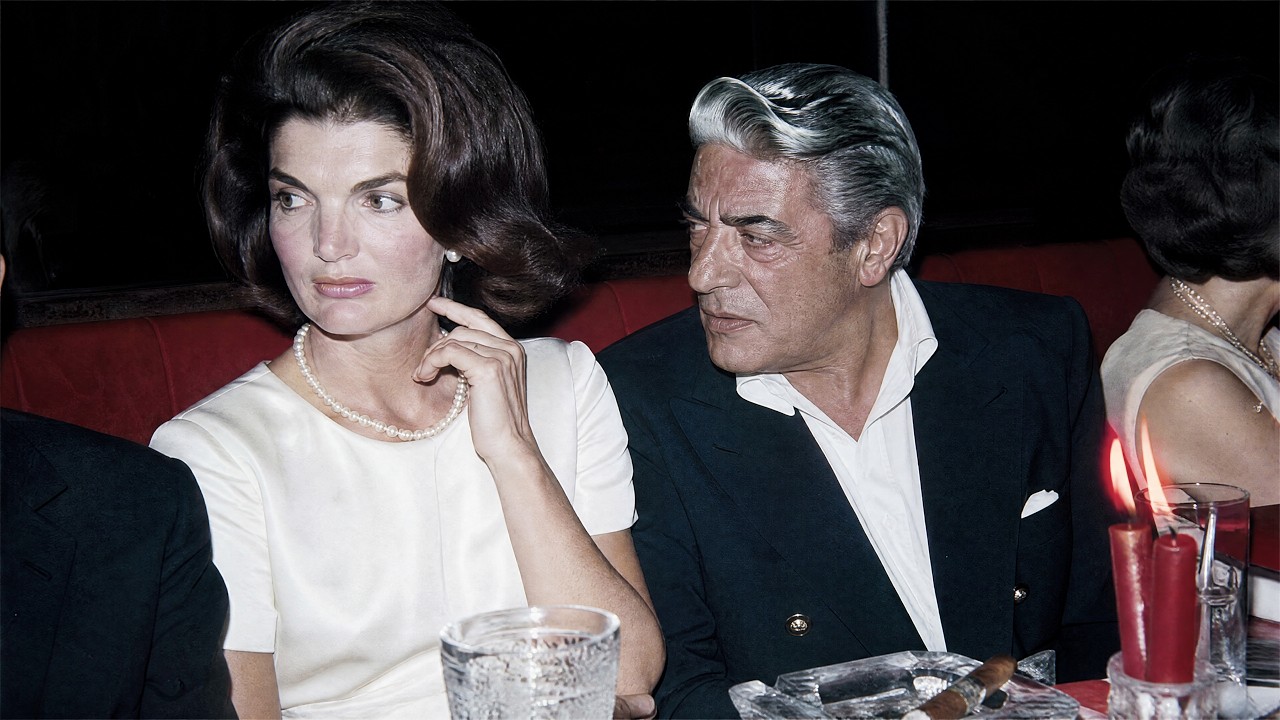
The document sealed the marriage. The marriage did not seal the man, because on the other side of Europe, in an apartment on Avenue George Mandel in Paris, a woman was waiting who did not read the contract and never had to.
Within months of the wedding on Scorpios, Aristotle Onassis was dining in Paris with the woman he had told confidants was the love of his life.
Maria Callas, born Maria Anna Cecilia Sophia Kalogeropoulos in New York in December 1923 to Greek immigrant parents, was in her early 40s by the year of the Scorpios wedding and, by any measurement other than commercial appearances, the greatest operatic soprano of the 20th century.
She had reshaped what audiences expected from Bellini, from Cherubini, from Verdi. She had turned the role of Norma into her own signature. She had sung "La Traviata" in Milan that people still argued about in her lifetime. She had, in the middle 1950s, been at the very center of every serious opera house in Europe.
She had also, by the year of the Scorpios wedding, effectively retired from the great stages. Her voice had begun to fail in the early 1960s, at the same time that her personal life had reordered around Aristotle Onassis.
Her marriage to the Italian industrialist Giovanni Battista Meneghini, three decades her senior, had ended publicly and messily in the aftermath of the 1959 Christina O cruise. From 1959 forward, in the company she kept, in the residences she took, in the way she structured her days, she was the woman Aristotle Onassis had chosen.
She was not the woman he had chosen to marry. That was Jackie. She was the woman he had chosen to keep.
The historical record on this point is unusually clean, because Onassis's own longtime secretary put it in a book. Kiki Feroudi Moutsatsos worked for Aristotle Onassis as his personal secretary until his death. She published her memoir, "The Onassis Women," in 1998.
In it, in a passage that has been quoted by every serious Callas biographer since, she wrote that Aristotle and Maria never stopped seeing each other. Never.
Within months of the wedding to Jackie, they were dining together in public in Paris. Callas kept an apartment on Avenue George Mandel. Onassis kept an apartment on Avenue Foch. The two streets are a short walk apart. The paparazzi in the years of the marriage to Jackie began working the corner between them because they knew the traffic went in both directions.
For Callas, the return of Onassis to her life within weeks of his wedding to Jackie was cruel arithmetic. She had, by every reasonable reading, spent nearly a decade rearranging her career and her marriage for him.
Peter Evans, in his controversial book "Ari" and again in his later book "Nemesis," alleged that Callas had, at Onassis's request, ended at least one pregnancy in the years of their affair. Evans's specific claims about a lost child in 1960 are not universally accepted and have been questioned by other biographers, and they are attributed rather than settled.
What is not contested is that Callas gave the last productive years of her career and much of the possibility of her private life to a man who, when the choice was between the woman he wanted and the woman he wanted the world to see him with, chose the second — and who, within weeks of the wedding to the second, quietly went back to the first.
For Jackie, the meaning of the return of Callas was written on the same city map. Her husband's apartment on Avenue Foch was a 15-minute walk from her rival's apartment on Avenue George Mandel.
When Onassis was in Paris, he was not in New York with his wife. When he was in Paris, he was often, according to the paparazzi photographs, at dinner with the woman he had told his own household staff was the great love of his life.
The most famous woman in the world was quietly and consistently being humiliated on the front pages of European newspapers by a woman whose voice her husband had loved for a decade.
Jackie's public response to this was silence. She did not defend herself in print. She did not brief reporters. She rarely spoke about her marriage in her lifetime and never spoke about Callas by name.
Her private response, according to the biographers who have looked closely, was containment. She lived in New York. She kept her children on the Kennedy schedule. She saw her husband when he was on her continent, and she did not chase him when he was on his.
She managed the arrangement with the discipline of a woman who had learned over the death of her first husband that public display of pain was a currency she was not willing to spend.
The tabloid economy of the late 1960s and early 1970s made this containment nearly impossible. Ron Galella, an American paparazzo who eventually became the subject of a landmark lawsuit that Jackie brought against him for stalking her, made his name in these years, photographing her walking on Madison Avenue in a headscarf and sunglasses.
Those photographs became, and to some extent remain, the enduring public image of Jackie Onassis. The sunglasses were the signature. They were also, in this period, a shield. They meant that even on a Manhattan sidewalk on a bright afternoon, the most photographed woman in the world could not be seen to react to the news that her husband had been photographed the night before in Paris with the mistress he had never given up.
Callas herself continued to live between Paris and Milan for the rest of her life, mostly alone, teaching master classes at Juilliard in New York in 1971 and 1972 that are still studied by opera students, and dying alone in her Paris apartment on September 16, 1977, at the age of 53 — two years and six months after Aristotle Onassis.
The cause of her death was formally recorded as heart failure. Her friends who wrote about her in the years afterward were consistent that she had been, for a decade, the woman he had loved and not chosen.
For the argument of this story, Callas is the woman whose presence in the marriage is the proof that Jackie was never the woman Aristotle Onassis wanted. Jackie was the woman he wanted to be seen with. Callas was the woman he came back to.
Both were, in different ways, discarded by the same man, and both were dressed up by the tabloids as rivals when they were, more accurately, two casualties of the same fortune.
For most of the marriage, the man she had married slept on a different continent than the woman he had married. The pattern was set within the first six months.
During the American school terms, Jackie was in New York at 1040 Fifth Avenue, the 15-room co-op she had bought in 1964. Caroline and John, still small children at the wedding, were in Manhattan schools. Jackie's job, in her own understanding of it, was to keep them fed and read to, and to keep them out of the frame of the men with cameras who had learned to camp outside the building.
Aristotle Onassis, in the same months, moved among Paris, Athens, Scorpios, and Monte Carlo on the ordinary rotation of his business. His shipping empire was headquartered in Monte Carlo. His airline, Olympic Airways, was headquartered in Athens. His personal geography was European.
When his business brought him to New York, he did not, for most of the marriage, stay at 1040 Fifth Avenue with his wife. He stayed in his own suite at the Pierre Hotel on Fifth Avenue and 61st Street, six blocks from her building.
Sarah Bradford records this in "America's Queen." Barbara Leaming records it in her own biography of Jacqueline Kennedy. It appears in the private accounts of the household staff. The most famous woman in America and one of the richest men in the world had a marriage that operated in New York as two hotel reservations six blocks apart.
They were, by every account of the marriage that has been produced from the household side, rarely in the same country for more than a week at a time. Their honeymoon in the autumn of 1968 was on the Christina O and on Scorpios. After it, the pattern of separate residencies began.
During Christmas and summer, Jackie brought the children to Scorpios or to the yacht, and the family assembled. Between those blocks, the marriage was largely conducted by telephone.
The physical geography of the marriage was underwritten by a fortune worth pausing on. Aristotle Onassis's estate at his death was valued at around $500 million in the money of 1975.
He owned personally or through his companies a fleet of oil tankers estimated at 40 to 50 ships. He owned Olympic Airways, the Greek national carrier, from 1956 to 1975, running it as effectively his own airline. He owned a substantial share in the Monte Carlo casino operator, the Société des Bains de Mer, from the middle 1950s until his forced buyout by the Monaco government in 1967.
He owned Scorpios and the smaller neighboring island of Sparti. He owned the Christina O. He owned an apartment on Avenue Foch in Paris, houses in Athens, a permanent suite at the Pierre in New York, and interests in mainland Greek real estate that came with being one of the country's largest private employers.
It was, in the money of the day, one of the 12 or 15 largest private fortunes on Earth. That fortune paid, in effect, for a marriage that mostly existed on paper.
When Jackie flew from New York to Paris to Athens to Scorpios, she flew on Olympic Airways, generally with a private cabin blocked off for her at the front of the aircraft. When she stayed at the Avenue Foch apartment, she stayed in rooms he had furnished before her. When she walked out into a Manhattan afternoon in a couture coat and headscarf and sunglasses, the coat was paid for out of the household accounts he had opened for her at various Paris and New York houses.
The fortune surrounded her. The husband did not.
The daily texture of the arrangement, in the biographies that draw on the household side, is that of a marriage lived largely by telephone. A husband on the wrong side of the Atlantic, a wife in a Manhattan apartment furnished for two lives, one of which was almost never present.
Weeks would pass in which the couple was not in the same country, and the domestic infrastructure of a marriage — meals and rooms and calendars — had to be run for a household of one dressed as a household of two.
The one physical geography where the marriage held was Scorpios in the summer. On the island, Onassis was in his own kingdom. He walked the paths in white trousers and open collar, put a cigar in one hand and a whiskey in the other, and behaved as a host to his own household.
Caroline and John swam. Jackie read on the terrace. Photographs of these summers, some taken by paparazzi at great distance from the water, some staged for the wire services, sold the fairy tale back to the American public.
What the wire photographs did not carry was the fact that the family was on the island for six weeks a year, and that for the other 46 weeks, the marriage was a shared calendar and a phone line.
For a woman who had married for safety, this geography had one particular consequence. It meant she could not, in the daily sense, count on her husband to be near her. Her Secret Service protection was gone. Her Kennedy protection had thinned. Her new husband's protection came in the form of a fortune that paid for guards, for apartments, for planes, for the island.
But when she looked up at the empty seat at the table on any given weekday, there was no man in it. The safety she had traded her country for was, on almost every day of the year, in another country.
In her first year of marriage, Jacqueline Onassis reportedly spent $1.5 million, and every dress became evidence in a case her husband was already building against her.
The $1.5 million figure is one of the most frequently repeated numbers in the Jackie Onassis story. It has been attributed to reporting from Onassis's own office and to accounts from his personal staff. Like the numbers in the Cafarakis contract, the specific figure has been repeated so often that it has passed into legend.
It stands most usefully not as an audited total but as a plausible order of magnitude for what a wife of Aristotle Onassis with an open account at Valentino and at various New York and Paris jewelers could spend in 12 months if she wanted to. By every account of the household, she wanted to.
Jackie's spending habits after her first husband's death had already been noted in the American press. As the wife of the richest man alive, the constraint on those habits had been removed. The couture accounts opened. Clothes she sometimes wore only once were resold rather than photographed on her a second time. The Paris couture houses expected her business through the whole of the marriage. So did the jewelers on Fifth Avenue in New York.
Aristotle Onassis, who had bought a Greek airline, an oil fleet, and an island without flinching, took the bills for his wife's dresses very badly indeed.
This is not a subtle detail in the Onassis biographies. It is the detail. From the first year of the marriage, he was in front of his own household staff and his closest business associates complaining about her spending. Sarah Bradford records him mocking her to friends. Peter Evans, with the usual cautions, records him doing the same.
In the letters and diaries of household staff quoted in later books, the complaint recurs in nearly identical language across sources. He had imagined he was acquiring a serene, self-contained public icon who would grace his boats and his islands. What he was billing for, he thought, was a woman who was quietly converting his fortune into clothes she did not need.
The scale is the point. In the same year in which his wife was reportedly spending $1.5 million on personal expenses, the American federal minimum wage was $1.60 an hour. A new suburban house in the United States cost roughly $25,000. A midsize American family car cost about $3,500.
Her single year of personal expenditure could have bought 60 houses. It could have bought 400 cars. It could have bought the accumulated annual wages of nearly 500 American workers.
That is not a moralistic point about her personal choices. It is the arithmetic that made her husband see her, when he looked at her, as an outflow.
There is a deeper irony that Aristotle Onassis apparently did not see. He was at exactly the same time spending vast sums on the yacht, on the island, on private aircraft, on Callas, on the Avenue Foch apartment, and on his own children without complaint.
He was buying a certain lifestyle in Monte Carlo that would have shocked most of the American public if it had been itemized. He was tolerating Maria Callas's own expenses across the entire arc of their affair. But when the bills for the couture houses and the New York jewelers arrived, he made those bills a moral issue.
His wife's spending was greed. His mistress's expenses were a courtesy. His own expenses were the cost of being Aristotle Onassis.
The double standard is not incidental. It is the whole story of the marriage. In the world Aristotle Onassis lived in, a woman's cost was a mark against her character. A man's cost was a mark of his fortune.
Jackie was, in his private conversation, becoming greedy. He, in the same private conversation, remained generous.
The double standard applied to a woman he had already begun to lose interest in poisoned the marriage very fast. By the early 1970s, the poisoning was, in his circle, common knowledge. He complained about her spending to his lawyers. He complained about her spending to his sister, Artemis. He complained about her spending, most damagingly, to his children, Alexander and Christina, both of whom already disliked the American widow their father had married and now had additional reason to see her as a threat to the inheritance they considered theirs.
Christina, by the middle years of the marriage, was calling Jackie, in the household, nicknames it would be ungenerous to reprint. Alexander shared his sister's view. The family council against Jackie was, by 1972, a stable feature of Onassis household life.
Jackie's response again was silence. She did not brief reporters on the state of her marriage. She did not defend her spending. She managed her side of the arrangement, kept her children on their schedule in New York, took the Onassis fortune's calls at nine in the morning, and put down the phone.
What she could not manage, because it lay outside her control entirely, was the sequence of family losses that would take the ordinary bad marriage of 1972 and turn it, within a year, into something colder and more dangerous.
On January 22, 1973, Aristotle Onassis's only son climbed into a small amphibious aircraft at Athens airport and never climbed out again.
The aircraft was a Piaggio P.136, an Italian-built twin-engine amphibious light plane popular among wealthy Greek owners for its ability to land on both runways and coastal water. It belonged to the Onassis family.
Alexander Onassis, 24 years old, was a licensed pilot in his own right. On the afternoon of January 22, 1973, he flew as a passenger in the right-hand seat while a Czech pilot ran a training flight.
The plane took off from Ellinikon Airport in Athens. Within seconds of leaving the ground, it banked hard right, dropped its right wing, cartwheeled, and slammed into the runway.
Alexander suffered massive head injuries. He was extracted from the wreckage alive. He was flown to a private Athens hospital unconscious. His father called neurosurgeons in London, Boston, and Paris and had at least one flown to Athens on his own aircraft. The specialists agreed there was nothing to do. The head injuries were catastrophic and irreversible.
On January 23, at the age of 24, Alexander Onassis was declared dead. His father authorized the removal of life support himself. He never recovered from it.
This is not a novelist's line. It is the assessment of every person who knew Aristotle Onassis in the two years afterward: his household staff, his business partners, his secretary Kiki Moutsatsos, his sister, his daughter, the friends who saw him monthly on the yacht, the biographers who interviewed those people.

To a person, the account is the same. On January 23, 1973, Aristotle Onassis went into a grief he did not walk out of.
His first response was to refuse the accident. He believed, or wanted to believe, that his son had been murdered and that the crash had been sabotaged. He commissioned at his own expense a private investigation. He offered a reward reported at $1 million for evidence of foul play.
Investigators searched the wreckage. They interviewed the Czech pilot, who had also been badly injured. They tested the flight controls. They found nothing. The Greek official inquiry ultimately concluded that the accident had been caused by a mechanical failure of the aileron control cable, the cable that operated the plane's roll axis.
Onassis never accepted the finding until the day he died. He told friends that his son had been killed by an enemy. He never named the enemy convincingly.
The grief broke him physically. In the year after Alexander's death, his own health began to fail visibly. He was diagnosed with myasthenia gravis, a chronic autoimmune disease in which the body's own antibodies attack the receptors that let nerves tell muscles to contract.
Its first common sign in adults is that the eyelids stop working. The eyelid muscle is small and easily overwhelmed. Onassis's eyelids began to droop and then to close on their own. To read papers in his last months, he had to have his eyelids taped open.
The most powerful private hand in the shipping world sat at his own desk and could not, without help, hold his own eyes up to see it.
The grief broke him relationally. He began, in the months after Alexander's death, to say something to his household that no one who knew him had heard him say before. He began to speak of Jackie as bad luck. He began to say that the woman he had married had brought misfortune into his house.
He began to link, in his private conversation, his son's death to the fact that he had married the widow of a president whose brother had also been shot and whose whole American family seemed to draw down catastrophe.
Several accounts, including Peter Evans's, record him using the word "jinx" and the word "curse" and the phrase "family curse" in his conversation about her.
There is no evidence of any kind that this superstition tracked to anything Jackie had actually done. There is a great deal of evidence that grief and myasthenia and a lifetime of buying his way out of every problem had combined in this man in his mid-70s to produce a strain of anger that had to land somewhere. It landed on his wife.
The funeral on Scorpios in late January 1973 was the moment when the marriage, if there had ever been a chance of it, effectively ended.
Alexander was buried on the island in a mausoleum his father had constructed at speed, close to the chapel of Panagitsa, where Aristotle had married Jackie four years and three months earlier.
Onassis stood beside the grave. Christina stood beside him. Jackie stood a step behind him. The father wept. The daughter wept. The wife did not.
Christina, according to the biographers who have interviewed household witnesses, did not forgive her stepmother the composure at that graveside for the rest of her life.
Jackie's composure on that day was, on every reading of her character, the same composure she had brought to the grave at Arlington in November 1963. It was her mode of grief. It was the mode of grief a Kennedy widow had been trained into. It was not indifference.
But to Aristotle Onassis, at his lowest hour, standing beside the coffin of his only son, the woman he was married to looked, in the language he used to his friends afterward, like a wall.
He had already privately begun to blame her for his family's fortunes. He now added to the ledger the fact that at his son's funeral, she did not weep with him.
From that day forward, according to every account of the Onassis household in the last two years of his life, he began to plan against her. Not immediately, not efficiently, but steadily, and with lawyers.
In his grief for his son, Aristotle Onassis began to speak of his own wife as a jinx, a curse he had married into his family.
The line, in various forms, is quoted in every serious biography of the marriage. It is not a single sentence he ever wrote down. It is a pattern of comments to sisters, to old friends, to household staff, to Onassis's own private lawyer, in which he expressed more and more openly across the year of 1973 and into 1974 the conviction that Jackie had brought bad luck to his family.
Some of the comments are secondhand and should be treated as such. Others are attributed by named witnesses. Taken together, they establish a fact even Onassis's defenders concede: that in the last two years of his life, he no longer saw his wife as his partner, but as a source of his misfortune.
The belief did not root in a vacuum. Place it in the wider run of losses inside his family in this same window.
Alexander was dead in January 1973. His former wife, Athina Livanos, called Tina, whom he had divorced in 1960 and who had gone on to marry his own rival, the shipping magnate Stavros Niarchos, was found dead of a suspected overdose in Paris on October 10, 1974, at the age of 45.
The circumstances of her death remain contested. The official cause was recorded as an edema of the lung. Some accounts have alleged a barbiturate overdose. Aristotle Onassis, on hearing the news, is reported to have wept in a way his staff had not seen him weep since the day of his son's death.
In 14 months, Onassis had lost his only son and, in effect, his first wife, the mother of both his children. His own health was collapsing. The Greek airline Olympic, which he had owned since 1956, was about to be effectively nationalized by the Greek state in a dispute he did not have the physical energy to fight.
Every plank of the life he had built out of the fire at Smyrna was, in 1974, cracking under him at once.
Superstition is a common companion of overwhelming grief in old age, and Onassis had always kept his own strain of Greek superstition close to hand. The word he began to use for his wife was, in the language he was raised in, an ordinary word. In the language his wife was raised in, translated by the household staff and biographers who reported it, it hardened into curse, jinx, evil eye, and family curse.
Peter Evans, in his book "Ari," records him using the phrase "family curse" repeatedly. Nicholas Gage, in his book "Greek Fire," which is centrally about the Callas relationship but which touches on the last years, records the same pattern of speech. Sarah Bradford records the accounts more cautiously but reaches the same conclusion.
There is a second layer to the anger that has to be named. Onassis's grief for Alexander went in a specific direction. He believed his son had inherited from him a fortune that had come at the cost of a certain amount of blood out of the shipping industry, and that Alexander was to have inherited it and used it to redeem the second half of the family story.
When Alexander died, the redemption plan died with him. The remaining son of the household story was the daughter Christina, whom he adored but did not believe capable of running the empire. That is a common failure of imagination on the part of fathers of that generation in the shipping business.
Onassis, in his grief, is reported to have said that he had built the empire for his son and now, without his son, saw the empire as pointless. He said it in front of Jackie. He said it in front of his own staff. In each case, according to those who were there, the implication was that the wife present at his side was, in his eyes, not the woman he had wanted to build for.
Jackie, in this period, absorbed the accusations largely in silence. She continued to travel between New York and Scorpios. She continued to stage the family holidays. She continued to appear at her husband's side at public occasions when his own health allowed.
She continued to write him private letters that, on the few occasions they have been reported by biographers with access to family files, were both dignified and affectionate. She did not, in the historical record, ever accept the accusation that she was a source of ill luck. She also did not, so far as can be documented, ever leave the marriage.
The most quoted attempt on her part to reach him in this period comes from Peter Evans, again with the standard cautions. Evans reports that Jackie tried in the middle 1970s to arrange a private lunch with Aristotle in Paris, at which she asked quietly whether he wanted her to leave the marriage.
Evans reports that Onassis said no, that he wanted her to remain his wife, but that in the same conversation he told her that his life was over and that his son's death had ended him.
If that account is accurate, and it is worth flagging that it depends on a single biographer with a mixed record, it captures the essential paralysis of the last two years. Aristotle Onassis could not commit fully either to keeping his wife or to divorcing her, and the same man was capable of asking her to stay in the marriage on one day and, on other days, hiring the lawyers who would tell him how to end it.
There is one more piece of context that belongs here, because it explains the shape of what came next. Christina Onassis, 22 years old at the time of her brother's death, was by the year of her brother's funeral effectively the heir. She was also, by that year, married to a man her father disapproved of, the American real estate investor Joseph Bolker, whom she had married in Las Vegas in July 1971, without her father's consent and against his wishes.
Aristotle pressured her to divorce. She did, in February 1972. In the year of her brother's death, she was moving from one bad marriage to the beginning of a life shaped all four times around the men her father wanted her to have. She would have three more husbands over the following 16 years.
Her judgment on her stepmother in the same years was ferocious. She agreed, in her own conversation with her father's assessment, that Jackie was a curse.
The last thread of warmth in the marriage was cut, in short, not by any specific incident, but by a slow domestic combination of a father's grief, a daughter's hostility, a first wife's suspicious death, an old husband's decaying body, and a superstition that gave a name, however unjust, to the whole disaster.
That combination sent Aristotle Onassis to his lawyers.
In the last year of his life, Aristotle Onassis instructed a lawyer to prepare divorce papers and hired a private detective to follow his wife.
The best single source for this passage of the marriage is Arianna Stassinopoulos's biography of Maria Callas, published in 1981 and later reissued under her married name, Huffington. Stassinopoulos interviewed Callas's circle at length. She interviewed household witnesses in Paris and Athens.
She was able to establish, on the basis of multiple corroborating sources, that Aristotle Onassis in the last months of his life had begun the concrete work of preparing a divorce from Jackie. He had instructed a lawyer to draft proceedings. He had hired a private investigator to follow Jackie in New York with the specific aim of producing evidence of adultery. He had, according to Stassinopoulos, wanted the separation to be as humiliating for his wife as it could legally be made to be.
Some readers of the Jackie story will recognize the specific name that has been attached in various popular accounts to the lawyer he retained. That name is Roy Cohn, a prominent New York attorney of the period.
Cohn's name in the Onassis divorce plan appears in several popular books and in tabloid retellings. It does not appear as securely in the primary sources. Serious biographers of Jackie treat the identification with more caution than the tabloids. What is well documented is that Onassis retained legal counsel to prepare a divorce action against his wife. The specific identification of Roy Cohn as that counsel is widely repeated but less firmly attested and is presented here as reported rather than established.
The private detective is on firmer ground. According to Stassinopoulos and to accounts corroborated in Peter Evans and Nicholas Gage, Onassis hired at least one investigator to follow Jackie in New York in the second half of 1974 and the beginning of 1975.
The investigator's brief, in the version that has been reported, was to identify men Jackie was meeting, to establish where and when, and if possible to produce photographic evidence of an extramarital relationship.
Jackie's private life in this period is described by her biographers as quiet. She was in mourning for a marriage in which her husband was dying and hated her. She spent evenings with old friends. She saw her children. The investigator's brief, in the historical record, appears not to have produced any actionable material.
What matters is not what the investigator found. What matters is that he was hired.
Sit for a moment with that fact. The most photographed woman in the world, the widow of a murdered American president, the woman onto whom the American public had projected a decade of grief, was in the last months of her second husband's life being followed on the streets of Manhattan by a man on that husband's payroll.
She did not, so far as any credible account records, know it at the time. She would learn about it, if she ever learned about it in detail, only after her husband's death, when the trail of hired invoices could be reconstructed by biographers.
To understand why he did it, you have to hold two facts alongside each other. First, Onassis was in genuine physical decline and knew he was likely to die. He wanted, if he could, to be dead legally single. He wanted his wife locked into whatever settlement he could construct rather than into whatever share Greek forced inheritance law and American widows' law would combine to give her at his death.
Second, he wanted to punish her. This is not a moral gloss. It is the reading multiple biographers, including his own household staff in their later accounts, took of his mood in his final year. He wanted, before he died, to hurt her publicly. He wanted the last chapter of the marriage to be the exposure and shame of the woman he had once acquired.
There is a small chilling detail from Christina Onassis's later interviews with biographers that belongs here. Christina, whose hostility to her stepmother has been documented from the wedding onward, was aware of her father's divorce planning. She encouraged it. She believed, in her own account to later biographers, that a divorce would protect the Onassis fortune from what she considered an American plunderer.
Her father's lawyer was, in effect, working simultaneously for two clients, an ailing father and an angry daughter, both of whom wanted the same outcome.
The lawyer was also, according to the same accounts, cautious about the timing, because the physical evidence was that Aristotle Onassis was too ill to survive a divorce proceeding. The lawyer was right.
Onassis's health collapsed at the end of 1974. He was flown to Paris, then to New York, then back to Paris. He was too weak in the last three months of his life to hold the pen that would sign the papers his own lawyers had begun to draft. The divorce action, in the final accounting, was never filed.
Jackie Onassis was, in the last months of her husband's life, being followed by a detective he had hired and was at the same time the future beneficiary of a will he had not yet been able to rewrite against her. She was, in one and the same room in Paris, still legally his wife and still the target of the divorce he would not survive to file.
Only his own dying body kept the last shame off her.
In the last months of his life, Aristotle Onassis's eyelids had to be taped open so that he could see the papers he was signing against his wife.
The myasthenia gravis had been diagnosed in 1973. By the beginning of 1975, it had progressed to the point at which Onassis was being kept upright with steroids and effort. His breathing weakened, his swallowing weakened. He lost weight. In photographs from Paris in the winter of 1975, the man looks a decade older than he had at Scorpios seven years earlier.
He was at that point either 75 or 69 years old, depending on which of his birth dates you take. Either way, he was a physically diminished version of the man Jackie had married.
In early February 1975, he collapsed at the family home outside Athens. He was diagnosed with acute cholecystitis, an inflammation of the gallbladder complicated by the underlying myasthenia and by an already weakened cardiovascular system. His family flew him to Paris.
On February 10, at the American Hospital of Paris in the suburb of Neuilly-sur-Seine, he was operated on for the gallbladder. The surgery itself was survivable. His body was not. He remained in the hospital for the next five weeks, mostly on a respirator, unable to speak, breathing with mechanical assistance for hours at a time, drifting in and out of lucidity.
Jackie remained in the United States for most of those five weeks. Contemporary press reports and the later biographies established that she was in New York with her children during the crisis, that she flew to Paris to see him, and that she flew back to the United States.
The most persistent line of criticism against her in the American press in the years afterward has been that she was not at her dying husband's bedside for the final hours. The historical record is that on the day he died, March 15, 1975, she was in New York and Christina was at the hospital. The house had been, in effect, the daughter's for the final week.
It has been debated for 50 years whether this reflected Jackie's coldness, Christina's refusal to have her present, Onassis's own drift and reluctance, or all three at once. The most cautious reading is that the family's household politics in that final week were as poisonous as they had been for the previous two years, and that Jackie's absence at the moment of death was determined by decisions on both sides, not by hers alone.
Aristotle Onassis died on March 15, 1975. He was formally 69 years old, or 75, or 76, depending on the birth year. Christina was at the hospital. Maria Callas was in her apartment on Avenue George Mandel, a few miles away. Jackie was in New York.
The three women whose lives had turned around him were, at the moment of his death, arranged in a triangle exactly like the one that had defined the marriage.

His body was flown back to Greece. His funeral was held on Scorpios on March 18, 1975, three days later. He was buried in the small family mausoleum beside his son Alexander, whose grave the two years of grief since 1973 had shaped every remaining hour of his life.
Jackie attended. Christina attended. Callas did not. Tina Livanos, the mother of both his children, had been dead six months.
The mausoleum on Scorpios, in the small chapel yard of Panagitsa where Aristotle had married Jackie in 1968, became the physical center of the Onassis family story. At the funeral, the two women who had lived through the marriage stood in the same yard and did not stand in the same story.
Jackie, composed in dark glasses, held the register her whole public life had trained her into. Christina, 24, her father's daughter and now his sole surviving heir, stood with the hostility toward her stepmother she had carried since Scorpios.
Almost as soon as the funeral was over, the will became the story.
Aristotle Onassis, in a will drawn up in Athens in late 1974, in the weeks after his health had collapsed but before he had lost lucidity, had made an unusual set of provisions.
He had left roughly 55 percent of his estate to his daughter Christina. He had left the remaining 45 percent to a foundation to be established in his son's memory, the Alexander S. Onassis Foundation, to fund cultural and scholarly work in Greece and abroad.
He had left his wife, in the terms most commonly reported, an annuity of around $250,000 a year for life and $150,000 a year for each of her children. The house on Scorpios, the yacht, the apartments in Paris and Athens, the ships — all went to Christina and to the foundation.
Jackie was left with an American cash flow and effectively no share in the physical fortune she had lived among for seven years.
For a widow who had been married, however unhappily, to one of the 12 richest men in the world, a $250,000 annuity was a deliberate insult. It was more than she needed to live on. It was less than a fraction of what Greek forced inheritance law and American practice, taken together, would have given a widow whose husband had died without such careful provisions.
It was, on any fair reading, a message from the deathbed. Aristotle Onassis had not been able to divorce her before he died. He had done, in his will, the next best thing.
The will that Aristotle Onassis left behind cut his American widow down to an annuity and told her stepdaughter to fight her.
Almost immediately after the funeral in March 1975, the fight over the estate began.
On one side, Christina Onassis, 24 years old, inheritor of an empire she had been trained by her father not to expect to run and now had to. On the other side, Jacqueline Kennedy Onassis, 45 years old, the widow of a president and now the widow of a shipping magnate whose American lawyers understood exactly how far the will could be pushed under Greek forced inheritance law and under American widows' rights.
The legal ground was almost embarrassingly complicated. Aristotle Onassis had died a Greek national, and his primary estate was under Greek law. Greek forced inheritance rules guaranteed a surviving spouse a fixed portion of the estate regardless of the will's provisions. The provisions in the will attempted to override that guarantee by naming the annuity as a full and final settlement of Jackie's claims. Whether it could override that guarantee in the actual courts of Piraeus was open to argument.
Jackie's American lawyers argued that under Greek law she was entitled to something in the neighborhood of one-eighth of the entire estate, which, on the reported estate value of $500 million, would have amounted to more than $60 million.
Christina, on her side, had inherited not only the money but her father's private determination that his American widow should be given as little as possible. She spent the first year after the funeral making that determination public, in her conversation with her father's circle and in her handling of the estate.
Every trace of Jackie's presence in the Onassis physical world, in Bradford's account of the household aftermath, was quietly separated out and returned to her in New York.
The negotiations moved slowly, and with occasional press leaks, through the second half of 1975, through 1976, and into 1977. Both sides had reasons to settle.
Christina wanted to run the empire without the reputational drag of an ongoing lawsuit with the widow of a beloved American president. Jackie wanted the money and the release. A prolonged suit in the Greek courts would have taken years and, given the volatility of the drama and the political situation in Greece in the second half of the 1970s, could have degraded the very fortune both women were fighting over.
The settlement was reached in 1977. The most commonly reported figure is $26 million paid to Jackie in exchange for a full and final release of all further claims on the Onassis estate. Some accounts give the figure closer to $20 million. Some later accounts give it slightly higher. The exact number is not audited in the public record. The order of magnitude, in the money of 1977, is not in dispute.
It was at the time one of the largest cash settlements ever paid to an American widow. In today's money, indexed for inflation, the settlement is often described as being worth roughly $100 million to $120 million.
It made Jackie, at 47, a wealthy woman independent of the Onassis fortune, of the Kennedy trusts, and of the Bouvier and Auchincloss family money she had grown up around. It also — and this is the point — released her.
Whatever her marriage to Aristotle Onassis had been, from Scorpios to the American Hospital of Paris, its legal ending was on paper, signed, closed, and paid. She was no longer his widow in any active sense. She was no longer his daughter's adversary. She was her own client.
The scale of the fortune she had left behind makes the sense of the exit clearer. Christina Onassis, 27 when the settlement was signed, inherited a business estate that included still a substantial oil fleet, interests in Greek and international real estate, residual airline stakes, and the private wealth in the foundation.
She inherited one of the largest private fortunes in the world at 27. On any measure, a wealthy woman for the rest of her life. She married four times in her adult life: to Joseph Bolker of Los Angeles, to Alexander Andreadis of Athens, to Sergei Kauzov of Moscow, and to Thierry Roussel of Paris. She had one child, a daughter named Athina, born in 1985.
She struggled publicly with weight, with depression, and with dependence on prescription medication for most of her adult life. She died in Argentina on November 19, 1988, of heart failure, at the age of 37.
Her daughter Athina, 3 years old at her mother's death, became the sole heir to the Onassis fortune. Athina Onassis, born in 1985, is the last direct descendant of Aristotle Onassis.
Scorpios, the island of the wedding and the funerals, was eventually sold in effective terms to a family connected to the Russian billionaire Dmitry Rybolovlev, in a deal involving Athina's inheritance, and the small private world in the Ionian passed out of Onassis hands.
The Christina O was sold, restored, and now operates as a charter vessel. The Alexander S. Onassis Foundation, established under the will, remains a substantial funder of Greek cultural and scholarly work more than five decades after Aristotle's death.
In the same year that Jackie signed her release, in a small footnote no one in the immediate family attended, Maria Callas died in Paris on September 16, 1977, alone, at 53.
The father dead in Paris in 1975. The mistress dead in Paris in 1977. The first wife dead in Paris in 1974. The son dead in Athens in 1973. The daughter still alive but 11 years from her own death in Buenos Aires. And the widow Jackie in New York, released, cashed out, and for the first time in a decade, alone.
At 47, Jacqueline Onassis walked away from the fortune that had failed her and took a job at a New York publishing house.
The house was Viking Press. She joined it in 1975 as a consulting editor at a starting salary of $200 a week, working four days a week. She worked on a floor in Manhattan with editors who at first were unsure what to do with a colleague who was the most famous woman in the country and then, within months, stopped noticing.
She acquired books. She edited manuscripts. She sat in editorial meetings and defended her lists. She left Viking Press in 1977, the same year as the estate settlement, after a dispute over a novel that fictionalized a Kennedy assassination.
She moved to Doubleday, another New York publishing house, where she worked from 1978 until her death, eventually as a senior editor.
The books she published at Doubleday matter. Under her editorship, the house brought out memoirs of the ballet dancer Rudolf Nureyev and of the Egyptian first lady Jehan Sadat. It brought out the writer Naguib Mahfouz in English, work that later contributed to his Nobel Prize. It brought out a series of books on the visual and performing arts that reflected the editor's own long-standing interest in dance, in architecture, and in the preservation of American public buildings.
She was, by every credible account of her colleagues, a working editor, not a symbolic hire. She sent handwritten notes to writers. She fought for her lists in editorial meetings.
The second life had a second partner. In the middle 1970s, she began a discreet relationship with Maurice Tempelsman, a Belgian-born American diamond merchant, a divorced father, an old family friend from her years as first lady, and a man whose personal register was as private as hers.
They never married. Tempelsman moved into her Fifth Avenue apartment in 1982 and remained her companion for the final 12 years of her life. He was, by the account of her closest friends, the only man who ever managed to make her feel safe.
He was also, and this is the very small revenge of the story, an unusually skilled investor. He is credited by her biographers with managing the $26 million Onassis settlement into a private fortune reported at her death of between $100 million and $200 million.
That, on the face of it, is an answer to Aristotle Onassis. The husband who had cut her down to a $250,000 annuity had, in the end, given her the seed capital of an independent fortune that she then, in a decade, multiplied under the hand of a man she actually loved.
The husband who had planned to have her followed by a detective was, in death, the reason the woman she became at Doubleday could afford to say no to any book, any interview, any dinner she did not want. The husband who had lobbied Greek law to reduce what his wife could take from him had, in the end, been outmaneuvered by her lawyers, her second partner, and her own patience.
She lived quietly for those last decades in a way that was hard for Americans to see clearly at the time. She walked in Central Park in the mornings. She swam and rode horses on Martha's Vineyard, where she and Tempelsman built a house at Red Gate Farm. She was a grandmother to Caroline's three children and remained close to John Jr.
She kept up her long involvement with historic preservation in New York, most famously the campaign to save Grand Central Terminal in 1975 and 1978, when the terminal was under threat of demolition and her intervention was, by the accounts of the preservationists who were there, decisive.
In the late winter and spring of 1994, she was diagnosed with non-Hodgkin lymphoma. She underwent chemotherapy. She was seen briefly walking in Central Park in a headscarf and sunglasses in early May.
She died on May 19, 1994, at 1040 Fifth Avenue in New York, at the age of 64, with her children beside her. Her funeral was held at St. Ignatius Loyola Church on Park Avenue, a few blocks from her home.
She was buried, at her own request, next to John Fitzgerald Kennedy at Arlington National Cemetery in Virginia, in the plot where their two lost children, a stillborn daughter and their infant son Patrick, had already been laid to rest.
She was not buried beside Aristotle Onassis on Scorpios. That, more than any biography and any memoir and any interview she never gave, was her final statement on which marriage had been hers.
The husband who had planned to divorce her had, in death, been legally her husband. The husband who had been assassinated in a limousine in Dallas 30 years earlier had, in her private definition, always been.
She lay down at Arlington beside the Kennedy she had lost. The Onassis grave at the far side of Europe, on the small Greek island in the Ionian, had no place waiting for her, and she had asked for none.
The gap between the two graves, one at Arlington and one on Scorpios, is the visible shape of the argument. The Onassis marriage was, from Scorpios to the estate settlement, a manufactured image inside a contract inside a house divided across an ocean. It was not, at any point, the marriage in which she lived.
The marriage in which she lived, the marriage she chose in her own resting place, was the one she had lost in Dallas.
For 30 years, we watched her behind the sunglasses and told ourselves she had won.
The sunglasses became her. That was the tabloid line, and it was true in its way. On the sidewalks of Madison Avenue, on the beach at Scorpios, in the crowd at Grand Central Terminal, on the back of a New York taxi in the rain, in the arrivals hall at Charles de Gaulle, the same photograph appeared in slightly different frames for three decades: a woman in a headscarf, a woman in dark glasses, a face that had learned, over the deaths of two husbands and the erosion of one marriage into a plan for its own destruction, not to be read.
We told ourselves it was style. We told ourselves it was privacy. We told ourselves that a woman that famous had earned the right to a black plastic frame between her eyes and the country that had asked her to grieve on cue for a decade.
All of that was partly true. What was not partly true was the story we told ourselves about what was behind the sunglasses.
The story we told ourselves was that she had been rescued. That the Scorpios wedding was the last chapter and the second act was safety. That the widow of the Kennedy assassinations had been carried across an ocean and set down on a private island by a man rich enough to build a wall around her forever.
What was actually behind the sunglasses over the seven years of that marriage was a woman who was often eating dinner alone at a table set for two.
A woman whose husband kept an apartment on Avenue Foch and a mistress on Avenue George Mandel. A woman whose prenuptial contract had been negotiated with a senator on a Greek island. A woman whose spending on couture houses — spending her husband tolerated in his own mistress without a word — became the file her husband built against her.
A woman whose husband, in his final year of life, blamed her for his son's death in the language of a family curse and hired a lawyer to draft her divorce and a detective to follow her through Manhattan on the way to it.
A woman who was, in the strictest arithmetic, saved from a public divorce only by the collapse of the body of the man who was going to file it.
We looked at those photographs for 30 years and we saw a fairy tale, and we owe her now the acknowledgement that we chose not to see.
We watched her walk into the chapel on Scorpios. We watched her walk out of it into the rain. We watched her step onto the Christina O with her children on either side of her. We watched her disappear behind the sunglasses on Fifth Avenue for a decade.
We watched her walk into Grand Central Terminal to save it from the wrecking ball. We watched her walk out of Doubleday's Manhattan offices with a manuscript under her arm. We watched her walk beside Maurice Tempelsman on the Vineyard in the last summer of her life.
And in each of those photographs, we saw a woman who had come out ahead, and we did not ask what had happened to her on the other side of the sunglasses in the years between the pictures.
She was, in the end, only the most famous of them.
The systems that made and broke her were not invented for her: the marriage market that treated a widow as an acquisition, the inheritance law a husband could bend against his own wife, the tabloid economy that sold the photograph of her rescue and then the photograph of her humiliation and then the photograph of her second widowhood.
All of it existed before her and after her, and works in more polite forms still.
The wire services on October 20, 1968, sent one photograph around the world. A chapel in the rain, a bride in ivory, a yacht offshore, a Greek island bought for her.
It was, in its way, the most successful piece of image-making of the 20th century, because for 50 years afterward it was the picture everyone remembered.
Set that photograph beside every other picture we have of her, and look this time at where the eyes were behind the dark glasses.
She was not rescued at Scorpios. She was acquired. She spent seven years discovering that. She spent the 17 years after his death building the life she should have been allowed to build from the start.
She lies now at Arlington beside the husband she had chosen and lost, not beside the one she had signed for.