The American Old West has been romanticized for generations through films, literature, and folklore, but many of the most familiar stories about the frontier are more fiction than fact. The reality behind the legends reveals a more complex history involving diverse populations, contested lands, and working people whose lives looked little like Hollywood portrayals. One of the most enduring myths is that the frontier was open land freely available for the taking. In 1862, Abraham Lincoln signed the Homestead Act, which offered 160 acres to individuals willing to pay a small filing fee, improve the property, and live on it for five years.
Settlers eventually claimed about 270 million acres, much of it west of the Mississippi. By 1893, the U. S. Census Bureau declared the frontier era effectively closed, and historian Frederick Jackson Turner introduced his influential frontier thesis, arguing that successive waves of settlers shaped American identity.
That interpretation, however, ignored a crucial reality: the land was never empty. Indigenous communities had lived across these regions for thousands of years with established societies, trade networks, and cultural traditions. The Louisiana Purchase and territorial gains from the Mexican-American War vastly expanded U. S.
territory, but these developments came through complex political and military processes that had lasting consequences for the people already living there. Another common myth holds that American Indians were always on the losing side of frontier conflicts. While native populations suffered displacement and disruption, they also mounted effective resistance. In 1680, the Pueblo Revolt forced Spanish authorities to withdraw from the Santa Fe region for more than a decade.
In 1791, a confederation of native nations secured a major victory over U. S. forces in what became known as St. Clair’s defeat, one of the worst military setbacks in early American history.
During the 1860s, Red Cloud’s War successfully forced the temporary closure of the Bozeman Trail. The most widely known indigenous victory came at the Battle of the Little Bighorn in 1876, when Lakota, Northern Cheyenne, and Arapaho forces defeated George Armstrong Custer. Although American reports framed the outcome as a tragedy, many indigenous participants understood it as a defense of their communities. The broader conflicts eventually culminated in events such as the Wounded Knee Massacre, marking a turning point that reshaped indigenous life across the plains.
Hollywood has also exaggerated the violence of the Old West. Films by directors like Sam Peckinpah and Quentin Tarantino portray the era as one of constant danger, but the reality was far more varied. Some rapidly growing frontier towns tied to railroad expansion or mining booms did experience relatively high crime rates. Dodge City, Kansas, and Bodie, California attracted large transient populations that sometimes created instability.
In response, many communities imposed strict gun regulations. Tombstone, Arizona, for example, commonly required visitors to check their weapons upon entering town. Before formal law enforcement became widespread, the U. S.
Army and regional groups like the Texas Rangers often maintained order. In areas with limited official authority, local residents formed informal vigilance committees, such as San Francisco’s Committee of Vigilance during the Gold Rush, which took action against accused individuals and pressured officials to step down, though not always through established legal procedures. A persistent myth claims that Anglos were the first Europeans to settle the West. In fact, Spanish explorers arrived decades before English-speaking settlers reached the region.
In 1540, Francisco Vázquez de Coronado led a major expedition north from New Spain in search of reported wealth, crossing parts of modern-day Arizona, New Mexico, Texas, Oklahoma, and Kansas. Instead of cities of gold, he found established Pueblo communities with complex societies. Spain maintained long-term interest in the region, formally establishing the province of Nuevo México in 1598 and founding Santa Fe in 1610, the earliest lasting European settlement west of the Mississippi. In 1769, Gaspar de Portolá led an expedition into Alta California, establishing the first European settlement in what is now California at San Diego, and later reached San Francisco Bay.
Spanish authorities developed a chain of 21 missions in partnership with figures such as Junípero Serra, which introduced new agricultural practices and trade networks but also brought profound cultural change to indigenous communities, reshaping social structures, economies, and belief systems. Spanish political control ended in 1821 following the Mexican War of Independence, but Spanish heritage remained deeply embedded in the region, visible in place names, language, architecture, and cuisine. The image of the cowboy as a white hero roaming vast landscapes is another Hollywood invention. Historians estimate that roughly one in four cowboys was African-American, while many others were of Mexican or Hispanic background.
These workers drew on traditions such as the Spanish vaquero system, which heavily influenced riding techniques, equipment, and ranching practices. Daily life was far from glamorous: most of the job consisted of long hours of repetitive, physically demanding labor herding cattle, repairing fences, and enduring harsh weather. Pay was modest and living conditions basic. As author Patrick Dearen noted in Saddling Up Anyway, the profession could take a heavy toll over time, with injuries, exhaustion, and exposure as common challenges.
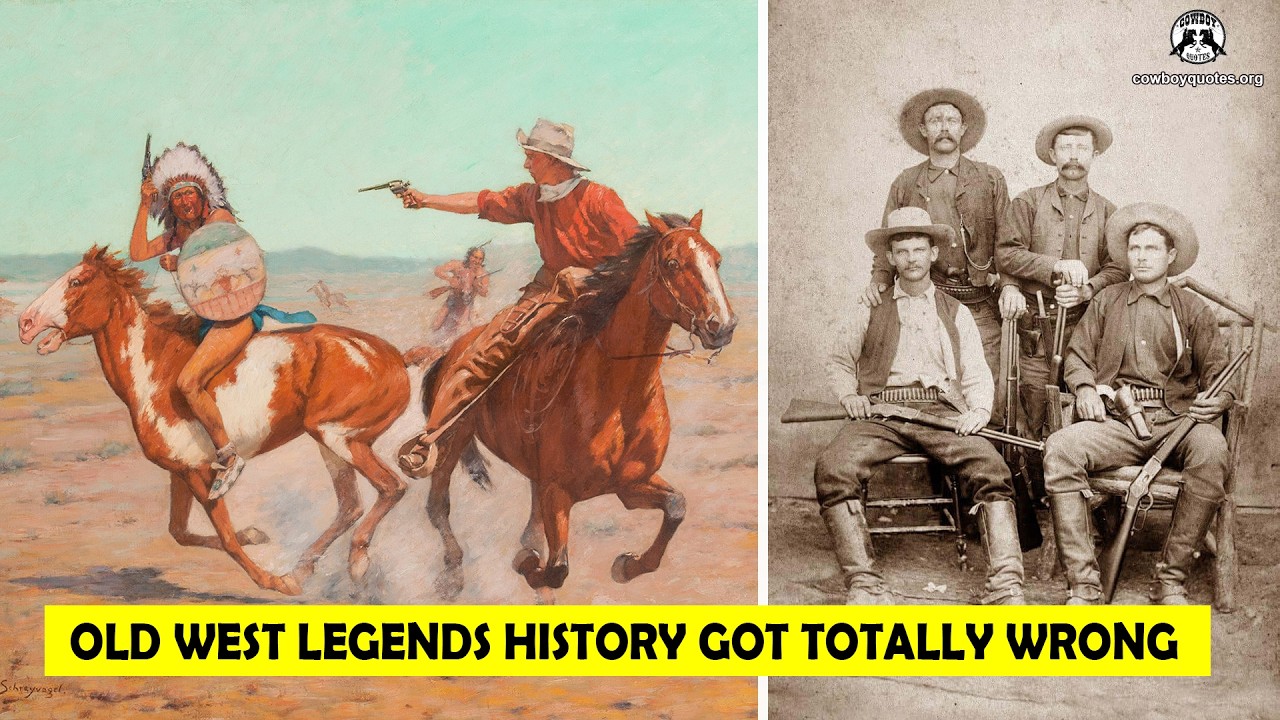
Contrary to film portrayals, cowboys were not typically engaged in frequent gunfights. Most risk came from the work itself, and ranch owners generally discouraged drinking, gambling, and fighting because reliability was essential. Even the iconic wide-brimmed hat was not the standard gear of the era; the derby or bowler was more commonly worn in town, while the practical John B. Stetson design became popular on the open range and eventually a lasting symbol.
Many legendary Western heroes were also products of myth-making rather than accurate history. Buffalo Bill Cody was said to have completed an extraordinary Pony Express ride of more than 300 miles as a teenager, an event not supported by historical records. Stories from 1876 described him taking dramatic revenge after the Battle of the Little Bighorn, but later retellings often exaggerated or reshaped these events. Davy Crockett was celebrated in folklore for extraordinary feats and a heroic death at the Alamo, though some historical accounts indicate he may have been captured before his death.
Daniel Boone was portrayed as a relentless adversary of Native Americans, when his actual interactions with indigenous groups were varied and sometimes cooperative. Much of this myth-making traces back to early American literature. James Fenimore Cooper’s Leatherstocking Tales created enduring archetypes of the rugged frontiersman through characters like Natty Bumppo. Dime novelist Ned Buntline blended fiction with real personalities, and in 1872 brought Buffalo Bill, Wild Bill Hickok, and Texas Jack Omohundro to the stage in dramatized versions of frontier life.
Building on that success, Cody launched his Wild West Show, blending staged reenactments with elements of real frontier experience, shaping American and global perceptions of the West for generations. The film industry amplified these themes, simplifying complex history into recognizable characters. Even director John Ford acknowledged this tendency in The Man Who Shot Liberty Valance, when a newspaper editor chooses to preserve a heroic legend over the truth, declaring, “When the legend becomes fact, print the legend. ”
The myth that women in the West were confined to narrow roles as schoolmarms or homemakers also obscures a more complex reality.
Annie Oakley achieved international fame as a performer in Buffalo Bill’s Wild West Show, becoming a symbol of skill and self-reliance and inspiring audiences during the Victorian era. Sue Robinson traveled through California’s gold camps as a child performer and later rose to national prominence on the stage. Susan McSween, after losing her husband during the Lincoln County War, took control of her circumstances and developed one of the most successful ranching operations in the region, earning recognition as the cattle queen of New Mexico. Nelly Cashman, an Irish emigrant, built a reputation as both a businesswoman and prospector, joining the late 19th century gold rushes in Alaska and the Yukon, where she generated wealth through mining and by supplying goods to other prospectors.
While structural limitations certainly existed, many women navigated these constraints creatively, contributing to commerce, culture, and community building. The truth about the American Old West is far more complex than the myths that have shaped popular understanding for generations. Behind the legends of fearless gunfighters and lawless towns lies a story shaped by diverse people, hard realities, and events that have been simplified and reshaped over time.
Separating fact from fiction does not diminish the West’s significance; it offers a richer and more authentic understanding of the past.