General George S. Patton had witnessed the worst of human destruction across a long and violent military career. He was a hardened cavalryman who had seen men torn apart by machine-gun fire in the trenches of France during the First World War. He had spent three years leading armored columns through the blood-soaked battlefields of North Africa, Sicily, and Western Europe.
Known to the world as "Old Blood and Guts," Patton was a brilliant but ruthless commander who carried ivory-handled revolvers and believed the highest honor a man could achieve was to die fighting for his country. He was not a man easily shocked. He had walked through shattered cities and burning forests without blinking.
Nothing in his career, in the textbooks of warfare, or in his worst nightmares could have prepared him for what he witnessed in the spring of 1945. When the United States Third Army smashed into the heartland of Germany and pushed through the gates of a place called Ohrdruf, the legendary general did something no one had ever seen him do. He broke down.
The man who had once slapped a weeping American soldier for showing weakness, and who demanded unbreakable toughness from everyone around him, was physically brought to his knees. The stench of the camp, the cruelty of the SS guards, and the scale of the mechanized murder forced Patton to turn his back, lean against a wooden shed, and vomit.
His sickness did not last long. Within minutes, it turned into a cold, merciless rage. What Patton and his American combat troops did to the Nazi guards and local German officials in the hours and days after the liberation of Ohrdruf remains one of the most powerful and controversial moments of justice in human history.
To understand the impact of Ohrdruf on the American military high command, one must understand the mindset of Allied soldiers as they crossed into Germany. For years, the American public and regular combat troops had heard vague rumors about terrible camps hidden in the forests of the Third Reich.
According to the historical archives of the United States Holocaust Memorial Museum and the memoirs of soldiers who fought in the European theater, many American troops initially believed these rumors were exaggerated wartime propaganda. They expected tough prisoner-of-war camps and brutal work details, but something that still fell within the boundaries of recognizable human war.
They had no idea they were about to uncover an entire industrial empire dedicated to the torture and extermination of human beings. The SS, the fanatical paramilitary organization that ran these camps, had spent over a decade marinating in a toxic ideology of racial superiority.
According to the historical analysis by Ladislas Farago in his book "Patton: Ordeal and Triumph," these SS guards did not see themselves as regular soldiers. They genuinely believed they were a biologically superior master race, and that the people they guarded were nothing more than insects to be crushed.
For years, these guards had operated with absolute authority, living in comfortable homes near the camps, eating warm food, and listening to classical music while just a few hundred yards away they starved, beat, and murdered innocent men, women, and children with bureaucratic efficiency. They thought they would never be held accountable.
Everything changed on the morning of April 4th, 1945. The battle-hardened veterans of the Fourth Armored Division and the 89th Infantry Division, serving under Patton's Third Army, were pushing rapidly through the German state of Thuringia.
As they approached the small, seemingly quiet town of Ohrdruf, the soldiers began to notice something strange. According to detailed combat reports filed by commanding officers, the first thing the American troops noticed was not a visual sight, but a smell.
It was a thick, sweet, sickening odor that hung heavy in the cold spring air, clinging to the uniforms of the soldiers and burning the back of their throats. As the tanks rolled closer to the fenced enclosure just outside the town, the silence was deafening. There was no gunfire and no resistance.
The American GIs, boys from farms in Ohio and city streets in New York who had fought their way across the beaches of Normandy and survived the freezing hell of the Battle of the Bulge, finally pushed through the main gates of the Ohrdruf camp.
The sight that greeted them would haunt their nightmares until the day they died. According to official military testimonies recorded by the United States Army Center of Military History, the entire compound was littered with the unburied corpses of prisoners, stacked like cordwood in the mud.
The few survivors who slowly emerged from the wooden barracks did not even look human anymore. They were walking skeletons, their eyes hollow, too weak to even cheer for their liberators. The SS guards, realizing the American army was closing in, had tried to execute as many prisoners as possible before fleeing into the woods, but they had run out of time.
The American soldiers, tough, battle-scarred infantrymen who had seen their own best friends blown to pieces in combat, dropped their rifles and wept openly. Some fell to their knees and vomited in the dirt. But that initial shock and crushing wave of grief very quickly mutated into a blinding, uncontrollable rage.
The regular enlisted soldiers were deeply traumatized, but the defining moment of the Ohrdruf liberation came eight days later, on April 12th, 1945. The Supreme Allied Commander, General Dwight D. Eisenhower, along with General Omar Bradley and General George S. Patton, arrived at the camp to see the horrors for themselves.
This was an unprecedented gathering of military power. The three most important men in the entire European war effort were walking together through the muddy, blood-soaked grounds of a concentration camp. According to General Omar Bradley's personal memoir, "A Soldier's Story," the atmosphere was incredibly tense.
Eisenhower, a man who usually commanded armies from a desk in a clean headquarters, forced himself to walk into the deepest, darkest corners of the camp. He inspected the torture rooms and walked right up to the piles of decaying bodies. Bradley noted that Eisenhower's face turned completely pale, almost gray, and his jaw was locked so tight it looked like it might shatter.
Eisenhower knew he had to see every terrible detail, because he knew humanity would eventually try to forget it. But the most shocking reaction came from General Patton. Patton, the ultimate warrior who had always romanticized the glory and bloodshed of combat, was completely physically overwhelmed by the cowardly evil of what he was looking at.
According to multiple eyewitness accounts from officers present, Patton walked into a shed where the bodies of starved prisoners had been carelessly tossed, took one look, turned his face to the wooden wall, and violently threw up. The stench and horror had broken through his heavy armor of military toughness.
When he finally composed himself, his face was red and his eyes were burning with a hatred that no German army had ever provoked in him. Patton turned to Eisenhower and Bradley and said, in a voice trembling with rage, that they had to make the German people see this.
He realized that this was not just a military victory. It was a psychological war, and the Nazi mythology of the master race had to be completely and permanently destroyed in the minds of the everyday German citizens who lived right down the road.

While the generals were formulating their strategic response, the American combat troops on the ground were dealing out their own brand of immediate justice. The historical records of what the regular GIs did to the SS guards caught in or near the Ohrdruf camp are complex, deeply controversial, and often carefully sanitized in modern history books.
According to numerous historical accounts and oral histories provided by veterans of the Third Army, when American soldiers found the guards who had tortured and executed starving prisoners, the strict rules of the Geneva Convention vanished into the smoke of the burning camp. The GIs did not see these SS men as enemy combatants entitled to the rights of a prisoner of war. They saw them as rabid animals.
In many documented instances, when American troops rounded up the remaining guards, they did not politely march them away to a holding pen. Instead, they forced the clean, well-fed, arrogant SS officers to walk through the piles of the dead. They forced them to look into the hollow faces of the survivors they had tormented.
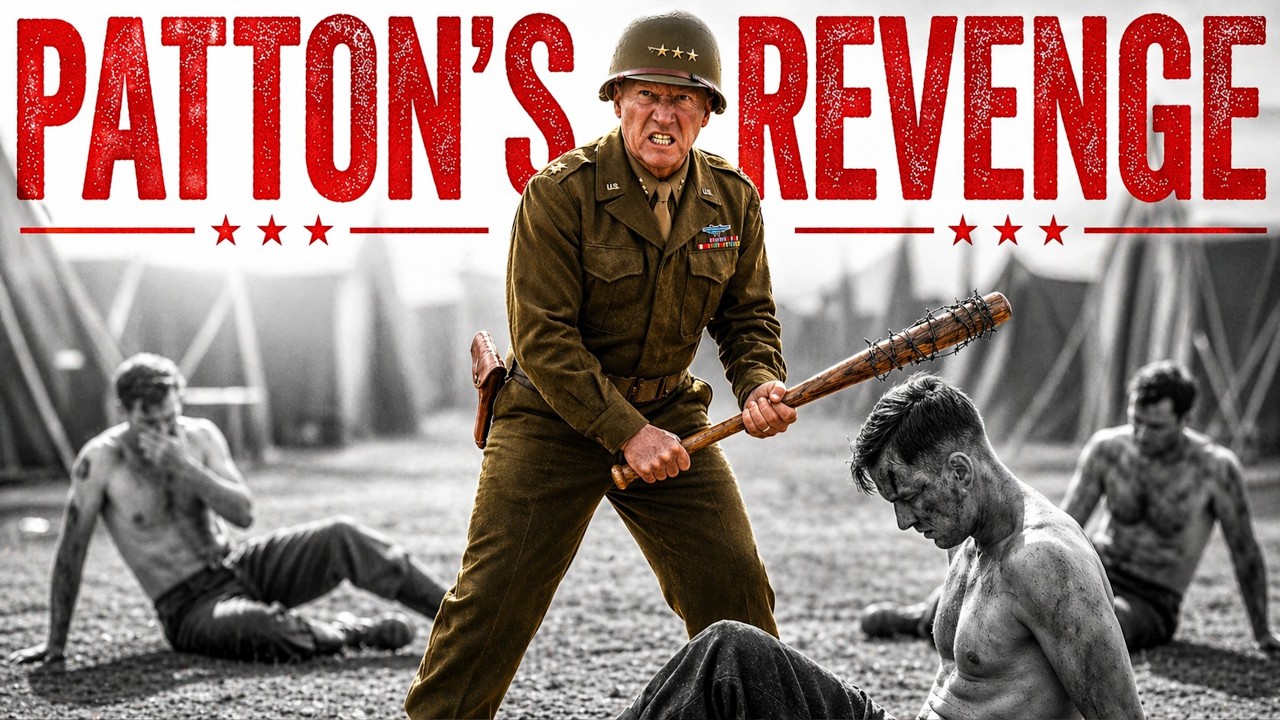
In a terrifying display of raw retribution, the American soldiers often simply handed their own heavy M1 Garand rifles or wooden batons over to the liberated camp inmates, and then purposefully turned their backs and walked away.
The sound of gunshots, heavy screaming, and brutal beatings echoed through the camp for days as the starving victims finally tore their former tormentors to pieces. The American soldiers, men raised in civilized, law-abiding towns back in the United States, stood by and let it happen, smoking their cigarettes and shedding no tears for the dying Nazis.
Was this a war crime or the purest form of natural justice the world has ever seen? This is a question historians have debated for almost 80 years.
But General Patton was not satisfied with just punishing the guards. He understood that the massive machinery of the Holocaust could not have existed without the silent complicity, willful ignorance, and quiet cooperation of the average German citizens who lived in the clean towns right outside the gates of these camps.
Ohrdruf was located just a short distance from the picturesque town of Gotha. The citizens of Gotha claimed, as almost all German citizens claimed when the Americans arrived, that they had absolutely no idea what was happening inside the camp. They claimed they never smelled the burning flesh, never saw the trains full of starving people, and were innocent victims of Hitler's regime.
Patton knew this was a lie. According to historical accounts preserved by the National Archives, Patton flew into a legendary rage when he heard these excuses. He immediately issued a terrifying military order.
He commanded his military police to march down to the town of Gotha and drag the local mayor, a man who had comfortably overseen the town while thousands died on his doorstep, along with his wife and several prominent citizens, up the hill to the Ohrdruf concentration camp. Patton was going to force the civilian population to face the bloody mess they had allowed to happen.
The military police, acting with zero patience and zero politeness, forced the mayor, dressed in his fine civilian clothes, to walk through the thick bloody mud of the camp. They forced the mayor and his wife to stand over the rotting, emaciated corpses of the prisoners. They forced them to smell the stench of death they had claimed to never notice.
The American officers yelled at them, demanding to know how they could claim ignorance when the ashes of these innocent people had been falling on their clean German houses. The psychological impact of this forced tour was devastatingly effective, and the outcome was something no one entirely predicted.

That very night, after returning to their comfortable home in Gotha, the mayor and his wife, completely broken by the overwhelming guilt, the horror of what they had been forced to witness, and the crushing realization that the entire world now knew the truth of their society, took their own lives. They hung themselves in their home.
When General Patton was informed of the mayor's suicide the next morning, he reportedly showed absolutely no sympathy. To Patton and to the battle-hardened American troops, it was simply the overdue confession of a guilty conscience.
The liberation of Ohrdruf changed the entire trajectory of the Allied psychological strategy for the remainder of the war in Europe. General Dwight D. Eisenhower, recognizing the profound importance of what they had discovered, immediately issued a series of sweeping orders that would echo through history.
According to official communications preserved by the Eisenhower Presidential Library, Eisenhower sent urgent high-priority messages back to Washington and London. He demanded that politicians, members of Congress, and international journalists be flown across the Atlantic immediately to witness the camps with their own eyes.
Eisenhower knew human nature. He knew that as time passed and the shock faded, people would try to deny that these crimes had ever taken place. He famously stated that he wanted everything photographed, everything documented, and everything recorded, so that the path of history would not be distorted and no one could ever dismiss this as wartime propaganda.
He forced every single American soldier in the area who was not actively engaged in combat to walk through the camp. Eisenhower wanted his men to know exactly why they had been fighting this long, terrible war, and exactly what kind of evil they were wiping off the face of the earth.
Because of Eisenhower's foresight and Patton's aggressive enforcement of making the Germans face their own crimes, we now have the undeniable photographic proof of the Holocaust. We have the footage of the bulldozers pushing the bodies, the footage of the weeping survivors, and the footage of the shocked American farm boys standing in the gates of hell.
As we look back on the actions of General George S. Patton, the decisions of General Eisenhower, and the raw retribution carried out by the everyday American GIs at the gates of Ohrdruf, we are forced to confront the most difficult and uncomfortable realities of human conflict.
The story of Ohrdruf is not a sanitized Hollywood movie where the heroes ride in on white horses and everything is neatly resolved. It is a messy, brutal, and deeply traumatizing chapter of our history. It shows us that war fundamentally alters the human soul.
The American soldiers who arrived in Europe as innocent young men were transformed into hard, unforgiving judges who handed down swift and violent sentences to the SS guards who had abandoned their own humanity.
We can sit in the comfort of the modern world and debate the legality of what the American troops did to those guards. We can debate whether Patton's psychological torment of the German mayor was unnecessarily cruel. But unless we have stood in that freezing mud, smelled the overwhelming stench of an industrial slaughterhouse, and looked into the hollow, dying eyes of a fellow human being treated worse than an animal, we can never truly judge the actions of the men who liberated those camps.
They did what they felt they had to do in the presence of pure, unadulterated evil. They broke the mythology of the Nazi master race, not just with tanks and artillery, but by dragging the arrogant architects of that system down into the mud and forcing them to face the terrifying consequences of their arrogance.
The educational value of this heavy, difficult story is immense. It teaches us that civilization is incredibly fragile. It teaches us that everyday people can easily become complicit in the most horrific crimes if they choose to look the other way, just like the citizens of Gotha. And most importantly, it teaches us that there are moments in history where evil must be met with absolute, uncompromising strength.
The lessons of Ohrdruf remain a warning. They ask whether the modern world has truly learned from the past, or whether we are still capable of looking the other way while atrocities happen. The memory of those who suffered demands that we never forget.