Newly surfaced testimony from the late Major Richard “Dick” Winters has reignited public fascination with one of the most controversial figures of the Second World War, Captain Herbert Sobel, the reviled first commander of Easy Company whose harsh training methods and battlefield incompetence became the emotional core of the acclaimed HBO miniseries “Band of Brothers.”
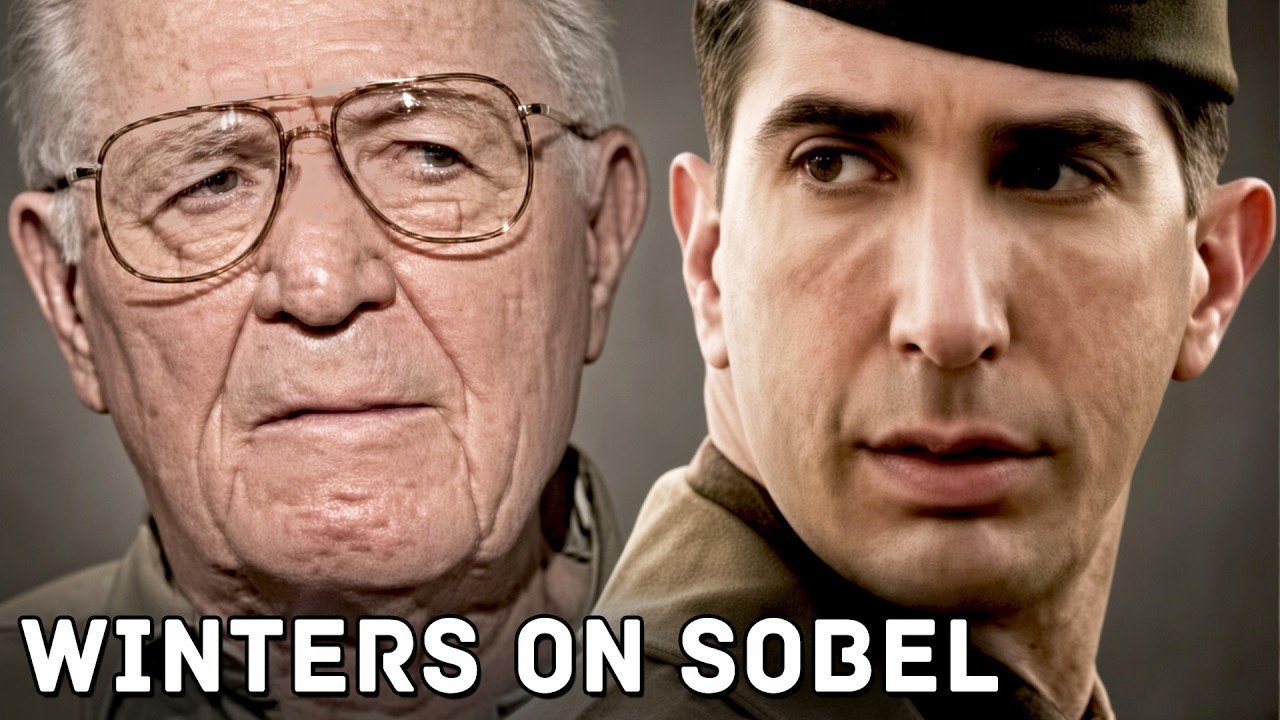
In the newly circulated video segment, Winters, who served as Easy Company’s executive officer and later its commanding officer, speaks with visible amusement about one of the most infamous episodes attributed to Sobel: the nighttime order to cut through a farmer’s barbed wire fence during a field exercise, an incident dramatized in the series and now confirmed by Winters himself as a genuine example of Sobel’s chronic lack of common sense.
“I want to talk about the time Sobel ordered the fence cut, and the farmers got a little angry because their cows got out. How enjoyable was that for you?” the interviewer asks Winters, who responds with a knowing smile.
“Oh, it was, well, you’re smiling now, so it must have been a good one. It was very good.”
Winters, however, is quick to note that the enlisted men never fully grasped the magnitude of the trouble they had engineered for their unpopular commander. “They couldn’t realize it because the battalion kept it secret,” Winters explains, “but it was just another example of Sobel’s bumbling.”
According to Winters, the incident was far more than a prank to the men of Easy Company. It became a stark illustration of Sobel’s repeated failures in tactical judgment, particularly his inability to read maps, a deficiency that would have proven catastrophic had he led the company into combat. “He could have gone over the fence.
He could have gone under the fence. And it would have been over,” Winters recalls. “But no, he cut the fence.”
 The consequences were immediate. The furious farmer arrived at battalion headquarters the following day to lodge a formal complaint about his escaped cattle, an appearance that, as Winters confirms, resulted in a severe dressing-down for Sobel from Colonel Robert Sink. “He didn’t like it at all,” Winters says of the farmer.
“Yeah, just another example of Sobel’s lack of common sense.”
The video transcript also reveals a detail that the miniseries altered for production purposes: the field exercise that led to the fence-cutting actually occurred at night, not in broad daylight as depicted on screen. The change, the transcript notes, was a logical concession to the practical difficulties of filming a nighttime sequence convincingly.
Equally significant is the confirmation that Sobel never discovered the true architect of his humiliation. George Luz, Easy Company’s radio operator, impersonated Major Oliver Horton and issued the fraudulent order that sent Sobel into the farmer’s field. The deception, which became one of the most memorable scenes in “Band of Brothers,” remained a secret Sobel carried to his grave.
The transcript further documents the escalating tension between Sobel and Winters, a rivalry that reached its breaking point when Sobel attempted to court-martial Winters over a latrine inspection. Sobel deliberately changed the inspection time and failed to notify Winters, a maneuver that prompted Colonel Sink to intervene by transferring Winters out of Easy Company and assigning him as battalion mess officer, a post Winters often regarded as a dumping ground for officers deemed useless elsewhere.
By that point, however, Easy Company’s noncommissioned officers had reached their own breaking point. Fearing that Sobel would get them killed in combat, the sergeants agreed to resign their ranks in protest, each penning a letter to Colonel Sink explaining their decision. The mutiny, as it became known, earned the NCOs a formal reprimand, but it also sealed Sobel’s fate.

Colonel Sink relieved Captain Herbert Sobel of command of Easy Company and reassigned him to run a new parachute training school in Chilton Foliat, Wiltshire, England. He was replaced by First Lieutenant Thomas Meehan, a decision that, in the cruel arithmetic of war, would save Sobel’s life. Meehan’s C-47 transport aircraft was shot down during the D-Day landings, killing him and every man aboard.
Winters and Sobel met face-to-face only once more during the war, a brief encounter when the 101st Airborne was stationed in Mourmelon-le-Grand, France, between February 25 and April 2, 1945, shortly after Winters was promoted to major. The miniseries dramatized this moment in the celebrated “we salute the rank, not the man” scene, though the transcript notes the encounter is depicted inaccurately in Austria after V-E Day rather than in France.
Despite the animosity that defined their relationship, Winters acknowledges in the video that Sobel was driven by an uncompromising ambition for Easy Company to be the finest unit in every measurable category. “He expected Easy to lead the 506th Parachute Infantry Regiment in every category that could be measured,” the transcript states, “and he intended Easy to be fully prepared when it entered combat.”
That paradox, a commander whose field incompetence endangered his men but whose brutal training regimen may have saved them, has been echoed by numerous Easy Company veterans. Many later admitted that Sobel’s relentless discipline and physical conditioning were instrumental in their survival through some of the war’s bloodiest engagements, including the Normandy invasion, Operation Market Garden, and the Battle of the Bulge.
Sobel’s story ended in tragedy long after the guns fell silent. He carried bitterness over the loss of Easy Company command until his death, and his postwar life was marked by personal and financial hardship. The transcript references a forthcoming documentary, “The Real Life and Tragic End of Captain Herbert Sobel,” which promises to examine those final years in depth.

The resurfacing of Winters’ reflections comes as historians and enthusiasts continue to reassess the complex legacy of a man who never led troops into battle yet left an indelible mark on the soldiers who did. Sobel’s story, as Winters’ testimony makes clear, is not merely one of incompetence and humiliation, but of the strange, unintended gifts that even flawed leaders can bestow upon those they train.
For the men of Easy Company, the fence-cutting incident remains a symbol of the absurdity of their early training under Sobel, a moment of dark comedy in the shadow of a war that would soon claim so many of their comrades. For historians, it is a reminder that leadership is measured not only in moments of triumph but in the small, telling decisions that reveal a commander’s character.
Winters, who died in 2011 at the age of 92, remained throughout his life a reluctant hero, insisting that the real heroes were the men who never came home. His willingness to speak about Sobel, even decades later, offers a rare window into the personal conflicts that shaped one of the most storied units in American military history.
The video transcript concludes with an invitation to viewers to explore more of the real stories of Easy Company veterans, underscoring the enduring public appetite for the human dramas behind the history. As the last witnesses to that era fade, testimonies like Winters’ become ever more precious, preserving not just the facts of what happened but the texture of how it felt to serve under a man like Herbert Sobel.
For now, the fence, the cows, and the farmer’s complaint stand as a small but unforgettable chapter in the legend of Easy Company, a reminder that even in war, the most human moments often prove the most enduring.