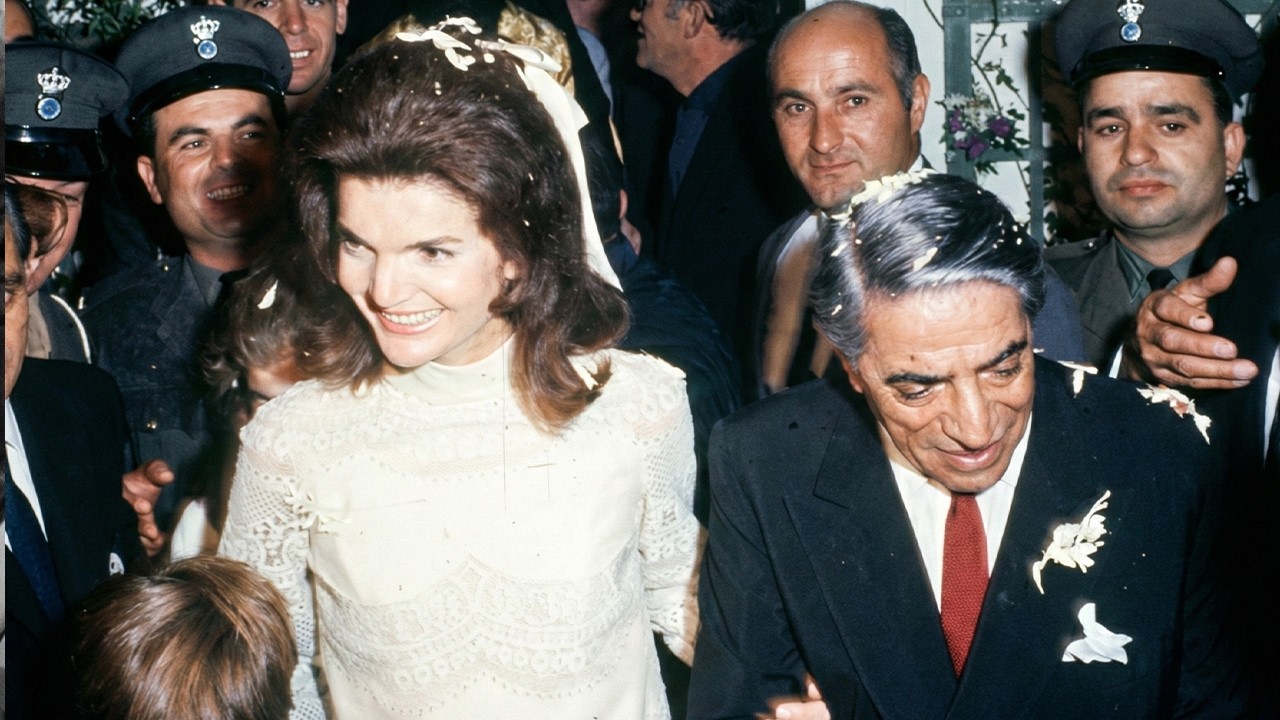
On October 20, 1968, on the Greek island of Scorpios, Jacqueline Bouvier Kennedy stood in a small Greek Orthodox chapel beside Aristotle Onassis. There were about 40 guests and flickering candles. The bride was America's widowed queen, the woman who had walked behind her husband's casket with heartbreaking dignity. The groom was a Greek shipping magnate, 23 years her senior, divorced, and wealthy beyond imagination.
The reaction in America was immediate and furious. Newspapers ran headlines like "Jackie marries blank check." The Vatican newspaper called her a public sinner who married for money. Former admirers turned vicious, asking how America's grieving widow could marry this man.
But the public did not understand the terror driving Jackie's decision. After Bobby Kennedy's death, she had said it clearly: "If they are killing Kennedys, my children are the number one targets. I want to get out of this country." This was not a love story. It was an escape plan.
To understand why Jackie Kennedy fled America five months after Bobby's assassination, and why she chose a Greek island fortress over the White House legacy, you have to go back to Dallas.
On November 22, 1963, Jackie sat beside her husband in an open limousine in Dealey Plaza, waving to crowds. Then came gunshots. The president's head exploded, and blood and brain matter sprayed across Jackie's pink suit. She crawled onto the trunk of the speeding car, reaching for pieces of her husband's skull.
At Parkland Hospital, she refused to leave his side and refused to change her blood-soaked clothes. "Let them see what they've done," she said.
For the next five years, Jackie lived with that trauma. Nightmares, insomnia, and flashbacks — what we now call post-traumatic stress disorder. Biographer Barbara Leaming documented Jackie's symptoms: obsessive ruminations about the assassination, thoughts of suicide, sleep disturbances, and paranoia. Everywhere she went, cameras and questions followed. The world would not let her grieve privately.
She moved to New York and tried to build a normal life for Caroline and John Jr. But normal was impossible. She was America's most famous widow. The press stalked her, and paparazzi camped outside her Fifth Avenue apartment.
Then came the anchor, the one person who could help her through it: Robert F. Kennedy. After JFK's death, Bobby became Jackie's lifeline. He visited constantly, helped raise Caroline and John Jr., and became a surrogate father. Bobby had been there during her darkest moments before Dallas. When she miscarried, it was Bobby, not Jack, who stayed with her at the hospital. When Patrick died just months before the assassination, Bobby comforted her.
Now, after Dallas, Bobby was everything: her counselor, her protector, her children's father figure. Jackie supported Bobby's 1964 Senate run. When advisers urged him to enter the 1968 presidential race, Bobby reportedly said, "That depends on what Jackie wants me to do."
Jackie did not want him to run. She was terrified. But Bobby felt obligated. The Vietnam War was spiraling, Johnson was failing, and the country needed leadership. So Bobby ran. And Jackie watched in horror as he moved through crowds, shaking hands, giving speeches, exposed. Just like Jack.
At midnight on June 5, 1968, at the Ambassador Hotel in Los Angeles, Bobby Kennedy had just won the California primary. The nomination was his. The presidency was his. He walked through a kitchen hallway toward a press conference. Jackie was not there. She was home in New York with the children.
A gunman stepped forward. Eight shots from a .22 caliber revolver. Bobby fell. Twenty-five hours later, he died.
Jackie flew to Los Angeles. She walked into the hospital room, saw Bobby's body, and something inside her shattered. According to friends, Jackie became convinced, "If they're killing Kennedys, then my children are targets."
It was not paranoia. Martin Luther King Jr. had been assassinated two months earlier, on April 4. Race riots burned through American cities. Violence was everywhere. And the Kennedys, America's most famous political family, were being eliminated. Who was next? Ted Kennedy? Caroline? John Jr.?
Jackie could not risk it. She had to get out — out of America, out of the spotlight, out of the kill zone. She needed protection, real protection, not Secret Service agents who had failed Jack, not political handlers who had failed Bobby. She needed a fortress. She needed money. She needed someone powerful enough to keep her children safe.
She needed Aristotle Onassis.
Onassis was one of the world's richest men: a Greek shipping magnate, owner of Olympic Airways, and controller of a fleet of tankers, with a net worth in the hundreds of millions. But he was also crude and divorced, and his reputation in America was questionable. He had pled guilty to shady shipping deals in 1955. He was 62 years old, though some sources said 68. He smoked cigars, drank heavily, and preferred belly dancers to ballet.

Not exactly Prince Charming. But Jackie did not need Prince Charming. She needed a shield.
Onassis had been in Jackie's life for years. He had comforted her after baby Patrick died in 1963, even inviting her on his yacht to recover. JFK had been skeptical but allowed it. Now, after Bobby's death, Onassis offered something no one else could: escape. His private island, Scorpios, in the Ionian Sea. His 325-foot yacht, the Christina. His homes in Paris, Athens, and New York. His wealth could buy privacy, security, and distance.
And Jackie accepted.
Was it love? No. Biographer Barbara Leaming documented that Jackie was suffering from PTSD that flared up after Bobby's assassination. She was not thinking about romance. She was thinking about survival. After Onassis died in 1975, Jackie's statement was carefully worded: "Aristotle Onassis rescued me at a moment when my life was engulfed with shadows." Rescued. Not loved. Rescued.
The wedding took place on Scorpios less than five months after Bobby's death. Caroline and John Jr. held candles during the ceremony. Jackie's sister, Lee Radziwill, was matron of honor, though she was reportedly furious, having previously dated Onassis herself.
As a result of the marriage, Jackie lost her Secret Service protection, a privilege entitled to widows of U.S. presidents. Think about that. She gave up federal protection to marry Onassis. Why? Because she believed Onassis' private security was better, more loyal, and more effective.
The prenuptial agreement was legendary. Reports varied, but sources suggested Onassis settled millions on Jackie immediately, with additional monthly allowances and inheritance provisions. Critics called her a gold digger. Onassis' daughter Christina and son Alexander referred to Jackie as the gold digger from the start.
But was it about money, or was it about buying safety?
America was brutal. The press crucified her. They coined a new nickname, Jackie O. Headlines screamed betrayal. How could she abandon America? How could she marry this man? The Vatican newspaper condemned her as a public sinner. Catholic groups debated whether she should be excommunicated, though Cardinal Cushing dismissed it as nonsense.

Former admirers turned vicious. She had been their princess, their symbol of grace through grief. And now she had married a divorced Greek billionaire on a private island.
But Jackie did not care. She told friends she was done being America's grieving widow, done standing on pedestals, done playing the role assigned to her. As one source noted, marrying Onassis was one sure way to topple herself from that pedestal. She wanted privacy. She wanted safety. And she wanted to raise her children away from whoever was killing Kennedys.
The marriage was difficult. Onassis preferred bouzouki music and Greek businessmen. Jackie loved ballet and literature. They lived separate lives. Paparazzi never stopped. The privacy she had hoped for never materialized. Onassis allegedly resumed his relationship with opera singer Maria Callas, and rumors of affairs filled the tabloids.
After his son Alexander died in 1973, Onassis was never the same. He reportedly called Jackie the witch and claimed JFK's death had cursed her. When Onassis died in 1975, reports leaked that he had been planning to divorce Jackie. Christina fought her over the estate, though they eventually settled.
Were they ever in love? Probably not. Jackie made a strategic decision. Onassis provided security and escape. That was the deal.
Did Jackie flee America fearing for her children's lives? Yes. Her words after Bobby's death were explicit: "If they are killing Kennedys, my children are the number one targets." She believed someone was systematically eliminating the Kennedy family. Jack, Bobby — who was next?
The marriage gave her distance from America, financial independence, and the security money could buy. Was it perfect? No. The marriage was unhappy. Paparazzi never stopped. America never forgave her. But Caroline and John Jr. survived. They grew up. They lived. And maybe that is all Jackie cared about.
After Onassis died, Jackie returned to New York. She worked as a book editor, first at Viking Press, then at Doubleday. She built a life on her own terms. She died in 1994 at age 64 and was buried beside JFK at Arlington National Cemetery.
Her son described her at the funeral as having three defining attributes: love of words, bonds of family, and spirit of adventure. But he left out one more. Survival instinct.
Jackie Kennedy survived two presidential assassinations, survived PTSD, survived a difficult marriage, survived public condemnation, and she kept her children alive. On October 20, 1968, when she married Aristotle Onassis, it was not about love or money. It was about escape from America, from the spotlight, from whoever was killing Kennedys. Sometimes the bravest choice looks like betrayal.