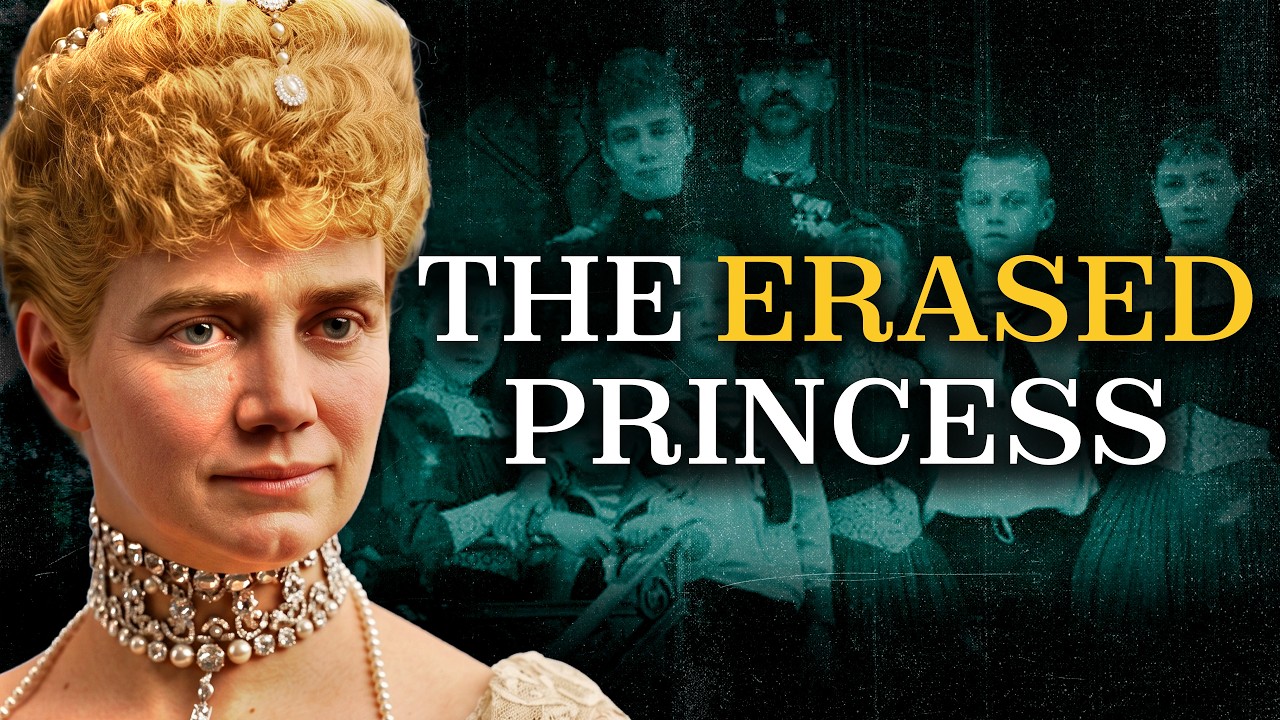
In a Copenhagen studio in 1862, Prince Christian of Denmark posed with his family against a painted backdrop. The photograph shows a respectable royal household of middle rank, arranged in the stiff formal style that thousands of European families adopted that year.
Christian stands in the back row in dress uniform, flanked by his two eldest sons, Frederick and George. Louise sits at the center. Four-year-old Valdemar stands solemnly in front of her. Alexandra sits to the right in a wide hooped skirt. Dagmar, dark-eyed and watchful, occupies the left of the frame.
Beside her seated mother stands a thin, dark-haired girl of nine. Her name is Thyra. She would outlive everyone in the picture except her baby brother.
Most people have never heard of her. That obscurity was not an accident.
Princess Thyra Amalie Caroline Charlotte Anna of Denmark was born on 29 September 1853 at the Yellow Palace in Copenhagen. Despite the name, the building resembled the home of a respectable Danish accountant more than a royal residence.
Her father, Prince Christian, did not yet wear a crown. He came from the comparatively impoverished Schleswig-Holstein-Sonderburg-Glücksburg line, a name so unwieldy that contemporaries shortened it to Glücksburg.
Christian became heir presumptive in 1852 because King Frederick VII's line ran short on legitimate heirs. He did not inherit the throne until November 1863, when Thyra turned ten.
Until then, the household ran on what diplomats politely called genteel economy. Thyra shared bedrooms with her sisters. Her mother, Louise, managed the home down to the curtains. The children learned languages, music, and needlework from governesses rather than imported scholars.
By 1900, this modest household had produced the king of Denmark, the king of Greece, the queen of the United Kingdom and Empress of India, the Empress of Russia, and one Duchess of Cumberland. All of them grew up taking turns at the same family piano.
Glamour drove the sibling rankings. Alexandra played the beauty card and would marry the future Edward VII in 1863. Dagmar carried personality, a dark-eyed charm that would capture the future Tsar Alexander III. Frederick held the heir's slot for the Danish throne. George was exported to Athens at seventeen to become King of the Hellenes.
Everyone doted on Valdemar, the baby boy. Then came Thyra, the youngest daughter, slotted into the family roster as the gentle one.
Photographs show a serious young woman with dark hair, dark blue eyes, and an expression suggesting difficult long division in her head. Tutors described her as sweet-natured, dutiful, passive, and emotionally fragile. Court observers said she lacked Alexandra's radiance and Dagmar's electricity.
By her fifteenth year, Queen Louise kept a list of European princes against whom her daughter might be matched. Denmark had recently lost Schleswig and Holstein to a Prussian-led war in 1864, shrinking the kingdom by a third. A small country with embarrassment hanging over its army needed allies.
Louise treated her youngest daughter less like a child and more like unsold inventory the dynasty needed to move. Letters between Louise and Queen Victoria's daughter Vicky in Berlin discuss Thyra's prospects in the cold tone of a difficult financial transaction.
Thyra kept doing what she always did. Horses around Bernstorff, piano practice in the long afternoons, letters to Alexandra in London and Dagmar in St. Petersburg. Walks in the gardens with Valdemar. No surviving evidence shows she ever asked to be removed from the marriage process.
By the spring of 1871, she felt lonely in the specific way that only teenagers surrounded by busy adults can feel lonely.
Then came the lieutenant. Wilhelm Freiman Marcher served in the Danish Cavalry, attached to the Royal Horse Guards. Born on 19 October 1839, he was almost exactly fourteen years older than Thyra. He came from minor Danish nobility and reportedly cut a tall, handsome figure in the slightly mournful style of nineteenth-century cavalry officers.
Nobody knows exactly how the relationship began. Court archives from this period lack inconvenient sections, which historians have learned to read as evidence in itself.
The most probable reconstruction, drawn by Bo Bramsen in his 1975 book Huset Glücksborg from surviving private correspondence, places Thyra and Marcher meeting privately during the winter of 1870 and into the spring of 1871 in the gardens of Bernstorff and the corridors of Christiansborg.
By summer 1871, Thyra was carrying a child.
Queen Louise summoned Dr. Emil Horneman, the royal physician, in early summer. Horneman received instructions that left no room for interpretation. Princess Thyra had developed a severe case of gulsot, the Danish word for jaundice. She would require extended rest and time away from Copenhagen.
The official story put out by the Danish court in late summer 1871 was a small masterpiece of misdirection. Thyra suffered from a stubborn liver complaint, the country learned. Dr. Horneman recommended a long convalescence in a warmer climate. Officials decided to send her to her brother, King George I of the Hellenes, in Athens.
It sounded plausible. Royal princesses really did travel abroad for health cures. The Mediterranean really did count as restorative. And Greece hosted a Danish-born king with a discreet court and no domestic press worth mentioning.
Thyra left Copenhagen in the autumn of 1871 under unusual privacy and arrived in Athens by private rail and steamer, accompanied by a tiny retinue handpicked by Queen Louise.
What happened in Athens is harder to document because the people involved did not want it documented. The most credible account suggests Thyra remained confined to private quarters at the Athens Royal Palace from October 1871. In early or mid-November, attended by Queen Olga, a Greek doctor sworn to discretion, and one Danish lady-in-waiting, she gave birth to a baby girl.
The infant disappeared from her care almost immediately.
The widely accepted version holds that the baby traveled quietly back to Denmark within weeks and was placed with a respectable Odense couple named Rasmus and Anne Marie Jürgensen. The child took the name Katharina, eventually called Kate, and grew up in modest middle-class circumstances.
Strict academic historians point out that this story rests on circumstantial evidence rather than primary documentation. The adoption papers, if they ever existed, have never appeared. Relevant sections of the Danish royal archives covering the autumn of 1871 sit either sealed or missing.
What remains is a perfectly fitting timeline, a quietly raised child of unknown origin, a family tradition that surfaced decades later, and a royal household that spent the rest of the century refusing to discuss any of it. Most serious Danish historians take the story as proof.
Thyra returned to Copenhagen in the spring of 1872, officially restored to health. She never publicly acknowledged any of it. No surviving letter refers to the daughter she carried for nine months and held for less than a week in a borrowed room three thousand kilometres from home.
While Thyra remained in Athens being treated for a fictional liver complaint, Lieutenant Marcher remained in Copenhagen being interrogated by people far more powerful than him. The exact contents of his meetings with King Christian IX in the autumn of 1871 never reached any record.
What is known is the outcome. Marcher received an order forbidding contact with Thyra ever again. He also received an understanding that his presence at court, in the Royal Horse Guards, and arguably in Copenhagen itself was no longer welcome.
On the night of 4 January 1872, Marcher was found dead in his quarters, hanging from a beam. The official ruling was suicide by hanging. The Danish press printed almost nothing.
A brief notice acknowledging the death of a young officer ran in a few papers. Most readers in Copenhagen would have assumed an accident or a duel. Court insiders who knew the real story kept silent under explicit orders, and the silence held for the better part of a century.
Did Marcher hang himself from despair, or did someone hand him a rope and an order to protect the royal family? Bramsen and other Danish historians have noted that the swiftness, the silence, and the convenience of his death all point in an uncomfortable direction.
Coerced suicide was a recognized concept in nineteenth-century European officer culture. An officer who embarrassed his monarch could find himself presented with a pistol, a quiet room, and a clear set of expectations. The primary sources have vanished and the witnesses are dead.
When Thyra returned to Denmark in 1872, she returned a different person. Letters from Alexandra and Dagmar over the following years describe a sister prone to long stretches of melancholy who refused to speak of Marcher or of the child who vanished from her arms in November.
Marcher's name never came up again. Thyra allowed her mother to resume the marriage negotiations as if nothing had happened.
The next several years unfolded as a procession of failed matches. Queen Louise threw herself into rehabilitating her youngest daughter's prospects with the determination of a woman trying to sell slightly damaged furniture before the buyer notices.
First came King Willem III of the Netherlands. Willem, sixty-one and widowed, carried a reputation so bad that his own subjects called him Koning Gorilla. His foul temper preceded him, along with allegations of violence toward servants. Thyra and her parents politely declined.
Queen Victoria entered the picture briefly. Her son, Prince Arthur, the Duke of Connaught, floated as a possibility around 1874. Victoria refused to entertain it. Alexandra already filled the role of Danish daughter-in-law, and one was sufficient.
There also remained, by the Queen's own account, the matter of rumours out of Copenhagen regarding the youngest princess. British diplomatic correspondence picked them up and forwarded them to Windsor. The Marcher affair carried less secrecy than the Danish court believed.
Victoria knew. Her ambassador knew. Half the chanceries of Europe knew. They all simply chose not to use the information publicly. Prince Arthur withdrew from consideration.
Various German princelings underwent assessment and rejection. By 1878, Thyra had reached twenty-five, which in royal marriage terms approached the cliff edge of unmarriageability.
Then a candidate emerged who suited Queen Louise's specific political grudges so perfectly that the match approached inevitability. His name was Ernst August, Crown Prince of Hanover.
Ernst August was the most politically loaded match in Europe. His very surname triggered diplomatic reactions in Berlin, London, Vienna, and Copenhagen simultaneously.
In 1866, the Kingdom of Hanover sided with Austria in the Austro-Prussian War. Prussia won in seven weeks, annexed Hanover outright, and erased a kingdom from the map. Ernst August's father, King George V of Hanover, refused to abdicate. He fled into exile in Austria with his court, his treasury, and his unending grievance. He died in June 1878 still calling himself King of Hanover.
His son inherited two things. The first was the title, which by 1878 named a country that no longer existed. The second was the family fortune, a staggering private hoard accumulated over centuries of Welf rule, which Bismarck ordered sequestered into a Prussian-controlled account.
Ernst August also inherited the family's defining political position: absolute and lifelong refusal to acknowledge the Prussian annexation of Hanover.
The political logic of the match showed elegant spite. Denmark lost Schleswig-Holstein to Prussian aggression in 1864. Hanover lost everything to Prussian aggression in 1866. Marrying the youngest Glücksburg daughter to the dispossessed heir of the most anti-Prussian dynasty in Germany delivered a discreet but unmistakable message to Berlin.
Bismarck understood immediately. The wedding took place on 21 December 1878 at the Chapel of Christiansborg Palace in Copenhagen. Ernst August's father had died in June without ever abdicating, which meant Thyra married the head of the Welf dynasty in exile rather than a crown prince.
The wedding drew representatives of nearly every royal house in Europe except those that mattered most. Conspicuously absent was anyone of significance from the German Empire. Bismarck sent only a low-ranking observer, while the Tsarevna of Russia, the Princess of Wales, and the King of the Hellenes all attended in person.
The German Empire, the largest power in continental Europe, effectively boycotted the wedding of a princess on its own doorstep.
Otto von Bismarck possessed an unusual talent for converting personal grudges into formal state policy. After 1866, he ordered the entire Hanoverian royal fortune confiscated and held in a Prussian-controlled fund. The official justification claimed the deposed Welfs might use the money to recover their lost kingdom.

The actual purpose became obvious within a few years. The fund came to be called the Welfenfonds. Bismarck used the interest from the sequestered fortune to finance discreet political activities of his own, including paying friendly journalists, bribing minor officials, and maintaining a network of informants across the German Empire.
Press critics eventually nicknamed the operation the Reptilienfonds, the Reptile Fund, after Bismarck himself sneeringly referred to his opponents as malicious reptiles. Thyra married directly into the family whose ancestral wealth funded, in real time, the political apparatus that crushed them.
No surviving record shows her ever publicly mentioning this. But her husband talked about almost nothing else for the entirety of their marriage, and Welf grievance became the household weather she lived under for forty years.
Then came the 1884 Brunswick crisis. The Duchy of Brunswick survived as a small but real German state, still ruled by a senior line of the Welf dynasty. In October 1884, its reigning duke, Wilhelm, died childless.
By every existing rule of dynastic inheritance, the throne should have passed to Ernst August. Bismarck saw an opportunity to twist the knife. He invoked an obscure clause arguing that no German prince who refused to renounce a claim against the empire could ascend to a German throne.
Ernst August had spent the previous six years loudly insisting that Hanover belonged to him. The Imperial Bundesrat voted to block his accession to Brunswick. The duchy fell under a regency by Prince Albrecht of Prussia, which is to say, under direct Hohenzollern control.
Thyra and her husband found themselves barred from the only territory they could legally have ruled. For Ernst August, this was a catastrophe. For Thyra, it was a quieter kind of disaster.
She now lived married to a man whose entire political identity revolved around a kingdom he could not claim, a duchy denied him by Berlin, and a fortune he could not access. The Welf family shrank to a court in exile with magnificent titles and limited cash.
With Hanover gone and Brunswick blocked, Thyra and her husband settled in the only territory that would have them: Austria. They bought land at Gmunden in Upper Austria, on the shore of the Traunsee, and built a residence so absurdly large that it remains one of the most impressive aristocratic complexes in the country.
Schloss Cumberland rose between 1882 and 1886 in a neo-Gothic style that managed to look both German and theatrical. Towers and battlements crowned the silhouette. Hundreds of rooms filled the interior. A private chapel, a hospital wing, stables, and gardens designed in formal British style served as a visual reminder of where the family thought it should sit.
The whole project announced in stone that the Welfs intended to live as if they still ruled, even if the empire decided they did not.
Thyra organized everything inside it, rigid in the old Welf style her husband insisted on without compromise. Meals appeared at fixed hours. Servants wore Welf livery. Staff addressed visitors by the titles they would have held in the old Kingdom of Hanover.
To outsiders, the arrangement looked like elaborate theatre. Her husband saw it as the dignity owed to a king. Thyra experienced it as the new shape of her daily life, and she ran the household with the dutiful competence she had absorbed in childhood.
She also became an unusually active philanthropist. Schools for the children of Cumberland estate workers opened on her personal initiative. Hospitals in Gmunden received substantial donations from her private accounts. She managed the family's charitable affairs personally and visited recipients in person, an unusual practice among continental aristocratic women.
And she raised six children, work that consumed most of her thirties and forties.
Marie Louise came first, born in October 1879. She would eventually marry Prince Maximilian of Baden, the last Imperial Chancellor of Germany, the man who in November 1918 announced the abdication of Kaiser Wilhelm II without securing the Kaiser's permission first.
Georg Wilhelm arrived in October 1880. He came as the heir, the eldest son, the boy on whom the entire dynastic future supposedly rested. His death in 1912 would become the hinge of his mother's life.
Alexandra arrived in 1882 and would marry Grand Duke Frederick Francis IV of Mecklenburg-Schwerin. Olga arrived in 1884 and never married, choosing instead to remain at her mother's side at Gmunden for the rest of Thyra's life.
Christian arrived in 1885. He died at sixteen in 1901 of peritonitis brought on by what was almost certainly untreated appendicitis, the first major bereavement Thyra suffered as a mother and one she never really recovered from.
Last came Ernst August Jr., born in November 1887, the youngest and in time the most consequential of the six.
On 14 May 1912, Thyra's brother, King Frederick VIII of Denmark, died unexpectedly in Hamburg while travelling incognito. He collapsed during an evening walk and was carried to a hotel as an unknown gentleman, identified by police only hours later.
The funeral was set for Copenhagen at the end of May, and the entire Glücksburg family planned to attend. Thyra's eldest son, Georg Wilhelm, thirty-one years old and holding a serving officer's commission in the Prussian army through his role in the Cumberland Hussars, set out for Denmark by motorcar.
The route took him through Brandenburg. On 20 May 1912, near the village of Neckel, his car left the road at high speed, threw Georg Wilhelm clear of the wreckage, and killed him almost instantly on the way to his uncle's funeral.
News reached Gmunden the same day. Thyra collapsed, then absorbed the loss of two sons in a single afternoon. The dynasty's heir was gone. Her careful Welf succession plan, painstakingly maintained by her husband for thirty years, imploded with one wrong turn on a German country road.
What followed would have looked unimaginable in 1880, when Thyra's son entered a household that considered the Hohenzollerns an occupying enemy power. By 1912, the world looked very different, and the Welf-Hohenzollern feud had run out of fuel on both sides.
Ernst August Jr., now twenty-four, travelled to Berlin in person to thank Kaiser Wilhelm II for the official condolences sent regarding Georg Wilhelm's death. While at the Imperial Court, he met the Kaiser's only daughter, Princess Victoria Louise. They fell in love.
The romance developed quickly and visibly, and Berlin society noticed within weeks. By early 1913, talk of marriage entered serious territory. By spring, it received political agreement.

On 24 May 1913, Ernst August Jr. and Victoria Louise married in Berlin in what amounted to the largest royal wedding the German Empire ever staged. Every reigning German prince attended, along with the British and Russian royal houses. It would later count as the last great gathering of European royalty before the war that destroyed all of them.
As part of the settlement, Ernst August Jr. formally renounced any claim to the Kingdom of Hanover, the position his grandfather and father had defended for almost fifty years. In exchange, the Kaiser permitted him to ascend the throne of Brunswick, the duchy his father had been excluded from in 1884.
The Welf-Hohenzollern feud closed at last, officially.
Thyra's reaction to all this is poorly documented, fitting for a woman who spent her entire life perfecting the art of leaving no paper trail. Evidence shows she attended the wedding. Letters confirm she signed off on the renunciation of Hanover, which her dying husband resented but accepted.
For the first time since 1884, a Welf actually ruled a German territory under her family's name. What she felt about her son sitting on a throne at the price of the family's defining grievance remains a question the surviving record cannot answer.
By the time of Georg Wilhelm's car crash and the 1913 reconciliation marriage, Thyra had turned sixty. Alexandra in London reigned as Queen Mother of the United Kingdom, recently widowed by Edward VII's death in 1910. Dagmar in St. Petersburg held the position of Dowager Empress of Russia, watching with increasing alarm as her son Nicholas II produced one disastrous decision after another.
Frederick lay dead. George I still occupied the Greek throne and would face assassination by a Greek anarchist in March 1913, two months before Ernst August Jr.'s wedding. Valdemar remained in Denmark, the only sibling still living in the country of their childhood.
The Glücksburg family stood scattered across the chanceries of Europe at precisely the moment those chanceries drifted toward war.
When war arrived in August 1914, Thyra's family stood on every side of it. Ernst August Jr. reigned as Duke of Brunswick and served as a general in the German army. Victoria Louise, her daughter-in-law, claimed the Kaiser as her father. Maximilian of Baden, her son-in-law, held a senior German political position.
Her nephews, George V and Nicholas II, commanded the British and Russian armies opposing him. Cousins, nieces, and grandchildren of hers wore the uniforms of three rival empires and shot at each other across the trenches of France and the forests of Poland.
Thyra spent the war at Gmunden in Habsburg territory, technically on the side of her son's German Empire. She turned much of Schloss Cumberland into a military hospital for wounded Austrian and German soldiers.
She wrote letters constantly. Surviving correspondence shows her trying to maintain contact with Alexandra in London through neutral intermediaries in Denmark and Switzerland, often via her brother Valdemar in Copenhagen. The letters read careful and evasive on military matters, packed instead with health updates, condolences for the dead nephews on every side, and family chatter that pretends the world does not burn.
It burned. By November 1918, every empire her relatives had married into was gone or collapsing. The Romanovs were murdered in Yekaterinburg in July of that year, an event her sister Dagmar refused to believe for the rest of her life. Vienna's Habsburgs collapsed in October.
The Hohenzollerns collapsed on 9 November, with Maximilian of Baden, Thyra's own son-in-law, announcing the Kaiser's abdication on behalf of the Imperial government. Brunswick's Welfs collapsed alongside them.
On 8 November 1918, Thyra's son Ernst August Jr. abdicated the Duchy of Brunswick. After exactly five years on the throne, it had taken his family fifty years to recover it.
Thyra and Ernst August spent the postwar years in a Schloss Cumberland that had suddenly become the residence of a couple of private citizens with grand titles and no government. Austria and Germany were both republics now. The Brunswick throne was gone. The Hanoverian claim, formally renounced by their son in 1913, lay beyond resurrection.
Ernst August never recovered. He had spent his entire adult life defending the Welf dynastic position against Prussia, and Prussia ceased to exist as a kingdom in 1918, taking with it the war he had fought. He died on 14 November 1923 at Gmunden, aged seventy-eight, in the home Thyra had run for him for forty years.
Thyra survived him by a decade. She lived almost entirely at Schloss Cumberland with her daughter Olga, who never married and quietly assumed the role of her mother's companion.
Visitors described a small, white-haired woman in dark clothing: polite, melancholic, withdrawn, even by the standards of widowed European royalty. Letters travelled back and forth with Alexandra in England, who outlived her own husband by fifteen years before dying in 1925. Other letters reached Dagmar in Denmark, where the Dowager Empress eventually settled after her escape from Russia.
The three Glücksburg sisters had begun life together at the Yellow Palace in Copenhagen seventy years earlier. By the late 1920s they were the last witnesses to a vanished version of Europe, and they kept writing to each other about the weather, the grandchildren, and the dead.
Dagmar died in October 1928 in Denmark at the home of her brother Valdemar. Alexandra had already died in 1925. Thyra alone of the three sisters lived on at Gmunden into the early 1930s, watching the next political catastrophe begin to assemble itself in the new German Republic.
She died on 26 February 1933 at Schloss Cumberland, aged seventy-nine, and was buried in the family mausoleum at Gmunden alongside her husband, her son Christian who died at sixteen, and her son Georg Wilhelm who died on a road in Brandenburg in 1912.
The funeral drew Welf relatives and a small number of Austrian dignitaries. No foreign royal delegation appeared. Hitler had taken office as Chancellor of Germany four weeks earlier, and Europe was already looking elsewhere.
The reason most people have never heard of Thyra of Denmark is partly that she did her job too well. Royal women of the nineteenth century were expected to maintain dignity, raise children, support husbands, avoid scandal, and leave no embarrassing paper trail. Thyra delivered on all of it with a degree of self-erasure that turns almost frightening when set beside the actual events of her life.
Most royal biographies of the nineteenth century tell a story of large external events happening around a relatively passive central figure. Thyra's life follows that pattern broadly. But the volume and strangeness of those events staggers when lined up.
She sat at the centre of three separate dynastic crises that historians still write books about, and almost nobody outside academic Danish historiography knows her name.
That brings the story back to the studio portrait from 1862, where Prince Christian and his family pose on the cusp of everything that will happen to them. The frame holds a future king of Denmark, a future queen of the United Kingdom, a future king of Greece, and a future Empress of Russia, all arranged stiffly against a painted Copenhagen backdrop.
Beside her mother stands the nine-year-old girl who will outlive every other person in the frame except her baby brother. We see her there because we know to look. The nineteenth century did not.
Her obscurity was, in a real sense, the product of her own labour. She spent sixty years not writing things down, not speaking publicly, not letting anyone outside the family hear the parts of her life that would have counted as most worth knowing. She kept her own secrets, and the historical record has obeyed her.
Her name was Thyra Amalie Caroline Charlotte Anna of Denmark. She lived from 1853 to 1933, and she survived almost everything that life threw at her.