For more than a decade, millions of Koreans believed Seo Taiji, one of the country’s biggest music icons, had never married. Then in 2011, a legal case revealed something nearly unbelievable: he had secretly married actress Lee Ji-ah years earlier in the United States, lived as her husband, separated, and divorced without the public knowing any of it. More shocking, the truth only surfaced after Lee filed a lawsuit reported to involve 5. 5 billion won.
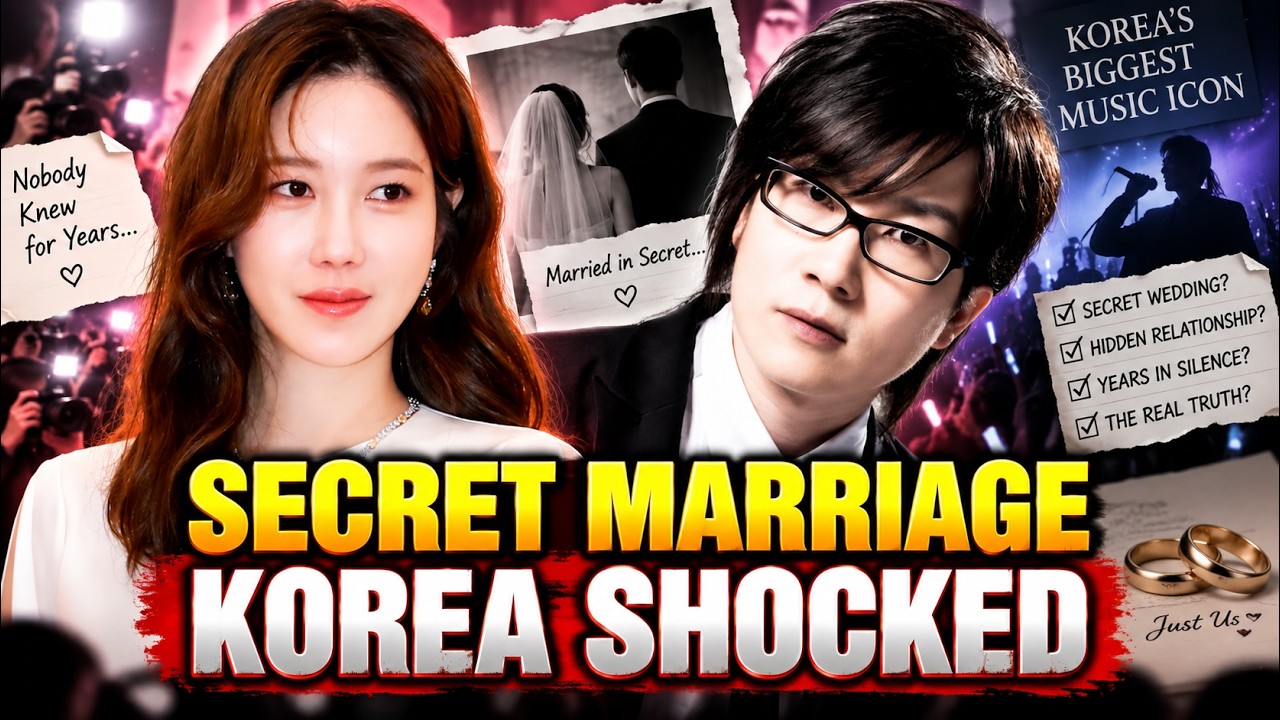
By that time, she had become a famous actress and had just announced a relationship with another major star, Jung Woo-sung. Suddenly, Koreans were asking the same question: how could a marriage involving famous figures stay hidden for so long? By the early 1990s, Seo Taiji was not just any Korean singer. He was becoming a cultural force.
After debuting with the group Seo Taiji and Boys in 1992, he helped reshape what young Korean audiences expected from popular music, blending rap, rock, dance, and social commentary in ways that were new at the time. His fame grew quickly, and so did his reputation for keeping his private life out of view. Fans knew his music, his performances, and his carefully controlled public image. But they knew almost nothing about what happened when the cameras were off.
That mystery deepened after 1996, when Seo suddenly withdrew from the group and left Korea. To the public, it seemed one of the country’s biggest stars had simply disappeared from the entertainment scene. No one knew that another life was forming around him, far from Seoul and far from the Korean press. The story of Lee Ji-ah and Seo Taiji begins in the United States in 1993.
Lee was still very young when the two first met through Korean community connections in America. Years later, that first meeting became one of the most contested parts of their story. Lee described it as the beginning of a relationship that ultimately changed the course of her life. Seo’s side later insisted the two did not start dating at that time.
According to Seo’s account, they stayed in touch for years and only became romantically involved around 1996, after he left the Korean music scene and moved to the United States. That difference matters because the exact timeline became a major public point of conflict many years later. What is undisputed is that the two knew each other long before Lee Ji-ah became famous and long before the Korean public had any reason to connect their names. Their relationship developed almost entirely away from the spotlight.
On October 12, 1997, Lee Ji-ah and Seo Taiji legally married in the United States. For a star of Seo’s level, the marriage was notable not for a grand ceremony but for the opposite. There was no public celebration. There was no official announcement to fans.
Korean entertainment reporters published no wedding photos or interviews. There was no public image of Lee standing beside him as his wife. Instead, the marriage existed almost entirely out of view. They spent most of their married life in America, away from the constant media coverage that would have followed Seo in Korea.
At the time, the Korean entertainment press was very different from the social media era that came later. There were no smartphones in every pocket, no Instagram stories, no constant online tracking of celebrity movements. That environment made keeping a secret much easier. One of Korea’s most famous musicians had become a married man.
Yet millions of fans continued to believe they understood the basic story of his life. Years later, Lee Ji-ah described that hidden marriage in emotional terms. During a television appearance in 2014, she said the secrecy surrounding the relationship made her feel isolated and forced her to give up much of her normal life. She suggested she became completely cut off from her family and from the ordinary social world most people take for granted.
According to her account, protecting Seo’s identity and their relationship became a constant part of daily life. Seo Taiji’s side strongly challenged that picture. His representatives said the marriage was private from the public but not entirely hidden from everyone around them. They claimed family members and some close friends knew about the relationship, that relatives visited them, and that the couple traveled and spent time together in ways that were more normal than Lee’s later description suggested.
These conflicting accounts created a lasting puzzle. The marriage itself is confirmed fact. But what life inside that marriage was really like depends on who is telling the story. By 2000, the relationship was already falling apart.
Seo Taiji returned to South Korea and resumed his music career, returning to a country that had no idea he had been married. According to Seo’s later statement, the two began living separately around June 2000, after less than three years of married life together. Lee remained in the United States for a while, while Seo rebuilt his public career in Korea. The separation generated no headlines because there was no public marriage in the first place.
There were no divorce rumors, no public separation statements, no reporters waiting outside a courthouse. A marriage that happened in secret could begin to end in secret too. For years afterward, Seo Taiji continued to be regarded as one of Korea’s most private stars. And since Lee Ji-ah had not yet entered the entertainment industry, their lives seemed to be heading in completely different directions.
Still, the records of that hidden relationship existed, quietly waiting for the moment a private legal dispute would make them impossible to conceal. By the time Lee Ji-ah finally entered the Korean entertainment industry, almost everything about her earlier life had been separated from the identity the public knew. Her big breakthrough came in 2007 when she appeared in the popular television drama “The Legend,” opposite actor Bae Yong-joon. The role introduced her to a massive audience almost overnight.
She was presented as a relatively mysterious newcomer, and that mystery became part of her public image. Viewers were curious about her background, her education, and the years she spent abroad. But none of that interest revealed the secret marriage that had already shaped a large part of her life. Over the next few years, she continued acting in Korean television series and gradually became famous in her own right.
What made the situation unusual was that Lee Ji-ah was now famous enough for entertainment reporters to chase. Yet no one publicly connected her to Seo Taiji. The two names lived in completely different worlds. One belonged to a legendary musical figure whose private life had long fascinated Korea.
The other belonged to a rising actress with an unusually guarded past. For years, no one outside a limited circle realized these two stories were actually part of the same hidden history. Then in early 2011, Lee Ji-ah’s personal life suddenly became more public. While working on the action drama “Athena: Goddess of War,” she became close to actor Jung Woo-sung, one of South Korea’s most famous film stars.
In March 2011, photos of the two together in Paris drew intense media attention, and their relationship soon became public. To fans, it looked like a glamorous love story between successful actors free to date. There was no public reason to believe Lee’s past contained anything that might complicate the story. But behind the scenes, a very different process had already begun.
On January 19, 2011, before the Paris photos became a major entertainment story, Lee Ji-ah had filed a legal action against Seo Taiji at the Seoul Family Court. Reports said the case sought about 500 million won in alimony and about 5 billion won in property division. The total figure reported by Korean media was 5. 5 billion won.
Korea’s most intriguing celebrity secret was no longer protected by silence alone. It was now written into legal documents. Once a private history enters a courtroom, keeping it secret becomes much harder. The legal dispute was complicated because the two sides did not fully agree on the most important timeline.
Seo Taiji’s position was that their divorce had been finalized in the United States in 2006. Lee Ji-ah’s legal argument raised questions about when that divorce should be considered effective for claims filed in South Korea, with 2009 cited as another important date in the dispute. This was not a minor technical disagreement. The timing could affect whether Lee still had a legal right to pursue property-related claims under Korean law.
Reports also emerged that the earlier American divorce documents included provisions in which Lee waived certain financial claims, raising further questions about why she was now seeking money in Seoul. From the public’s perspective, none of this was known yet. The case was moving quietly through the family court system while Lee’s relationship with Jung Woo-sung dominated entertainment news. The public was watching one version of her life while the courts handled another.
By the time reporters discovered the case, reports indicated multiple hearings had already taken place. Those details made the scandal seem even stranger later. The truth had not suddenly appeared. It had existed inside a legal process almost no one following Korean celebrity news had noticed.
Everything changed on April 21, 2011. Korean media reported that Lee Ji-ah and Seo Taiji had been legally married in the past and were now involved in a financial dispute. The reaction was immediate and enormous. To many Koreans, the story seemed impossible at first.
Seo Taiji was not an obscure musician with a small fan base. He was one of the most influential and closely followed stars in Korean popular culture. Lee Ji-ah was not an unknown ordinary citizen. She was a television actress recently photographed dating Jung Woo-sung.
Yet the public was suddenly told these two stars had once been married and the marriage had stayed hidden for years. The scandal was not simply that Seo Taiji had been married. The real shock was that an entire history of marriage, separation, and divorce existed without ever becoming part of his public biography. Search portals, television programs, newspapers, and online communities exploded with speculation.
Old interviews were re-examined. Timelines were reconstructed. Fans tried to understand how two famous people could protect such a big secret in an industry built on public interest. The story quickly went beyond mere entertainment gossip and became a national conversation about fame, privacy, and how much the public truly knows about celebrities.
Once the news spread, rumors multiplied faster than confirmed facts. One of the most damaging claims was that Lee Ji-ah and Seo Taiji may have had children together during their secret marriage. Lee’s representatives denied that claim directly, confirming the former couple had no children. Her agency also confirmed the essential facts that could no longer be hidden: she and Seo had indeed been married, they had separated, and there was now a legal dispute involving money and property.
Meanwhile, Seo Taiji initially remained silent, increasing public curiosity. When he finally issued a detailed statement on April 30, 2011, he confirmed the relationship and the marriage while providing his own timeline of how it began and ended. He acknowledged the news had shocked fans and apologized for keeping an important part of his life secret. On the same day, Lee Ji-ah sought to withdraw her lawsuit, explaining on her side that the exposure of her private life had caused severe emotional distress.
For a moment, the scandal seemed like it might end as suddenly as it began. But Seo Taiji did not simply accept the withdrawal and walk away. His side later objected, arguing that the legal dispute needed a clear resolution so the matter would not remain open to future claims. What had begun as a hidden marriage was now turning into an open legal battle, and the next phase revealed that ending the case could be as complicated as hiding the relationship had been.
The legal fight did not disappear after Lee Ji-ah’s attempt to withdraw her suit. Instead, the dispute entered a stranger phase because Seo wanted the matter resolved in a way that would prevent the same financial claims from resurfacing later. His team argued that simply letting the case fade would leave too many questions unanswered. That position kept the conflict alive through the spring and summer of 2011, even as intense public interest continued.
Lee eventually returned to the legal track, and both sides continued negotiating how to close the case. The stakes were no longer just about money. By that point, the lawsuit had already exposed one of the most guarded private records in Korean entertainment. Every court development generated a new wave of headlines, and every headline brought more speculation about what had happened inside the marriage.
On July 29, 2011, both sides finally reached a settlement through the Seoul Family Court. The agreement ended the legal dispute, and according to reports, it involved no money changing hands between the parties. That detail mattered because the original lawsuit had been widely publicized for its shocking 5. 5 billion figure.
In the end, the publicized number that fueled the scandal was not the amount that settled it. The settlement also tried to control what might happen after the courtroom battle ended. Reports said both sides agreed not to file further lawsuits against each other, not to attack each other publicly, and not to commercially exploit the story. The agreement reportedly included restrictions on turning the marriage story into books, films, or other projects without consequences.
A penalty estimated at 200 million won was tied to violations of the confidentiality and commercialization terms, making the settlement more than a simple financial resolution. It was also an effort to prevent the hidden marriage from becoming an endless public product. For both Lee and Seo, the damage to privacy had already been done, but the agreement set limits on what could be revealed later. The case had opened the door, and the settlement was designed to close it again.
Yet once millions know a secret exists, silence does not erase curiosity. The absence of details often makes a story more powerful. The public knew the basic facts but remained ignorant of the nature of the marriage, what those around them knew, and why the secrecy had lasted so long. The scandal also affected Jung Woo-sung, whose relationship with Lee had become public shortly before the marriage story broke.
By June 2011, reports confirmed the two had ended their relationship. Their breakup was immediately tied in public discussion to the Seo Taiji controversy. But the more logical version of the story is also the least dramatic. It is hard to prove exactly what Jung knew, when he knew it, or how much the scandal influenced the ending of the relationship.
Much of what circulated at the time came from anonymous sources, entertainment reports, or fan speculation. That uncertainty did not stop people from weaving simple narratives around it. Some portrayed him as someone who suddenly discovered a shocking secret. Others claimed he already knew parts of Lee’s past.
The evidence available to the public does not support turning either version into undisputed fact. What is clear is that the relationship did not survive the intense period that followed the revelation. Lee Ji-ah’s personal life went from unusually private to one of the most discussed stories in the country within weeks. For several years after the settlement, the story remained largely frozen in the version created by court reports and agency statements.
Then in August 2014, Lee Ji-ah appeared on the SBS program “Healing Camp” and spoke about the marriage in much more personal terms. She described meeting Seo when she was very young and spoke of the years that followed as a period of intense secrecy. She said she lived under the pressure of hiding a large part of her identity and suggested the relationship cut her off from normal connection with family and community. Her account gave the public something they had never received before: an emotional version of those hidden years from one of the people who lived them.
Lee described the experience as something that demanded great personal sacrifice. The interview quickly became a major news story. For the first time, the scandal was not just about dates, court documents, and money. It was about what the secrecy might have felt like from inside the marriage.
That shift changed how many viewers understood the story because it turned a celebrity mystery into a larger human struggle around identity, control, and isolation. The new version did not go unchallenged for long. On August 13, 2014, Seo Taiji’s company issued a response disputing several parts of Lee’s account. Seo’s side confirmed again that the two met in 1993 but said they did not begin a romantic relationship until around 1996.
His representatives also rejected the idea that Lee had been completely cut off from her family and normal life during the marriage. They said family members and close friends knew about the relationship, visited them, and spent time with the couple. In other words, both sides agreed the marriage existed, but they described the experience of that marriage very differently. Lee remembered a life shaped by secrecy and isolation.
Seo’s side described a private relationship that was hidden from the public but not from everyone close to them. That is the main reason the case remains difficult to reduce to a single clear narrative. The strongest version of the story is not one that declares someone wholly right and someone wholly wrong. It is the version that separates confirmed facts from personal memories.
The marriage happened. The public did not know. A legal dispute revealed it. The settlement ended the court battle, but the emotional truth of those hidden years remains divided between two people who remember them differently.
In the end, the secret marriage between Lee Ji-ah and Seo Taiji was not exposed by paparazzi, leaked photos, or an angry confession. It was exposed by a legal dispute that forced a hidden past into public view. The facts confirmed the marriage, the separation, the divorce battle, and the settlement. But the emotional truth remained much less clear.
Lee described isolation and sacrifice, while Seo’s side challenged parts of that story. Two people lived the same secret marriage and later remembered it in completely different ways. That is why the scandal still fascinates people today.