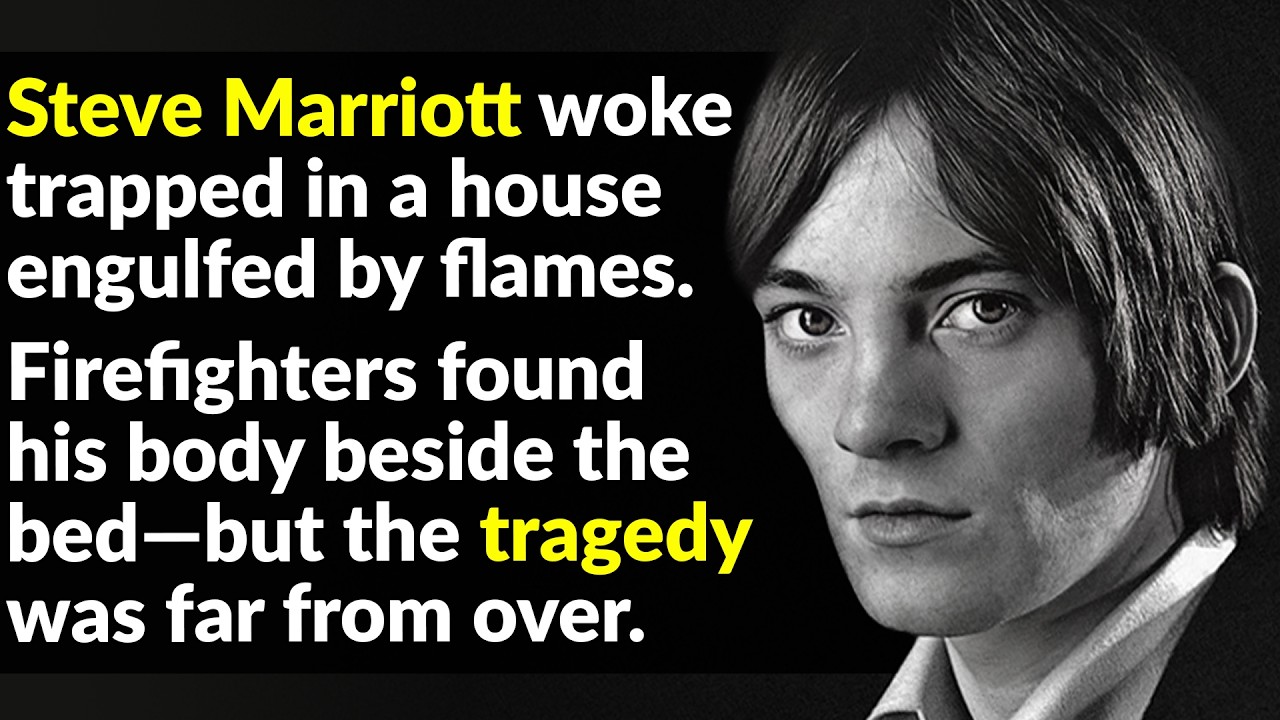
Steve Marriott woke up inside a house engulfed in flames and crawled between his bed and the wall to shield himself from the fire. That is where firefighters discovered his body. The tragedy marked the end of a life defined by an unrelenting passion for music, despite a long string of setbacks and disappointments. By the end, Marriott had grown so disillusioned with the industry that he chose to step away from the spotlight, only to perish in a fire that investigators believed started when he fell asleep after lighting a cigarette.
Born in January 1947 in Essex, Marriott arrived three weeks premature and contracted jaundice, which forced him to spend his first month of life in a hospital. As he grew, his parents watched their sickly baby transform into an energetic child with a talent for mischief. Marriott developed an early love of music by watching his father, Bill, play piano in pubs. He taught himself the ukulele and harmonica, and at age 12 he formed his first band, the Wheels, with two school friends.
Growing up in 1950s England, Marriott drew his greatest inspiration from Buddy Holly, even copying the icon’s look by wearing large-rimmed glasses without lenses. His bandmates called him Buddy because of how closely he emulated the singer. A year after forming the Wheels, Marriott’s father spotted a casting call for the Artful Dodger in the West End musical *Oliver* and signed him up without asking. Marriott reportedly impressed the show’s creator, Lionel Bart, and joined the cast for a year, earning £8 per week.
His parents encouraged him to pursue acting full-time, so at 14 he enrolled at the Italia Conti Academy of Theatre Arts. Since the family could not afford the fees, Marriott’s acting work paid for his tuition. Throughout the early 1960s, he sustained himself as an actor, appearing in radio, film, and television. Yet he eventually realized acting was never his true passion and returned to music, a decision his parents opposed.
The conflict prompted him to leave home. Marriott had formed another band in 1963, the Frantics, which later renamed itself the Moments. The group failed to attract record label interest, and in 1964 the band kicked him out, believing he was too young to sing lead. While working at a music store, Marriott met musician Ronnie Lane, who came in to buy a new bass.
The two connected instantly, bonding over a shared love of R&B. Marriott introduced Lane to his friend Kenny Jones, and the three agreed to perform together at a gig. The evening went badly. The trio drank excessively, and the night ended with Marriott destroying the piano he was playing.
Despite his rocky start, Marriott soon received an offer from another rising musician. David Bowie, also a devoted R&B fan, invited Marriott to form a duo under the name David and Goliath. The offer was tempting, but Lane and Jones’ band had just split up, and Marriott chose to form a new group with them instead. Bringing in a friend named Jimmy Winston, the four musicians needed a name.
A friend of Marriott’s named Annabelle joked that they all had small faces, and the name stuck. Small Faces gained a following in the English music scene, and one of their biggest fans was Robert Plant, the future Led Zeppelin lead singer, who ran errands for the band. The group signed with manager Don Arden in 1965, who placed them in a lavish house. They mostly used it for parties, with guests including Marianne Faithfull and Pete Townshend.
Arden was a powerful but notorious music manager, and his contract with Small Faces fell apart in 1967 after the band fought him over unpaid royalties. Arden then sold the band to Immediate Records. Among the people Marriott met during this period, one stood out: a model named Jenny Rylance, whom he first saw in 1966. She was dating Rod Stewart at the time, but Marriott wrote the song “Tin Soldier” about her.
The song brought them together, and they married in the spring of 1968. Small Faces released the concept album *Ogden’s Nut Gone Flake* in 1968 to critical acclaim, but Marriott felt the band’s creativity was stagnating. When his bandmates rejected his new ideas, he grew frustrated. He had also grown close to musicians Greg Ridley and Peter Frampton.
During a New Year’s Eve performance in 1968, Marriott stormed off stage in the middle of the set and announced he was leaving. He moved into a new project with Frampton and Ridley called Humble Pie. He immediately felt more appreciated and was granted creative freedom. His powerful vocals earned him recognition, and his manager pushed him to the front of the stage.
As the face of Humble Pie, Marriott toured the U. S. for years. During that time he began experimenting with hard drugs, which friends and family said changed him into a completely different person.
Jenny stayed by his side for five years but eventually divorced him in 1973. The failure of his marriage did not serve as a wake-up call. Marriott’s behavior grew hostile and tyrannical, causing a rift in the band. Humble Pie officially split in 1975.
Marriott soon entered a relationship with air hostess Pam Stephens. A year after they met, she gave birth to their son, Toby, and the couple married shortly afterward. By the late 1970s, Marriott’s money had run out, and he was so desperate that he stole vegetables from a neighbor’s field to survive. When he received an offer to reunite Humble Pie for a substantial sum, he accepted.
In 1981, he broke his wrist slamming it in a door, and that version of the band quickly fell apart without him. Left without a group, Marriott reconnected with Ronnie Lane, who had been diagnosed with multiple sclerosis during the Small Faces days. By 1981, Lane was in a wheelchair. The two reconciled, and Marriott invited Lane to perform with him again.
Together they recruited five other musicians and created the album *Magic Midgets*. Their collaboration ended there, as Lane’s condition prevented him from touring. Marriott’s marriage to Pam had been strained for years. When it came to light that he was having an affair with a woman who was pregnant with his child, Pam divorced him, becoming the second woman to leave him.
Marriott moved in with his sister, Kay, and put together a new band called Packet of Three. He then reconnected with an old friend, Manon Piercy, who helped him curb some of his destructive habits. They welcomed a daughter in 1985. That same year, Marriott began seeing another woman, Toni Poulton, whom he met at one of his gigs.
He moved in with her and married her in 1989. The couple settled in the village of Arkesden, and Marriott seemed to prefer the quieter life. He was content to remain small-time with Packet of Three, but his bandmates felt differently. When he began declining major record deals, they came to see him as a hindrance.
Marriott continued working on other projects, including an album with Peter Frampton in 1991. Behind the scenes, his marriage to Toni was deteriorating. On the flight back from his time in America with Frampton, Marriott drank heavily and picked fights with his wife. When they returned to the UK, the couple agreed to have dinner with a friend and stayed the night at the friend’s house.
They resumed arguing while in bed. When Toni woke a couple of hours later, Marriott had taken a cab home alone. Around 6:30 in the morning, a passerby alerted authorities to a fire at Marriott’s cottage. Firefighters put out the blaze, but it was too late.
Marriott’s body was found in his bedroom on the floor between the wall and the bed. Investigators concluded he likely woke up to the fire but was too disoriented to find the exit. They determined the most likely cause was Marriott falling asleep after lighting a cigarette. Marriott had achieved the rock star dream he once chased, only to find the reality deeply unsatisfying.
Disillusioned by the industry and the strings attached to fame, he chose relative obscurity. Though he never reached the same legendary status as some of his peers, he left a lasting mark.