On the evening of March 17, 1952, a cold rain fell over Harlem as a group of influential downtown policy operators gathered in a private dining room at a restaurant near the Hotel Theresa. They had come uptown to discuss territory with local numbers runners, men they believed could be used and, more importantly, controlled. Among those present sat Ellsworth Johnson, a quiet man known throughout Harlem by a childhood nickname he had carried into adulthood. He wore a plain gray suit and dark tie, kept his hands folded at the end of the table, and said little.
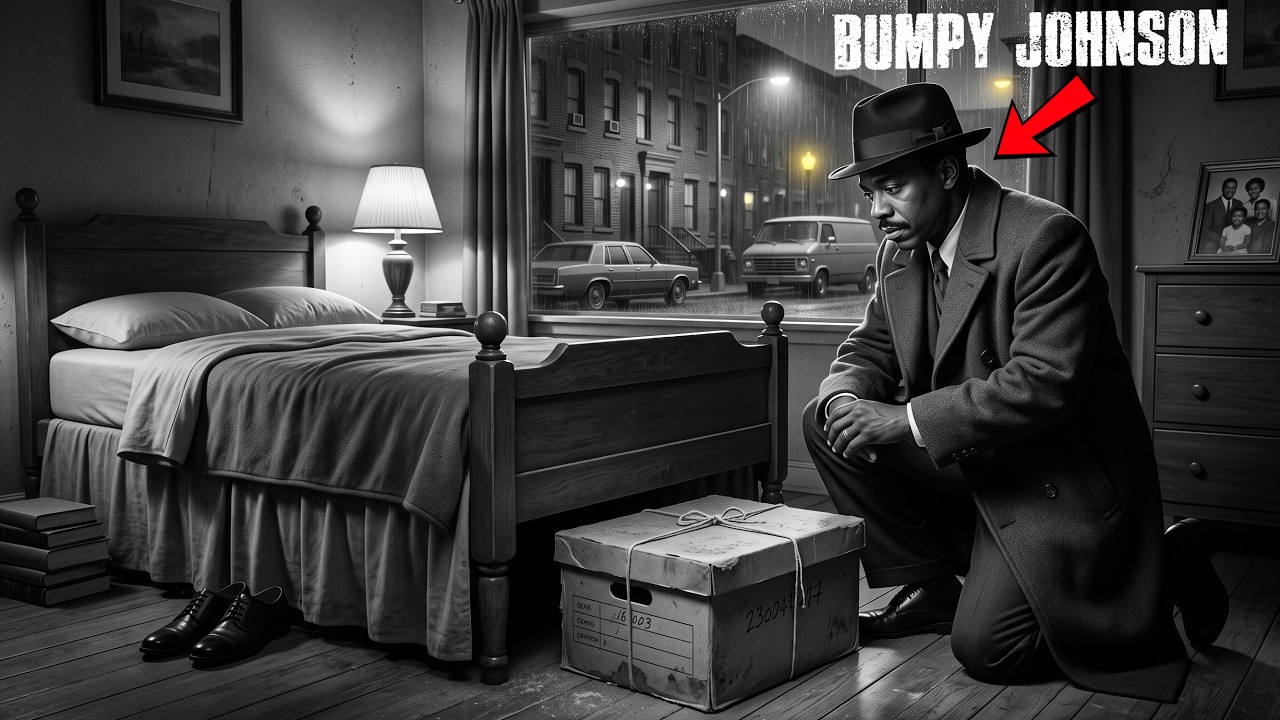
He was known for listening. As the conversation turned to specific blocks in central Harlem, a heavyset downtown banker leaned back in his chair and delivered a remark that shifted the tone of the evening. Without looking directly at Johnson, he said that uptown operators should be grateful for permission to work at all, and that Johnson should remember he was a guest in a business built by others and owned by others forever. The other men at the table smiled in agreement.
Johnson gave no response. He did not lean forward, raise his hand, or change his expression. He looked at the man who had spoken, then at the table, then at the rain streaming down the window. The others waited for him to say something.
When he did not, the discussion moved on. Johnson understood the comment was meant to provoke a reaction. An angry man is predictable, and a predictable man is easy to control. So he let the words pass over him like the rain outside, and kept his attention on the room, the faces, and the small movements that revealed who actually held power and who merely borrowed it.
The insult had been intended to diminish him. Instead, it gave him information. When the meeting ended, Johnson rose, thanked the host in a few quiet words, and walked out into the rain without looking back. He did not stop at any familiar establishment where his presence might draw attention.
He walked north alone, pulling his hat down against the weather. He did not complain to his associates about what had been said. He did not seek reassurance from loyal men. He went home and sat alone, thinking as the rain faded into mist.
What Johnson understood that night was that the man who insulted him was not the real problem. The man was merely a voice for something much larger and more enduring than any single person. The remark at the dinner table was not an outburst of temper. It was a statement of how the business worked.
Downtown men provided capital, protection, and connections to the top. Uptown men provided labor, local knowledge, and daily risk, receiving a share designed to keep them dependent. In that arrangement, Johnson was indeed a guest. The areas where he worked were not ultimately his.
Protection could be withdrawn, and downtown men could replace him with someone more loyal. Even if he expressed his anger, nothing would change. It would only mark him as someone unaware of his position. So the change that came over Johnson that night was not a move from anger to calm, but from anger to analysis.
He stopped thinking about the man who had spoken and began thinking about the structure that allowed such words to be spoken. He asked himself not how to answer the insult, but how to change the situation that made the insult possible. In the weeks that followed, those close to Johnson noticed a stillness in him that they could not explain. He did not withdraw like a wounded man rehearsing words he would never say.
He withdrew like a man engaged in serious work that required complete attention. He spent long periods alone. In the early mornings, before the streets became busy, he walked through the neighborhood as if seeing it for the first time. He noted which stores opened early and which stayed closed, which corners drew crowds and which stood empty, which people greeted one another and which passed in silence.
He was building a map in his mind of the neighborhood’s true structure: the web of relationships, loyalties, and dependencies beneath the visible surface of streets and buildings. He understood that this invisible structure, invisible to downtown men, was the foundation on which any lasting change had to be built. Downtown operators believed power flowed from above through capital. Johnson had reached a different understanding.
Money was one form of power, but it was not always decisive. There was a power of trust held by clergymen, elders, and those people ran to in times of trouble. There was a power of information held by those who knew the neighborhood’s secrets and could draw attention to a matter or deflect it. There was a power of labor held by those who did the daily work.
And there was a power of place itself. Downtown operators did not live in the neighborhood. They could not be everywhere at once. The people of the neighborhood were present on every street and in every building at every hour.
Johnson saw that these forms of power, though scattered and unorganized, were collectively far stronger than capital alone. The person who could gather and coordinate them would hold something downtown men could never acquire. This understanding set Johnson apart from others who had suffered the same humiliation. The neighborhood was full of men who responded to downtown contempt with anger, threats, and sudden violence that flared up and faded away.
They were remembered briefly, then forgotten, while the system that humiliated them continued unchanged. Johnson had watched this pattern for years and reached a conclusion few understood: anger could not defeat the system because the system was built to absorb anger. It could only be changed through patience, organization, and the slow building of influence in places downtown eyes did not reach. Downtown men had capital and protection, but they did not have the streets.
They did not live in Harlem, did not know its people, its churches, its shopkeepers, its rhythms, or its loyalties. They controlled the area from a distance through intermediaries, and their control depended on the cooperation of people they despised. Johnson saw a hidden dependency in their power. The person who understood it could turn it into a weapon.
In the following weeks, Johnson made no sudden moves. He moved through the area as he always had, doing his usual work, greeting familiar people, sitting in the same restaurants, talking with acquaintances. To an observer, nothing had changed. But beneath the surface of his ordinary days, he had begun a careful and deliberate work.
He had begun building. He understood that one man alone, however intelligent, could not stand against a system backed by capital, violence, and the protection of powerful men downtown. He did not need ordinary allies who would stand beside him in a fight. He needed a different kind of coalition: an assembly of people each holding a small piece of power that downtown controllers could not easily touch or replace.
He turned to community leaders whose influence flowed through churches, fraternal organizations, and social clubs that formed the real structure of Harlem life. These were people who could not be bought or threatened in the usual way, because their power rested not on money or force but on the trust of thousands of ordinary people. A pastor speaking on a Sunday morning could reach more people than any policy bank. The loyalty he commanded could not be purchased by any downtown operator.
Johnson approached these people not with demands but with respect. He sat in their offices and meeting rooms, listened more than he spoke, and gradually demonstrated that their interests and his were bound together in ways they had never considered. These leaders had long resented downtown control over the neighborhood’s underground economy: how money earned on Harlem’s streets flowed south and never returned, how the area was treated as a place to be exploited rather than a community to be served. Johnson proposed, without stating it directly, a different arrangement where the people working the streets would be local people, accountable to the neighborhood, rooted in it, willing to give something back.
He promised not reform but solidarity, and leaders who had watched outsiders exploit their people for decades listened. The discussions moved slowly over many weeks. Johnson understood that trust of this kind could not be built quickly, and that a man who moved too fast would seem to be scheming rather than building. He met with ministers in their reading rooms after the day’s work, sitting in old chairs as the light faded outside, talking about the neighborhood and its future rather than about himself or his ambitions.
He listened to their concerns, the concerns of people who carried the weight of a community’s suffering, and he took them seriously because they were serious. Through these conversations he understood the depth of resentment that had accumulated over many years: the anger of people who had watched their own being exploited by outsiders and had no power to resist. He saw that this anger was a tremendous potential force that needed only direction and method to become effective. He offered both.
He did not propose a war they would have rejected, but a strategy that would appear from outside as patient and lawful, and that promised to achieve what decades of protest and prayer had not. The ministers, who were practical people beneath their spiritual authority, found in Johnson’s vision a seriousness they had never seen before, and they agreed cautiously to lend their influence to his purpose. He also turned to lawyers who worked in offices along the avenue and understood court procedures, licenses, permits, and the quiet legal pressures that could make a business succeed or fail. For Johnson, a lawyer was not merely a protector but a strategist.
A man who knew where the system was vulnerable to legal pressure could accomplish with a properly filed complaint or a challenged license what no threat ever could. Downtown businessmen relied on a kind of invisibility, the assumption that their operations would never be examined too closely. A lawyer who knew how to turn official attention toward those operations was a perfect weapon. Johnson cultivated these men, paid them well, and treated them as partners rather than servants.
He understood that courts and regulatory agencies, however corrupt, could be used against downtown businessmen if someone who knew how the levers worked applied the pressure. He turned to the neighborhood’s businessmen, the men and women who owned shops, restaurants, and small enterprises and depended on the daily patronage of ordinary people. Their interests were tied to the neighborhood’s health. They suffered when the streets became dangerous and prospered when they were stable.
Johnson saw that downtown operators had made enemies of these people without realizing it by showing indifference to the neighborhood’s welfare. He offered them something downtown men had never offered: the assurance that stability was good for everyone, that an orderly street was good for commerce, and that money circulating in the neighborhood’s underground economy could support legitimate businesses rather than threaten them. In return he asked very little: only their goodwill, their willingness to speak on his behalf, and their readiness to withhold their cooperation from downtown men when the time came. It was a small thing to ask, costing them nothing, so they gave it.
Johnson knew that these small contributions from many people would combine to create enormous pressure, because a neighborhood where every shopkeeper was cool to downtown operators and warm to local men was a neighborhood where downtown operators were losing ground without knowing it. Finally he turned to the workers themselves, the men who ran the number routes, collected bets, and carried money through the streets: the day laborers of the underground economy whose cooperation was essential to the entire system. These were the people downtown men trusted and understood least, yet everything depended on them. Johnson had come up from their ranks.
He had worked the routes, carried the money, taken the risks. He spoke to them not as a boss but as a fellow worker, and gradually, without pressure, he made them understand that the system they worked in was designed to keep them poor and dependent, and that another arrangement was possible. He did not incite them. He only raised their awareness, and once that knowledge was planted, it took root.
The coalition Johnson built in those weeks was unlike anything downtown men had imagined. It was not a gang or an army. It could not be defeated by any method they knew. It was a web of aligned interests.
Each thread was held by different people and supplied a different form of power. The clergy held the neighborhood’s moral authority. The lawyers held the machinery of legal pressure. The businessmen held the street’s commercial life.
The workers held the daily operations of the economy. Johnson connected them all, not by force but by patiently demonstrating that their interests converged at a single point. He knew from the beginning that this kind of power could not be seized in a single effort. It had to be built step by step, in the quiet corners where downtown men never looked, until it was strong enough to reveal itself.
The strategy Johnson developed rested on a simple insight that downtown operators never grasped. Their power was real, but it was severely limited. They controlled capital, could deploy violence, and had connections to the upper levels of crime and politics. But their control over Harlem was fragile, resting entirely on the cooperation of local people: cooperation they assumed would last forever.
Johnson’s plan was to withdraw that cooperation slowly and simultaneously from every direction, until downtown operators realized their capital was frozen, their violence aimless, and their connections useless because the ground beneath them had shifted. He did not want to fight them directly. He wanted to make the neighborhood ungovernable without the consent of its people, and that consent was held only by him. The elegance of the plan was its indirectness.
A direct attack on downtown operators would have pitted Johnson’s strength against theirs, and theirs was greater. Johnson had no intention of matching strength with strength. He intended to pull out the foundation of their power so that their capital, violence, and connections, however formidable, had no field in which to operate. A man controls an area only as long as the people of that area permit it.
That permission, which downtown operators had always treated as a given, was in fact the very basis of their power. Johnson’s plan was to withdraw it carefully and completely, leaving downtown operators in a position where they held title to a house but could no longer enter it: what they had on paper, they had lost in reality. Because the withdrawal was accomplished not through a single visible rebellion but through thousands of small, lawful, invisible acts, downtown operators could not identify it, attack it, or stop it until it was finished. The economic dimension was the foundation of the plan.
Johnson understood that downtown operators derived their profits from the flow of money through the numbers game, and that this flow depended on the workers who ran it and the customers who participated. If workers slowed their pace, if they began making errors that were difficult to prove, if sources became unreliable and collections declined, downtown operators would see their profits diminish without any clear cause they knew how to address. Johnson did not order a strike, which would have been visible and demanded a response. He permitted a slow decline in enthusiasm and a gradual fall in efficiency, conducted so quietly it seemed like nothing more than the usual friction of business.
At the same time, he encouraged the rise of alternative operations: small independent enterprises accountable to the local neighborhood rather than to downtown men, offering workers and customers better shares and fairer treatment. These operations grew gradually and began drawing money away from downtown banks. Because they were rooted in the neighborhood and protected by the coalition, they were difficult to attack without antagonizing the very community whose cooperation downtown operators needed. The social dimension worked alongside the economic one.
Johnson understood that downtown operators depended on acceptance: the willingness of the neighborhood to tolerate their presence and control. The clergy and community leaders began to shift that acceptance through sermons, meetings, and private conversations. They spoke of money that left the neighborhood and never returned, of distant men indifferent to local suffering, of the difference between a neighborhood governed by itself and one governed from outside. They never named Johnson or his rivals directly, but they created an atmosphere in which downtown control seemed not merely unpleasant but illegitimate: not something to be endured but a burden to be resisted.
The businessmen contributed by speaking in favor of local arrangements and against outside ones, until the social ground beneath downtown operators began to erode invisibly. The legal dimension ensured precision. The lawyers Johnson cultivated began turning official attention toward downtown operations at carefully chosen moments. A complaint here, a license challenge there, a word in an inspector’s ear, an official who was owed a favor or seeking advancement.
Downtown operators found themselves facing a growing pile of legal complications whose single source they could not identify. Their establishments were examined, their arrangements questioned, their cost of protection rose while their benefits declined. None of it was dramatic. No single blow was decisive.
But the combined effect was to make downtown operations expensive and troublesome, to raise the cost of their presence in the neighborhood until it exceeded the profits they earned. Johnson understood that a system could be defeated not only by force but by attrition: by making it harder to continue operating than to stop. The dimension of competition and exposure completed his plan. Johnson made sure the neighborhood understood the difference between him and the downtown operators, not through boasting but through deeds.
Those men only took; they gave nothing back. Johnson’s operations gave something back, supporting local businesses, honoring community leaders, treating workers with relative fairness. The contrast spoke for itself. While downtown operators relied on secrecy, Johnson used his quiet channels to make their methods and indifference known, discussed, and despised.
He spread no lies. He let the truth of the situation circulate until it did its work. Downtown operators, accustomed to working in the shadows, found themselves increasingly exposed, criticized, and unable to maintain the distinction on which their power depended. The implementation of the strategy took many weeks, and its effects accumulated gradually, exactly as Johnson intended.
At first, nothing seemed to change. Downtown operators continued their business, collected their profits, and remained confident in their control. But beneath the surface, the ground had begun to shift. The numbers became less reliable and the take declined.
Downtown men attributed it to weather, season, or worker carelessness. They could not see the pattern because the pattern was designed to be invisible. As the weeks passed, the problems grew. Legal troubles accumulated.
Establishments became the focus of unwanted attention, and the cost of maintaining a presence in the area rose. The social atmosphere cooled, respect faded, resistance spread. Yet no single event explained it, because Johnson had built his campaign not as one great blow but as a thousand small pressures. The slow-building strategy was effective precisely because it did not reveal itself.
A single dramatic event, a strike or a direct confrontation, would have given downtown operators a target and a reason to retaliate. They knew how to respond to open defiance; they had crushed it many times before. An open challenge would have allowed them to direct their full strength against a visible enemy. Johnson gave them no such opportunity.
He gave them no enemy to fight, no specific obstacle to overcome, only a vague and formless crisis that grew for reasons they could not trace and could not solve. A person under attack can defend himself. But a person whose foundation is being eroded grain by grain has nothing to strike at, and all his strength becomes meaningless. Johnson had pushed the downtown operators into exactly this position with extraordinary patience: a situation where problems grew without visible cause, where power diminished without a clear enemy, where a slow and inevitable weakening could not be stopped by any display of force.
As the weeks turned into months, the accumulated pressure began to produce results that could no longer be ignored. The alternative operations Johnson had encouraged grew from small and tentative beginnings into genuine competitors, steadily drawing away the money that once flowed without obstruction into downtown banks. The legal complications, once occasional, became a permanent burden, requiring time, money, and favors that could not be obtained indefinitely. The social atmosphere, once merely cool, became actively hostile.
Downtown operators found themselves unwelcome in places where they had once been received, heard contemptuous talk that reached their ears, and were treated as outsiders in an area they had considered their own. The workers on whom everything depended became less reliable, less diligent, and less afraid, until the downtown business that once ran with mechanical smoothness stumbled through hundreds of small problems into a full-blown crisis. As the crisis deepened, downtown operators responded the way they always had. They reached for the instruments of domination.
They issued warnings, threats, and declarations that they would not tolerate interference. They summoned their workers and demanded greater loyalty and better results. They sought to identify the source of their problems and strike at it directly, as they had always struck at challengers. But they found themselves increasingly confused, because there was no single source to strike at.
The withdrawal of cooperation was general and diffuse, spread across the entire neighborhood, not concentrated in any individual who could be threatened into submission. The legal pressure came from government offices they could not easily reach. The social resistance came from clergymen and prominent citizens whom they could not intimidate without creating exactly the kind of open conflict they wished to avoid. Their threats fell on a neighborhood that had silently decided to stop being afraid, and a threat that produces no fear accomplishes nothing.
Johnson had known from the beginning that this moment would come: the moment when the instruments of domination revealed their limits. Downtown operators had built their power on fear and had never needed any other instrument because fear had always been enough. But Johnson had created a situation where fear no longer worked. The neighborhood was organized, united, and so aware of its own strength that the old methods could not control it.
Downtown operators found themselves in a position they did not know how to handle. Their capital could not be deployed, their violence produced no results. They faced a neighborhood that had silently and completely moved beyond their reach. As their crisis deepened, profits fell and costs rose, they were forced for the first time to consider an option they had never needed before.
They were forced to negotiate. The decision to negotiate was not easy for them, nor did it come suddenly. They resisted as long as they could, because it meant acknowledging a truth they were not prepared to accept: that they could no longer hold the power they had always assumed was theirs. They spent weeks trying every means they knew.
They intensified their threats, which accomplished nothing. They tried to identify and remove the leaders of the resistance and found there were no accessible leaders. The resistance was a diffuse but universal refusal spread across the entire neighborhood. They tried to buy the loyalty of key individuals and discovered that those they approached were already committed to a different purpose and could not be purchased.
They tried to use their connections to the upper levels of the city’s criminal world and learned that those connections had no more authority over the organized neighborhood than the downtown operators themselves. Every instrument in their hands failed, the crisis deepened, and the profits fell, until they understood they had to choose between negotiating a reduced position or losing everything through continued resistance. Like rational men in an irrational situation, they chose to negotiate. When the negotiations took place, they were conducted quietly in private rooms, with no authorities and no public involvement.
The downtown operators came not as supplicants but as one power approaching another, which was itself a measure of how much had changed. The man who had once been called a guest, told to be grateful for his position, had become someone without whose consent the downtown businessmen could no longer operate. Johnson conducted the negotiations with the same discipline he had shown at the dinner table months earlier. He showed no triumph, made no threats, demanded no humiliation from those who had once humiliated him.
He understood that agreements built on the humiliation of the defeated do not last. A humiliated man seeks revenge, and Johnson’s purpose was not revenge but power. He asked for terms that reflected the new reality: a larger share of the money earned from the neighborhood’s labor to remain in the neighborhood, real authority for local businessmen on their own streets, and a transformation of downtown operators from masters into partners. He asked only for what was possible in the new situation, nothing more.
And because his demands were measured, the men across the table understood they could accept them. The settlement reached through those negotiations was never announced, and no document exists that a historian could later produce as evidence. But its effects were visible in the neighborhood in the months and years that followed. The flow of money had changed.
A substantial portion of what was earned on Harlem’s streets stayed in Harlem, circulating through its businesses and supporting its institutions. Local operators, with Johnson at their head, had achieved a real authority over their own area that they had never possessed before: authority not borrowed from any distant man but built on the consent of the neighborhood. The downtown businessmen continued to operate in the neighborhood, but on terms that acknowledged the new balance of power, and they never again made the mistake of treating the people of uptown as guests in their own home. The change was real and lasting, and it altered the behavior of everyone involved.
Men who once spoke with contempt now spoke with caution. A neighborhood whose wealth had once been plundered now controlled its own resources. And Johnson, who had said nothing at the dinner table, had achieved through patience and organization what no amount of anger could have achieved. The victory could not be measured only by the flow of money.
It could be measured by the way the neighborhood held its head up, by the confidence of its leaders, the security of its businesses, the dignity of its workers. The coalition Johnson built did not dissolve after achieving its goal. The ministers continued to speak, the lawyers continued their work, the businessmen prospered, and the workers operated under a far fairer arrangement. The web of interests Johnson had woven became a permanent feature of the area’s life: a local power structure that outlasted the conflict that created it.
The lesson of that conflict was that the neighborhood was strongest when united, and that together the people held far more power than they did separately. It was part of the neighborhood’s self-discovery. He had demonstrated a method for transforming a community’s scattered strength into a force that neither capital nor violence could defeat. This change extended beyond the immediate conflict to the larger structure of power in the city.
Downtown operators understood that Harlem could no longer be controlled from a distance, and they changed their behavior, not only in dealing with Johnson but in their entire approach to the area. They understood that the old system, which treated the neighborhood as passive territory, no longer worked, and that any future business required the genuine cooperation of local leaders. This understanding spread through the informal channels connecting the city’s criminal and commercial economies, and it changed the relationship between Harlem and the forces that had long sought to control it. Through Johnson’s patient campaign, the neighborhood had established a principle that would shape its affairs for years to come: its consent could not be assumed, and its cooperation could not be compelled.
It had to be earned, and it could always be withdrawn. Why this method succeeded where others had failed is worth considering, because the answer carries the essential meaning of Johnson’s achievement. Many before him had known that downtown operators were their enemies and had been destroyed acting on that knowledge with courage and boldness. They had no lack of courage.
They lacked analysis. They saw the enemy but not the system, the men but not the structure. When they should have been uprooting the conditions that produced their enemies, they only struck at individuals. When they should have been organizing, they fought.
When they should have been concealing their strength, they displayed it. When they should have accepted the long discipline of a patient campaign, they sought immediate gratification. Johnson succeeded because he had learned through long observation that downtown power was not a person to be defeated but a set of interdependencies to be dissolved. Dissolving them required not a single decisive blow but patient pressure applied simultaneously at every point of weakness.
He learned that the strength of the powerful always depends on the cooperation of those beneath them, and that silently withdrawing that cooperation is more powerful than any weapon. He learned that the appearance of weakness can be a form of strength. The man who is underestimated moves freely, while the man who is feared is always watched. A campaign conducted in silence is a campaign that is finished before it can be answered.
For Johnson himself, the transformation was complete and lasting. The man who once sat quietly at the end of the table while others defined his place had become a figure whose place no one dared to define. His authority was not built on fear, though he could have inspired it if he chose. It was built on the deep foundation of the neighborhood’s respect, the loyalty of his coalition, and the demonstrated success of his methods.
He had become, in the fullest sense, a powerful man, because he had not merely won a fight but changed a system. He carried this authority with the same restraint he had always shown, because he understood that power held quietly lasts longer than power displayed loudly, and that the man who does not need to announce his strength is the man whose strength is least challenged. He continued to live in the neighborhood, walking its streets, sitting in its restaurants, exchanging greetings with its people. For the rest of his life, he remained a figure the people of the area looked to and relied upon.
The legacy of that time extended far beyond one man’s life. The method Johnson demonstrated, patient coalition building, withdrawal of cooperation, pressure applied simultaneously from every direction, and the preference for negotiation over domination, became part of the neighborhood’s tradition. It was proof of what a community could achieve when it organized its strength and applied it with intelligence and patience. The younger generation that followed studied what he had done, though few had the discipline to repeat it, and the memory of his campaign remained a lesson in the difference between noise and real power.
The people of the neighborhood remembered that their greatest victory had come not through a display of force but through the calm, deliberate work of a man who understood that systems are changed by organization, not by anger, and that real power belongs to those who have the patience to build it. So the evening of March 17, when a man was told he was only a guest in a business that was not his, was remembered not as the moment of his humiliation but as the moment of his awakening. The insult meant to diminish him began a long and patient work that changed not only his own position but the entire structure of power in his neighborhood. The men who spoke those contemptuous words had no idea what they would bring about, because they did not know the man they were addressing, and they did not understand that the quietest man at the table is sometimes the one who understands the most.
Johnson never spoke of that evening again. He never mentioned the insult or the name of the man who made it, because he knew that the true answer to an insult is not words but a change in the world. And the world had changed. The rain that fell on Seventh Avenue that night had stopped long ago, and the neighborhood it soaked was no longer what it had been.
Few people understood the source of the difference, but it was the work of a man who chose patience over anger and organization over noise, and through that choice made himself and his community the owners of ground they had been told was only lent to them.