For 62 years, the official story of the assassination of President John F. Kennedy has rested on a single conclusion: Lee Harvey Oswald acted alone. On November 22, 1963, according to the Warren Commission, Oswald fired three shots from the sixth floor of the Texas School Book Depository in Dealey Plaza, Dallas, in 8.6 seconds.
That conclusion was reached on September 24, 1964, in an 888-page report backed by 26 volumes of supporting evidence. It was delivered less than a year after the shooting, before the country had finished grieving. For more than six decades, it stood as the wall between the public and everything the government's files contained.
On January 23, 2025, President Trump signed Executive Order 14176, mandating the declassification of all remaining assassination records held by the CIA, FBI, and National Archives. On March 18 and 19, 2025, the National Archives released between 64,000 and 80,000 pages of previously withheld or heavily redacted documents.
Some of those pages confirm what researchers had argued for decades. Others go further than anyone expected. Roughly 3,000 documents remain sealed even now, along with an additional 2,400 newly discovered FBI records whose existence had not previously been acknowledged.
The Warren Commission was presented as a thorough, independent investigation conducted by the most senior legal and political minds in America. Chief Justice Earl Warren, Senator Richard Russell, and Congressman Gerald Ford, who would later become president, were among its seven members. The world believed it was getting the truth.
What the commission actually worked with was something else. The CIA withheld documents. The FBI withheld documents. The Secret Service destroyed records. Naval medical personnel were ordered to falsify autopsy entries. Witnesses were interviewed once, briefly, and never recalled.
The single most important piece of physical evidence, the acoustic recording of the shots fired in Dealey Plaza, was classified, removed from the public record, and not seen again for 15 years.
Witness accounts from the day itself did not align with the single-shooter conclusion. Jean Hill, standing on the south side of Elm Street, told investigators she heard four to six shots and that some came from the grassy knoll. S. M. Holland, on the overpass directly in front of the motorcade, said he saw a puff of smoke rise from behind the wooden fence on the knoll immediately after the shots.
Lee Bowers, operating a railroad tower with a direct sight line to the grassy knoll parking lot, reported seeing two men behind the fence in the moments before the shooting and unusual activity in the area immediately after. All three were interviewed by the Warren Commission. None of their testimonies appeared in the final report's primary conclusions.
According to documents released in the 2025 files, at least one grassy knoll witness received a second visit from a federal agent in the weeks after the assassination. The visit was not documented in the official record. The witness subsequently changed their account, and the changed account is the one that appears in the Warren Commission's published testimony.
The original account, given in the immediate hours after the shooting before the official story had fully solidified, is now visible in the unredacted 2025 release.
The acoustic evidence is where the physical record becomes impossible to dismiss. In 1978, the House Select Committee on Assassinations commissioned the Bolt, Beranek, and Newman firm, the same group that analyzed the Watergate tapes, to examine a police Dictabelt recording made during the motorcade.
The Dictabelt had sat in the Dallas Police Department's evidence archive since 1963 without scientific analysis. The HSCA's 1979 result was unambiguous. The analysis identified four distinct impulse patterns consistent with gunshots. Three originated from the direction of the Texas School Book Depository. One did not.
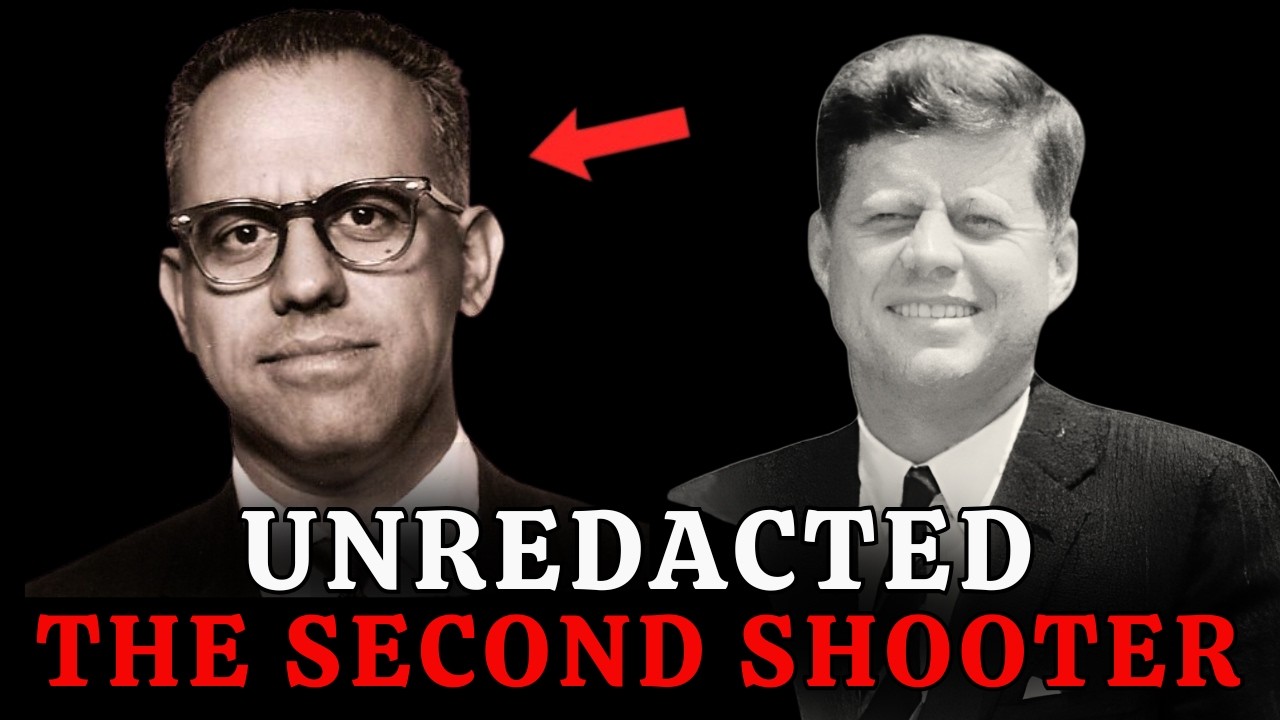
One impulse, timed to approximately 1.66 seconds before the final fatal shot, originated from the direction of the grassy knoll with a 95 percent acoustic confidence rating. The HSCA concluded there was a high probability of a conspiracy.
That report has existed since 1979 and has been publicly available. It directly contradicts the Warren Commission's single-shooter conclusion, and the government did not reopen the investigation.
The Warren Commission was given the original acoustic evidence in 1964. They classified it, not because it was inconclusive, but because it was not. The recording remained inaccessible to independent researchers for 15 years. The HSCA only obtained it because it had subpoena power the Warren Commission did not exercise.
Six weeks before Dallas, in October 1963, a different thread was already in motion. Lee Harvey Oswald traveled to Mexico City in late September 1963, visiting the Soviet Embassy and the Cuban Consulate. His movements were monitored by a CIA surveillance operation running since at least 1959.
The CIA photographed Oswald entering and exiting the Soviet Embassy. They intercepted phone calls. They compiled a file. According to a CIA memo written in October 1963 and released in the 2025 files, a mid-level analyst flagged the Oswald file as a potential security concern and requested escalation to senior leadership. The request was denied.
Oswald returned to the United States on October 3, 1963. Fifty days later, he was in Dallas.
The CIA officer responsible for overseeing the Mexico City surveillance operation at that time was a man named George Ioannides. His name does not appear in the Warren Commission report, in the 26 volumes of supporting evidence, or in any public accounting of the assassination investigation conducted between 1964 and 2025.
Ioannides managed the Mexico City station's assets and liaison relationships. He was also the officer who had authorized a $25,000 payment to an anti-Castro Cuban exile organization called the DRE, the Directorio Revolucionario Estudiantil, in the months before the assassination.
The DRE had direct documented contact with Oswald in New Orleans in the summer of 1963. Oswald handed out pro-Castro leaflets in front of a building occupied by DRE members. DRE members confronted him. There was an altercation. The incident was photographed and filmed, appeared on local television, and was used in the weeks after the assassination to establish Oswald's public identity as a pro-Castro activist.
That identity made his guilt legible to the American public and made a Soviet or Cuban conspiracy theory both plausible and controllable as a narrative.
The CIA officer who monitored Oswald in Mexico City was the same officer who funded the Cuban exile group that staged a public confrontation with Oswald four months before Dallas. That group then became a primary source for the media narrative establishing Oswald as a communist sympathizer within hours of the assassination.
George Ioannides did not simply avoid the Warren Commission's notice. He was brought out of retirement in 1978 specifically to serve as the CIA's liaison to the House Select Committee on Assassinations, the same committee investigating whether the CIA had withheld information from the Warren Commission.
The CIA sent the man whose name was in the withheld files to decide what files the HSCA would see. The HSCA's chief counsel, G. Robert Blakey, did not learn Ioannides' full operational history until 2001. When he did, he said publicly that the CIA had obstructed the HSCA's investigation and that Ioannides' assignment as liaison had been a deliberate act of concealment.

On November 24, 1963, two days after Dallas, Oswald was being transferred from the Dallas Police Department to the county jail. The transfer was conducted in public, in front of cameras, inside the basement of the police building.
Jack Ruby, a Dallas nightclub owner with documented ties to organized crime figures in Chicago and Dallas, walked into that basement through a police entrance and shot Oswald at point-blank range. Oswald died two hours later. The one man who could have answered questions about the assassination was silenced before he faced a courtroom.
The official explanation for how Ruby accessed the basement was that he walked in through an unguarded entrance while a detective's attention was elsewhere. The explanation was accepted. The investigation into Ruby's access was minimal, and the investigation into his connections was truncated.
An FBI document released in the 2025 files contains the record of a telephone call received by the FBI's Dallas field office on the morning of November 24, before Oswald was shot. The caller told the FBI that a man named Jack Ruby was going to shoot Oswald during the transfer.
The call was received. It was logged. It was not acted upon. Oswald's transfer was not modified. The security arrangements were not changed. Four hours after the FBI received a warning with Ruby's name, Oswald's name, and the method of killing, Ruby walked into that basement and did exactly what the caller had said he would do.
That document existed in the FBI's archive since 1963. It was classified. It became publicly visible in 2025.
One more document requires examination. It is not American. It is Soviet. After the Cold War, portions of KGB files relating to Oswald's time in the Soviet Union were made available to American researchers.
Oswald had defected to the Soviet Union in 1959 at age 19. He lived in Minsk for two and a half years, worked in a radio factory, and married a Soviet woman, Marina Prusakova. He was then allowed to return to the United States with his Soviet wife in 1962, during the height of Cold War counterintelligence operations, when a returning defector would ordinarily face years of scrutiny.
The KGB files contain an assessment of Oswald prepared during his time in Minsk. It notes his demeanor, work habits, and social behavior. It also notes with clinical specificity his physical capabilities. The KGB assessed Oswald as a poor marksman, a man who could not reliably hit a stationary target at moderate range.
The Warren Commission's reconstruction requires Oswald to have fired three shots in 8.6 seconds from a bolt-action rifle at a moving target approximately 88 yards away, with two shots striking the president and one striking Governor Connally. The single bullet theory requires one round to have entered Kennedy's upper back, exited his throat, entered Connally's back, exited his chest, passed through his wrist, and lodged in his thigh.
The government that had the most to gain from Oswald being a Soviet-connected shooter, the KGB, concluded in its own internal assessment that he lacked the physical capability to make the shots attributed to him.
The Warren Commission knew Oswald had defected. They knew he had been in Soviet custody. They knew the KGB had files on him. They did not request those files. The files that would have directly addressed Oswald's marksmanship were available through diplomatic channels in 1964 and were never requested.
The question that remains is not whether a cover-up happened. The documents establish that it did. The question is why.

In the immediate days after the assassination, Lyndon Johnson received intelligence assessments indicating that Oswald's Mexico City visits and his meetings at the Soviet and Cuban embassies could be interpreted as evidence of foreign state involvement in the president's murder.
If that interpretation was made public, the geopolitical consequence was not investigation. It was war. Johnson was 11 months away from a presidential election, and the Cuban missile crisis was 13 months in the past.
Johnson's own private recordings, released decades later, show him explicitly telling Senator Richard Russell that pursuing a conspiracy theory risked triggering a war that could kill 40 million people. That was the number Johnson put on the cost of following the evidence where it led.
The Warren Commission was not incompetent. The suppression was not accidental. The alternative, admitting a coordinated conspiracy on American soil sponsored by a foreign power or executed by rogue elements inside American intelligence, was a truth the government calculated the country could not survive intact.
Oswald was not chosen as the sole perpetrator because the evidence pointed unambiguously to him. He was chosen because he was available, because he was dead, and because a dead man with communist sympathies, a Soviet wife, and a documented street altercation with Cuban exiles was a story that closed the case without opening a war.
Every redacted name, every sealed file, every acoustic recording locked in a Dallas police archive for 15 years was not classified because it was sensitive in the ordinary national security sense. It was classified because it was accurate.
The Warren Commission classified the acoustic evidence in 1964. The CIA sent George Ioannides to control what the HSCA could see in 1978. The National Archives confirmed in 1992 that thousands of records would remain withheld until 2017, then 2021, then 2025. Every deadline was extended, and every extension was justified.
The 2025 files cracked the wall. They did not demolish it. Roughly 3,000 documents remain withheld as of March 2025. The FBI has acknowledged the existence of 2,400 additional records that were not previously cataloged in any public index. You cannot request a document you do not know exists.
Eleven government departments, six decades, eight presidents, and dozens of intelligence directors, attorneys general, national security advisers, and agency chiefs each inherited the same decision and each made the same choice to extend it rather than end it.
That is not a conspiracy in the Hollywood sense. That is an institution deciding that a particular truth was incompatible with its continued existence, and then doing what institutions do when they make that decision: protecting themselves across generations until the weight of the evidence and the pressure of a presidential order made continued protection more costly than partial disclosure.
The darkest truth about the unredacted files is not that they reveal a conspiracy or a cover-up. The darkest truth is that the cover-up was not reckless and not incompetent. It was disciplined, sustained across 62 years, and executed with the same precision as the act it was designed to conceal.
The files were not buried because the government panicked. They were buried because someone calculated that a managed lie held the country together better than an unmanaged truth. That calculation held for 62 years, and it took a presidential executive order to crack it open.
Even now, after the largest single release of classified assassination records in American history, 3,000 documents remain sealed, and 2,400 more exist in an archive the public was never told about. The investigation was not closed. It was filed.