In 1948, a seven-year-old girl in Berlin sat down to write a letter. Around her, the city lay in ruins. Two million people faced the threat of starvation. Soviet forces had blocked every road and railway into West Berlin.
But Mercedes Simon did not write about hunger or fear. She wrote to complain about an American pilot. His cargo planes flew over her house constantly and frightened her family's chickens. During the blockade, when eggs were worth more than gold, those chickens had stopped laying.
"Dear Chocolate Uncle," she wrote, "your planes are scaring our chickens. Please drop candy next to the garden with the white chickens."
The pilot, Lieutenant Gail Halvorsen, answered her letter. He enclosed sticks of gum and a lollipop. Twenty-four years later, in 1972, they met face to face, and their friendship lasted until Halvorsen's death in 2022 at the age of 101. That is how a child's letter and a pilot's kindness became one of history's most enduring friendships.
On June 24, 1948, Soviet forces cut every land route into West Berlin. No trucks, no trains, nothing moved by road toward the city. More than two million civilians, men, women, and children, faced starvation.
Berlin had been divided after Germany's defeat in 1945. The Western Allies, America, Britain, and France, controlled West Berlin. The Soviets controlled East Berlin and all the surrounding territory. When the Western Allies introduced a new currency in their zones, Soviet dictator Joseph Stalin responded by blockading West Berlin completely.
The goal was simple: starve the Western Allies into leaving Berlin or force them to abandon the city. President Harry Truman refused both options. On June 26, 1948, the Berlin Airlift began. American and British cargo planes would supply the entire city by air. Food, fuel, medicine, everything West Berlin needed to survive would be flown in.
The mission seemed impossible. Berlin needed about 4,500 tons of supplies per day just to sustain basic life. In June 1948, Allied planes managed to carry only 90 tons per day. By July, they reached 1,000 tons per day, still far below what was required.
Pilots flew around the clock. Planes landed at Tempelhof Airport every few minutes. The operation was massive, dangerous, and unprecedented. At least 78 American, British, and German crew members died in accidents during the 15-month operation.
Among the pilots was First Lieutenant Gail Halvorsen, 27 years old, from Utah. Gail Halvorsen was born on October 10, 1920, in Salt Lake City, the son of sugar beet farmers. He grew up in Idaho and Utah during the Great Depression. His family struggled. Luxuries were rare, and candy was something special.
In the fall of 1941, Halvorsen earned a private pilot's license through a scholarship program. When Pearl Harbor was attacked in December, he joined the Civil Air Patrol, then the Army Air Forces. He served as a transport pilot during the war, carrying supplies in the South Atlantic. After the war, he stayed in the service that later became the U.S. Air Force.
In July 1948, he volunteered for the Berlin Airlift. He flew a Douglas C-54 Skymaster, a four-engine cargo plane carrying food, coal, and medicine into the blockaded city.
One day in July, Halvorsen had free time between flights. He walked to the end of the Tempelhof runway, where a barbed-wire fence separated the airfield from a residential area. On the other side of the fence stood about 30 German children watching the planes land.
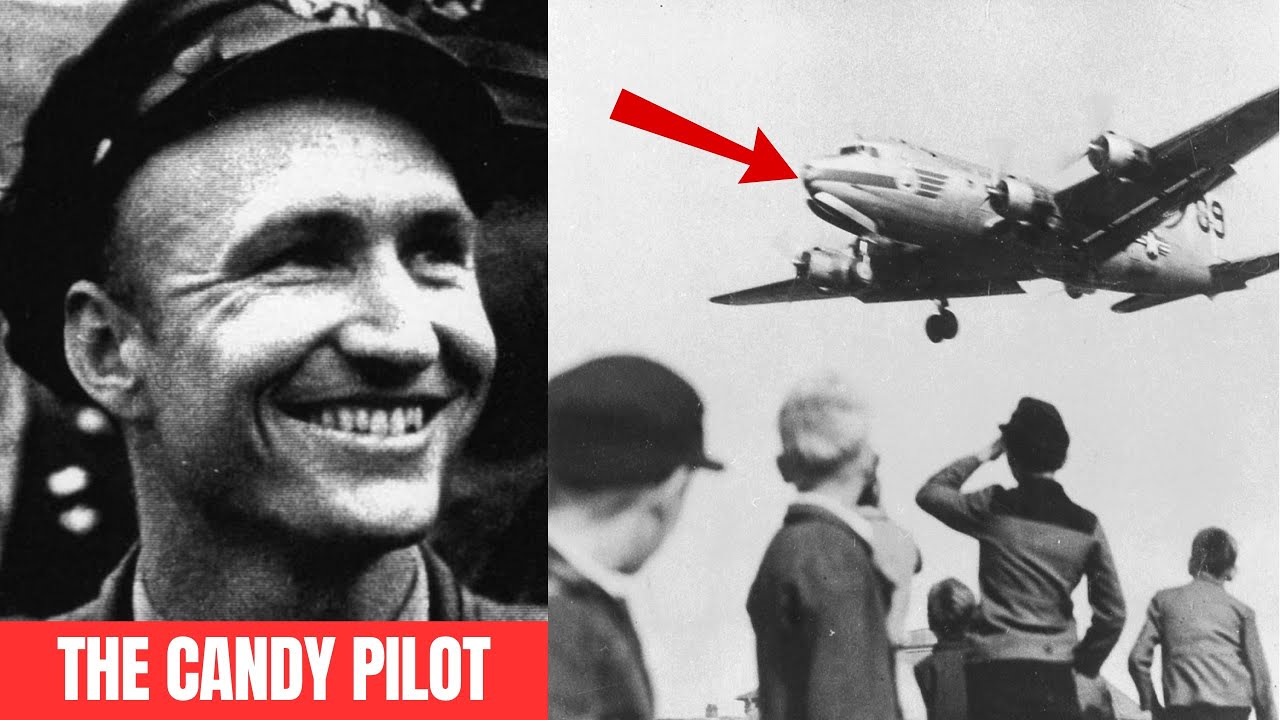
Halvorsen approached them. They did not beg. They did not ask for anything. That amazed him. These children were starving, yet they stood quietly, grateful simply that food was arriving.
Halvorsen reached into his pocket. He had two sticks of Wrigley's Doublemint gum. He broke them into small pieces and passed them through the fence. The children who received gum tore strips of the wrapper and shared them with others who had gotten nothing. They smelled the wrapper paper as if it were a treasure.
That moment changed everything for Halvorsen. These were German children, former enemies, and they were grateful for just a piece of wrapper paper. He promised them he would return the next day to drop candy from his plane.
One child asked, "How will we know it's your plane? All the planes look the same." Halvorsen thought for a moment. He said, "I'll wiggle the wings."
The next day, in July 1948, Halvorsen tied two chocolate bars to a parachute made from a handkerchief and dropped them over Tempelhof as he approached to land. He wiggled his plane's wings as promised.
Word spread immediately. The children told their friends. Within days, dozens of children were waiting at the fence. Halvorsen kept dropping candy, attached to parachutes made from handkerchiefs. Other pilots in his unit noticed and asked to join him. They donated their own candy rations.
Halvorsen kept the operation secret from his commanders. Technically, he was violating regulations by dropping unauthorized items. But after three weeks, a newspaper published a story about it. His commander summoned him. Halvorsen expected punishment. Instead, his commander told him, "You've started something wonderful. Now we'll finish what you started."
The operation was officially named "Little Vittles," a play on the name "Operation Vittles," the code name for the airlift. Halvorsen became the face of the effort. Letters poured in from American children sending candy. Candy companies donated thousands of pounds. Other pilots joined the drops.
By the end of the airlift in May 1949, pilots had dropped more than 23 tons of candy for Berlin's children. German children nicknamed Halvorsen "Uncle Wiggly Wings" because of his signal of wiggling his plane's wings.
Among the thousands of children who watched those planes was seven-year-old Mercedes Simon. Mercedes Simon lived with her family in the Friedenau district of Berlin. Her father was a pilot in the German Air Force, missing in the war and presumed killed. Her mother struggled to support the family. They raised chickens in their small garden. Those chickens and their eggs were vital for survival during the blockade.
Mercedes heard about the American pilot who dropped candy. She saw handkerchief parachutes landing near the airport, but none fell in her garden, so she wrote him a letter.
Dear Chocolate Uncle, your planes fly over Friedenau every day. Please drop a parachute over the garden with the white chickens. They have stopped laying eggs. When you see the white chickens, drop it there.
She included her address: Linden Allee 20, Friedenau, Berlin.

Weeks passed. Then an envelope arrived. Inside was a letter from Lieutenant Gail Halvorsen. He had answered her letter, and he enclosed sticks of gum and a lollipop. For Mercedes, that gesture meant everything. She had lost her father. Her city was destroyed. Food was scarce. And an American pilot, a stranger, a former enemy, took the time to write to her and send candy.
She later said, "Most children at school didn't have a father because of the war. Colonel Gail Halvorsen was a father figure at my school."
She kept that letter. For the next 74 years, Mercedes Simon Wild kept Halvorsen's first letter inside its original envelope.
The airlift continued through a harsh German winter. Planes landed every three minutes at the peak of operations. More than 2.3 million tons of supplies were delivered on more than 277,000 flights. On May 12, 1949, the Soviets ended the blockade. They had failed. West Berlin had survived.
Shortly after Halvorsen left Berlin, he continued his Air Force career, eventually reaching the rank of colonel. He married Alta Jolley in 1949. They had five children.
Mercedes grew up, married Peter Wild, and built their lives in Berlin. But neither of them forgot that letter from 1948.
In 1972, Gail Halvorsen returned to Berlin. He had been promoted to colonel and became commander of Tempelhof Central Airport, the same airport over which he had dropped candy 24 years earlier. Mercedes Wild and her husband Peter learned that the chocolate pilot had returned. They invited him to dinner. They were among dozens of Berliners who remembered Halvorsen and wanted to thank him.
When Halvorsen arrived at their home, Mercedes brought out something she had kept safely for 24 years. The original letter he had written to her in 1948, still in its envelope, alongside the first candy parachute she had received.
Halvorsen looked at the letter. He remembered a seven-year-old girl, white chickens, and the Friedenau district. In that moment, as Mercedes later described it, "we touched that link."
The letter became a bridge between 1948 and 1972, between a desperate child and a compassionate pilot, between two people who had never met but had always been connected.
That dinner began a friendship that lasted 50 years. The Halvorsen and Wild families became close. Halvorsen visited Mercedes and Peter whenever he returned to Berlin. Mercedes visited Halvorsen in Utah. They talked regularly by phone. They attended each other's family occasions, birthdays, anniversaries, and celebrations.
Mercedes became what she called a German ambassador of friendship. She appeared with Halvorsen at countless events, air shows, school visits, military ceremonies, and anniversary commemorations. Whenever Halvorsen came to Berlin, Mercedes was there.
In 2009, Halvorsen returned to Berlin for the 60th anniversary. He was 88 years old, moving more slowly, but his warmth remained the same. Mercedes, then 68, stood beside him as she always did. They visited schools together. Children performed the "Chocolate Pilot" song for him. Halvorsen cried, remembering the children at the fence 61 years earlier.

In 2019, for the 70th anniversary, Halvorsen returned again at age 98. He was frail but determined. A baseball field at Tempelhof was renamed "Gail S. Halvorsen Park" in his honor. Tens of thousands attended the celebration. Mercedes brought him to the stage. She read from the children's book "Mercedes and the Chocolate Pilot," which told their story.
She said, "He became like a father to me. Our families have a special bond, and he is the best ambassador we could have for German-American friendship."
Halvorsen told the crowd, "The heroes of the Berlin Airlift were not the pilots. The heroes were the Germans, the parents and children on the ground. They were the ones who stood firm against the Soviet Union."
After the ceremony, Halvorsen, 98 years old and needing help to walk, stood at Tempelhof and handed out candy to children, just as he had in 1948.
Alta, Gail Halvorsen's wife, died in 1999. He married Lorraine Pace. He continued traveling to Berlin for anniversary events. Even in his late nineties, he attended commemorations.
In 2020, Halvorsen contracted COVID-19 at the age of 100. He recovered.
On February 16, 2022, Gail Halvorsen died at Utah Valley Hospital in Provo, Utah. He was 101 years old. The cause was respiratory failure. Most of his children were by his side.
News of his death spread internationally. The German Embassy in Washington issued a statement. Berlin's "candy bomber" had passed away at the age of 101. Thank you for your kindness, Colonel.
Berlin's mayor, Franziska Giffey, said Halvorsen's deeply humanitarian act had never been forgotten.
Mercedes Wild mourned the man she had called "Candy Uncle" for 74 years, the godfather figure who sent candy to a frightened child in 1948, and the friend who was part of her life for half a century.
Halvorsen was buried with full military honors at Provo City Cemetery. A KC-135 aircraft from the Utah Air National Guard flew over the site. An honor guard fired a military salute.
Mercedes Wild, now 81, keeps their story alive. She still has the first letter Halvorsen wrote to her. She still speaks at schools and events about the "candy bomber" and what his kindness meant, not only to her but to an entire generation of Berlin children who learned that former enemies can become friends.
Halvorsen dropped 23 tons of candy during the airlift. But the weight of what he gave cannot be measured in tons. He gave them hope. He gave them dignity. He showed the children of Germany that Americans saw them as children, not as enemies.
And one of those children, Mercedes Wild, carried that memory for 74 years. She became the living link between a desperate Berlin in 1948 and modern Germany's friendship with America.
As Halvorsen once said, "It's not about the plane. It's not about the candy. It's about the spirit of people who never give up."
That spirit, and Halvorsen's refusal to see the children of enemies as anything but children, is what Mercedes Wild has preserved and shared for more than seven decades. Their friendship was never about war or politics. It was about one simple truth. Small acts of kindness can change the world, one child at a time.