On the afternoon of October 14, 1952, a man named Ellsworth “Bam” Johnson walked into a pawnshop on Seventh Avenue in Harlem with an $11 pawn ticket and the exact amount of cash needed to redeem it. The ticket belonged to a deceased friend, a piano tuner named Oates Vance, and his widow, Karen, had spent nearly a month collecting the money from relatives and neighbors. The pawnbroker’s clerk, a heavy-set man named Reeves Callahan, barely looked at the money or the ticket. He announced that the debt had been transferred to a midtown finance company and was no longer $11 but $63, thanks to transfer fees, storage costs, and accumulated interest.
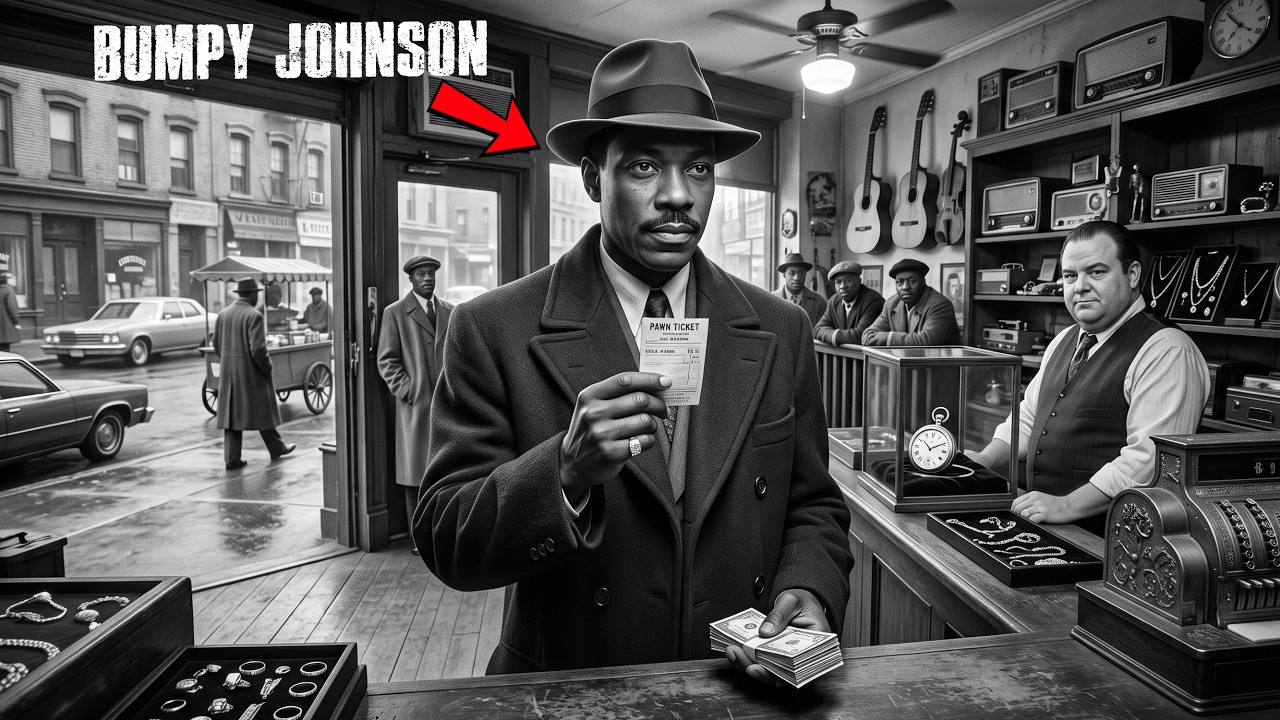
He added that a piano tuner’s watch wasn’t worth the argument anyway. Bam did not raise his voice or argue. He calmly asked for the paperwork documenting the transfer. Callahan said the papers were at the finance company’s office in midtown, and he doubted they would show them.
Bam picked up his $11, folded it back into his wallet, said “thank you,” and walked out without another word. For six blocks, he said nothing to anyone. When a friend named Talbert Hughes asked what had happened, the answer, given indirectly, was that Bam needed to know who owned the pawnshop and who owned them. He spent the evening in the back room of a restaurant on Lenox Avenue, turning the ticket over in his fingers.
He was not angry at Callahan, who was merely an employee doing what he was told. What bothered him was the arithmetic: $11 had turned into $63 without any new service or change in ownership, only a transfer of papers from one office to another. He had heard similar stories in passing: a seamstress on 129th Street whose sewing machine debt tripled in eight months, forcing her to take in laundry; a deacon’s nephew whose pawned watch became grounds for a claim against his mother’s grocery store; a retired dockworker who lost a stake in a small shop he had spent a decade building. These scattered stories, told in kitchens and churches, suddenly looked like pieces of a single machine.
Bam realized that the pawnshop was not in the business of lending against watches and rings. It was in the business of manufacturing debts that working families could never repay, then selling those debts to finance companies in midtown that specialized in collecting paper rather than collecting from people. The real operation was behind the storefront, run by men he had not met, men who had built a system that did not need threats because the numbers did the threatening on their own. Over the following days, Bam quietly assembled a team to dismantle that system.
He used Talbert Hughes, a bookmaker who knew how to sit in rooms where men talked too much, to find out who owned what. Within a week, Hughes came back with a name: the finance company was called Continental Provident Trust, operating from a modest office on lower Broadway, and it was quietly funded by a syndicate of midtown lenders who preferred their names not appear on any Harlem storefront documents. For the legal side, Bam brought in Delmore Ashwood, a young lawyer with an office above a tailor shop on 125th Street, known for reading contracts more carefully than the men who wrote them. Ashwood grew up watching his father lose a hardware store to a debt that was secretly sold twice, and he went to law school partly to make sure he would never be on the losing side of an unclear deal again.
He explained that state law imposed strict limits on interest charged by licensed lenders and even stricter limits on fees pawnbrokers could add when property was redeemed, but Continental Provident had never clearly provided Karen Vance or anyone else with the written disclosures required when a debt was transferred to a separate finance company. Bam also brought in Odessa Freeman, who ran a small print shop and understood that information traveled through Harlem along specific channels: church bulletins, barbershop talk, the back pages of the Amsterdam News. She had seen her own mother lose modest savings to a similar arrangement years earlier and considered the work a settling of an old account. He brought in Reginald Okafor, a deacon at a Baptist church on 138th Street, whose role was not to organize protests but to knock on doors and ask families, gently, whether they too had pawned something over the past two years and found the debt growing stranger and larger than they remembered agreeing to.
In three weeks, Okafor’s notebook held eleven names, each with a story so similar to Karen Vance’s that no honest person could call it coincidence. He found a widow whose sewing machine, pawned to cover a hospital bill, had accrued fees she could not explain despite paying every amount she was asked; she had kept her receipts without quite knowing why. Okafor copied the numbers and asked whether anyone had ever given her a written explanation for the growing balance. She said no one had ever offered her anything in writing; they just told her the amount was what it was.
Freeman spent long hours at her print shop deciding not what to say but what to leave out. She drafted the story three times, reading each version aloud to Ashwood, and settled on language that described only what Okafor’s notebook could prove, in the simplest terms possible. Bam also spoke with Palmer Royce, a jeweler and small lender who ran an honest pawn business on 116th Street and had long resented how pawnshops like Hauerland & Combs undermined reputable lenders by advertising low rates while actually collecting far more through hidden fees. Royce agreed to independently appraise the true value of any items in question, so that no one could later claim a watch or sewing machine was worth less than it was.
With Hughes providing the map of ownership, Ashwood the legal foundation, Freeman the means to spread the story, Okafor the documented pattern of harm, and Royce the independent valuations, Bam set a plan moving on four fronts at once. He gave a clear explanation to Hughes and Ashwood together: the goal was never to win any single confrontation but to make every possible response cost the other side something they could not easily recover. The first front was economic. Bam quietly began buying up outstanding pawn tickets at Hauerland & Combs and two sister stores run by the same syndicate, paying the original principal directly to the families holding them and taking the tickets out of circulation before Continental Provident could resell the underlying debt.
He did this through Hughes and Royce so no clerk could claim he recognized a pattern. This did two things at once: it restored dignity and property to individual families, and it deprived the syndicate of the raw material its entire business model depended on, because a debt already redeemed at face value could not be inflated and resold later. In the first month, more than thirty tickets were quietly settled this way. The second front was legal.
Ashwood filed a formal complaint with the New York State Banking Department, attaching Okafor’s eleven documented cases with dates, amounts, and the specific fee structures applied without written disclosure. He requested a preliminary investigation into the legal status of Continental Provident Trust, and in time it was granted. The process moved slowly, but once opened, it generated its own momentum independent of anyone’s wishes. The third front was social.
Freeman placed a modest, carefully worded article in the Amsterdam News describing, without naming individuals, a pattern of Harlem families losing pawned family possessions to debts that grew mysteriously after being sold to an unnamed midtown finance company. It did not accuse anyone of a crime. It simply described what eleven families had experienced, in plain language, and invited any reader who found the pattern familiar to speak with their pastor or local civic association. It ran on a Thursday in a section read carefully by the people who would recognize themselves in it, and by the people who preferred such things never be printed at all.
The fourth front was competition, which Bam considered the most important, because embarrassment and legal pressure could wound a business, but only an alternative could end its purpose entirely. He quietly provided funds, without attaching his name, for a small lending cooperative run from the back of Okafor’s church, offering short-term loans secured by personal property at rates matching what state law allowed, with written terms anyone could read in under a minute and fully understand. Families who would have walked into Hauerland & Combs out of habit or necessity now had somewhere else to go. The following weeks passed slowly, without drama or a single dramatic confrontation.
In the first week, Royce appraised the eleven documented cases and confirmed to Ashwood that the balances claimed in each case exceeded any honest calculation by four times or more. In the second week, the church cooperative opened with a modest fund, and word spread through Sunday services and barbershop talk faster than any advertisement could have carried it. By the third week, Hauerland & Combs saw a gradual drop in daily foot traffic that might go unnoticed from one day to the next but would show clearly in the books by the second month. The Banking Department investigation led to a formal request for records that Continental Provident Trust was required to answer.
Answering honestly meant admitting fee structures never registered with the state; answering dishonestly invited a far more serious charge. The Amsterdam News article drew a handful of letters to the editor from people with similar experiences, each one adding weight to a pattern that could no longer be dismissed as a random misunderstanding. By the fifth week, a second, longer article followed, noting that the state had opened a formal investigation into the practices of an unnamed finance company, a detail any reader following lower Broadway news could easily identify. The news reached the principal backers of Continental Provident Trust, a small group of men who preferred to be known as investors rather than lenders.
The investigation displeased them, and their first response was, predictably, to apply their own pressure. A well-dressed man came to Ashwood’s office above the tailor shop one evening and suggested, in the manner of friendly advice, that a young lawyer with his career ahead of him might want to consider which complaints were worth filing and which might instead cost him referrals he would need for years. Ashwood listened without interrupting, thanked the man for his concern, and continued preparing his second file the moment he left. A larger man, less inclined to friendly advice, was seen loitering near the church cooperative for two evenings in a row.
Parishioners of Okafor’s church, without any direction from Bam, began automatically walking each other home in groups after Wednesday evening services. The man stopped coming after the second night, having accomplished nothing except making his face known to an entire neighborhood. Bam himself received, through an intermediary, a message suggesting that the pawnshop matter was none of his business and that continued interest might be costly. He read it once, folded it, and sent back a simple note: a state banking investigation, once opened, could not be withdrawn by anyone outside the banking department itself; the Amsterdam News did not take instructions from Broadway; and a cooperative lending twenty dollars at a time from a church basement could not be threatened with closure because it had nothing to lose.
He added that he had no interest in destroying Continental Provident Trust, only in ending the specific practice of manufacturing unpayable debts for Harlem families, and the choice of how to end it was entirely theirs. It was not a threat. It was a statement of facts delivered without emotion, containing nothing to argue against: no insult to answer, no fear to exploit, just a list of facts that would remain regardless of what anyone in midtown decided to do. The men behind Continental Provident Trust were practical above all, and practical men understand the difference between a battle they can win by waiting and one that grows more costly the longer it continues.
Threats failed to move Ashwood, failed to intimidate Okafor’s congregation, and failed to reach Bam at all. The Banking Department investigation proceeded on its own schedule, and a second, broader request for records had already arrived at their Broadway office by the start of the sixth week. The cooperative kept drawing business away from Hauerland & Combs week after week. Royce reported that two other pawnbrokers in the neighborhood, watching the same pattern, had quietly stopped selling any of their tickets to midtown, cutting off Continental Provident’s supply of new debt from a direction no one had planned.
The Amsterdam News story, though it named no one, became a topic of discussion among pastors, civic leaders, and small business owners whose goodwill midtown investors had quietly counted on for other projects entirely unrelated to pawnshops. Negotiations, never offered at first, became the only remaining option within six weeks, and those same men who had once sent an immaculate messenger to threaten a young lawyer now sent a different kind of representative, authorized to discuss terms. A government examiner, a quiet and methodical man named Corinne Peals, arrived at Hauerland & Combs on a Wednesday morning in the fourth week without prior notice, carrying a leather folder of forms and a letter authorizing him to inspect the store’s lending records. Callahan’s replacement, still new and unaware of half the events his predecessor had set in motion, provided the available records without hesitation.
Peals spent four hours examining them with patience that suggested he was paid by the day rather than by the task, and left with copies of enough pages to occupy the department’s lawyers for a month. News of his visit reached lower Broadway by that evening. In the middle of that sixth week, before any settlement was reached, Bam visited Karen Vance in her rented room on 131st Street, not to tell her of a victory he had not yet achieved, but because he had promised her at the funeral that he would see what could be done. He told her only that the matter was moving, would take longer than either of them wished, and that she should not pay Hauerland & Combs or Continental Provident Trust a single cent in the meantime, no matter what letters arrived.
She asked no further questions. She had learned the same lesson Hughes had learned years earlier: some men do not need to be asked twice to keep a promise, and pressing for details before a matter is finished only delays its completion. The settlement, when it came, was not arranged in a dramatic meeting but in a series of quiet deliberations between Ashwood and a lawyer representing the principals of Continental Provident Trust. The opposing counsel opened with an offer to quietly compensate the eleven documented families individually, on condition that the Banking Department investigation be allowed to lapse without further filings.
Ashwood refused on the grounds that the eleven families were not the only ones affected, and a private settlement covering only documented cases would do nothing for those who would come after them. He countered with terms that addressed the practice itself rather than its individual victims. After two additional rounds of discussion, the other side accepted, having concluded that a public structural solution, however unpleasant, would end the matter more completely and permanently than a series of private payments that left the underlying method untouched and available for future use. Continental Provident Trust agreed to cancel completely all outstanding debts associated with any pawn ticket originally issued for under $50, a category Royce’s estimates showed covered nearly all eleven documented cases plus dozens of others.
The company agreed to a written fee schedule filed with the state and posted conspicuously at Hauerland & Combs and its sister stores, matching exactly what the law allowed, with each fee named in plain language a customer could read before signing anything. It also agreed, as a condition Ashwood insisted on, to return Oates Vance’s pocket watch to his widow, free of any remaining fees, along with a formal letter acknowledging that the original debt had been fully paid. Ashwood also secured a seemingly minor provision that proved more significant than it appeared: any future sale of a pawn ticket to an outside finance company required written disclosure to the original borrower within ten days, closing the exact loophole that had swallowed Karen Vance’s eleven dollars in the first place. Karen Vance received the watch on a Sunday in early December.
Reginald Okafor delivered it to her door himself, having asked to be the one to bring it, feeling that a promise made in a church should be returned through the same door it left by. He carried it wrapped in a simple handkerchief, inside a small box that still bore Hauerland & Combs’ name faintly printed on its underside. She held it for a long moment without opening the lid, turning it once in her palm the way a person turns something they have decided not to believe in until it proves itself. Then she opened it.
The watch was exactly as it had been: the glass face intact, the hands stopped at the time it had stopped working years before, the engraving on the inner cover nearly worn away but still legible enough to read the letters of her late father-in-law’s name. She did not exaggerate her gratitude. She thanked Okafor and asked him to thank everyone involved. She placed the watch in a drawer where it remained for the rest of her life, taken out only rarely to show a grandchild who asked about it.
Hauerland & Combs remained open after the settlement, though the nature of its business changed. Reeves Callahan was gone by the following spring, replaced by a manager instructed in writing to explain any fee to a customer before applying it, and to post the full fee schedule where any customer waiting at the counter could read it without asking. The store’s daily ledger, which Royce was permitted to inspect twice a year under the settlement terms, showed a business continuing on fair terms, smaller than it had been under the old arrangement but no longer dependent on debts that could never be repaid. The cooperative at Okafor’s church continued operating for years, eventually run by a rotating committee of church members.
It lent small amounts quietly with small collateral at rates families could actually repay, and never once required a customer to sign anything they had not been given a full day to read. Other pawnshops across Harlem, hearing how the matter ended, began adjusting their practices on their own, not wanting to become the next subject of an Amsterdam News article or the next name in a Banking Department investigation. Within two years, it became common practice for Harlem pawnbrokers to declare their fees clearly and warn a customer in writing before selling any ticket to an outside company, even though no new law required it. In the years that followed, Bam rarely spoke about the matter himself.
In the few occasions when he discussed it at length, his point was that the insult at the counter was never the injury worth answering. Callahan’s smile, the laughter near the door, the little performance of superiority staged before an audience of strangers—all of it was designed to provoke a reaction that would have ended the matter in five minutes and changed nothing. A loud voice, a threat, perhaps a blow, would have confirmed everything Callahan and his men believed about who deserved to be taken seriously and who did not. Bam refused to give them that response, and spending six quiet weeks assembling a lawyer, a printer, a deacon, a jeweler, and a messenger who knew how to listen required far more patience than any angry word would have taken.
But it produced something no angry word would have produced: a change in the actual terms under which an entire neighborhood borrowed money. The families who never met Bam Johnson and never would came to understand that the arrangements offered by midtown lenders were not natural laws that could not be questioned, but practices that could be examined, documented, and changed with enough patience and different kinds of pressure applied at once. Ashwood’s file submitted to the Banking Department became a reference document consulted by other lawyers in the neighborhood whenever a similar pattern appeared elsewhere, showing in precise neutral language how a debt could be manufactured and what evidence was required to cancel it entirely. The cooperative at Okafor’s church survived for decades after its founders were gone, eventually merged into a small credit union that still traces its earliest funds to a modest sum quietly provided in the winter of 1952, though few of its later members knew the full story of its beginnings.
Palmer Royce’s honest pawnshop on 116th Street grew steadily in the following years, as families who had assumed all such stores worked with the same hidden calculations learned to tell the difference between an honest lender and a dishonest one, and told their neighbors. The story of the pawn ticket circulated quietly around Harlem for years, told in barbershops and church basements with slightly different details each time. In most versions, the lesson was not the confrontation at the counter, which lasted less than two minutes and ended without a raised voice. The lesson was that everything that followed was built slowly: a lawyer’s patient reading of state law, a printer’s understanding of how a story spreads, a deacon’s patient knocking on eleven doors, an honest jeweler’s willingness to put his name on an appraisal, and a man who walked out of a pawnshop without saying a word because he had already decided that the system, not the clerk behind the counter, was the thing worth changing.
No one was struck. No one was threatened into silence. No debt was settled by anything louder than a formal complaint and a printed notice.
The watch did not keep time more accurately after its return than it had before it left, but it came back, and with it came something larger than a watch, into the hands of a neighborhood that had learned again that patience, carefully organized, is a force of a particular kind, quieter than any threat and, in the end, far harder to erase.