On the evening of Thursday, October 11, 1951, a light rain fell over Harlem. Inside a banquet hall on West 125th Street, 300 people sat around white-covered tables for the annual dinner of the Harlem Community Relief Fund, a charity that collected donations to cover winter fuel bills, burial costs, and school fees for families who had run out of options. At the head table sat the Reverend Josiah Lourd Pryor, a 54-year-old pastor of a congregation of about 400 members meeting in a converted commercial building on 138th Street. His church had no stained glass, no bell tower, foldable chairs, and a coal furnace that broke twice every winter.
He had moved north from Buford County, South Carolina in 1919, worked for eleven years cleaning Pullman railroad cars, then as a night watchman at a Hudson River warehouse. He was ordained at thirty-eight. Pryor was known for one particular practice: he kept his church’s records open. Any member could inspect them, a policy he adopted in 1943 after a scandal in another congregation where a church building fund vanished into a trustee’s pockets.
In a community of scarce resources, he concluded, the only protection against suspicion was a record anyone could examine at any time. This principle made him more than a pastor of a small church. He became a minor institution of trust in a place where formal institutions were rare. Families needing character references went to him.
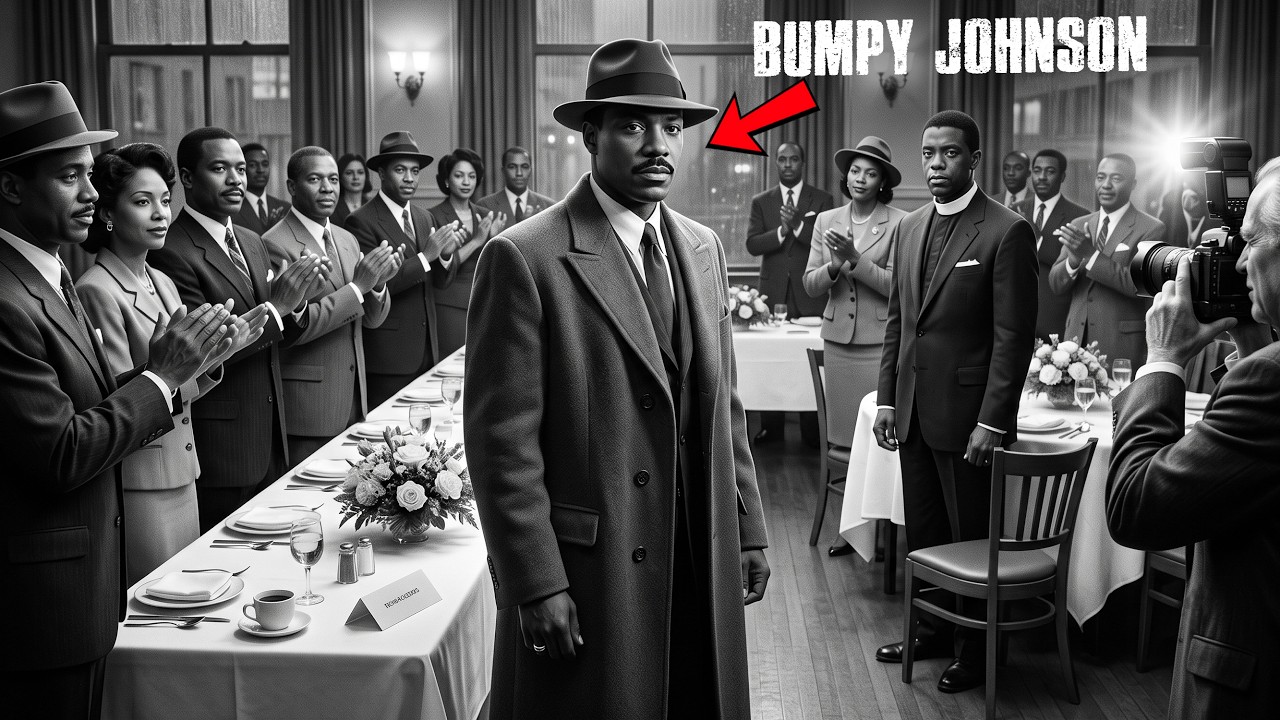
Burial societies needing a neutral party to hold cash funds went to him. When two shopkeepers quarreled over a debt, they sometimes came to him instead of a lawyer. The evening’s program had a planned climax. The year’s largest donation would be announced: $4,000 from Ellsworth Raymond Johnson, known as “Bumpy,” the biggest individual gift the fund had ever received from a private person.
Johnson, 46, had come to Harlem from Charleston as a boy, spent much of the 1930s in insurance, served prison time, and by 1951 carried the most complicated reputation in Harlem. He gave money generously and openly. He also ran an economy that drained workers’ wages six days a week, and had used and ordered violence. Both things were true at once, and Harlem lived with both.
The fund’s president, Alton Fessy, a 50-year-old owner of three dry-cleaning shops, had built the evening around announcing Johnson’s gift. He had rented a larger hall than usual and invited a photographer from a Harlem weekly paper. After an eleven-minute speech about the coming winter, Fessy announced the $4,000 donation. The crowd rose and applauded warmly.
Johnson stood, tilted his head slightly, and sat back down. Then Fessy did something that made the evening unusual. He kept the audience standing and said it was fitting for the clergy present to thank this generosity. He asked the four pastors at the head table to come forward one by one to offer a word of thanks and a prayer for the donor.
Three pastors spoke in turn, thanking the donor by name and invoking God’s blessing. Then Fessy called on Pryor. The pastor walked to the small podium, a tall, thin man with gray at his temples, and stood before 300 people for about four seconds of silence. He said he thanked God for every dollar that would warm a family that winter.
He wished health to everyone in the room without exception. He said giving to the poor was a good work in itself and he would not diminish it. Then he said he would not stand before the congregation to praise any person, because praise belongs to God alone, because he did not know everything any person had done, and because a pastor who publicly blessed a name reassured his congregation. He said he could not say that about anyone living, including himself.
Then he said, “Thank you,” and returned to his seat. The audience did not applaud. There was a sound like silence, three hundred people adjusting themselves in their seats at once. Fessy stood at the podium with his mouth slightly open, then closed it.
He recovered himself after about six seconds and said something about dessert being served. Bumpy Johnson did not move his head. He finished his coffee and spoke to the man on his left about another matter. His face showed nothing.
What happened next did not happen that night. It happened over the following eleven days, and it was done almost entirely by Alton Fessy, in a way that allowed everyone involved to say later that nothing had happened. On Saturday the 13th, the Harlem Weekly reported on the dinner. It named the donor and the three pastors who had spoken, but not Pryor, not his church, not its $118 contribution.
On Monday the 15th, the fund’s treasurer called Pryor’s church and said his name had been removed from the fund’s advisory committee. The stated reason was reorganization. On Wednesday the 17th, Curtis Ball, manager of a burial association of about 900 members who had kept the association’s cash box in Pryor’s church office for four years because there was no safer place in the neighborhood, came to the pastor and said the board had voted to move the funds to a midtown bank account. On Thursday the 18th, a private day school on 141st Street, where Pryor had volunteered on a three-member scholarship committee since 1946, dissolved the committee with a short letter of thanks.
On Saturday the 20th, two families planning fall weddings at his church moved to another church. On Monday the 22nd, the Brooklyn savings institution holding the church’s mortgage sent a letter politely requesting documentation of improvements made to the property, citing a coal chute and internal partition installed in 1948, within 30 days. It was the first letter of any kind from the institution in six years. Pryor read the letter twice, standing at his office door with his coat still on.
He did not go to see Fessy. He did not go to see Bumpy Johnson. He did not preach about it the following Sunday, though the congregation was waiting. He chose a text from Nehemiah about rebuilding a wall and preached it simply.
He did not write to the paper. He did not call the three pastors. Many in his congregation wanted him to fight; he thanked them and said nothing. Instead, he walked.
For nearly two weeks, in late October and early November, Pryor walked through Harlem from 125th Street north to 155th, from river to river, looking at buildings and counting things. He counted small churches. He counted funeral parlors. He counted the buildings between a family’s apartment and the nearest bank branch that would open a savings account for a domestic worker.
He stood outside a savings institution’s Harlem collection office, just a small office with two employees, and watched for an hour who went in and out. At 135th and Lenox on a Tuesday afternoon, he stopped for twenty minutes and watched a mail carrier working the neighborhood, a young man of about twenty-two, efficient, moving with skill. The man took envelopes from a shoeshine stand, from a barbershop entrance, from a woman selling sweet potatoes from a cart, from three men waiting at a bus stop, from a janitor who came up from a basement stairway specifically to meet him. Nine transactions in twenty minutes.
None took more than ten seconds. The carrier threatened no one. He offered a service people wanted and performed it with the courtesy of a man who knew his customers had choices. Pryor thought about this for days.
He had preached against gambling for twelve years, but had never addressed the real question: not why people bet, but what they could do with ten cents that gave them any chance at an amount sufficient to make a difference. Ten cents saved earned ten cents. No institution in Harlem accepted ten cents from a domestic worker and returned anything other than the ten cents. A midtown bank required a $5 minimum, personal appearance during working hours for a housekeeper in Riverdale, and entry into a lobby where a guard watched her cross it.
The bookmakers had understood something no legitimate financial institution in New York could be bothered to understand: the amount must be small enough to be easy, and the transaction must happen where people actually are. He passed three funeral parlors on Eighth Avenue and realized something else. Burial was the largest single financial event in most Harlem families. The burial societies that facilitated it collected enormous sums in small weekly payments from people who could not save a single dollar.
The mechanism already existed. Harlem residents were entirely capable of saving money regularly. They did it every week by the thousands for their own funerals. What was missing was not discipline.
It was an institution that allowed them to do it for a purpose other than death. In the second week, he went to the Schomburg Library on 135th Street and asked the librarian about cooperative banking materials. He spent four afternoons there, reading about the credit union movement, the Federal Credit Union Act, cooperatives among farmers in Nova Scotia and factory workers in Massachusetts, and a failed attempt in Harlem in 1938. He copied passages in small handwriting into a school notebook.
He did not know he was preparing himself for the next four years of his life. What he concluded was a description of a machine. The insult at the dinner was not the machine. Fessy was not the machine.
Even Johnson with his $4,000 was not the machine, though he was the part everyone could see. The machine was this: in 1951, Harlem had almost no institutions of its own that held money and were subject to the authority of its residents. Banks downtown took Harlem’s deposits and lent little back. Insurance companies issued policies in Harlem at high rates and refused them elsewhere.
Property owners lived elsewhere. The department stores on 125th Street employed few Black workers and no Black managers. This created a vacuum, and into that vacuum flowed the only source of liquid capital available uptown: the money from the illegal numbers trade. That money paid rent when people could not, bought coal, buried the dead, funded baseball teams, block parties, and charity dinners.
Because it was the only money in circulation, the men who controlled it acquired something more valuable than money itself: the power to grant legitimacy, to decide who was respectable, who was admitted to the community, whose name appeared in the weeklies, whose church was named from the podium. Pryor realized he had not been punished for insulting a man, but for refusing to participate in a transaction of legitimacy. The dinner was not a dinner; it was a ceremony in which a certain kind of money bought a certain kind of blessing. The clergy had provided it.
He had refused to provide his share. The machine had responded as any machine does to a part that does not turn. He understood the second thing, harder and more important. The machine held power only because Harlem had no alternative source of capital.
The family in crisis had one place to go for $200. The man who supplied that money held the moral leverage of the neighborhood. The solution was not a sermon. It was a second place to go.
He began building it in the first week of November 1951. It took four years and two months. He started with a man named Wendell Marsh, a 61-year-old lawyer who practiced above a shoe repair shop on Lenox Avenue, a graduate of a northern law school, class of 1917, who had spent his career writing wills, handling small real estate cases, and defending tenants against eviction. Marsh was one of perhaps twelve people in Harlem who understood New York State banking law, because he had spent eleven months in 1938 and 1939 trying to help a group of Harlem businessmen establish a savings institution.
He had learned where every obstacle lay. Pryor went to Marsh not with a complaint but with a question: what did state law actually require to charter a credit union? Marsh told him it required three things, and the third was the hardest. It required a clear common bond among members, which a church congregation could easily provide.
It required a charter application, bylaws, and a supervisory committee, all paperwork. It also required a proven deposit base and evidence of management competence, meaning a group of people with no capital had to prove their ability to manage capital before being allowed to. Marsh had watched this requirement kill the 1938 attempt. He agreed to do the legal work for free because he was 61 years old and had been waiting since 1939 for someone to ask again.
Pryor went to a woman named Ida Reno Chalk, who had spent 22 years as the accountant for a Harlem funeral parlor, learning how poor people managed their money: in small sums, on irregular schedules, under conditions where a two-dollar shortfall on the wrong day was a catastrophe. Chalk, 58, precise and difficult, had refused three offers to manage relief fund accounts because she did not care for how they were kept. Pryor asked if she could design a savings and lending system for people paid in cash on Fridays, who could not read official statements, and who would not walk into a marble lobby under any circumstances. She said she had been planning it in her head for eleven years and no one had ever asked.
She joined on condition of absolute authority over the accounts; no official, including the pastor, would hold a key to anything she kept. He went to a man named Solomon Dietz, a bakery delivery driver and secretary of his local union, who knew by name and shift number around two thousand workers in northern Manhattan. The operation would stand or fall on small regular deposits from wage earners, and there was no substitute for a person who could be believed in the break room. He went to Curtis Ball, the burial association official whose cash box had been withdrawn in October.
Pryor said the burial association collected small sums regularly from 900 people and paid large sums at irregular intervals, which was precisely the actuarial problem a credit union had to solve, and that Ball knew more about it than anyone in Harlem. Ball felt shame and gratitude at once, and agreed before Pryor finished speaking. He went to two shopkeepers: a pharmacist named Holloway Vance and a woman named Ernestine Pike who ran a fabric and notions store on Eighth Avenue. Both had spent their working lives making informal loans to customers, recording them in a book under the counter.
Both had learned what no midtown banker would believe: Harlem residents repaid debts at rates that would astonish any credit officer, when the lender was known to them and the terms were fair. Their records, covering 26 and 19 years respectively, became the evidence that made the charter possible. Finally, among the founders, he went to a retired postal supervisor named Roscoe Thur, 31 years of federal service, with a federal pension, meaning he was one of the few men in the neighborhood whose income no local pressure could touch. Thur agreed to be the first chairman of the supervisory committee.
His independence was not incidental. It was the point. Seven people. Pryor deliberately arranged these relationships so that no two depended on a single source of income, so that pressure on any one of them would not transmit to the others.
In October he had felt pressure transmit instantly to all his relationships. He did not intend to build a second institution with the same weakness. The strategy they settled on during the winter of 1951-52 had four parts, each discussed in an unheated room on Tuesday evenings for four months before moving further. The economic part was the foundation, and it was very simple.
They did not seek large sums from wealthy donors, because wealthy donors in Harlem were few and entangled. Instead, they decided to build capital from very small deposits from a great many people, amounts as small as 25 cents, collected weekly in person at the church, at three stores, and at two workplaces. Twenty-five cents a week from 1,200 people is $300 a week, $15,600 a year. No individual depositor could be intimidated into withdrawing money in a consequential way, because no individual depositor mattered.
The social part was Pryor’s personal contribution, based on the reputation he had spent eight years building without knowing its purpose. Every deposit was recorded in a passbook held by the depositor, copied into a ledger open for inspection, and accounts were read aloud in summary. Total deposits, total loans, total arrears, total expenses, all presented to the congregation on the second Sunday of each month, for the entire life of the institution. Chalk insisted on reading the arrears figure aloud, saying that any organization willing to announce its bad news monthly would never have bad news big enough to hide.
The legal and political part was Marsh’s. He saw that a federal credit union charter under the Federal Credit Union Act of 1934 would be easier for this group than a state charter, and he spent fourteen months preparing the application. He also did something less visible. He wrote into the bylaws from the start that no credit union official could accept a gift, loan, or fee from any person or company outside the membership, and that any official who did so was automatically removed without a vote.
Marsh explained his reasoning at the third Tuesday meeting. The system’s mechanism was not violence but absorption. The only defense against absorption was a rule that made acceptance impossible, not merely disgraceful. A man could be persuaded, but an internal rule could not.
The competitive part was the quietest and hardest. They studied the real reasons people in Harlem borrowed money. It was not for business capital. It was for a funeral, an eviction, a doctor’s visit, a payment for a house in Carolina when someone died, or a sudden $50 on a Wednesday.
That need was met by policy-linked lenders at rates of 20 to 40 percent per month, by pawnbrokers, and by informal generosity from men like Johnson that cost nothing in money and everything in obligation. The credit union would lend at 1 percent per month on the unpaid balance, with no collateral, with two members’ signatures, in amounts up to $150, with a decision within 48 hours. Ball had calculated what loss rate they could absorb. Vance and Pike’s books suggested actual losses would be lower.
They were right. They announced none of this. There was no meeting, no letter to the weekly paper, no sermon. Dietz began speaking to the men at the bakery, at two clothing stores, and at the bus stop in March 1952.
Pike mentioned it to customers. Chalk built the records system. Marsh filed the papers. Pryor preached his usual sermons and did not raise the subject from the pulpit for nine months.
The first deposits were made on Sunday, April 6, 1952, in the church vestibule, at a card table, into a locked box that Roscoe Thur carried home weekly to a federally insured account opened in his name with a joint signature requirement, because the credit union was not yet legally recognized. Fifty-one people deposited money that day, totaling $19. 40. By the end of June, there were 210 depositors.
By Christmas 1952, 640 depositors and a balance of $2,900. Chalk began making informal emergency advances against deposits, all repaid. By June 1953, 1,000 depositors and a balance of nearly $8,000. The monthly reading of accounts became an event people made a point of hearing, even those who did not usually attend, standing in the back in their coats.
Chalk designed the passbook. It was 4 by 6 inches with heavy paper covers, 32 ruled lines inside. She had it printed at a shop on 129th Street in lots of 500; the first lot cost $19, paid by Thur from his pension. The book had one feature she insisted on over two founders’ objections: the running balance was printed in the right-hand column in type large enough to be read by someone with poor vision in dim light, and the depositor wrote his own name on the inside cover, not a clerk, so that anyone able to sign possessed something in his own handwriting.
Many members later told her it was the first document of any kind they had ever owned with their names and a number of their own. Dietz set up collection routes, recruiting 11 volunteers by the summer of 1953. Each was responsible for a defined area, and each followed a rule Marsh had written. No collector ever handled money alone.
Two people counted every amount collected at every stop. Both signed the sheet, and the sheet reached Chalk within 24 hours. Marsh’s logic was structural, not moral. In an operation collecting coins from a hundred people, any unaccounted shortage in the first two years would end the project regardless of its size.
The way to prevent theft was not to choose honest people but to build a system in which theft required the consent of two people, and then never place two people close together. Dietz changed the pairs monthly. In 31 years, there was one discrepancy of $4. 20 in 1961, later found to be an arithmetic error.
Vance and Pike ran the loan committee for the first three years with Ball. They met Thursday evenings and made decisions within 48 hours as promised, and the promise mattered more than the interest rate. A man facing eviction on Monday could not use money that arrived Friday. Ball brought to the committee what he had learned in 20 years of burial insurance: the strongest indicator of repayment was not income but regularity, and a woman earning $18 a week without interruption was a smaller risk than a man earning $60 in irregular bursts.
The midtown banks, lending on collateral and recognized employment, had no way to know this. The loss rate in the first decade was lower than that of any commercial bank branch in northern Manhattan, and Marsh made a point of reporting the figure to federal examiners in writing every year, because he understood the number was decisive. Pryor’s contribution during these two years was mostly something that looked like nothing. He was present.
He sat at the card table in the vestibule every Sunday morning for 400 consecutive Sundays. He knew the depositors’ names and their children’s names. When a woman came to withdraw her entire balance in February 1953 because her sister in Virginia was dying, he counted out the money and asked her not a single question. She returned four months later and started from zero, and told dozens of people how the money had been handed over without scrutiny.
That story built the depositor base more than any sermon. The federal charter was granted on March 2, 1954. Marsh brought the document himself by subway, set it on the table in the church office, and sat silently for some time. Pressure began in the second year, when the situation became known, and it came in the form everyone expected.
A city buildings department inspector came to the church in August 1953 and cited the property for four violations, including the 1948 coal chute. Marsh had anticipated this eighteen months earlier and had a licensed contractor’s certificate for the 1948 work in his file. Three violations were dropped; the fourth cost $11 to fix. The Brooklyn savings institution wrote again in November 1953 about the mortgage.
By that date, the congregation, through credit union members and without any public appeal, had raised enough to pay off the remaining balance of $4,100. Marsh paid it in full, and the institution had no mechanism for refusal. The church owned its building outright on December 9, 1953, for the first time in its history. The letter that was supposed to be a lever removed the lever permanently.
In January 1954, a man visited Solomon Dietz at the bakery and spoke about the possibility of changing the work shift of a produce handler. Dietz reported it at the Tuesday meeting. The committee’s response was to do nothing except record the date, place, and description of the man in the minutes book kept by Thur, noting that a copy was held by Marsh in his office and by Thur in a midtown bank box. The news of this practice spread, as it always did.
No one came to see Solomon Dietz again. Alton Fessy approached Pryor twice. The first time, in the fall of 1953, he suggested the credit union join the relief fund in sharing offices and accepting two fund representatives on its board. Pryor declined, saying the credit union’s bylaws did not allow outside officers.
In the spring of 1955, Fessy came to the church office alone without an appointment and asked whether the credit union would accept a $6,000 deposit from a party he was not authorized to name. Pryor explained that the union accepted deposits only from members, that membership required residence or work within the defined geographic area, that every deposit was recorded in a ledger available to any member, and that the amount and its source would be read aloud before the congregation on the second Sunday of the following month. Fessy considered this for a moment, said he understood, and left. The offer was never renewed.
The situation had changed. It was not a confrontation but a description of a procedure, calmly delivered, and the old method had no answer to it. One meeting took place between Pryor and Bumpy Johnson in October 1955, nearly four years after the dinner. It occurred on a bench outside the church on 138th Street in the afternoon, lasted less than ten minutes, and both men remained seated throughout.
Neither recorded what was said. What is verifiable is what happened afterward. Johnson made no further attempt, direct or indirect, to place money with or through the credit union, and none of his associates contacted its officers again. When a credit union member was threatened over an unrelated debt in 1957, the threat was withdrawn within two days after one phone call made by Ball.
The relationship was not friendship, nor a truce in any emotional sense. It was an acknowledgment of boundaries drawn by institutional design, not subject to persuasion. By the end of 1957, the credit union held deposits of $41,000 from 2,240 members. Since 1954 it had made 196 loans.
Its cumulative loss rate was 1. 110 percent. It had financed 162 funerals, 411 eviction defenses, and the first payments on nine homes. Between 1956 and 1961, it made the first commercial loans ever received by four Harlem businesses from a lender who was neither relative nor racketeer: a print shop, a moving company, a cosmetics manufacturer, and a bus rental service for church groups traveling south for family funerals.
Pryor served as president until 1963 and as an ordinary member of its supervisory committee until his death in the spring of 1971. The accounts were read aloud before the church on the second Sunday of every month for 31 years, including the months when the news was bad, which happened sometimes. The main change was not the money, though the money was real. It was the alternative.
After 1955, families in that part of Harlem facing emergencies had two places to go instead of one. The second place asked for a signature instead of a debt, charged 1 percent per month instead of 30, and required no public expressions of gratitude. The power to grant legitimacy, which had been the real advantage all along, no longer belonged to one person. Three other Harlem groups established credit unions between 1957 and 1962, two of them founded by people who had attended the unheated Tuesday meetings.
Marsh, who lived to 89, wrote the bylaws for all three free of charge, and in each set of bylaws he reproduced, unchanged, the clause forbidding officials from accepting anything from outside the membership. The relief fund dinner continued. Pastors were still invited forward, but starting in 1956, the fund’s program listed donations by amount without naming the donor. A change introduced by Alton Fessy that he never explained, and no pastor was ever again asked to bless a donor from the podium.
None of this was published. No public vindication was issued. Pryor, asked about the 1951 dinner only once, in 1968 by a young man writing a church history, said only that he had not been treated worse than he expected, much better than he had feared, and that the important thing that evening was not what he refused but what he learned about why it was asked. He said he entered that room believing he was being asked for a blessing.
He left understanding he had been asked to sign someone else’s budget. The difference between those two things, he said, was the entire remainder of his work. The building on 138th Street still stands. The congregation has declined.
The credit union merged with a larger federally chartered institution in 1989, and all member accounts were transferred intact. In the church basement there is a bound minute book in Roscoe Thur’s handwriting from November 1951, whose first entry records that seven people met on a Tuesday evening in an unheated room and agreed that the problem facing them was not a problem of type “n. “