The Sobibor killing center, established in occupied Poland during World War II, was the site of one of the most daring prisoner revolts of the Holocaust. Among the SS officers killed during the uprising on October 14, 1943, was Rudolf Beckmann, a fanatical Nazi who had risen through the ranks of the regime's killing apparatus.
Beckmann's path to Sobibor began in 1940, when he was sent to the Grafeneck T4 facility. Grafeneck was the first centralized killing center established under the Nazi euthanasia program, which targeted institutionalized patients with mental and physical disabilities in Germany.
The facility began secret killing operations in January 1940, when recruited T4 personnel arrived at Grafeneck Castle. Approximately 100 staff members, including physicians, nurses, and police, were led by German physician Horst Schumann. Patients were gassed in chambers using pure chemically produced carbon monoxide.
During its year of operation, more than 10,600 people with disabilities were killed at Grafeneck through lethal injections and gas. Beckmann's duties included moving the murdered victims from the gas chambers to the crematorium. The killings ended abruptly in December 1940 after the clandestine activities at the castle attracted public attention.
Shortly before Grafeneck closed, most of its staff, including Beckmann, transferred to the newly established Hadamar T4 facility. In the first phase of killing operations there between January and August 1941, around 10,000 men, women, and children were asphyxiated with carbon monoxide in a gas chamber disguised as a shower room.
Victims arrived at Hadamar by train and gray buses and were sent before physicians such as Adolf Wahlmann, who marked each person with colored sticking plaster to indicate one of three categories: murder, murder and removal of the brain for research, or murder and extraction of gold teeth. In the summer of 1941, staff celebrated the cremation of their 10,000th patient with beer and wine. Because the crematorium ovens were often filled with two corpses at a time, thick, acrid smoke frequently hung over the town.
Between 1941 and March 1945, almost 15,000 men, women, and children were killed at Hadamar through starvation, lethal injections, and gassings. The victims included mentally disoriented elderly people from bombed-out areas and German soldiers deemed psychologically incurable. The T4 program predated the Holocaust by roughly two years, and historians estimate it claimed the lives of 250,000 people.
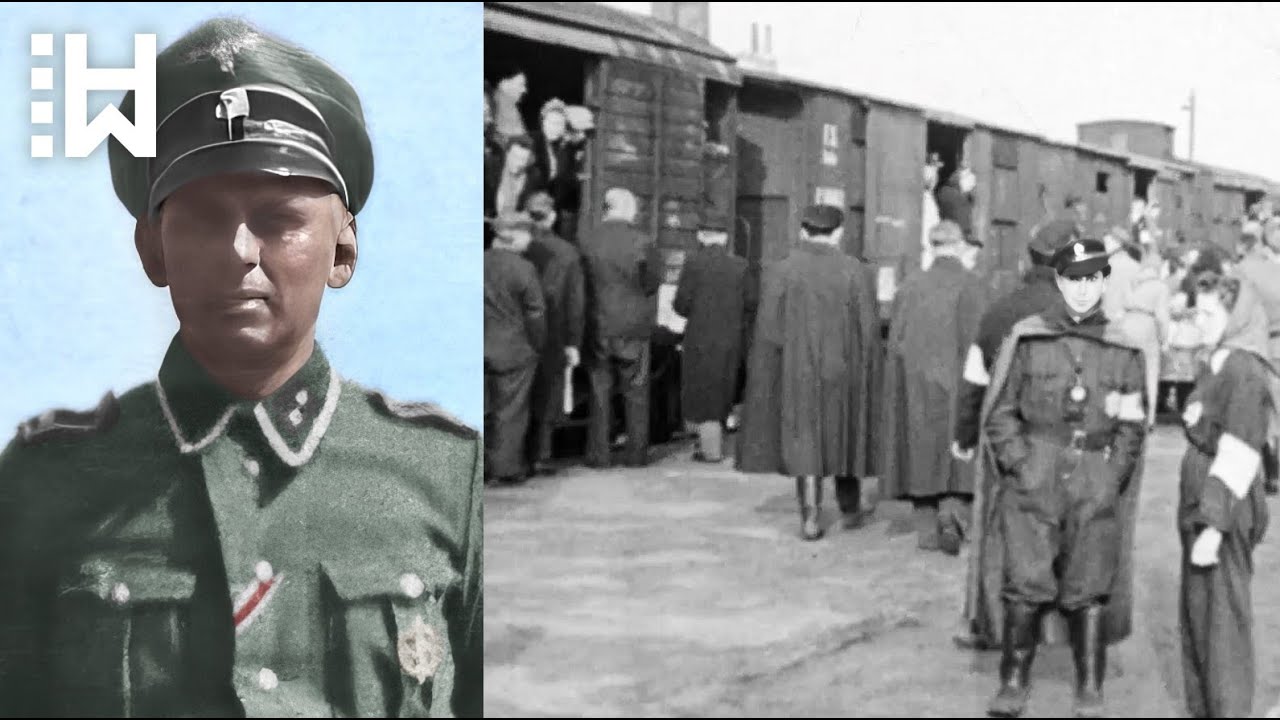
In the fall of 1941, Nazi Germany implemented a plan to systematically murder the 2 million Jews living in German-occupied Poland. The plan was code-named Operation Reinhard, and it led to the establishment of three killing centers: Belzec, Sobibor, and Treblinka.
Rudolf Beckmann helped establish the Sobibor killing center in spring 1942, when he became the camp's head of the sorting commands. He was in charge of sorting the clothing and other possessions taken from murdered Jews. Beckmann also handled administration matters and was responsible for tending to the horses.
German SS and police officials conducted deportations to Sobibor between May 1942, when regular gassing operations began, and the fall of 1943. Most of the Jews brought to Sobibor were immediately gassed by carbon monoxide piped into the gas chambers from an engine. About 250,000 victims were murdered at the site.
Approximately 50 German and Austrian personnel served at Sobibor, generally from lower middle-class backgrounds. According to survivors, female local civilians from the village of Sobibor were often employed in the camp as housekeeping staff and cooks. These civilians had economic incentives for the camp's existence and are believed to have known what was happening inside.
The Germans constructed Sobibor as a rectangle measuring 1,312 by 1,969 feet. A double barbed wire fence woven with tree branches surrounded the perimeter, designed to hide the view of what was inside. The camp had two side-by-side gates, one for trains and another for foot traffic and vehicles.
The Nazis paid special attention to the front compound, which consisted of living quarters and recreational buildings for camp personnel. SS officers lived in cottages with colorful names, which helped conceal the purpose of the camp from new arrivals who came in on the adjacent ramp.
When transports of 40 to 60 freight cars arrived at the Sobibor railway station, only 20 cars at a time were taken into the camp, while the rest of the victims remained locked in the rail cars. Victims were brought into the so-called arrival area, where an SS man would give a speech welcoming them and claiming they had reached a transit camp on their way to labor camps.

They were told that before continuing their journey, they were to take showers, have their clothes disinfected, and get a meal. Men and women were then separated, with children sent with the women. The Nazis ordered the victims to remove their clothing and hand over their valuables, and the Jews were then marched on the run to the gas chambers.
The honking of geese was used to obscure the cries of the victims from those still locked in the rail cars as they were beaten, screamed at, and had warning shots fired at them. About 450 to 550 Jews were forced into the chambers at a time. Once the chambers were sealed, poisonous gas was piped in, and within 20 to 30 minutes all those inside were dead. Those too ill, weak, or elderly to make the walk were shot in an open pit.
SS personnel at Sobibor enjoyed privileges including higher pay and regular visits home. Every three months they could visit their families for two weeks. The SS also stole possessions from victims, including gold, food, hair, and other valuables. Guards would even take toys from murdered children home to their families.
It is believed that Rudolf Beckmann participated in this plunder, as did colleagues such as Johann Niemann, who made sizable deposits of money each time he went home. Between transports, SS personnel drank, played music, and enjoyed card and board games, all while thousands of people were being murdered. As a reward, they even received an official trip to Berlin and Potsdam.
During the year and a half that Sobibor was operational, several escape attempts were made by prisoners. On one occasion, when 72 Dutch Jews organizing an escape were betrayed by the Kapo, they were executed on the order of Johann Niemann, the camp's deputy commander.
In the summer of 1943, rumors began to circulate that Sobibor would soon cease operations, and prisoners understood this would mean certain death for all of them. The Sobibor prisoners knew this because Belzec prisoners had sewn messages into their clothing before they were killed. One message read: "We worked at Belzec for 1 year and did not know where we would be sent next. They said it would be Germany. Now we are in Sobibor and know what to expect. Be aware that you will be killed also. Avenge us."
In September 1943, 20 Jewish Red Army prisoners of war arrived at Sobibor on a transport from the Minsk Ghetto and were selected for labor. One of them, Alexander Pechersky, would become a leader of the revolt, which began late in the afternoon on October 14, 1943.

The targets were carefully selected, and the first person assassinated by the prisoners was deputy commander Johann Niemann, the highest-ranking SS officer on duty that day. At 4:00 p.m., Niemann, after a ride on horseback, was lured to a scheduled appointment with a tailor in the tailor's barracks, with a promise to be fitted for a leather jacket taken from a murdered Jew.
When Niemann arrived at the tailor's barracks, armed with his pistol and whip as usual, Alexander Shubayev, a Jewish Red Army prisoner, was already waiting with an axe in his hand. When Niemann came inside and asked the tailor what Shubayev was doing there with an axe, the tailor replied that he was there to repair the table. The tailor then asked Niemann to remove his pistol holster, put on the jacket, and turn around to check if any alterations were needed in the back. When Niemann complied, Shubayev crept up behind him and buried the axe in the back of his head, splitting his skull open. Niemann was dead on the spot.
The next target was Rudolf Beckmann, then 32 years old. The conspirators had originally planned to lure Beckmann to a scheduled appointment in the storage barracks where they would kill him. But on his way to the appointment, Beckmann suddenly turned around and headed back to his office in the administration building.
Chaim Engel, a Polish Jew, together with a Kapo, N. Pozicki, volunteered to kill Beckmann in his office. Engel and Pozicki went to the administration building, where they found Beckmann behind his desk. While Pozicki restrained Beckmann, Engel stabbed their overseer, and with every stab, Chaim cried, "This is for my father, for my mother, for all the Jews you killed."
Beckmann tried to fight back, causing Engel's knife to slip, cutting his own hand and covering him with blood. When Beckmann was dead, the two, not having enough time to better hide his body, pushed Beckmann under the desk and took his rifle.
In total, 11 SS officers were killed by the rebels. Chaos then took over. Prisoners had to escape by climbing over a barbed wire fence or running out of the main gate through a minefield under heavy machine gun fire. Some stepped on mines. Some gave up and did not run at all.
Chaim Engel, who had killed Beckmann, was among those who did run. He grabbed his girlfriend, Selma, ran into the woods, and hid in a Polish farmer's hayloft for nine months before finding their way to Holland. Approximately 300 prisoners were able to escape, but most were chased down and killed. Those prisoners who had not joined the escape were killed as well. Some 50 of the escapees did survive the war.
After the prisoner revolt, SS chief Heinrich Himmler ordered that the Sobibor camp be closed. After a funeral was held for Beckmann and the other officers killed during the uprising, the widow of Johann Niemann, the first Nazi officer killed, was sent her late husband's belongings, including two photograph albums he had compiled containing images of his Holocaust-era service. The collection is known as the Sobibor Perpetrator Album and was made public only in 2020.
There were no tears shed for Rudolf Beckmann.