On May 10, 1940, Nazi Germany invaded the Netherlands. German paratroopers seized tactical points while ground troops advanced across the country, supported by heavy aerial bombardment.
The bombing of Rotterdam culminated on May 14 with the destruction of its entire historic center. When the Germans threatened to bomb Utrecht in the same way, the Dutch forces surrendered.
Soon after the occupation began, the Nazis installed a civil administration and introduced anti-Jewish laws designed to exclude Jewish people from society and restrict their livelihoods. The systematic deportation of Dutch Jews to death camps started in July 1942.
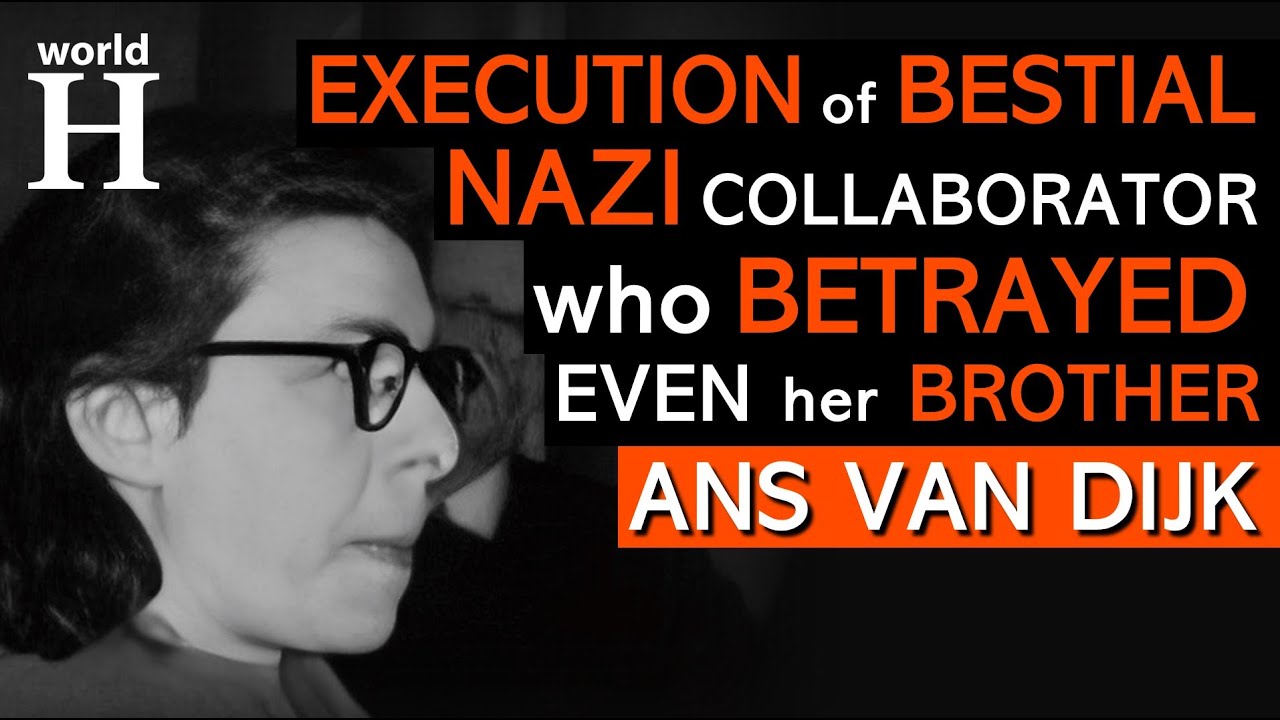
Many Jews went into hiding, but their chances of survival were reduced by Jew hunters tempted by monetary rewards. One such hunter was Ans Van Dijk.
Ans Van Dijk was born on December 24, 1905, in Amsterdam to Jewish parents Aron Van Dijk and Kartia Blick. She was a difficult child and was under the care of a pediatrician from the age of five.
In 1919, at the age of 14, she lost her mother. In 1927 she married Abraham Guerido, who was also of Jewish descent. The marriage remained childless, and the couple separated in 1935.
Soon afterward, Van Dijk began a lesbian relationship with a woman she employed in her shop on a major shopping street in central Amsterdam. The two women lived together in an apartment above the store, went out to cafes, and Van Dijk made numerous friends in the Amsterdam lesbian scene.
World War II began on September 1, 1939. That same year, her father died in a psychiatric institution.
After the German invasion, a civil administration was installed under SS auspices, and Arthur Seyss-Inquart was appointed Reichskommissar of the Netherlands. Among his first steps were laws imposing economic discrimination against Jews.
During 1940, the occupation authorities banned Jews from the civil service and required them to register the assets of their businesses. On October 3 of that year, Van Dijk and Abraham Guerido were officially divorced.
In January 1941, the German authorities required all Jews to register as Jews. A total of 159,806 persons were registered, including 19,561 born of mixed marriages. The total included some 25,000 Jewish refugees from the German Reich.
A Jewish council was established in February 1941. On February 22 and 23 of that year, German forces raided the Jewish quarter in Amsterdam, arresting and deporting more than 400 Jewish men to concentration camps.
The Dutch reaction was unique among Nazi-occupied Europe. They organized the February strike, a two-day general strike that began on February 25, 1941. German officials brutally suppressed it.
The action was followed by a hardening of Nazi policy. The German authorities, along with collaborating Dutch authorities and civil services, segregated Jews from the general population and incarcerated 15,000 of them in German-administered forced labor camps.
The Germans then ordered the concentration of Jews in Amsterdam and sent foreign and stateless Jews to the Westerbork transit camp in the northeast. Some of the remaining provincial Jews were sent to another camp.
Signs forbidding Jews appeared on the doors and gates of cafes, swimming pools, sports fields, museums, zoos, libraries, theaters, markets, and many other public places. Jews had to hand over their valuables, and their businesses were confiscated.
That was also the case for a shop owned by Ans Van Dijk, who had to close it in November 1941. To conceal herself, she dyed her hair blonde and obtained a false identity card in the name of Alfonsia Maria Anidong. Her friend fled to Switzerland in July of the following year.
Regulations forcing Jews to wear a yellow Star of David were announced in the Netherlands on April 29, 1942. Those caught without the badge after May 5, when it came into effect, were arrested and detained for a six-week period. In the Netherlands, everyone knew this was a death sentence.
Deportations of Jews from the Netherlands began in July 1942. The last train left Westerbork for Auschwitz on September 3, 1944. During those two years, the Germans and their Dutch collaborators deported some 107,000 Jews, mostly to Auschwitz and Sobibor, where they were murdered. Only 5,200 survived.
Some Dutch citizens could not bear to see what was happening to their country and people, so they resisted the occupation. The resistance's counterintelligence, domestic sabotage, and communications networks helped provide key support to the Allied forces throughout the liberation of Holland. Members of the resistance, if discovered, were immediately sentenced to death.

Van Dijk initially helped the resistance by supplying fellow Jews with hiding places, identity papers, and necessities. Between 25,000 and 30,000 Jews went into hiding in the Netherlands, and Ans Van Dijk was one of them.
Hiding in Amsterdam, she had accommodated two Jewish ladies at another address in the same street. However, these ladies were betrayed and in turn told that the hiding place had been handed to them by Van Dijk, who was arrested on Easter Sunday 1943 by a detective of the Office of Jewish Affairs of the Amsterdam Police.
At the office, Van Dijk was given a choice: either go to the east or work with the Nazis. She decided to team up with the SD, the German Security Police. From that moment on, her life took a dramatic turn.
Pretending to be a member of the illegal resistance organization Free Netherlands, she offered to help Jews find hiding places and obtain false papers. Van Dijk convinced dozens of Jews that she sought to help them. Instead, she betrayed their hiding places to the detective, who in turn had the Jews arrested.
Her house in Amsterdam served as a trap. The previously rather shy woman with little self-confidence blossomed through her work for the bureau. She received praise and recognition for every person caught by the Germans with her help.
Within a couple of months of making her arrangement, Van Dijk found herself at the head of a group of women hunting Jews. Among these women were Rosalie Rosendal, who tried to protect herself and her mother from deportation, and Brana Simons, who was also given the choice by the SD to be deported or to help track down Jews in hiding.
Both Van Dijk and Simons were regularly placed in a cell with arrested Jews and thus obtained further information from them. However, the most fanatical of the group was Van Dijk, whom her Nazi superior described as the best of his 10 employees.
She developed what the prosecutor later described as a satanic hunting instinct. She betrayed anyone who got in her way: friends, her own brother, his wife, and their three children, as well as the family of her own girlfriend.
Abraham Guerido, her former husband, died on June 30, 1944, in the Blechhammer concentration camp. However, a connection between his deportation and Van Dijk's activities is not confirmed.
Van Dijk also tried to make an appointment with the brother of her friend who had fled to Switzerland. Fortunately, he did not trust the case, did not show up, and survived the war.

Together with her accomplices, Ans Van Dijk betrayed 145 people between May 1943 and August 1944: 107 Jews and 38 non-Jewish Dutchmen. Only a small proportion of these people survived the concentration camps. She may have been responsible for the deaths of as many as 700 people.
In his book "The Backyard of the Secret Annex," author Herald Kmer claims that Van Dijk was responsible for betraying Anne Frank and seven other Jews in hiding behind Otto Frank's office building in Amsterdam. According to Kmer, his late father occasionally spotted Van Dijk during visits to a Nazi office building where he had worked during the war. There she supposedly met with handlers and made phone calls. But despite independent and police studies, this theory has neither been proved nor disproved.
After the Allied landing in Normandy in June 1944, the Western Allies rapidly advanced toward the Dutch border. The invasion and the growing certainty that Germany would lose the war did not dampen the zeal of Ans Van Dijk and her colleagues.
After they came into contact with a resistance fighter and hinted that they themselves were also involved in the underground, they won his trust and traced a number of hiding places through him. On August 18, 1944, the Germans raided various places in the Dutch town of Zaste and arrested 30 to 40 people, including 12 Jews. Only a few of those 12 survived the war.
In the Netherlands, between 25,000 and 30,000 Jews went into hiding during the war. Two-thirds of those managed to survive. The Germans officially surrendered all their troops in the Netherlands on May 5, 1945, three days before the general capitulation of Germany.
After the end of the war, Van Dijk moved to The Hague, where she was arrested at her girlfriend's home on June 20, 1945. Charged with 23 counts of treason, she appeared before a special court in Amsterdam and confessed to all the counts against her, explaining that she had acted only out of self-preservation and citing her enormous fear of the SD.
During her trial, which began in February 1947, Van Dijk admitted to helping the Nazis capture at least 145 Jews, including her relatives. Her ex-lover, whose relatives had also been betrayed by Van Dijk, referred to her as a devil in human form.
Requests to have her psychologically examined were rejected by the presiding judge, who asked her, "How can you still sleep? Don't you always see all those people in front of you?"
Ans Van Dijk was sentenced to death for treason. She filed appeals to both the court and Queen Wilhelmina, but both were rejected.
Van Dijk's accomplices Rosalie Rosendal and Brana Simons were arrested as well. Rosendal was released from prison in 1947, and Simons in 1959.
The day before her execution, in a final desperate attempt to save her life, Van Dijk had been baptized and joined the Roman Catholic Church. However, nothing could save her.
Ans Van Dijk was 42 years old when she was executed by firing squad on January 14, 1948. Her former superior, jointly responsible for the arrest of 10,000 Jews, was executed the same way one year later.
After the war, a total of 39 people were executed in the Netherlands because of their wartime past. Of those 39, Van Dijk, who has become synonymous with the treason of the Jews in the Netherlands, was the only woman. There were no tears shed for Ans Van Dijk.