A former child star who once charmed millions in Hollywood shorts died on the floor of a modest suburban living room after being shot during a dispute over a $50 dog-training debt. Carl “Alfalfa” Switzer, best known for his iconic cowlick and off-key singing in “The Little Rascals,” was 31 years old when he bled to death on January 21, 1959. Switzer’s death was ruled justifiable homicide, a legal conclusion that closed the case quickly. But decades later, a witness who was inside the house that night told a different story, raising questions that could never be officially revisited.
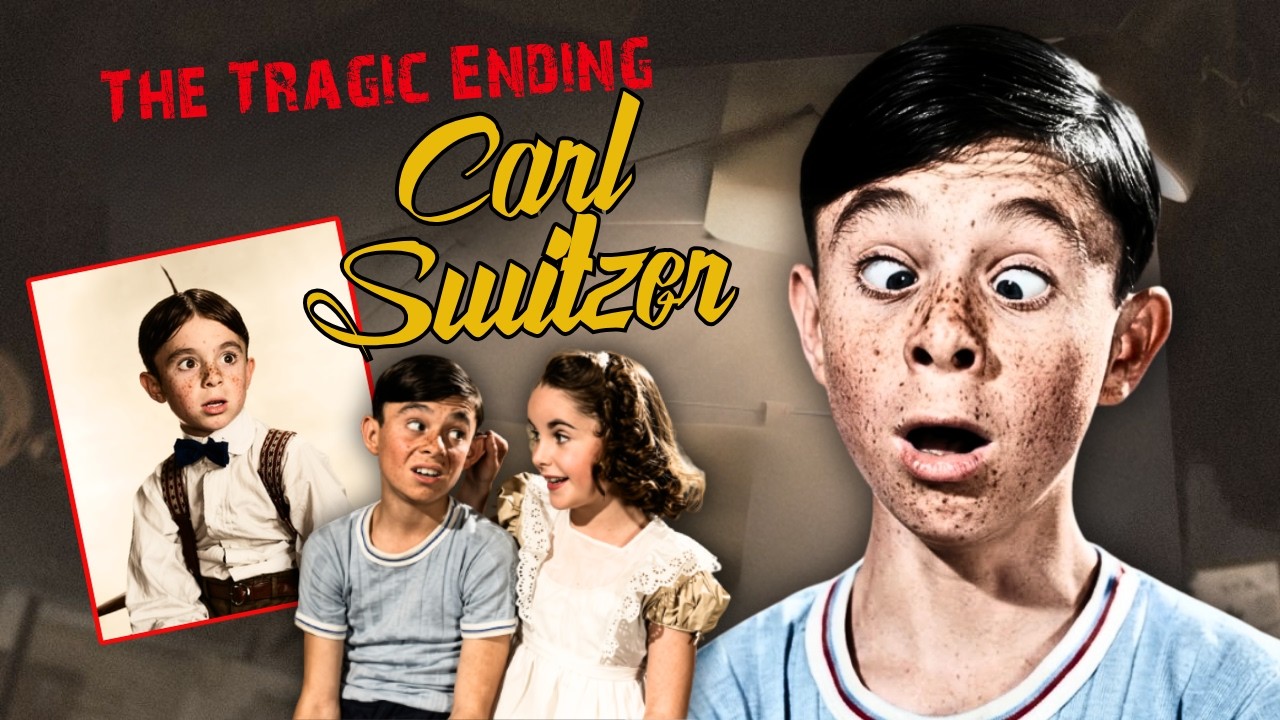
Born on August 7, 1927, in Paris, Illinois, Switzer had no family ties to show business. He and his older brother Harold were simply energetic children with a natural instinct for performance. When the family moved to California in the mid-1930s, a visit to Hal Roach Studios, home of the “Our Gang” comedy series, changed everything. According to industry accounts, the Switzer brothers broke into an impromptu musical routine in the studio commissary.
Studio officials took notice, contracts were offered, and the boys joined the “Our Gang” cast. Carl quickly overshadowed his brother, becoming the most recognizable face in the ensemble by age seven or eight. The character of Alfalfa was carefully engineered. His signature cowlick served as an unmistakable visual trademark.
His inflated self-regard, painful singing, and relentless pursuit of castmate Darla Hood created a reliable comedic formula. Audiences laughed at the gap between Alfalfa’s belief in his own charm and the cringing reactions of everyone around him. The comedy depended entirely on one physical fact: Alfalfa was a very young, pre-pubescent boy. The humor came from watching a small child display exaggerated adult vanity.
When Switzer entered adolescence in the late 1930s, biology betrayed him. His voice deepened, his height increased, and his face lost its youthful roundness. The visual dissonance that made Alfalfa funny vanished. By 1940, at age twelve, Switzer’s time as a lead character was over.
He had aged out of the role that defined him. For the rest of his life, he would exist in the shadow of a character he could no longer play. Switzer did not disappear from Hollywood entirely. He continued to work, but in increasingly marginal roles.
His most notable appearance came in Frank Capra’s 1946 classic “It’s a Wonderful Life,” where he played Freddie Othello, the disgruntled high school student who opens the gymnasium floor and drops George Bailey and Mary into the pool. It was a brief, functional role, not a career revival. During the late 1940s and early 1950s, Switzer landed supporting parts in several films directed by William A. Wellman, including “Island in the Sky” and “High and the Mighty.
” These roles showed he could act competently in dramatic contexts. But casting directors could not see past his childhood persona. A face and voice so deeply associated with juvenile slapstick made it difficult for audiences to accept him in serious adult roles. The acting industry was moving toward a new style of masculinity embodied by actors like Marlon Brando and James Dean.
Switzer, with his slightly awkward, youthful features, did not fit the mold. His fame remained, but it was fame without professional power. He was recognized everywhere he went, yet could not secure steady work. By the mid-1950s, Switzer’s financial situation had deteriorated badly.
The television reruns of “Our Gang” under the revived title “The Little Rascals” brought no residual income for his performances. He found himself struggling to survive while his childhood image generated profits for others. Switzer turned to what he genuinely loved: the outdoors. He became a professional breeder and trainer of hunting dogs, specializing in Treeing Walker and Black and Tan Coonhounds.
These are working animals used to track and tree predators like mountain lions and black bears. Switzer earned a measure of respect in this rugged, working-class community that had eluded him in Hollywood. The bitter irony was that many of his highest-paying clients were Hollywood elites who had cast him aside. Actors and producers such as Roy Rogers and Henry Fonda hired Switzer to guide their hunting trips.
He would lead these wealthy figures into the Sierra Nevada mountains, serving as hired labor for the industry that had rejected him. In 1954, Switzer married Diantha Collingwood, an heiress to a Kansas grain empire. The couple had a son, Justin Lance, in 1956. For a brief time, it seemed Switzer might build a stable family life.
But the marriage collapsed by 1957 under the weight of financial insecurity and Switzer’s deep personal frustration. His ex-wife received primary custody of their son. By the late 1950s, acquaintances described Switzer as hardened, sarcastic, and quick to anger. He developed a reputation for aggressive practical jokes and a dark sense of humor.
These traits were not natural defects but defensive mechanisms, a way of pushing people away before they could mock him or reduce him to his childhood character. The circumstances of Switzer’s death began with a routine professional failure. In January 1959, a Treeing Walker Coonhound owned by a welder named Moses Samuel “Bud” Steltz escaped while under Switzer’s professional care in the San Fernando Valley. The dog was considered lost.
Switzer searched the surrounding countryside without success. He then visited a local bar and posted a cash reward for the dog’s safe return. A local man found the animal and brought it back. Switzer paid the $35 reward and bought the man and his companions a round of drinks, bringing his total out-of-pocket expense to $50.
In 1959, $50 was not trivial, especially for a man struggling with chronic underemployment. Switzer believed Steltz owed him that money, since he had recovered the man’s lost property using his own limited funds. When Switzer presented this account, Steltz refused to pay. Steltz argued that the dog had been lost under Switzer’s watch, making Switzer fully responsible for the cost of its recovery.
The disagreement quickly turned hostile. On the evening of January 21, 1959, Switzer decided to confront Steltz directly. He brought along a friend, Jack Piet, a 37-year-old actor and photographer, likely for support or as a witness. The two men drove to a modest working-class home at 10400 Columbus Avenue in Mission Hills, California.
Steltz was staying there with his girlfriend Rita Corrigan and her teenage children. Switzer demanded his $50. Steltz refused and told him to leave. Switzer refused to back down.
The argument escalated into a physical struggle in the cramped living room. Steltz, realizing he was facing two younger men and that Switzer was behaving aggressively, retreated briefly to a bedroom. When he returned, he was armed with a . 38 caliber revolver.
The introduction of the firearm was meant to end the confrontation. But Switzer did not freeze or flee. Instead, he lunged at the armed man. A violent struggle followed as Switzer tried to wrestle the gun away.
During the close-quarters fight, Steltz’s finger tightened on the trigger. The first shot struck the ceiling, though a fragment ricocheted and hit teenager Tom Corrigan in the leg. The first shot marked a decisive turning point. The struggle briefly stopped, and the two men separated by a few feet.
What happened in the next three to five seconds would determine the legal outcome and end Switzer’s life. According to Steltz’s sworn statement to the Los Angeles Police Department, Switzer did not retreat toward the door after the first shot. Instead, Steltz testified, Switzer reached into his pocket, pulled out a hunting knife, and opened the blade. Steltz claimed Switzer then advanced toward him, threatening his life.
Believing he was about to be stabbed, Steltz deliberately fired a second time, hitting Switzer in the lower abdomen. The bullet severed a major artery, causing massive internal bleeding. Switzer collapsed on the living room floor. An ambulance arrived and rushed him to a local hospital, but emergency surgery could not save him.
Carl Dean Switzer was pronounced dead on the operating table that evening. He was exactly 31 years old. The LAPD investigation focused not on whether Steltz had fired the gun, but on whether the shooting met California’s legal standard for self-defense. Steltz had remained at the scene, surrendered the weapon, and freely confessed to pulling the trigger.
The question was whether he had acted under a reasonable fear of death or great bodily harm. The discovery of a knife on the floor near Switzer’s body proved decisive. Combined with Steltz’s sworn testimony and the statements of other adults in the house, the evidence supported a self-defense claim. A coroner’s inquest jury reviewed the findings and concluded Steltz had acted within legal boundaries.
The shooting was classified as justifiable homicide, and Steltz was cleared of all criminal charges. That legal verdict stood unchallenged for more than four decades. Then, in 2001, Tom Corrigan, the teenager wounded by the ricocheted bullet, gave an interview that contradicted the official account. Corrigan, who was 14 at the time of the shooting, said that after the first shot struck the ceiling, Switzer did not pull out a knife or advance toward Steltz.
Instead, Corrigan claimed, the sound of the gunshot stunned Switzer, who was retreating toward the front door when Steltz aimed and shot him in the stomach. As for the knife, Corrigan alleged it was a closed pocket knife that had fallen from Switzer’s pocket during the initial struggle, not a weapon that had been brandished. He also said Switzer was holding a watch, not a knife, when he was shot. This recantation-like account, offered decades after the fact, raised troubling questions about the decisive moment.
If true, the shooting would shift from an act of self-preservation against an armed attacker to an aggressive act of fatal violence against a retreating man. However, Corrigan’s account carries no legal weight. It was given more than 40 years after the event, making it vulnerable to the natural erosion of human memory. Bud Steltz had died in 1984 and could not defend himself against the new claims.
The 1959 coroner’s ruling remains the official, closed conclusion. The death of Carl Switzer is thus preserved in two parallel layers: the undisputed legal record that exonerated Bud Steltz, and an unresolved historical ambiguity about a desperate man and a closed knife in the seconds before the fatal shot. While Switzer bled to death in Mission Hills, his childhood image was experiencing a profitable cultural resurgence. In the 1950s, Hal Roach Studios repackaged the “Our Gang” shorts for the booming television market under the new title “The Little Rascals.
” New generations of children, born after the original theatrical releases, came to know Alfalfa’s cowlick, his awful singing, and his endless pursuit of Darla Hood. Television made Alfalfa immortal. The character never aged, never struggled, and never faced the harsh realities of adulthood. Meanwhile, Carl Switzer had lived the brutal full trajectory of outgrowing his usefulness to a massive institutional industry.
He experienced complete loss of status, physical labor in the mountains, the desperation of fighting over a $50 debt, and the horror of a fatal gunshot wound. In the decades after his death, popular culture historians and tabloid media often invoked Switzer’s tragic end as evidence of a supposed “Little Rascals curse. ” Proponents point to the early deaths of several cast members as proof of supernatural misfortune. This curse narrative is a fabrication built on selective statistics and confirmation bias.
The series employed dozens of child actors over two decades; the majority lived long, productive, ordinary lives. Jackie Cooper became a respected adult actor and Oscar nominee. Dickie Moore built a successful public relations firm. Darla Hood enjoyed a stable career in music and voice acting.
Carl Switzer was not the victim of a supernatural curse. The chain of events that ended his life was rooted in the harsh material world of mid-century economics. The real curse of child stardom was industrial, not mystical. It was a studio system that legally extracted maximum commercial value from growing children without providing financial protection or psychological support.
When their biology made them unprofitable, they were cast aside. Switzer’s lack of stable acting work led him to dog training. A dog got lost. That loss created a simple debt.
His stubborn, desperate refusal to let that debt go led directly to a physical confrontation with an armed man. Hollywood did not pull the trigger on January 21, 1959. That bullet came from a working-class dispute entirely separate from studio lots. But the studio system unquestionably built the psychological and professional maze that Carl Switzer spent his entire adult life desperately trying to escape.
He was the extreme case of the child star paradox, a human being made into an American cultural icon before he had the cognitive ability to decide who he truly wanted to be. The character was forever young, frozen in the collective memory, while the man was forced to endure the unforgiving consequences of growing up.