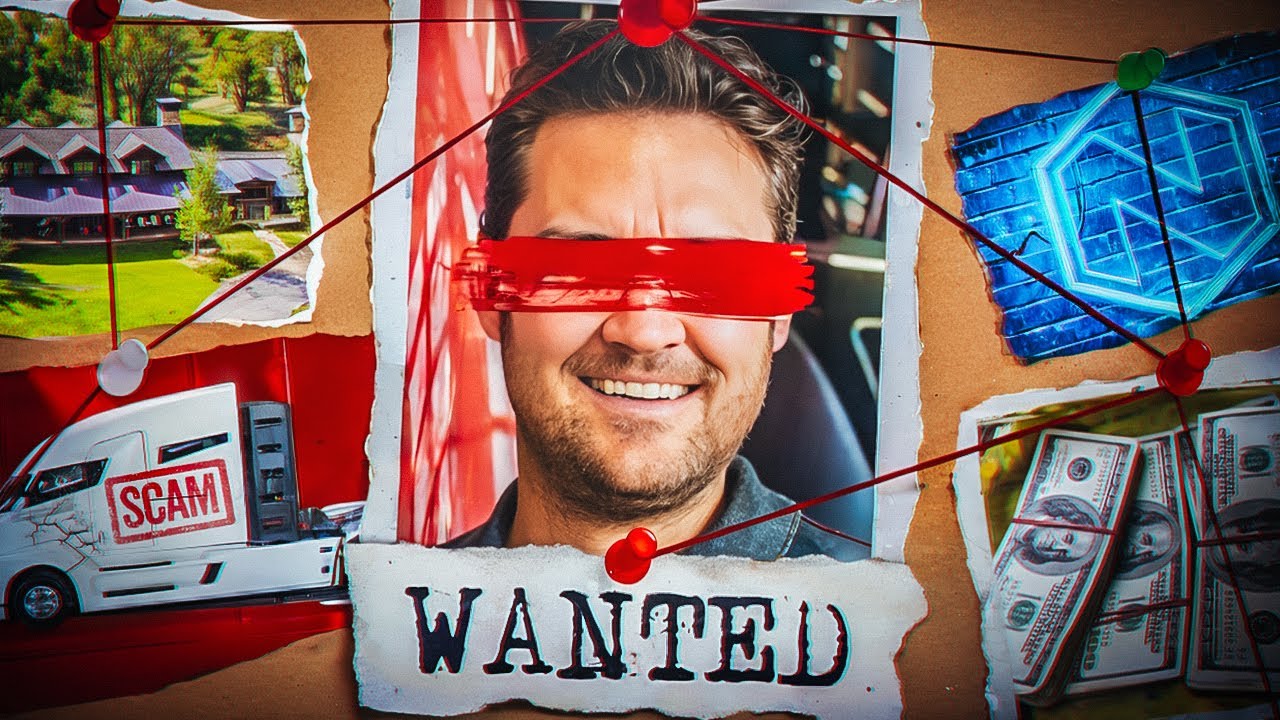
Trevor Milton, the founder of electric truck maker Nikola Corporation, is facing years in prison after a jury convicted him of fraud charges for misleading investors about his company’s technology and business prospects. Federal prosecutors announced charges against Milton, the former CEO and executive chair of Nikola, accusing him of running a multi-billion-dollar scheme built on false promises about electric and hydrogen-powered vehicles. Milton, once hailed as the next Elon Musk, was found guilty of securities fraud and wire fraud after a trial that revealed a pattern of deception spanning years. The case centered on claims Milton made between November 2019 and September 2020, when he used social media, television interviews, newspapers, and podcasts to convince retail investors to buy Nikola stock.
The story began in Kanab, Utah, where Milton grew up facing constant bullying from peers. He found escape in computers and later joined the wrestling team, though he struggled there as well. At 19, Milton dropped out of college and moved to St. George, Utah, where he launched a home security company called St.
George Security and Alarms. After building the company from the ground up, he sold it to a married couple, Glenn and Tammy Phils, for $793,000. The couple soon discovered they had inherited a troubled business. When the Phils attempted to collect customer payments, they found that Milton had instructed customers to make checks payable to him personally rather than to the company.
The couple tried repeatedly to reach Milton for clarification, but he never responded. With mounting debts and the onset of a recession, the couple was eventually forced to close the business. Milton moved on to found Upillar, an online marketplace for secondhand goods ranging from automobiles to aircraft. Despite advertising and celebrity endorsements, the company struggled to turn a profit, and Milton eventually abandoned it.
His next venture was dHybrid, a company designed to convert trucks to hybrid technology. Milton secured a deal with Swift, a major trucking company, to convert up to 800 trucks for $16 million. Swift later sued dHybrid, claiming the truck conversions did not work as promised and that some employees were misusing company funds. A report from Hindenburg Research claimed Milton had exaggerated the value of the Swift deal to investors, saying he represented it as worth between $250 million and $300 million.
In 2014, Worthington acquired dHybrid for $16 million. Milton then moved to Salt Lake City with the proceeds and founded Nikola in 2016, naming the company after inventor Nikola Tesla. The company attracted significant attention and investment. Milton announced the Nikola One semi-truck at a major event on December 1, 2016, claiming the company had developed the best hydrogen technology for trucks.
Prosecutors said Milton lied about having created a fully functional prototype of the Nikola One when in reality the vehicle did not work. He also falsely claimed the company was developing an electric and hydrogen-powered pickup truck called the Badger from scratch using its own technology. Milton misled investors by saying Nikola was producing hydrogen at low cost when the company was not producing hydrogen at all. He also told investors that reservations for Nikola trucks were firm orders worth billions of dollars when most could be cancelled.
In January 2018, Milton posted a video on Twitter showing the Nikola One driving, but the truck was actually being towed downhill and was not operating independently. Prosecutors also said Milton misled an individual to accept stock options instead of cash, even though he could not sell his own stock during a lockout period. In 2018, Nikola announced that the Nikola One was poised to become the largest energy consumer in America. The company also faced a legal battle with Tesla, which alleged patent infringement and sought $2 billion in damages.
Nikola refunded all 11,550 deposits for its vehicles to demonstrate financial integrity. In 2019, Nikola unveiled five zero-emission vehicles at the Nikola World event. A partnership with Anheuser-Busch, which ordered 800 trucks, further boosted the company’s profile. A partnership with General Motors marked a new chapter, with GM taking responsibility for fuel cell and battery systems in exchange for a $2 billion equity stake.
The turning point came with a damning report from Hindenburg Research titled “Nikola: How to Parlay an Ocean of Lies into a Partnership with the Largest Auto OEM in America. ”
The report sent shockwaves through the industry, leading to Milton’s resignation as CEO and a period of uncertainty for the company. A federal judge in New York City, Edgardo Ramos, sentenced Milton after the jury delivered its guilty verdict. Prosecutors asked for an 11-year prison sentence and a $5 million fine, while Milton’s lawyers argued for probation.
Judge Ramos fined Milton $1 million and said he must repay additional amounts later. Milton was allowed to remain free on bail while he appeals the verdict. At his sentencing, Milton became emotional and quoted from the Bible, asking for leniency. He said he felt sorry for everyone involved and insisted he did not commit the crimes.
Judge Ramos noted that Milton was not as bad as some other fraudsters he had sentenced, but said he still hurt real people. The losses caused by Milton’s actions were enormous. Nikola was not the only electric vehicle startup that attracted massive investment without producing profits or many vehicles. Companies like Canoo, Lordstown Motors, and Lucid Motors also drew significant investor money with promises to challenge established automakers.
Many electric vehicle startups went public through special purpose acquisition companies, which allowed them to avoid some of the rules and checks that usually accompany a traditional public offering. People who bought these stocks lost significant money. Nikola shares have dropped 99% since 2020 and now trade at about 9 cents each. In June 2020, they were selling for more than $65 per share.
Short sellers, who profit when stock prices decline, were among the few who benefited from the situation. Less experienced investors suffered the most. According to prosecutors, Milton targeted individual investors who were not experts. He also lied about his background, claiming he left college to start a business when he was actually expelled for cheating.
After selling some of his Nikola shares for $100 million, Milton spent $83. 5 million on planes and luxury homes in the Turks and Caicos Islands. Prosecutors said Nikola investors lost more than $660 million because of Milton’s actions, though a defense expert claimed the losses were much lower, possibly even zero.
The rise and fall of Trevor Milton and Nikola Corporation serves as a cautionary tale about unchecked ambition, deception, and the consequences of building a business on false promises.