On March 15, 1939, German mechanized columns rolled toward Prague through cold spring snow. There was no battle and no defense of the city.
Six months earlier, the Munich Agreement had stripped Czechoslovakia of its border fortifications and handed the Sudetenland to the Third Reich. Now Adolf Hitler ordered the Wehrmacht to occupy what remained of Czech territory.
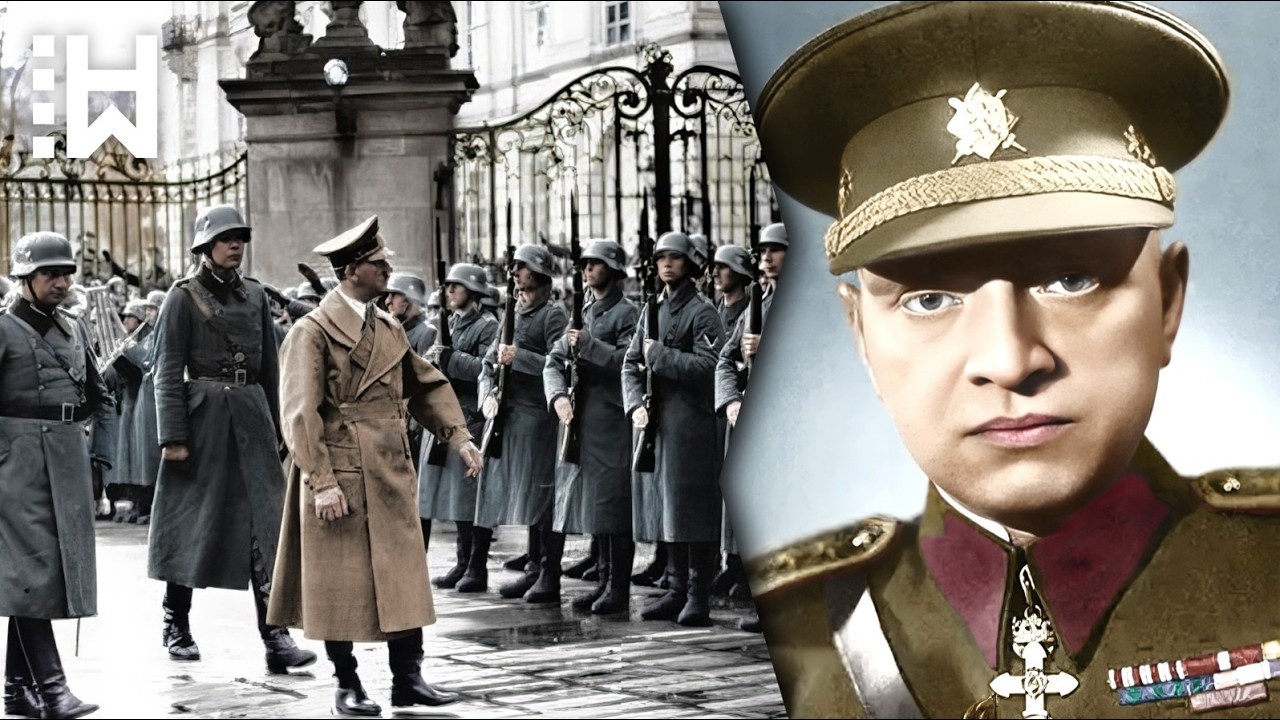
By dusk, Hitler himself was sleeping in Prague Castle, overlooking the city of the kings of Bohemia. The next day, he announced from its halls the creation of the Protectorate of Bohemia and Moravia.
The independent Czechoslovak state, born two decades earlier, ceased to exist. Among those watching the German columns pass in silence was a decorated colonel and famous military writer.
Only months before, he had pleaded face to face with his president to fight the Germans rather than surrender. Within three years, he would wear a uniform of his own design, broadcast weekly speeches supporting the Nazi occupier, and become the most hated Czech of the war.
He was the living symbol of collaboration whom his nation would remember as a Czech traitor. His name was Emanuel Moravec.
Emanuel Moravec was born on April 17, 1893, in Prague, then part of the Austro-Hungarian Empire, to a modest merchant family. He graduated from a technical school and worked as a clerk at a Prague company, an ordinary beginning for a man who would spend his life in uniform and as a writer.
When World War I broke out in the summer of 1914, Moravec was drafted into the Austro-Hungarian Army and sent to the front. In 1915, the Russians captured him and held him in a prisoner-of-war camp in Samarkand, in present-day Uzbekistan.
There he volunteered to fight against the Austro-Hungarian Empire and took command of a machine-gun platoon in the First Serbian Volunteer Division, a unit formed from Slavic prisoners of war to fight alongside the Russians.
In September 1916, Moravec fought fierce battles against Bulgarian forces on the Dobruja front, where he was wounded and later taken to hospital. After recovering, he joined the Czechoslovak Legion, a volunteer force of Czechs and Slovaks fighting for the Allies for the idea of an independent homeland and the formation of the new state of Czechoslovakia.
At the time, Moravec was desperate to obtain an officer's rank, so he falsely claimed to hold a degree in engineering. Moravec, along with other members of the Czechoslovak Legion in Russia, was affected by the developments of the Russian Civil War, and their return to the newly created Czechoslovakia took years.
During this period, in January 1920, Moravec married Helena Grigoryevna Naberova, a Russian woman who was 17 years old and pregnant with his child. Similar relationships with much younger women became a recurring pattern throughout his life.
After returning to the newly formed Czechoslovak state, Moravec remained a professional soldier in the Czechoslovak Army. He served as an intelligence officer on the staff of the land military command in Uzhhorod, a city in western Ukraine today that was then part of Czechoslovakia.
Later, he enrolled as a student at the War College in Prague, and even before graduating he was promoted to the rank of major in 1923. From 1923 to 1927, Emanuel Moravec worked on the staff of the land military command in Prague.
In 1926, an in-depth audit of Moravec's department uncovered financial irregularities. In 1927, Moravec was transferred and became commander of the 1st Field Battalion of the 24th Infantry Regiment in the town of Zvolen. It was there that his marriage began to collapse.
Moravec was transferred to the town of Michalovce in Slovakia, where he met Ila Emma Pavla Sundova, who was 21 years his junior. In 1932 he divorced his first wife, and in the same year the 39-year-old Moravec married 18-year-old Ila Surova.
At that time, Emanuel Moravec taught at the War College in Prague while building, alongside his military career, a second reputation as a writer. Under the pseudonym Stanislav Yester, he contributed articles on political and military affairs to newspapers and magazines.
By the early 1930s, he was one of the country's most prominent military thinkers and had become a colonel in the General Staff. The main theme in Moravec's writings was the German danger to the Czechoslovak Republic.
He repeatedly warned of Nazi Germany's expansionist ambitions and argued that Czechoslovakia should arm itself and seek alliances with Poland and Italy. He described the Bohemian lands as a natural fortress protecting the head of the Danube basin, a barrier whose fall would open central Europe to whoever seized it.
His arguments and patriotism drew the attention of President Tomas Garrigue Masaryk, the founder of the Czechoslovak state, and Moravec repeatedly showed loyalty to the president and to democracy. When Masaryk died in 1937, Moravec led the military procession through Prague and stood as an honor guard at his coffin.
The decisive test for him came in September 1938. As Hitler pressed his demands over the Sudetenland, Czechoslovakia's border region, and the threat of war loomed over Europe, Moravec sought a meeting with Masaryk's successor, President Edvard Benes.
In a confrontation lasting about two hours on the eve of the Munich Agreement, he pleaded with the president to reject the ultimatum and lead the country into war rather than surrender. The Czechoslovak Army had mobilized its forces and stood ready behind the border fortifications, but Edvard Benes chose to accept the Munich terms.

Moravec's pleas fell on deaf ears, and the surrender broke something inside him. He raged that men without courage had led the nation toward capitulation, and declared that a state unwilling to defend its principles had no right to boast of them, just as a prostitute has no right to boast of her honor.
In a gesture of contempt for the government, he requested his discharge from the army so he could join the forces of El Salvador, the Central American state. Under the short-lived Second Czechoslovak Republic, as Prague sought to appease Berlin, Moravec was removed from his teaching post at the military academy and banned from writing for newspapers on the grounds that his anti-German policies were too provocative.
Then came March 15, 1939, and the German occupation of what remained of the Czechoslovak Republic. Moravec had every reason to fear the new Nazi rulers, as his name was known throughout the Reich as an enemy of Germany.
So he was surprised when the new German authorities informed him that he could resume writing books and newspaper articles. Moravec returned to writing, adopting an editorial line that blamed Benes and the intellectual elite for Czechoslovakia's defeat.
He declared that the elite's unwillingness to confront Germany militarily was what exposed the moral decay of democracy. One of the most vocal supporters of the idea of defending Czechoslovakia turned into a collaborator with the Nazis.
Moravec appeared on the radio every week, putting his talents as a writer and speaker at the service of the occupiers' propaganda. His defining moment came with the arrival of Reinhard Heydrich as acting Reichsprotektor of Bohemia and Moravia in the autumn of 1941.
Heydrich wanted harsher control and a clearer Czech commitment to the war effort, and Moravec suited his plans perfectly. In January 1942, despite the objections of Emil Hacha, the German-controlled president of Bohemia and Moravia, Heydrich forced Moravec's appointment as Minister of Education and National Enlightenment, granting him amnesty for his pre-Munich attacks on Germany and putting his enthusiasm to work.
In May 1942, he helped found the "Board for the Education of Youth," a fascist organization aimed at drawing Czech youth into the Reich's schools, and became its head. As minister, Moravec presided over an education system already emptied of its content by the occupation, with Czech universities closed since 1939.
He declared there was no need to reopen Czech universities, made German a compulsory subject in schools, and promoted the idea that Czech culture was in fact a branch of the Germanic world. Moravec designed his own ministerial uniform, a blend of Czechoslovak Army and SS designs, and wore it with evident pride.
Few figures in the protectorate were as deeply hated by their own people as Moravec. From the winter of 1939 into 1940, the resistance considered killing Moravec, and even the Czechoslovak government-in-exile in London planned his assassination.
When Reinhard Heydrich was fatally wounded by Czechoslovak agents in May 1942, the Nazi regime responded with terror against the civilian population, killing thousands. It was Moravec who stood at large organized rallies denouncing the assassinations and the exiled Benes, calling on Czechs to prove their loyalty to the Reich.

In 1943, he even proposed sending a Czech government army to the Eastern Front to fight for Germany, a plan Hacha and even the State Minister for Bohemia and Moravia, Karl Hermann Frank, rejected and did not present to Hitler. Moravec also adopted anti-Semitism echoing the Nazi Party line, blaming Jewish interests for the pre-war hostility between Czechs and Germans.
Moravec's private life was as turbulent as his politics. He married three times and had children with his first wife. He had two sons, Igor and Jiri. A second marriage produced a third son, Pavel.
In 1942, the 49-year-old Emanuel Moravec married a former maid, Juliana Emrova, who was 16 years old when their relationship began. His sons were dragged into the wreckage of his choices.
Igor volunteered for the Waffen-SS, the military wing of the Nazi paramilitary organization, and fought on the Eastern Front with the Totenkopf Division. In 1947 he was hanged in Prague after the war on charges of treason.
Jiri served in the German army but criticized his father in secret. The youngest, Pavel, was killed in an air raid in 1944.
By the spring of 1945, the war was clearly lost. As the Red Army approached, Moravec directed his propaganda to warning of the Bolshevik danger, hoping to rally Czechs against the advancing Soviet forces.
His appeals found no echo when the Prague uprising erupted on May 5, 1945. Moravec, aged 52, boarded a police truck in front of the Kolowrat Palace, where his ministry was headquartered, and set off for a meeting with Karl Hermann Frank.
On the way, however, German vehicles came under fire from the insurgents. The convoy therefore headed for Prague Castle by a different route. The car carrying Moravec ran out of fuel as it moved, so the driver got out.
At that moment, Moravec made a final decision. Rather than be captured by the countrymen he had betrayed, he drew a pistol and shot himself.
Emanuel Moravec was not the only man broken by the Munich Agreement. Thousands of others felt the same humiliation and chose a different path. They joined the resistance, went into exile, fought the Nazis, or died for the homeland that had been abandoned.
In 1938, Moravec made another choice. The officer who had once demanded that Czechoslovakia fight became a servant of the occupier, a minister who supported Nazi propaganda, and a voice urging his people to accept submission. His story is therefore not merely one of disappointment or bitterness. It is a story of betrayal, of a man who, when others turned their anger into resistance, turned his anger into collaboration.