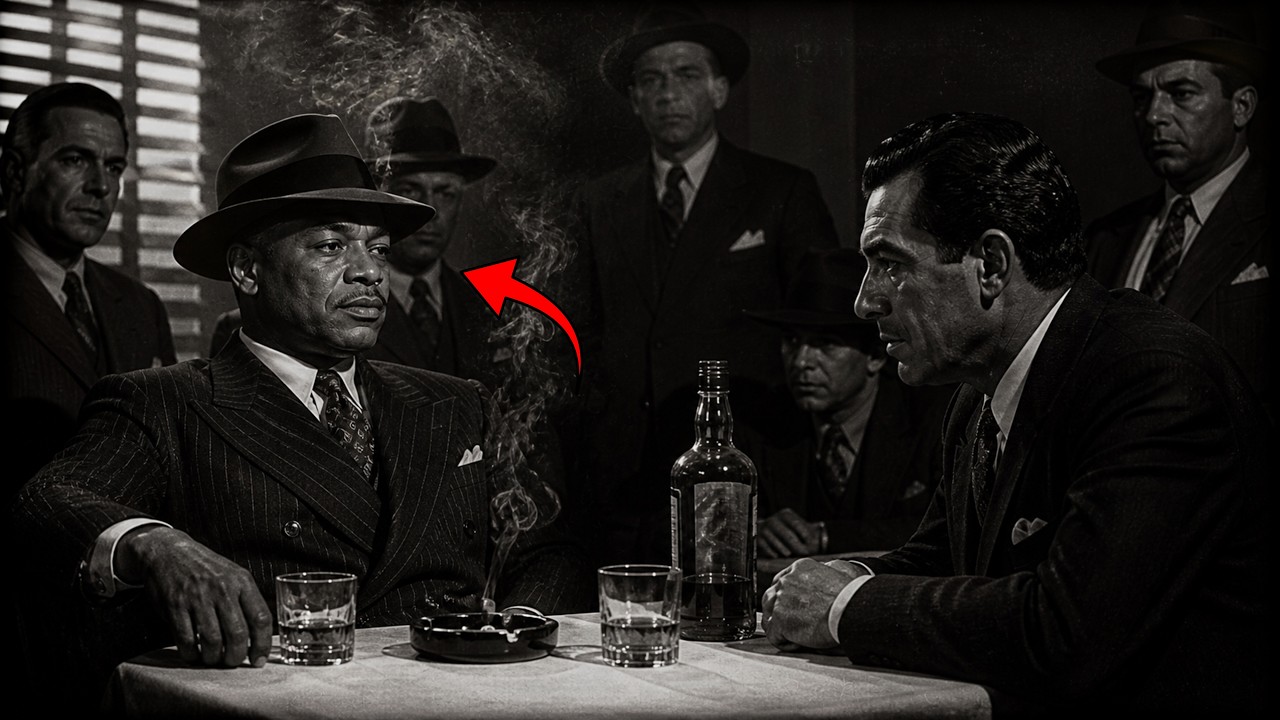
In November 1935, just three weeks after Dutch Schultz was gunned down in a Newark chop house, Ellsworth “Bumpy” Johnson walked alone into the Waldorf Astoria to meet Charles “Lucky” Luciano—the most powerful figure in American organized crime. Johnson was not there to surrender. He had come to negotiate the independence of Harlem’s numbers racket, the underground lottery that served as the neighborhood’s only real financial institution. Harlem in the early 1930s ran on a three-digit combination written on slips no bigger than a matchbook.
A dime bet could pay out $60 by sundown in a community where $60 was a month’s rent. The system supported thousands of runners, controllers, and bankers, all working outside banks that would not lend to Black families and businesses that would not hire Black workers. By 1932, some 40 independent policy banks operated in Harlem, built entirely with Black labor and capital. That economy caught the attention of Dutch Schultz, a Bronx bootlegger looking for new revenue after Prohibition ended.
With the backing of Tammany Hall politician James Hines, Schultz moved into Harlem and gave the policy bankers a choice: surrender their businesses or pay him a cut. Many who refused were beaten, cut, or shot. When the takeover was complete, only about half the original banks survived, and the survivors worked as middlemen for the mob. One operator refused to submit.
Stephanie St. Clair, known as Madame Queen, organized the remaining Black bankers against Schultz, confronted his collectors in the streets, and took her fight to the Seabury Commission and the mayor’s office. But she could not match the machinery of the city—police, courts, and bail bondsmen that Schultz controlled. By 1932 she needed a different kind of ally, and she turned to a man just released from Sing Sing prison.
Bumpy Johnson came home from prison broke, 27 years old, with half his life already spent behind walls. He had spent years in solitary confinement reading philosophy, poetry, and history, studying how power worked and how empires fell. St. Clair hired him as her lieutenant and enforcer, impressed more by his intelligence than his capacity for violence.
Johnson then led a guerrilla campaign against Schultz’s operation, using the neighborhood itself as a weapon. For three years, his small crew picked off Schultz’s men while residents—laundry women, barbershop regulars, kids on stoops—fed him information. The war cost roughly 40 lives on both sides and never fully turned the tide, but it made Schultz’s position in Harlem untenable. Schultz was murdered in October 1935, not because of Harlem but because he had proposed assassinating prosecutor Thomas Dewey.
The Commission, the governing body Luciano had built, ordered the hit because Schultz had become reckless. His death did not end the threat to Harlem’s numbers bankers. It merely transferred ownership of their operation to Luciano’s organization. Luciano was not a hothead.
He thought like a corporate executive, managing risk and return. He understood that white outsiders could not effectively run the numbers routes, but he intended to absorb the profits. Johnson saw the opening before the noose tightened. Instead of waiting to be summoned, he requested the meeting.
No transcript of the Waldorf Astoria meeting survives. What is known is the outcome. Johnson argued that taking Harlem by force would be self-defeating. The neighborhood operated on information and trust; put white mob figures on the ground and the runners would vanish, the slips would stop moving, and the money would disappear into the walls.
He offered a better arrangement: he would continue to run Harlem’s operations, and the Commission would receive a guaranteed percentage of the profits. In exchange, no Commission men would be stationed in the neighborhood, and the Black bankers would be left alone. Luciano accepted. The deal held for four decades.
Bumpy and Luciano later met regularly to play chess on a sidewalk table on 135th Street, two men who understood power in fundamentally different ways but had found a workable arrangement. After Luciano was deported to Italy in 1946, Frank Costello took over and left Harlem alone. But Vito Genovese, who had always regarded the agreement as a temporary concession, saw an opportunity. In early 1950, with Luciano’s conditional approval, five seasoned professionals from Chicago and Detroit arrived in New York to establish a Commission presence in Harlem.
They moved carefully, avoided the neighborhood at night, and gathered intelligence on routes, banker schedules, and productive blocks. Johnson let them finish their reconnaissance. Then, on a February evening, his men surrounded them. Not a single shot was fired.
Johnson told the five men they had entered his territory without permission and that they would now carry a message back to the man who sent them. Days later, Luciano received word that the men had vanished and that a delivery had arrived for Genovese. Luciano refused to authorize retaliation. He understood that a war in Harlem would be unwinnable, not because of raw numbers, but because Johnson controlled the neighborhood completely.
The agreement held, but Genovese never forgot the humiliation. At the height of his power, Johnson moved in celebrity circles—Sugar Ray Robinson, Cab Calloway, Billie Holiday, Lena Horne. He married Mayme in 1948 and raised his granddaughter, Margaret, as his own daughter. But the federal government had been watching.
In 1952, Johnson was indicted in New York for conspiracy to sell heroin. He claimed he was framed, and many believed him. He was sentenced to 15 years and arrived at Alcatraz in 1954, one of the few Black organized crime figures ever held on the Rock. On Alcatraz, Johnson kept a low profile.
He read, played chess, and earned respect through intellect rather than violence. In June 1962, Frank Morris and brothers John and Clarence Anglin made their legendary escape from the island, paddling into San Francisco Bay on a raft made of raincoats. They were never officially seen again. Years later, fellow inmate Clarence Carns claimed Johnson had arranged a boat to pick the escapees up from the bay and drop them at Hunters Point.
Johnson’s wife, Mayme, echoed the claim. The FBI closed its investigation in 1979, and the case remains officially open. The story cannot be confirmed, but it remains part of the lore surrounding a man who built his life on information and patience. Johnson was released on parole in 1963.
That same year, Attorney General Robert F. Kennedy ordered Alcatraz closed. When Johnson stepped off the transport in New York, Harlem came out to meet him in an impromptu parade. But the neighborhood he returned to was not the one he had left.
During his 11 years away, heroin had replaced numbers as the dominant racket. The parallel economy he had defended had been hollowed out, replaced by a drug trade that extracted wealth from the community rather than circulating it. Johnson opened a legitimate exterminating business, but relentless federal surveillance made it nearly impossible to operate. A young detective named William Butler became his constant shadow.
Johnson resumed his role as an elder statesman of crime, respected by those who intended to replace him. Frank Lucas, who would later build his own empire, watched him closely and later described him as refined and classy, more like a legitimate businessman than most people in the underworld. Johnson also remained connected to Malcolm X, a friend since the 1940s. In 1964, after Malcolm broke from the Nation of Islam, Johnson offered him armed protection.
Malcolm declined, saying it would look like he was provoking something. Two weeks later, he was assassinated at the Audubon Ballroom. Mayme Johnson later recorded her husband saying, “He should have listened to me. ”
In December 1965, frustrated by police surveillance of Black neighborhoods, Johnson staged a sit-down strike at a police station and refused to leave.
He was charged with refusing to leave a police station and acquitted. By 1967, he was under federal indictment again for drug conspiracy. He maintained he was framed, and many believed him again. His trial was still pending when he died.
Shortly before 2:00 a. m. on July 7, 1968, Johnson was sitting at Wells Restaurant on Lenox Avenue with childhood friends. A waitress had just served him coffee, a chicken leg, and hominy grits when he fell over clutching his chest.
He was taken to Harlem Hospital and pronounced dead of congestive heart failure. He was 62 years old. His funeral at St. Martin’s Episcopal Church on July 11 drew thousands, including criminals, politicians, and ordinary residents.
Not one Italian crime family sent a representative. No mayor or congressman attended. But police officers in civilian clothes were stationed on the surrounding rooftops. Mayme Johnson later speculated they feared he would get up from the casket and start raising hell.
Johnson is buried at Woodlawn Cemetery in the Bronx. The arrangement Johnson negotiated with Luciano lasted from 1935 until his death. He became the first Black man to establish a mutually beneficial arrangement with the Italian Mafia, solidifying his position as the de facto boss of Harlem. For many, he was Harlem’s Robin Hood, paying rents, settling debts, and delivering turkeys at Thanksgiving.
His legacy is complicated by the heroin trade that devastated the community during his later years and after his death. Johnson never gave a speech, never held a press conference, never wrote a memoir. He left no manifesto. He left a neighborhood that was still there.
The numbers racket itself is gone, replaced by state lotteries that take a dime and promise $60 by sundown, except the money now goes to Albany instead of staying in Harlem. In recent years, his story has been reintroduced through shows like Godfather of Harlem, but the portrayals are the echo, not the event. The event was a man who walked into the most powerful room in organized crime with nothing but his word and a neighborhood that believed in him—and walked out with an agreement that held for 40 years.