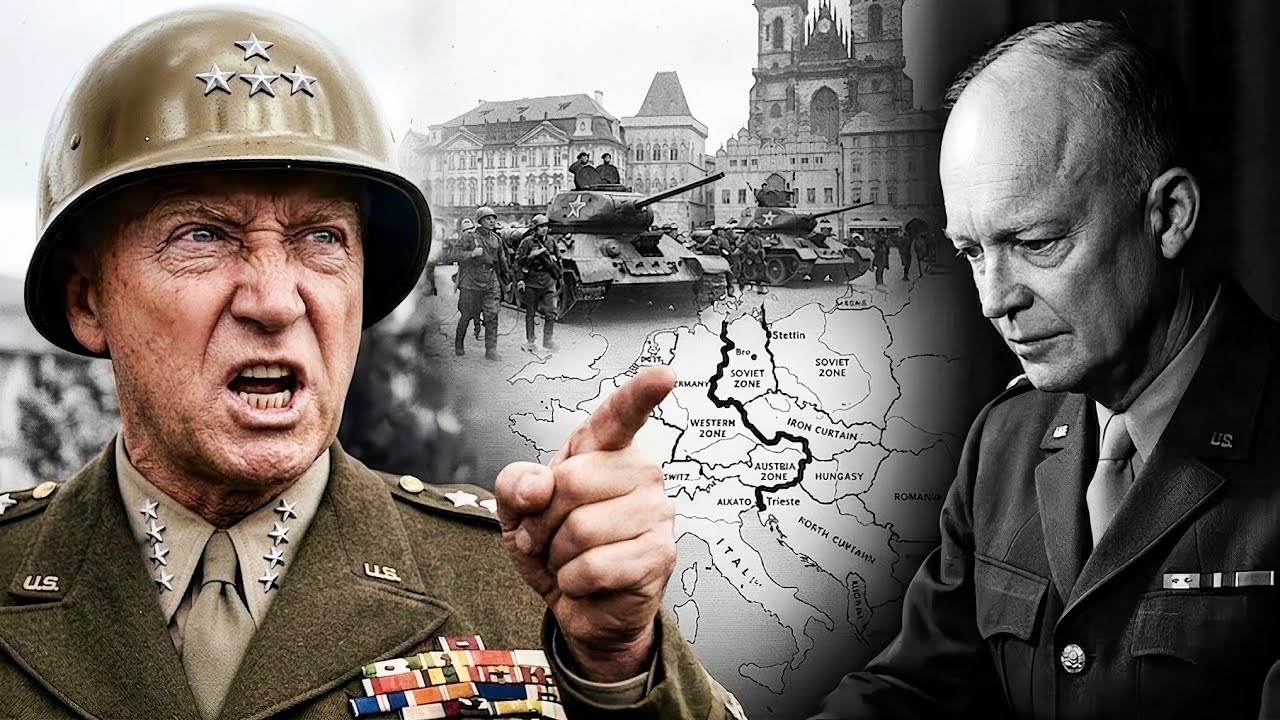
In the final days of World War II in Europe, General George S. Patton and General Dwight D. Eisenhower faced a decision that would echo for four decades. Patton's Third Army stood poised to seize Prague's vital communication hubs in May 1945. A single command halted the advance, sacrificing tactical momentum for a fragile political peace with the Soviet Union.
The question remains whether this was a master stroke of alliance management or whether logistical caution inadvertently paved the way for the Iron Curtain.
On May 4, 1945, the engines of the 16th Armored Division idled across the rolling landscape of West Bohemia. Their crews looked eastward with the hunger of men who knew the final prize was within their grasp. Patton, a commander who viewed military operations as a high-stakes sport, was already mentally miles ahead of his tanks, his mind fixed on the spires of Prague.
Patton operated on a philosophy he called the directed telescope, a system of real-time intelligence in which liaison officers from the Third Army Information Service bypassed the stifling 12-hour lag of traditional reports. To Patton, information was a perishable commodity, fresher than eggs and twice as fragile.
The reports reaching his headquarters in Plzeň told a story that contradicted everything being discussed in the hushed corridors of SHAEF. While Patton sensed a vacuum of power in the East, Allied intelligence believed that fanatical SS divisions were retreating into a mountainous Alpine fortress to wage a suicidal guerrilla war that could last for years.
This deception, influenced by a masterfully orchestrated campaign of Nazi propaganda led by Joseph Goebbels, had created a psychological anchor in Eisenhower's mind. It forced him to prioritize a broad front strategy to sweep Southern Germany and Austria rather than a decisive narrow thrust toward Berlin or Prague.
Eisenhower, the ultimate manager of a fragile coalition, viewed his mission as the total destruction of the German armed forces. Yet he was increasingly being outmaneuvered not by soldiers but by the diplomatic pressure of a Soviet Union that already looked toward the post-war landscape.
The friction between these two giants was not merely professional. It was an existential clash between two different eras of warfare. Eisenhower believed that victory was a product of logistics, committee-driven planning, and the meticulous synchronization of multinational forces. Patton maintained that orders in battle must be written wholly by the general himself.
As the Third Army stood at the largest it would ever be, a massive engine of over 540,000 men and 18 divisions, Patton felt the crushing weight of a command structure that seemed determined to restrain his impatient armor. He saw the strategic value of Prague not as a symbol of prestige but as the central nervous system of Central Europe, a hub where telephone, telegraph, and radio lines converged to control the withdrawal of Army Group Center, the last intact military formation of the Third Reich.
By May 5, the situation in Prague had transformed from a military problem into a revolutionary firestorm. Spontaneous crowds surged into the streets, tearing down German signage and painting over the symbols of an occupation that had endured since 1938.
The heart of the uprising was the Radio Prague building on Vinohradská Street, where Czech journalists and police officers engaged in a ferocious room-to-room battle with SS guards to seize the airwaves. The broadcast pleaded in broken English for all Czechs to come quickly to their aid, a desperate signal picked up by American radio monitors in Plzeň.
Patton was electrified by the call, yet he found himself tethered to a demarcation line that ran through Karlovy Vary and České Budějovice. It was a boundary line agreed upon with the Soviets that he was forbidden to cross.
The declassified cables from this period reveal a command structure buckling under the weight of Soviet diplomatic pressure, specifically in the correspondence between Eisenhower and General Alexei Antonov. On May 4, under intense pressure from Winston Churchill to secure Prague for the Western Allies, Eisenhower considered advancing his lines to the Vltava and Elbe rivers.
In a tactical error that historians still debate today, Eisenhower chose to ask for Soviet permission rather than simply announcing his intent to move. Antonov's reply on May 5 was a calculated lie. He claimed the Red Army's Prague operation had already begun and warned that an American advance would lead to disastrous friendly fire incidents.
In reality, the Soviet offensive would not truly commence for another 48 hours. But the misinformation served its purpose, freezing the American advance in its tracks.
Patton, refusing to be entirely blinded by the halt orders, dispatched a small clandestine scout team to penetrate the 60 miles of territory between Plzeň and the capital. Among them was a young Czech-born soldier, Rudolf Heller, whose father commanded a platoon of Czechoslovak soldiers sent by the British to assist the Third Army.
Riding through the night on motorcycles, the scouts encountered virtually no German resistance. The Wehrmacht was not fighting to hold ground but was desperately fleeing westward, hoping to surrender to the Americans to avoid the vengeance of the Red Army.
When the scouts entered Prague, they found a city of 2,049 barricades made of cobblestones and overturned trams, where civilians with hunting rifles were holding off the remnants of the Waffen SS. The report brought back to Patton was unambiguous. The road to Prague was open, and the city could be liberated in a single day.
Sensing a final opportunity to be a hero and to secure the future of Central Europe, Patton called his superior, General Omar Bradley, with a plea that would become legendary. He told Bradley that the patriots in the city needed help and that there was no time to lose.
Patton even suggested a daring ploy. He would get lost, cutting off his communications to present the capture of Prague as a fait accompli, much as he had done with the city of Trier earlier in the campaign. But Bradley, wary of Eisenhower's strict adherence to the accords, refused to budge, and the Third Army remained a silent spectator to the tragedy unfolding just 50 miles away.
The logistical caution of SHAEF was increasingly seen by Patton's staff as an ideological cage. While the American High Command was obsessed with supply lines and the orderly linkup of forces, the Soviet leadership was playing a different game, one focused on the strategic control of information and territory.
By seizing the communication hubs of Prague, the Western Allies were inadvertently granting the Soviet Union a monopoly on the liberation narrative. The radio transmitters and telephone exchanges that Patton wanted to capture were the metadata and content data nodes of 1945. Their loss meant that the post-war history of Czechoslovakia would be written by Moscow.
As the fighting in Prague reached its peak, the interpersonal friction between Eisenhower and Patton reached its own boiling point. Eisenhower, the humble manager from Kansas, had spent the war cleaning up the messes left by his wealthy, flamboyant friend. By May 1945, his patience was exhausted.
He viewed Patton's aggressive drive as a romantic indulgence that threatened the stability of the Grand Alliance, a distraction from the broad front strategy that he believed was the only way to ensure the total prostration of Nazi power. Eisenhower's long-range thinking was fixed on the destruction of the enemy, while Patton was already looking at the map of a new world, one where the Soviet Union was no longer an ally but a looming threat.
The irony of the situation was that while Patton was accused of neglecting logistics, his units in Czechoslovakia were actually thriving on improvised supply chains. Third Army veterans later recalled hot-wiring disabled German vehicles and utilizing captured enemy stores to maintain their pace, demonstrating an operational velocity that the Soviet forces could not yet match.
The halt was not a matter of fuel or ammunition but of political will. The declassified records show that the Americans could have reached Prague in two or three hours. Yet they were held back by a line on a map that had become a wall of diplomatic stone.
The consequences of this decision began to manifest almost immediately. The Red Army, having misled the Americans about the timing of their offensive, did not enter Prague until the morning of May 9, long after the uprising had forced a German withdrawal.
By being the sole liberators, the Soviets were able to solidify the Communist Party's influence in the post-war government, marginalizing the Czech soldiers who had fought with the Western allies. The liberation became a central pillar of Soviet propaganda, a narrative that would justify the eventual 1948 coup and the loss of Czech democracy for two generations.
The National Redoubt, which had dictated so much of Eisenhower's caution, was finally exposed as a legend rather than a reality when American forces reached Berchtesgaden and found no fanatical guerrilla army, only a disintegrated Wehrmacht. General Omar Bradley would later remark that the Alpine fortress was the worst intelligence report of all time, a realization that came too late to save the people of Prague.
The myth had served its purpose, diverting the most powerful field army in history away from the political heart of Europe at the most critical moment of the 20th century.
In the final days of the war, the Third Army stayed in Western Czechoslovakia, helping to maintain order and rebuild infrastructure. But the occupation phase was already clouded by the shadow of the coming Cold War. By December 1945, under mutual agreement, all American and Soviet forces departed, but the seeds of influence had already been sown.
Patton's diary from this period is a bitter testament to his frustration. He saw the cession of Prague as a decapitation of Western influence, a strategic failure hidden behind a tactical victory. This was the prologue to the Iron Curtain, written in the static of the radio broadcast and the silence of Patton's tanks.
The struggle for the communication hubs of Prague was the first engagement of a new kind of war, a battle where information and geography were inseparable. Eisenhower had won the war against Germany, but in the process, he had allowed the Soviet Union to win the opening move of the Cold War. The personal rivalry and strategic divide between these two iconic generals had created a vacuum that would take 40 years to fill.
On May 6, 1945, the engine of the 16th Armored Division roared with a hollow metallic resonance in the crisp morning air of Plzeň. At precisely 0800 hours, Colonel Charles Noble led Combat Command B into the city, greeted not by the fierce resistance of a coherent German defense but by a population in the throes of a desperate, ecstatic liberation.

The American tankers looked at their watches, then at their maps, and finally at the road leading east. The highway to Prague was wide, inviting, and virtually empty of any force capable of stopping a determined armored thrust. Yet the radio in Noble's command tank remained silent of the one order that mattered, as the high-stakes diplomatic friction between the Western Allies and the Soviet Union had already paralyzed the American spearhead.
Patton, watching the reports stream into his headquarters from the Third Army Information Service, felt the tactical opportunity of a lifetime slipping through his fingers. He knew that the war's final chapter was being written not by the men with the guns but by the men with the pens in London, Washington, and Moscow.
The declassified cables from SHAEF reveal a command structure that was no longer focused on the tactical destruction of the enemy but on the indescribable horror of the world they were about to inherit. Eisenhower had recently visited the liberated concentration camps near Ohrdruf and Weimar, and the evidence of bestiality and cruelty he witnessed there had profoundly altered his psychological state.
He was a man who wanted the killing to stop, and his primary mission had shifted from a rapid campaign of exploitation to the total orderly prostration of Nazi power without risking a catastrophic rupture in the Grand Alliance. This humanitarian urgency and strategic exhaustion made him vulnerable to the calculated misinformation of the Soviet High Command.
When General Antonov replied to Eisenhower's suggestion of an American advance to Prague with a stern protest on May 5, he played upon Eisenhower's greatest fear, the possibility of a tragic friendly fire incident between the two converging giants. Antonov's claim that the Red Army's Prague operation had already commenced was a strategic lie, a diplomatic roadblock designed to ensure that the Soviet Union would hold the keys to the communication hubs of Central Europe.
The tragedy of this hesitation was compounded by the failure of SHAEF's G-2 intelligence section to recognize the phantom nature of the National Redoubt. While Patton's scouts were reporting that German soldiers were redeploying themselves as self-discharged veterans, dropping their rifles and walking toward the American lines in tattered uniforms, the analysts in London were still obsessing over rumors of an Alpine fortress.
This Alpenfestung was a masterpiece of Goebbels' propaganda, a mythic holdout where Hitler's fanatical elite were supposedly stockpiling enough munitions and food to prolong the war for a year or more. Even with the selective use of Ultra intelligence, which Eisenhower and his staff used to confirm their existing preconceptions rather than challenge them, the American High Command remained blinded to the reality that the German army was a hollow shell.
They feared that a narrow thrust into Prague by Patton's 18 divisions would leave their southern flank exposed to a guerrilla insurgency that never actually existed.
Patton, however, operated on a different frequency. His Third Army Information Service was designed to pierce the fog of war with a directed telescope. He utilized cavalry lieutenants as liaison officers, men who rode ahead of the armor and reported directly to his forward processing center, bypassing the slow bureaucratic channels of traditional military reporting.
Patton believed that a shared common picture of the battlefield was the ultimate power advantage, and his common picture showed that Prague was a strategic vacuum. He saw that the 900,000 men of Schörner's Army Group Center were not preparing a defense but were desperately seeking a way to surrender to the Americans to avoid the certain retribution of Soviet captivity.
Control of Prague's communication infrastructure, the telegraph lines, telephone exchanges, and radio towers, was the only way to coordinate an orderly surrender and prevent the further senseless shedding of honest blood.
By the afternoon of May 6, the situation inside Prague had reached a fever pitch of revolutionary fervor. The insurgents had seized the telephone exchange, allowing them to sever the communication between German units and their commanders, a move that Patton's staff recognized as a decapitation campaign carried out by civilians.
On Vinohradská Street, the battle for the radio building was becoming a seminal moment in Czechoslovak history as 30,000 Praguers constructed over 2,000 barricades to hold off the Waffen SS units being pulled back from the Eastern Front. The insurgents were poorly armed, possessing only hunting rifles, pistols, and a handful of captured panzerfausts.
Yet they held 10 of the city's 12 bridges. They broadcast their appeals for air support and armored intervention in English and Russian. Their voices rang through the static of every American radio set in West Bohemia. Patton listened to these cries and felt a profound sense of shame, knowing that his tanks were fueled and ready just 50 miles away.
The interpersonal friction between Eisenhower and Patton during these final days was not merely a personality clash but a fundamental disagreement over the nature of leadership. Patton, the wealthy warrior from a long line of military men, believed that inspired leadership on the battlefield was the chief ingredient of victory and that a general must write his own orders in the heat of the moment.
Eisenhower, the manager who had used the military to rise from a humble Kansas upbringing, felt that leadership was just one factor in a vast machine of logistics, politics, and worldwide strategy. Eisenhower saw Patton as a romantic who indulged in publicity-seeking maneuvers, while Patton saw Eisenhower as a man who had become so entangled in the tangled skein of European politics that he had lost the will to act decisively.
This distrust meant that when Patton proposed a daring dash to Prague, Eisenhower saw it not as a strategic necessity but as a dangerous indulgence that could spark a Third World War.

The declassified cables reveal that while the Americans were hesitating, the Soviet leadership was acting with cold, calculated precision. Stalin had recognized Prague as a particularly important prize as early as May 1, ordering the First Ukrainian Front to pivot south from Berlin to ensure a Soviet military presence in the city at the moment of surrender. Antonov's misinformation to Eisenhower on May 5 was the diplomatic shield that allowed the Red Army to move into position.
History now knows that the Soviet offensive did not truly start until May 7, meaning there was a 48-hour window where Patton could have liberated the city with almost no opposition. Had the American High Command been just a little more resolute, the entire post-war history of Central Europe might have been written differently, potentially saving two generations of Czechs and Slovaks from the totalitarian grip of a Soviet satellite state.
As the American 16th Armored Division consolidated its position in Pilsen, the German commander, General von Majewski, recognized the futility of further resistance and signed the capitulation at 14:15 hours on May 6. He surrendered his forces to the Americans, an act of desperation that was repeated across West Bohemia as German soldiers sought the protection of the Geneva Conventions.
Yet as the Americans took their prisoners, they were forced to watch as the Soviet advanced units began to appear on the horizon, moving to secure the territory that Eisenhower had ceded in his cables. The demarcation line, running from Karlovy Vary to Plzeň to České Budějovice, became a physical manifestation of the political barrier that was descending across the continent.
Patton's diary from this night reflects a bitter prophetic anger. He wrote that he would like to go to the line of the Moldau River and tell the Russians that is where he intended to stop, realizing that the spirit of comradeship Eisenhower cherished was a one-way street.
The human cost of the halt order was borne by the citizens of Prague during the four additional days of bloody fighting that followed. While the Third Army sat idle, the Waffen SS exacted a terrifying toll on the insurgents, committing atrocities that the American scout Rudolf Heller witnessed firsthand.
Heller and his team had infiltrated the city and saw Czechs dying for nothing, their barricades being crushed by German armor that the Americans could have easily destroyed. The scouts returned to Patton's headquarters with reports that were so shocking they prompted one final desperate plea from the general to Bradley and Eisenhower. But the order remained absolute. The Americans were essentially told to watch as their future rivals secured the strategic nodes of a city they had been within hours of saving.
The long-term geopolitical legacy of the Prague cession was the birth of the liberation narrative that the Communist Party used to dismantle democracy in Czechoslovakia. By being the sole force to enter the city on May 9, the Red Army was portrayed as the true protector of the nation, while the Americans were depicted as the hesitant imperialists who had abandoned the uprising in its hour of need.
This narrative, built on the foundation of Eisenhower's logistical caution and the Soviet-engineered misinformation, was the primary weapon used in the 1948 Communist coup. The communication hubs that Patton so desperately wanted to secure became the amplifiers for 40 years of totalitarian propaganda, a direct result of a command decision that prioritized diplomatic stability over tactical reality.
Eisenhower's broad front strategy, while successful in ensuring the total surrender of Germany, failed to account for the information power inherent in the communication nodes of Prague. He viewed the war as a technical problem of logistics and set-piece battles, whereas Patton understood that the next war, the Cold War, had already begun in the airwaves over Vinohrady Street.
The metadata and content data of 1945 were found in the telegraph exchanges and radio transmitters of the capital, and by ceding them, the Western allies lost their ability to influence the post-war political makeup of the region. The personal rivalry between the manager and the warrior had created a strategic vacuum that the Soviet Union was all too happy to fill with their own iron-fisted reality.
In the years following the war, both men would grapple with the consequences of those final weeks. Eisenhower's presidency would be dogged by theories that his failure to take Berlin and Prague had delivered Eastern Europe into Soviet hands, a charge that he defended as a necessary adherence to the common cause of human freedom.
Patton, whose life was cut short by a car accident in December 1945, died believing that the American leadership had lacked the resolve to finish the job correctly. He had seen the savages that Stalin led and recognized that the profitless quarrels Eisenhower wanted to avoid were actually the most important battles of the century.
The declassified cables today stand as a testament to a moment when the fog of uncertainty was thickened not by the enemy but by the diplomatic caution of friends. The myth of the National Redoubt finally crumbled when American forces captured Berchtesgaden and found no fanatical guerrilla army, only a collection of disillusioned officials and empty bunkers.
General Omar Bradley would later call it the worst intelligence report of all time, an admission of the staggering scale of the deception. The diversion of resources to the south had been a tactical victory over a ghost, while the real strategic prize in the east was allowed to fall into the hands of a power that would remain a rival for the next four decades. Patton's directed telescope had seen the truth, but the command structure was too heavily anchored in the tangled skein of the past to react to the future.
The tactical glory of the Third Army, with its M4 Sherman tanks and its unmatched operational velocity, was halted by a line on a map that was drawn in the ink of diplomatic compromise. The communication hubs of Prague remain a symbol of what might have been, a democratic anchor in the heart of Europe that was traded for a fragile, temporary peace with a Soviet ally.
The story of the Prague cession is a reminder that in the high-stakes game of global strategy, the most dangerous enemy is often the misinformation we choose to believe and the caution that keeps us from seizing the future. The silence that descended upon the American lines outside Prague on VE Day was not the silence of peace but the silence of a missed opportunity.
The engines of the 16th Armored Division were finally turned off, their mission fulfilled according to the orders of SHAEF, but the soldiers who looked toward the eastern horizon knew that the war was not truly over. They had seen the citizens of Prague begging for help, and they had seen the Red Army moving in to take the credit for a liberation they had nearly prevented.
Patton stood alone in his headquarters, a warrior without a war, watching as the strategic nodes of Central Europe were gathered under a different umbrella. World War II was a conflict of immense scale and complexity, but its final moments were defined by the personal and strategic decisions of two men, Dwight Eisenhower and George Patton.
The choices made in May 1945 regarding the liberation of Prague and the control of its communication hubs were the opening moves of the Cold War, a conflict that would haunt the globe for two generations. Was the Iron Curtain the inevitable result of geography, or the tragic consequence of a single halted advance?