On June 22, 1944, three years to the day after the first Wehrmacht tank crossed the Soviet border, the atmosphere inside the Wolf's Lair in East Prussia was suffocating. A heavy silence hung over the maps where the red lines of the Belarus salient loomed like a jagged blade.
While Berlin respected the tactical elegance of General George Patton in the West, it harbored a primal, unspoken terror for the man rising in the East. Why did Hitler and his seasoned marshals fear this one commander more than the combined weight of the Allied armies?
The tension in Hitler's situation room at 10:00 a.m. was a study in psychological contrast. On the western map table, red arrows marked Patton's advance across France, drawing loud arguments about fuel reserves and panzer repositioning. To the Prussian military elite, Patton was a mirror image: bold, decisive, and arrogant, a rival whose tactics followed the traditional rules of European maneuver.
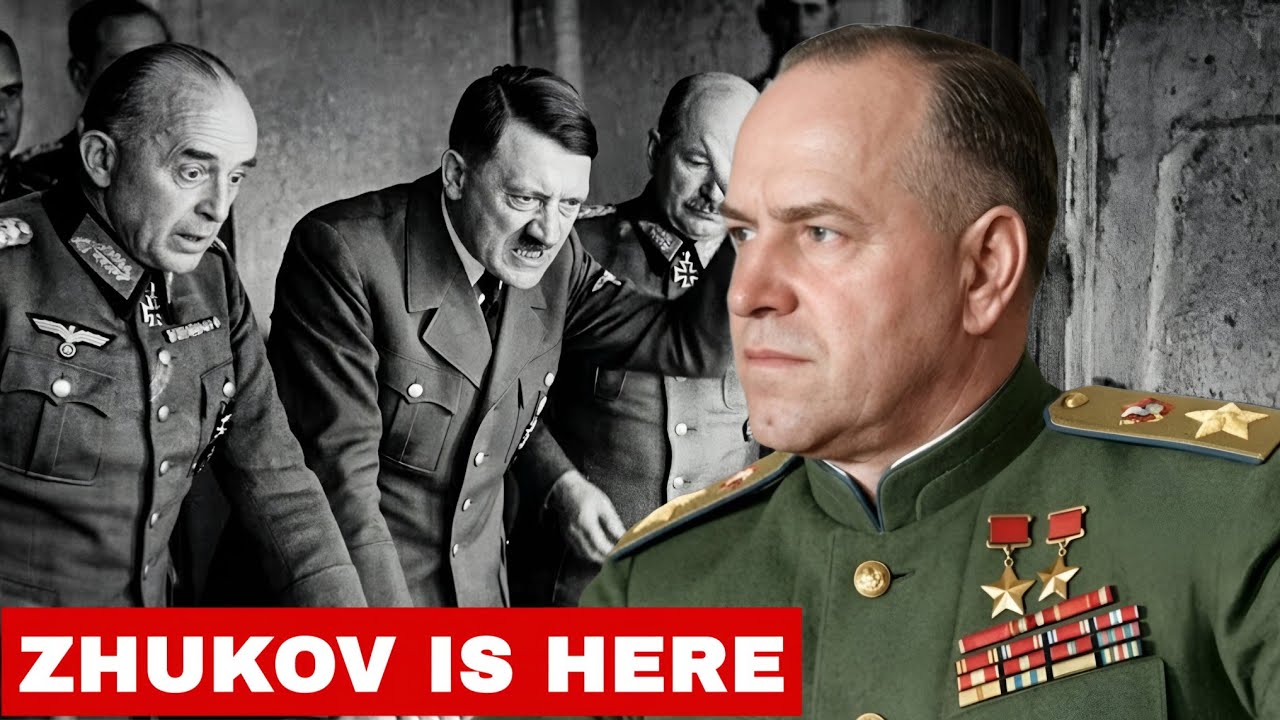
But on the eastern map table, there was no shouting, only a terrified heavy silence. The intelligence officers of Fremde Heere Ost were not looking at a rival. They were tracking a predator who viewed the war not as a conquest of territory, but as a mathematical exercise in total extermination.
German intelligence officers whispered his name like a curse, knowing that wherever Marshal Georgy Zhukov appeared, the front line did not just bend, it evaporated.
This historical enigma begins with a profound existential question. How did 1.7 million Soviet soldiers and 6,000 tanks remain completely invisible while standing mere miles from the German front?
The answer was the miracle of Maskirovka, the Soviet art of strategic deception that turned the massive forests of Belarus into a void where reality went to die. By 1944, the Red Army had mastered a darker doctrine that prioritized deception over simple speed.
While the German OKH, the High Command of the Army, convinced themselves that the Red Army was exhausted and capable only of local counterattacks in Ukraine, Zhukov was holed up in a secure bunker coordinating a strike of such magnitude that it would erase an entire army group in just 14 days.
To understand the weight of the coming catastrophe, we must examine the Belarus salient, a massive shelf held by Army Group Center that projected deep into Soviet territory. Field Marshal Ernst Busch, a commander whose loyalty to Hitler often superseded his tactical judgment, presided over 38 understrength divisions spread across four armies: the Third Panzer, Fourth, Ninth, and Second.
These forces, totaling roughly 500,000 to 850,000 men, were supported by a mere 120 Panzers and 450 assault guns, a ghost of the force that had once dominated the continent. The German High Command had fallen for the Soviet ruse hook, line, and sinker, positioning their precious armored reserves in the south and leaving the center vulnerable to a 7:1 Soviet superiority in armor.
The leadership dilemma was clear and fraught with ambiguity. General Hans Jordan of the Ninth Army saw the storm gathering, noting in his war diary that his army stood on the eve of an unpredictable battle. He bitterly complained about the High Command's refusal to sanction tactical withdrawals, warning that the army would either have to transition to a mobile defense or see its front smashed into dust.
But Hitler had issued his infamous Festung Platz directive, Order Number 11, declaring cities like Vitebsk, Orsha, and Bobruisk as fortress cities to be defended to the last man. This strategic paralysis effectively turned these urban centers into kill boxes, stripping the German commanders of the only weapon that could save them: mobility.
The silence before the storm was orchestrated with surgical precision. Soviet strategic intelligence created a false image of exhaustion, convincing Berlin that the main Soviet blow would fall in Ukraine.
They manufactured a myth of Red Army fatigue while simultaneously moving 1.7 million men into the central sector under the strictest camouflage discipline the Wehrmacht had ever witnessed. Tanks were hidden in barns, aircraft were camouflaged in forest clearings, and false radio traffic was generated to simulate an entire tank army in the south.
German reconnaissance pilots reported seeing empty fields, yet just beneath the canopy of the Belorussian pines, 33,000 artillery pieces and 5,800 tanks were being brought to bear on German trenches.
This brings us to the partisan prelude. On the night of June 19, 1944, the nervous system of Army Group Center was severed in a single, coordinated heartbeat.
Approximately 140,000 Soviet partisans, following direct orders from the Stavka, detonated 10,000 demolition charges across the German rear. Bridges evaporated, railroad junctions turned into twisted scrap metal, and communication lines were cut with such efficiency that the German front line was isolated from its supply hubs before a single Soviet rifleman stood up.
The German rail system was paralyzed, and reinforcements were trapped in narrow corridors where they could be blocked and ultimately destroyed by the advancing Red Army.
The psychological state of the German soldier at this moment was a study in mounting dread. Private memoirs from the Ninth Army describe the tonal weight of the silence, a heavy, vibrating pressure that preceded the Soviet artillery.
The landsers in the trenches, wearing their M35 Stahlhelm helmets and clutching Karabiner 98K rifles, were no longer the confident conquerors of 1941. They were hunted men sensing the presence of a predator who refused to make himself known until the moment of impact. Soldiers reported hearing the distant rumble of tank engines, but reconnaissance planes saw nothing but trees, creating an uneasy feeling of being watched by a monster.
The date was June 22, 1944, at 3:00 hours. The silence of the Eastern Front did not just break, it shattered with a roar that registered on seismographs hundreds of miles away.
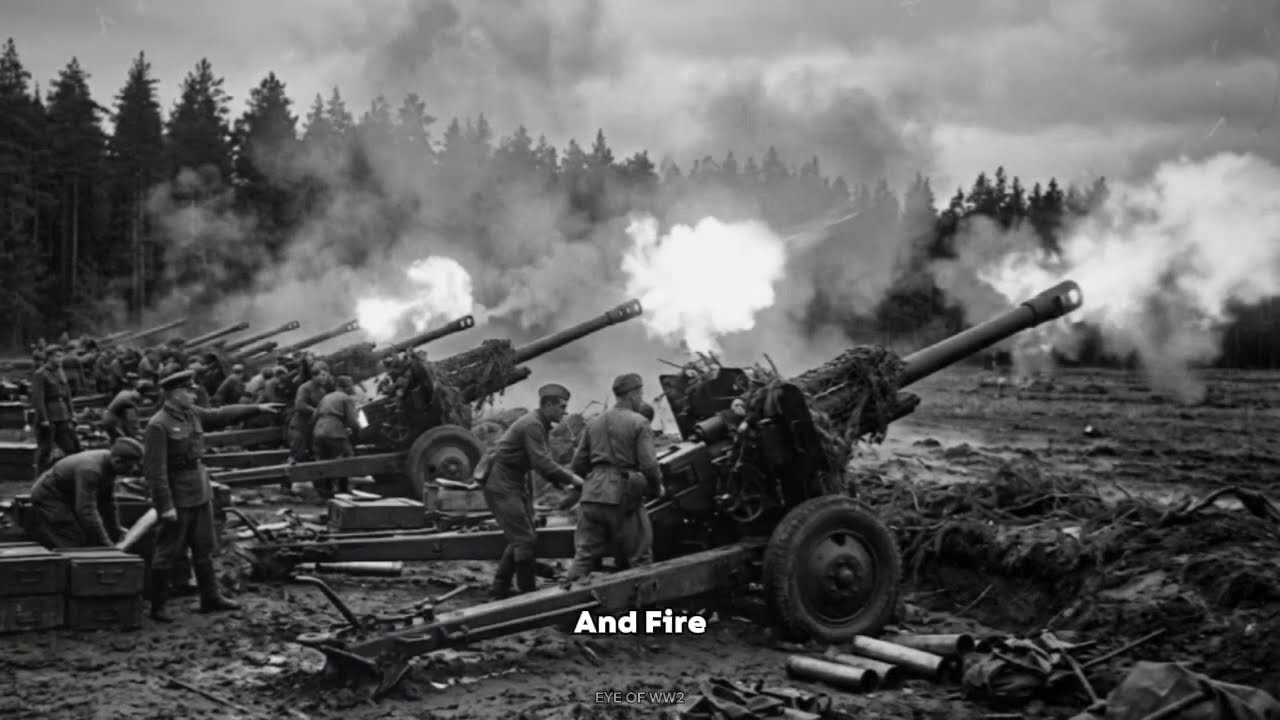
This was the rolling double barrage, a Soviet doctrine that targeted both the front-line weapon pits and the rear echelon command posts simultaneously. In the breakthrough sectors, Zhukov and Rokossovsky concentrated up to 200 to 300 guns per kilometer. This meant one heavy artillery piece, ranging from 76 mm to 203 mm calibers, was positioned every 5 meters along the front.
By German accounts, the bombardment was more intense and destructive than any seen previously in the war. As the shells rained down, the German defensive positions did not just take casualties, they ceased to exist. Entire battalions were buried alive in their bunkers, and the 122-mm M-30 howitzers turned the Belorussian soil into a moonscape of craters and fire.
This was not a battle as the West understood it. It was an erasure. Zhukov, a man who survived Stalin's purges by being indispensable, had mastered the art of trading lives for time and time for position. He was not fighting to conquer territory, he was fighting to exterminate the Wehrmacht, and the statistics of his deep battle doctrine were physically impossible for the German logistical mind to comprehend.
The northern sector near Vitebsk was the first to buckle. General Georg Hans Reinhardt's Third Panzer Army was a Panzer Army in name only, possessing only one armored division and several understrength Luftwaffe field units.
As the First Baltic Front under Ivan Bagramyan lunged forward, they did not attack the fortress city of Vitebsk head-on. Instead, they performed a wide flanking maneuver, bypassing the German strongpoints and severing the lifelines of the 53rd Corps area.
General Friedrich Gollwitzer begged for permission to withdraw, but by the time the OKH in East Prussia acquiesced, the trap had already snapped shut. Inside the cauldron of Vitebsk, 30,000 German soldiers were trapped in a pocket of absolute chaos, where Soviet air superiority was so total that the Luftwaffe could only watch from the ground.
The Fourth Luftwaffe Field Division was shredded in hours, leaving the 246th Infantry Division to hold the Dvina crossings with nothing but blood and iron. The fortress city had become a pre-packaged kill box, and the German commanders were paralyzed by Hitler's refusal to allow a retreat until it was too late.
This brings us to the core of the Zhukov terror. Unlike Patton, who sought to paralyze the enemy through speed and maneuver, Zhukov sought to render the enemy's existence irrelevant through overwhelming mass. He possessed absolute authority, and when he demanded sacrifice, he spent lives as a currency to achieve strategic bridgeheads.
At the breakthrough at Vitebsk, infantry and tanks with mine plows advanced following the barrage, literally crushing the German forward positions under their treads. The Germans, who calculated war based on efficiency and professional detachment, found themselves face-to-face with a commander who simply refused to stop, regardless of the cost.
The central sector at Orsha and Mogilev followed the same apocalyptic pattern. The Fourth Army under Kurt von Tippelskirch attempted to hold the Dnieper river line, but the Soviet Second and Third Belorussian Fronts pinned them down while the First Belorussian Front performed deep encircling hooks.
This was the realization of operational shock, where the speed of the Soviet advance, moving at 25 to 30 kilometers per day, outpaced the German ability to even report the losses to headquarters. By the end of the first week, Army Group Center was no longer a military organization. It was a collection of fragmented units wandering through the forest.

By late June, 25 German divisions had already been erased from the order of battle. 300,000 men were dead or captured in a destruction that made the Normandy landings look like a skirmish.
General von Salmuth, one of the few German commanders who managed to keep his unit intact, noted the terrifying difference. Against the Americans in the west, you could retreat and regroup. But against Zhukov, there was no rear. His tanks didn't stop at the first line of defense. They drove deep into the logistical heart, severing supply lines and creating pockets of absolute panic.
The mystery remains: why did Hitler believe that Walter Model could save a situation that had already surpassed the point of no return?
The transition from tactical retreat to absolute annihilation occurred in the southern sector of the salient near the city of Bobruisk. Here, the First Belorussian Front under Konstantin Rokossovsky faced the Ninth Army of General Hans Jordan.
The terrain was a nightmare of swamps in the Pripyat marshes, ground that the German planners deemed impassable for heavy armor. But Zhukov's logistics and engineering defied the laws of military physics. The Red Army began constructing corduroy roads of timber and branches, driving hundreds of T-34 tanks over the bogs in a feat that left the German defenders stunned.
This exploitation of impassable terrain was the hallmark of Soviet operational art, catching the Ninth Army in a pincer they never anticipated. As the southern pincer of the Soviet offensive closed, the Ninth Army found itself trapped in the cauldron of Bobruisk.
General Hans Jordan realized that his 35th and 31st Panzer Corps were being led into a slaughterhouse. He desperately ordered the 20th Panzer Division to counterattack, but the orders were so confused and the Soviet air strikes so relentless that the armored reserves were caught in the open and neutralized before they could coordinate their fire.
By June 27th, the two German Corps were encircled in a pocket east of Bobruisk under constant aerial bombardment from the 16th Air Army.
The first-hand accounts from this cauldron of death are visceral and haunting. Soviet archives and German survivors describe the Berezina River as a waterway of the damned, its banks paved with the charred remains of thousands of vehicles and the bodies of soldiers who had attempted to swim to safety.
One German officer noted in his diary that the ground was so densely covered in corpses that the retreating trucks were forced to drive over the dead to navigate the roads. A cauldron of death was boiling here, where the revenge was carried out, a Soviet report noted with grim satisfaction. This was the physical manifestation of Zhukov's doctrine: total erasure through the concentration of air and ground power.
On June 28, 1944, a moment of profound psychological weight occurred that would become a legend in the annals of military history. The 12th Panzer Division arrived as a desperate reinforcement to the Bobruisk sector, only to be met by the Ninth Army's chief of staff.
The commander of the 12th Panzer asked for his orders and the location of the Ninth Army's lines. The chief of staff, his eyes hollow with shock, replied with five words that signaled the end of the Wehrmacht: "Good to see you. 9th Army no longer exists."
In that instant, the chain of command in the south had evaporated, leaving 40,000 men to disappear into the forest.
This realization hit the Wolf's Lair like a physical blow. Hitler, in a fit of rage and denial, relieved General Hans Jordan of his command and dismissed Field Marshal Ernst Busch. In their place, he summoned Walter Model, appointing him commander of Army Group Center on June 28.
Model arrived with the reputation of a miracle worker, the fireman whom Hitler trusted to stabilize any front. He was the only general who dared to tell Hitler to his face, "Mein Führer, who commands the 9th Army? You or I?"
Model's arrival brought a shift toward a rolling defense, but he was attempting to reconstruct a line that had already been shredded by four Soviet fronts. His leadership style was a sharp contrast to the rigid obedience of Busch. He emphasized flexible defenses and a continuous front line, no matter how thin, that allowed troops to retreat and regroup rather than hold static lines.
But as Model stood over the map tables in Minsk, his monocle catching the dim light of the bunker, he faced an existential crisis. He was trying to stabilize a front that was 400 miles wide with a force that had been reduced by half a million men in less than two weeks. His reputation as the master of the large-scale defensive battle was being tested by a predator who refused to let him regroup.
The what-if pivot of this narrative is found in the decisions of early June. If Hitler had accepted Busch's proposal on May 20 to withdraw to the Berezina River, Army Group Center might have shortened its lines and created a strategic reserve.
The alternate reality was a manageable fighting retreat. The actual reality was a total eclipse of the German military capacity in the East. Because of the no-retreat order, the German soldiers were static targets for the greatest concentration of artillery in human history, turning the fortress cities into tombs before the first Soviet shell even landed.
As the Soviet Fifth Guards Tank Army under Pavel Rotmistrov lunged toward Minsk, the final pocket began to form. The remnants of the Fourth and Ninth Armies were being compressed into a massive cauldron east of the city.
The liberation of Minsk on July 4, 1944, was not just a territorial gain. It was the symbolic death of Army Group Center. Nearly 100,000 German prisoners were marched through the streets of Moscow shortly after, a visual testament to the fact that the Wehrmacht's spine had been snapped. The fortress city of Minsk had held only 1,800 organized troops by the end, surrounded by 15,000 unarmed stragglers.
The technical precision of the Soviet advance was aided by US lend-lease equipment, particularly the Studebaker trucks that allowed the Red Army to maintain a logistical tail that moved 40 to 50 kilometers a day. This speed surpassed even the most aggressive calculations of the German General Staff. They realized that distance was no longer their ally.
By the time a new defensive line was drawn on a map in Berlin, Zhukov's tanks were already 30 miles behind it, destroying command posts and supply depots with a scale of violence that rendered German tactical expertise irrelevant.
This brings us to the historical enigma of Georgy Zhukov's internal friction. While he was the architect of the greatest victory in Soviet history, he was constantly under the shadow of Joseph Stalin's paranoia. Stalin played his generals against each other, fueling a rivalry between Zhukov and Konstantin Rokossovsky to ensure that no single commander became more popular than the party.
Zhukov's ruthlessness was a survival mechanism. He knew that if he did not win with absolute certainty, he would be liquidated like the generals of the 1937 purges. His indifference to cost, spending 100,000 lives to gain a bridgehead, was what truly terrified the German mindset.
The psychological toll on the remaining German officers was a mixture of professional paralysis and personal terror. Unlike the Western Front, where surrendering to George Patton meant a POW camp and medical care, surrendering to Zhukov meant a journey into the void. This spurred a frantic, desperate resistance that had no strategic purpose other than the biological urge to survive.
General Heinrici noted that men who had fought with cool detachment were now trembling, checking cyanide capsules in their pockets as the rumor of Zhukov's presence caused entire units to crumble before the first shot was fired.
The climax of the Zhukov terror occurred in April 1945 at the Seelow Heights, the last gate to Berlin. Zhukov, under pressure from Stalin to take the city before the Western Allies, unleashed a bombardment that surpassed all history. He used 140 searchlights to blind the German defenders, a psychological terror tactic that turned the night into a blinding nightmare. The battle was a messy, brutal frontal assault that cost thousands of men, but it broke the final German line.
The consequences for Berlin were immediate. The city did not prepare for a siege, but for the end of the world.
The geopolitical legacy of Operation Bagration is the world we live in today. The Iron Curtain was drawn exactly where Zhukov's tanks stopped. The speed and violence of his advance meant that the Soviet Union would occupy Eastern Europe for the next 50 years, a reality that Eisenhower and Patton admitted with a shudder of respect. They realized that while they had fought a war of maneuver, Zhukov had fought a war of extinction.
We conclude with the image of Zhukov in the ruins of Berlin in 1945. But the seeds of that moment were sown in the forests of Belarus in 1944. He had stripped the German High Command of their arrogance, their territory, and finally their hope.
History remembers Patton for his pearl-handled revolvers and his speeches. But it remembers Georgy Zhukov for the silence he left in his wake. He was the only Allied commander who looked the Wehrmacht in the eye and made it blink, proving that in the brutal calculus of total war, the most terrifying weapon is a commander who simply refuses to stop.
The mystery of the fireman and the predator remains a subject of intense study for military historians. If the winner of a war is the one who refuses to stop, regardless of the cost, then Zhukov was the ultimate weapon.
Was the annihilation of Army Group Center an inevitable result of Soviet industrial evolution? Or could a different German leadership strategy have delayed the end? In the brutal calculus of total war, was Zhukov's indifference to casualties a mark of military genius or a fundamental failure of humanity?