Berlin was burning on April 30, 1945. The Red Army was advancing street by street toward the heart of the city, crushing whatever resistance remained.
Soviet forces were less than 500 meters from the bunker where Adolf Hitler was spending his final hours. Inside, six meters below ground, the air was suffocating.
The dictator who had dominated much of Europe for 12 years was now cornered. He knew everything was over.
Two days earlier, news had reached him that his closest ally, Benito Mussolini, had been captured and executed by Italian partisans. But it was not only the death that shocked Hitler. It was what came after.
Mussolini's body was hung upside down in front of a gas station in Milan, beaten, spat upon, and humiliated by an enraged crowd. It was a spectacle of public revenge, chaotic and brutal.
That image never left Hitler's mind. The idea of his own body being displayed that way, of becoming a trophy in enemy hands, was something he simply would not accept. He would not allow the Soviets to do the same to him under any circumstances.
To understand what happened to the ashes, one must know a man history almost erased. His name was Artur Axmann.
Unlike many figures associated with the regime, Axmann was not a decorated general or a minister known to the general public. He did not appear in the most important speeches, nor was he the face of Nazi propaganda. But his role was, in a way, even deeper.
Axmann was the leader of the Hitler Youth, responsible for shaping, indoctrinating, and preparing an entire generation of young Germans within the ideology of the regime. Thousands of teenagers passed through this structure, trained to believe, obey, and if necessary, die.
Still, in the final months of the war, Axmann had become something beyond that. While many still clung to the illusion of victory, he already saw the collapse approaching.
Months before the surrender, Axmann began organizing a discreet network of leaders loyal to the regime. People who would survive the fall of Nazi Germany and who, far from the spotlight, would keep the ideology alive in the shadows.
It was no longer about winning the war. It was about ensuring that even in defeat, something remained. An American intelligence agent, years later, summed this up in a phrase that became memorable: the guardian of the flame.
Within that distorted logic of loyalty and legacy, the description made sense. In the final days of the Third Reich, when everything was crumbling around him, Hitler needed to entrust something to someone. Something that was not necessarily political or military, but symbolic.
That was exactly why he chose Artur Axmann for a very specific task.
On the morning of April 29, 1945, inside the bunker, while Berlin collapsed outside, Hitler married Eva Braun. There was no grand celebration, no witnesses beyond a small trusted circle.
That same afternoon, Hitler dictated his final will. He named Admiral Karl Dönitz as his successor in an attempt to maintain some structure after his death, though he knew deep down that nothing would change the inevitable outcome. He was fully aware that this was the end.
In the early hours of April 30, after saying goodbye to his closest staff, Hitler and Eva walked to his private office without apparent haste or hesitation. They entered and closed the door. No one dared interrupt.
Some time later, the door was opened and both were dead. Hitler had shot himself in the right temple. Eva had ingested cyanide.
It was a quick, planned, controlled end, exactly as he wanted. No capture, no exposure, no public spectacle.
The bodies were immediately taken to the garden of the Reich Chancellery, still under the distant sound of Soviet artillery. There they were placed in a bomb crater, drenched with gasoline, and set on fire.
It was a clear attempt to erase any trace, to prevent the Soviets from finding the bodies, to prevent them from becoming a symbol or a trophy. But there was still a problem.
Open-air cremation is extremely inefficient. Berlin's sandy soil absorbed much of the gasoline before the fire could intensify. The wind dispersed heat, making continuous combustion difficult. The conditions were chaotic and improvised, far from any controlled process.
For about two hours, the flames consumed the bodies, but it was not enough. When the fire ceased, the remains were charred but not completely destroyed. Fragments still existed.
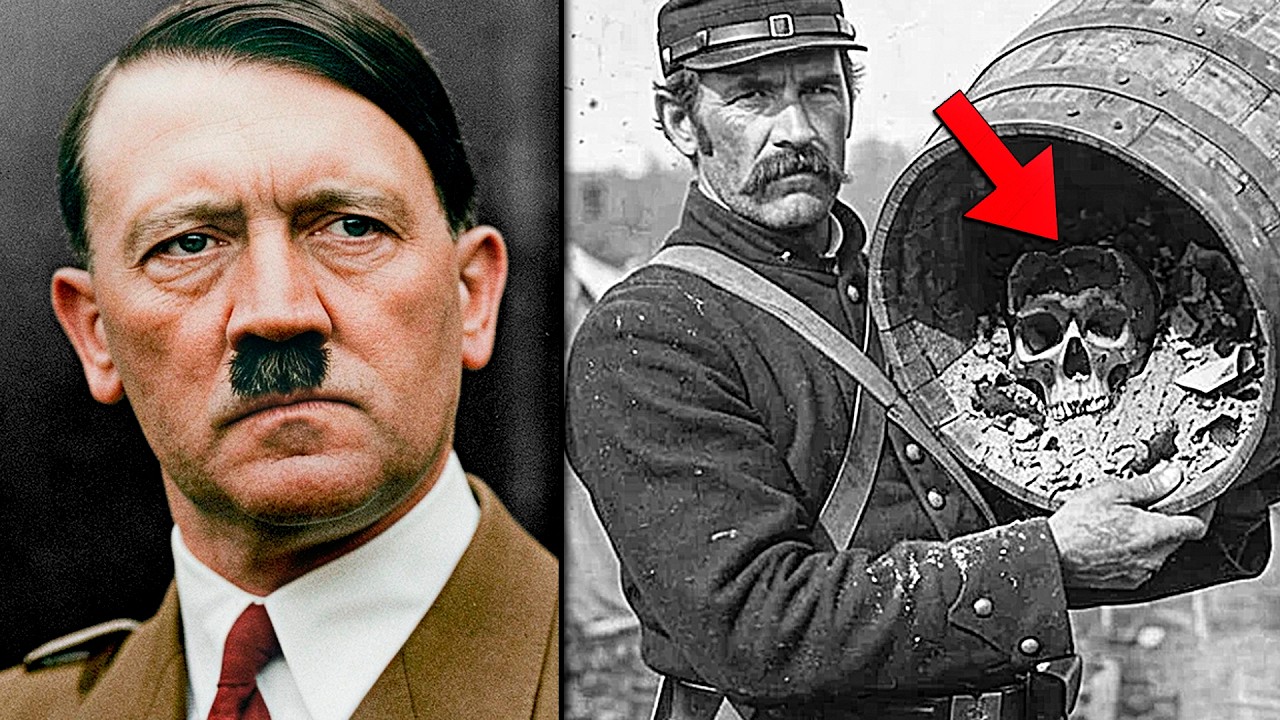
And it was at this point that something happened, something that rarely appears in the better-known accounts. Someone collected part of the ashes from Hitler's body.
Carefully, or perhaps urgently, they gathered what remained. They placed this material in a small metal box, and then this box was delivered to Artur Axmann.
Where does this information come from? It appears in testimonies collected shortly after the end of the war, more specifically in the words of Traudl Junge, who was Hitler's personal secretary.
During an interrogation conducted by the U.S. Army Counter Intelligence Corps in August 1946, according to the records, she stated: "I know from Otto Günsche that Hitler's ashes were collected in a box that was delivered to the Hitler Youth leader," Axmann.
It was not her direct assumption. It was an account based on what she was told by Otto Günsche, the officer responsible for supervising the cremation of the bodies in the Chancellery garden. Still, it was not an empty rumor. It was a testimony coming from inside the bunker.
And even with all the uncertainties surrounding those final days, this specific detail never completely disappeared from historical records.
On the night of May 1, 1945, while Berlin still burned under bombardments and incessant combat, the survivors of the bunker made a final attempt to escape the besieged city. There was no guarantee of success, no safe routes. It was, in practice, a desperate race against the Soviet advance.
Axmann was originally assigned to group number four, but in the confusion, he ended up being moved to group three. A seemingly small detail, but one that would completely change his destiny.
In this group were also Hans Baur, Hitler's personal pilot, and Ludwig Stumpfegger, an SS surgeon. What happened that night seems like a movie script.
The city was now a labyrinth of ruins. Axmann crossed completely destroyed streets, with collapsed buildings and still-active fires. He passed through partially flooded subway tunnels, where cold, dark water hid debris and, in some cases, bodies.
Above them, the war continued. Soviet checkpoints appeared at every corner, making any movement a constant risk. One misstep meant immediate capture or something worse.
To increase his chances, Axmann carried false documents, a new name, a new identity: Erich Diewert. It was all that separated him from death or prison.
Throughout the escape, the group was fragmented. Forced separations, unexpected confrontations, interrupted paths. Almost all were captured. One by one, they ended up in Soviet hands.
But Axmann was not. Somehow, whether by luck, calculation, or survival instinct, he managed to escape. He was one of the very few who actually reached the other side.
But Axmann was not simply fleeing. This was not just a survival attempt. He was executing a plan. A plan that had been built for months, long before the definitive fall of Berlin.
Between March and April 1945, while the regime still existed in speeches of resistance and imminent victory repeated endlessly in official propaganda, Artur Axmann was already moving in another direction.
Behind the scenes, he organized secret meetings with senior leaders of the Hitler Youth. These were discreet encounters, carefully planned, far from official eyes and the surveillance that still permeated what remained of the Nazi apparatus.
There, the tone was different. The subject was no longer victory, but continuity. The headquarters was transferred to Bad Tölz in Bavaria, a strategic region surrounded by dense, difficult-to-access mountainous areas, ideal for hiding, reorganization, and possible prolonged resistance.
As the Allied circle closed around Germany, that scenario began to appear less like a command post and more like a refuge for what would come after defeat.
There, the idea began to take shape gradually, but increasingly concrete. The plan envisioned that around 35,000 adult leaders of the Hitler Youth would retreat to mountainous regions of Bavaria, Austria, and Bohemia.
From there they would operate in a decentralized manner, organizing guerrilla attacks against Allied occupation forces. It was no longer about defending the Reich as a structured state, but about prolonging the conflict in a less visible, more fragmented form.
It would not be a conventional war. It would be a war in the shadows: quick attacks, almost instantaneous, sabotage of infrastructure, targeted ambushes, and then complete disappearance, as if they had never been there.
The Allies gave this type of operation a name: Werwolf, werewolf attacks. A direct reference to the idea of something that emerges in the dark, attacks, and vanishes without leaving a trace. An invisible enemy, difficult to track, that would turn the occupation into a constant environment of tension.

And in the middle of all this, Axmann carried with him something that went beyond false documents, coded orders, or strategic plans. He carried symbols. The kind of object that within that logic had an almost ritualistic weight, as if they were material fragments of a regime that refused to disappear completely.
Among them was the pistol with which Hitler had taken his own life and, possibly, his ashes.
This story did not remain hidden only in forgotten archives or isolated accounts. It appeared repeatedly in different investigations, analyses, and interpretations made over the decades, always in fragmented form, never fully conclusive, but persistent enough not to be ignored.
Major Hugh Trevor-Roper, a British intelligence officer tasked with investigating Hitler's death as early as 1945, addressed this possibility cautiously but significantly. In his analyses, he stated: "Would it have been a logical act to pass the sacred relics to the next generation?"
It was not a direct confirmation, but it was not a rejection either. It was the recognition that within the logic of the regime, loaded with symbolism and obsession with legacy, this type of action made perfect sense.
Years later, historian Alan Bullock, in his book "Hitler: A Study in Tyranny," published in 1962, mentioned the story of the ashes with an equally careful tone. He stated that there was some slight evidence pointing in that direction. Nothing definitive, but enough to keep the doubt alive.
American historian James O'Donnell, who also served as an intelligence agent in 1945, went a little further. Analyzing Axmann's role in the final days of the regime, he wrote: "Axmann was suspected of being the guardian of the flame, perhaps even the custodian of Hitler's ashes."
The same idea reappears. The same pattern repeats. And then, decades later, in 2007, a declassified CIA document brought a direct reference to this narrative, using almost identically the expression "sacred relics passed to the next generation."
Four distinct sources, four different moments, all pointing to the same possibility. Not as a proven fact, but as a hypothesis that never completely disappeared.
In December 1945, months after the end of the war, Axmann was still moving through northern Germany. He avoided predictable routes, changed identities, and disappeared amid the chaos of the post-war period, where thousands of displaced persons and refugees made any tracking extremely difficult.
But like many others in that period, he made a mistake. A small, almost banal detail. One of his companions was in a relationship with a Polish woman. What he did not know, or perhaps underestimated, was that she worked as an informant for the U.S. Army Counter Intelligence Corps.
It was enough. On December 15, 1945, Artur Axmann was located and arrested. To the Americans, he was not just another member of the regime. He was an important piece. Someone who had been in the bunker in the final days, someone who participated in the escape, someone who possibly knew details that had not yet been clarified.
And among all the questions surrounding his name, one stood out: What happened to Hitler's ashes?
During interrogations, Axmann denied everything, without hesitation or apparent contradictions. He rejected any involvement with the story of the metal box, the ashes, or any object linked to Hitler's remains, and maintained this position for decades.
In 1965, years later, he returned to the subject directly, writing: "One can read in newspapers that Hitler's ashes in a metal container were delivered to me. This is speculation, it is not true."
A clear denial. But despite this, the story did not disappear.
The answer, or at least a new piece of this puzzle, came from another member of Hitler's inner circle. Hans Baur, the Führer's personal pilot, was released from Soviet prison in 1955 after a decade in captivity.
He had been captured in the final days of the war and spent years under intense interrogations, living with the shadows of that past that insisted on not disappearing. When he finally returned to Germany, Baur resumed contact with some figures of the old regime, among them Artur Axmann.
The two maintained a close relationship over the following years. A friendship built on shared experiences, silence, and possibly secrets that few others knew.
And it was in this context that during the 1970s and 80s, Baur began to comment discreetly with close associates about what Axmann had allegedly done with Hitler's ashes. Not in official interviews, not in public documents, but in private conversations, far from formal records.
According to these accounts, Axmann had made a careful decision to make any trace disappear. He buried a portion of Hitler's ashes in an existing grave in southern Germany. Not in a location that could become a symbol, but in a common, anonymous tomb, mixed with the remains of another person, so that it could never be identified, isolated, or recovered.
If Baur told the truth, and considering his position, he was among the few who could know, then part of Hitler's remains may still exist today, buried, hidden somewhere in southern Germany.
And this is where the story becomes truly disturbing. Because Artur Axmann was, at first glance, the type of figure who would stand out as a caricatured villain of history. He did not have a grotesque appearance, he was not a figure easily identifiable as the symbol of evil. He was in many respects an ordinary man, or at least someone who could go unnoticed.

During the war, he lost an arm on the Eastern Front, fighting for the German army. He received the Iron Cross. He was one of only 11 men to receive the German Order, one of the highest decorations of the regime.
After the war, his life followed an almost banal path. He worked as a salesman in West Germany, lived for periods in the Canary Islands, and rebuilt his routine amid a country that was slowly trying to rebuild itself as well. Over the years, he became just another name among many.
Axmann died in Berlin in October 1996 at the age of 83. The last surviving minister who had served Hitler directly. And with him, it seems, was also buried the secret of the ashes. Or almost.
While Artur Axmann moved through the shadows of occupied Germany, trying to disappear amid the immediate post-war chaos, the world around him was changing irreversibly. The structures that had sustained the regime were crumbling rapidly, replaced by foreign forces, new authorities, and a reality that no longer left room for what remained of the Third Reich.
Germany had surrendered unconditionally on May 8, 1945, a moment known as the end of the war in Europe, the definitive collapse of a project that until a few months earlier still insisted on promises of resistance and survival.
Shortly afterward, the Nuremberg trials would begin, bringing to light before the entire world the true dimension of the crimes committed by the Nazi regime. For the first time, leaders of a defeated state would be judged internationally for war crimes and crimes against humanity.
Dozens of central figures of the regime would be brought to the dock, and many of them executed. It was the beginning of a historic reckoning, not only with individuals, but with an entire power structure that had operated for years, often in plain sight.
The regime that promised to last 1,000 years had barely exceeded a decade. Twelve years was the time needed to transform a country profoundly and devastate an entire continent, leaving marks that would take generations to begin to heal.
And the man whose ashes supposedly passed through Axmann's hands, Adolf Hitler, had left behind a trail impossible to measure with exact precision, both in numbers and in human impact. Entire cities reduced to rubble, nations destroyed, occupied, or fragmented. Between 50 and 80 million dead in one of the most lethal conflicts in human history.
And above all, a crime against humanity unprecedented in modern history: the Holocaust, which exposed how far an ideological regime taken to the extreme could go. It was the end of an era, but not the end of its consequences.
In 1949, Artur Axmann was brought to trial by a German court. Years had passed since the end of the war, but the consequences were still unfolding slowly amid a country trying to deal with its own past.
The sentence was relatively lenient, considering the role he had played. Three years and three months in prison, classified as a main offender, not for direct participation in war crimes, but for something that was, in a way, more diffuse and equally profound: his role in the indoctrination of an entire generation of young Germans.
A generation that grew up under his influence. A generation that in the final days of the war was thrown into the streets, often without adequate training, to fight a battle already lost.
In 1958, almost a decade later, Axmann would face legal consequences again. This time he was fined 35,000 marks by a court in West Berlin, again for the same reason: his responsibility in the ideological formation of youth during the Nazi regime.
But for many, that was far from representing full justice. Because there was no way to measure in years of prison or in monetary values the impact of decisions that led tens of thousands of teenagers directly to death, especially in the desperate final weeks of the conflict. The weight of this did not fit into a sentence.
But there was another side to this story, one that was not in the German courts. When the Red Army took the bunker on May 2, 1945, they found what remained of the regime's final core: the bodies of Joseph Goebbels and his wife, their poisoned children, and among them, the charred corpses of Hitler and Braun.
The Soviets treated this as a matter of state. They performed detailed autopsies, compared records, confirmed identities, mainly through dental examinations, one of the few reliable methods in that scenario. And then they went silent.
For more than two decades, the Soviet Union kept this information secret, but at the same time directly or indirectly fed the idea that Hitler might have escaped. Not by carelessness, but by strategy. Maintaining uncertainty served geopolitical interests, creating distrust in the West and fueling speculations that made a single, definitive narrative difficult.
It was only in 1968 that the reports began to be released more widely. And even then, the story was not yet over.
In 1970, the then-head of the KGB, Yuri Andropov, made a final decision. He ordered that the remains still in Soviet possession be completely cremated. After that, the ashes were thrown into the Biederitz River, without detailed public record and without possibility of recovery. The Soviets erased what they had, destroyed their own part of the story.
But this raises another inevitable question. The part that supposedly passed through Axmann's hands today is, in practice, almost impossible to prove or refute.
The central names disappeared with time. Axmann died. Hans Baur, Traudl Junge, and Otto Günsche met the same fate. One by one, all those who were close enough to confirm or deny this version of events are no longer here.
And the supposed grave, if it exists, was designed exactly not to be found. Anonymous by nature, mixed with another body, without mark, without identification, and without clues.
And even if someone suspected its location, there would hardly be political interest in reopening this chapter. Because some stories may be too dangerous to be unearthed, and others simply remain where they have always been, buried with those who guarded them.
So what does this story tell us? It tells us that ideologies do not die with their leaders. Axmann did not guard these ashes by accident. He guarded them as a symbol, as a relic, as a promise for a next generation that never came, or that came in ways we prefer not to recognize.
World War II ended. Nazism as a state ended. But the temptation to keep relics of hatred, to keep the flame burning in the dark, was never completely extinguished. Remembering these stories is not morbid. It is necessary.