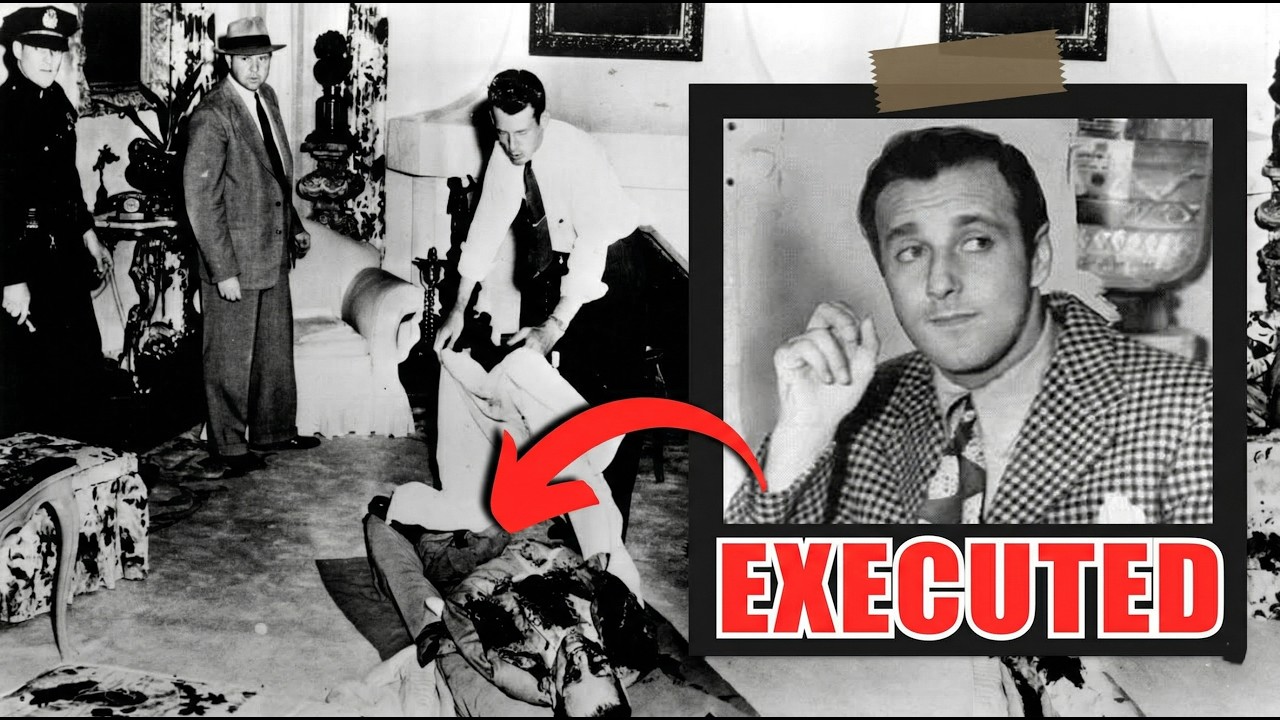
On the night of June 20, 1947, Benjamin "Bugsy" Siegel sat on a chintz-covered sofa in the living room of his girlfriend's mansion at 810 North Linden Drive in Beverly Hills, California. It was 10:45 p.m. He was reading the Los Angeles Times. His associate Alan Smiley sat beside him.
The curtains were open. The lights were on. Through the window, someone was watching.
At 10:46, nine rounds from a .30 caliber M1 military carbine tore through the glass. The first bullet hit the bridge of Siegel's nose. The second punched through his right cheek and exited the back of his neck. Two more slammed through the sofa and perforated both lungs.
The overpressure from the head shot blew his left eyeball from its socket. It was found 15 feet away on the dining room floor, eyelid still attached. Smiley dove to the ground. One round passed through his jacket, but he was not hit.
The entire attack took less than 10 seconds. The shooter had rested the carbine on a trellis just outside the window, no more than 14 feet from the couch. Then he vanished into the rose bushes. He was never found. The gun was never recovered. To this day, the Beverly Hills Police Department still lists the case as open.
This was not just another gangland killing. This was Benjamin Siegel, co-founder of the Bugs and Meyer mob and a man who had personally carried out murders for Murder Incorporated. He dined with Clark Gable, partied with Cary Grant, and had Hollywood studios on speed dial. He was among the most glamorous gangsters in American history. And he had just built a casino in the Nevada desert that would change the world.
What makes this story unlike any other mob hit is what happened 20 minutes later. Two hundred eighty miles away in Las Vegas, three men walked into the Flamingo Hotel and announced they were taking over. Twenty minutes. They did not just know the killing was coming. They were counting down the clock.
Benjamin Siegelbaum was born on February 28, 1906, in Williamsburg, Brooklyn, into a family of Jewish immigrants in one of the toughest neighborhoods in New York. His father worked in a garment factory. They had nothing.
By the time Ben was a teenager, he had dropped out of school and joined a street gang on Lafayette Street on the Lower East Side. He started with petty theft, shaking down pushcart vendors for a dollar at a time. He was fast, fearless, and completely unhinged when provoked.
That is where the nickname came from. Bugsy. As in crazy. As in this kid will shoot you over a nickel. He hated that name his entire life, but he earned it every single day.
Then he met the person who would shape the rest of his life: Meyer Lansky. Small, quiet, brilliant. Where Siegel was muscle and fury, Lansky was calculation and patience. They were teenagers when they found each other, and they recognized something immediately. Siegel had the nerve. Lansky had the brains.
Together, they were unstoppable. They formed the Bugs and Meyer mob in the early 1920s, a crew of Jewish gangsters who ran bootlegging, hijacking, and contract killings across New York and New Jersey. They were doing hits for the biggest names in organized crime. When Lucky Luciano needed someone eliminated, he called Lansky. Lansky called Siegel. And the problem disappeared.
By the early 1930s, Siegel and Lansky were not just muscle anymore. They were founding members of the National Crime Syndicate, the coalition of Italian and Jewish gangsters who divided up the rackets in America. Siegel sat at the same table as Luciano, Frank Costello, and Albert Anastasia. He was a full partner in the most powerful criminal organization in the Western Hemisphere.
By his late 20s, he had a rap sheet that included armed robbery, multiple murders, and bootlegging on a massive scale. Yet he kept beating the charges. Witnesses disappeared. Evidence vanished. Siegel walked out of courtrooms like he was leaving a restaurant.
In the mid-1930s, with Murder Incorporated drawing heat from New York prosecutors, Lansky sent Siegel west to Los Angeles. The assignment was simple: take control of the West Coast rackets, set up gambling operations, and manage the wire services that transmitted horse racing results to bookmakers across the country. Those wire services were worth millions. Whoever controlled the information controlled the bets.
Siegel arrived in Hollywood and transformed himself. He bought tailored suits. He got a suntan. He became friends with actor George Raft, a fellow Brooklyn kid who had made it in the movies. Through Raft, Siegel gained access to everyone: studio executives, producers, movie stars. He went to premieres and dinner parties. He dated starlets. He was handsome, magnetic, and absolutely lethal.
The Hollywood press loved him. They had no idea what he actually did for a living, or perhaps they did and did not care. Within a few years, Siegel had the West Coast wire service locked down. He was running gambling operations across Southern California. He had connections to the Los Angeles crime boss Jack Dragna. And he was making enormous amounts of money.
But for Siegel, money was not enough. He wanted something bigger. He wanted to build something. And that is when the desert called.
In 1945, a Hollywood reporter and publisher named William Wilkerson had an idea: build a luxury hotel and casino in Las Vegas, Nevada, where gambling was legal. He called it the Flamingo. He started construction, ran out of money, and that is when Siegel stepped in. First as a partner, then as the boss. Wilkerson was eventually squeezed out entirely. Some accounts say he was threatened with death if he did not sell his stake.
Siegel took over the entire project and brought in mob money from the syndicate. Lansky, Costello, Luciano, and Joe Adonis all invested. The original budget was 1.2 million dollars. That is where the trouble started.
Construction materials were scarce in post-war America. Labor costs were skyrocketing. And Siegel's girlfriend, Virginia Hill, was appointed as a project overseer.
Virginia Hill was born on August 26, 1916, in Lipscomb, Alabama. She was no ordinary girlfriend. She had been a Chicago Outfit courier since the mid-1930s, carrying messages and money between crime families. The FBI called her a central clearinghouse for organized crime intelligence. She was smart, ruthless, and she understood the business better than most of the men in it.
But putting her in charge of construction oversight was a disaster. Contractors realized they were dealing with people who did not know building codes from bar tabs. They double billed for materials. They ordered supplies, sold them on the black market, then ordered them again. Siegel did not notice, or did not care.
By October of 1946, the Flamingo's costs had blown past $4 million. By the time it was done, the total would exceed $6 million. In today's money, that is over $73 million. The mob was furious. They had poured millions into this desert pipe dream, and the bills kept climbing.
Worse, they suspected Siegel and Hill were skimming. The rumor was that Hill had been wiring money to Swiss bank accounts. The bosses believed approximately $1 million of the overrun had been stolen. Whether that was true or not almost did not matter. In the mob, suspicion is enough.
On December 20, 1946, at the Hotel Nacional in Havana, Cuba, Lucky Luciano called a meeting. The most powerful crime figures in America gathered in one place: Frank Costello, Albert Anastasia, Joe Bonanno, Tony Accardo from Chicago, Vito Genovese, Santo Trafficante Jr. Even Frank Sinatra showed up.
The official agenda covered narcotics, territories, and the future of the syndicate. But the real headline was what Lansky called the Siegel situation. The bosses wanted Siegel dead. They had voted on it. The contract was assigned to Chicago outfit consigliere Charles "Trigger Happy" Fischetti, who would delegate the job.
At the last moment, Meyer Lansky, the man who had been Siegel's friend since they were kids on the Lower East Side, stood up and made an argument. Wait. The Flamingo is scheduled to open December 26th. Let us see how it does. If it makes money, the investment is saved. If it does not, you can do what you want.

The bosses agreed. Siegel had a reprieve, but it came with a clock.
The Flamingo opened on December 26, 1946. Contrary to what later movies showed, the opening was not quite a disaster. The three-night event drew large crowds. Columnist Walter Winchell reported 28,000 people attended over those first three nights. Jimmy Durante headlined the floor show. George Raft was there. Virginia Hill appeared all three nights, changing her hair color each evening. Siegel greeted guests in a black tuxedo with a pink carnation.
But the numbers killed him. Without hotel rooms ready, the big winners walked out and gambled elsewhere. The casino lost $300,000 in its first week. Nick the Greek Dandolos alone won nearly half a million in four nights in January. Croupiers were running scams at the tables. The losses mounted.
Siegel shut the casino down on February 6, 1947, and did not reopen until March 1st, when the hotel rooms were finally completed. By May of 1947, the Flamingo actually turned a profit of $250,000. Lansky pointed to the number as proof that Siegel's vision was correct, but it was too late.
The bosses had lost patience. Six million dollars invested, months of losses, and the persistent suspicion that Siegel and Hill had been stealing from them. In the world of the National Crime Syndicate, there is no appeals court. There is no second chance. Once the commission decides, the clock starts ticking.
Four days before the shooting, Virginia Hill boarded an unscheduled flight to Paris. She and Siegel had been fighting constantly. Some people believe the trip was just another one of their dramatic breakups. Others believe she was warned to get out of town and not be there when it happened. Whatever the reason, she was not in that house on June 20th. That was no coincidence.
What happened on the night of the murder was not just a hit. It was a military operation executed across 280 miles.
At 8:30 in the evening, during the floor show at the Flamingo in Las Vegas, eight men sitting at a table in the showroom suddenly stood up. They did not applaud. They did not order drinks. They spread out to eight strategic positions. Two went to the front door. Two went to the hotel registration desk. Two went to the security desk. Two went to the cashier's cage. They were securing the casino two hours before the trigger was even pulled.
At the same time in Beverly Hills, Siegel was having dinner with Alan Smiley, Virginia Hill's brother Chick, and Chick's girlfriend at a restaurant. They returned to the house at 810 North Linden Drive around 10:30. Siegel sat down on the sofa and picked up the newspaper. Alan Smiley sat beside him.
At 10:46, nine rounds came through the window. Four hit Siegel. He died instantly. His blood soaked into the chintz fabric of a sofa in a seven-bedroom mansion that his girlfriend rented for $300 a month.
Within minutes, FBI agent Curtis Lynum received a phone call from a confidential informant calling from a payphone outside the Flamingo in Las Vegas. The informant told him, "Ben Siegel has been shot and killed in Beverly Hills." Historian Larry Gragg, who has spent years researching this case, is certain that informant was Moe Sedway, Siegel's own former partner.
Minutes after that call, Moe Sedway walked into the Flamingo alongside Gus Greenbaum and Morris Rosen. They announced to the staff that Siegel was dead and that they were now in charge. The takeover was complete before the police in Beverly Hills had even finished processing the crime scene.
So who pulled the trigger? That question has haunted investigators and historians for nearly 80 years. The suspects read like a mob all-star roster.
Frankie Carbo, a Lucchese family soldier and boxing promoter, was the leading suspect for decades. Former Philadelphia boss Ralph Natali later claimed that Carbo did it on orders from Meyer Lansky.

In 1987, Eddie Canizarro, a former associate of Los Angeles boss Jack Dragna, made a deathbed confession, claiming he was the shooter, acting on a contract from Lansky. But the Beverly Hills police required substantiation, and Canizarro's confession could not be corroborated.
Another theory points to Tony Brancato and Tony Trombino, the so-called two Tonys, hired by Joe Adonis. There is even a theory that the shooter was a man named Matthew "Moose" Penza, connected to Moe Sedway's wife Bee.
The accounts vary. What is documented is that the Beverly Hills Police Department still considers this an open case, and the files remain sealed.
What is known for certain is this: the mob wanted Siegel dead. The hit was coordinated across hundreds of miles. Someone made sure Virginia Hill was not in the house. And within 20 minutes, new management was running the Flamingo.
After the murder, photographs of Siegel's bullet-riddled body on the sofa appeared in newspapers across the country. It was the most graphic crime scene photo most Americans had ever seen, and it put Las Vegas on the front page of every paper in the nation. The irony is devastating. In death, Bugsy Siegel did more to advertise Las Vegas than he ever could have alive.
Under Gus Greenbaum's management, the Flamingo became wildly profitable. It became the model for every luxury casino hotel that followed: the Sands, the Sahara, the Desert Inn. All of them followed the Flamingo blueprint. Siegel's vision of a gambling paradise in the desert turned out to be exactly right. He just did not live to see it.
The endings for the people around him were brutal. Gus Greenbaum, the man who took over the Flamingo, was found murdered alongside his wife on December 3, 1958. Both had their throats cut.
Virginia Hill fled to Europe after being called to testify before the Kefauver Committee in 1951. She denied knowing anything about organized crime. In 1954, she was indicted for tax evasion. She never returned to America. On March 24, 1966, Virginia Hill was found dead near Salzburg, Austria. She was 49 years old. An overdose of sleeping pills was officially ruled a suicide. Whether it truly was remains another open question.
Moe Sedway, the man who walked into the Flamingo that night and took control, died of natural causes in 1952. He was one of the few people connected to this story who died in his own bed.
Meyer Lansky never spoke publicly about Siegel's murder, not once. The man who had been Siegel's friend since they were teenagers on the Lower East Side, the man who had pleaded for his life at the Havana conference, the man who many believe ultimately gave the final approval for the hit, carried whatever he knew to his grave. He died on January 15, 1983, in Miami Beach. His net worth at the time of death was officially listed at about $300,000. That was, of course, a fiction. Federal authorities believed his hidden fortune ran into the hundreds of millions.
The Flamingo still stands on the Las Vegas Strip today, though nothing of the original structure remains. It has been rebuilt, expanded, and renovated beyond recognition. But walk through that lobby, and you are walking on ground that was paid for with mob money, built on broken promises, and baptized in blood.
Benjamin Siegel spent his entire life chasing a version of greatness that the legitimate world would never give him. He wanted to be a mogul, a builder, a man whose name meant something beyond fear. And he was right about Las Vegas. He saw what nobody else could see: a city of lights in the middle of nothing, a place where the rules did not apply.
He just forgot the most important rule of all. In the mob, you do not get to keep what you build. You do not get to overspend and explain later. You do not get to skim from men who kill for a living.
Bugsy Siegel saw the future. He was right about everything except the one thing that mattered most. The men who funded his dream were not investors. They were executioners who had not decided on the date yet.