On August 25, 1932, in a rented bedroom at the Drake Hotel in Chicago, Edith Rockefeller McCormick died of cancer at the age of 60. The room was comfortable but impersonal, a commercial suite on Michigan Avenue with nothing on the walls she had chosen and nothing on the nightstand that identified her.
She had once owned a 44-room palazzo above Lake Michigan, with terrace gardens, a private beach, and a hangar for her husband's airplane. She did not die there. She died in a room that would be cleaned and occupied by a stranger within the week.
Around her bed, for the first time in 11 years, sat the people who had once made up her household: her former husband and her three surviving children. They had not gathered by choice. They had gathered because death does not accept delegation.
Edith Rockefeller McCormick was the daughter of the wealthiest man in the country, the wife of a Chicago industrial heir, and a patron of opera, science, and cities. The world had watched her philanthropy, her splendor, her scandal, and her strange late years. What the world had not seen was what happened to her children.
Five children were born inside a fortune so vast it operated like a system. Two died before their fourth birthdays. Three survived and discovered that the wealth their family had built was not protection. It was machinery. And the machinery did not stop when their mother's breathing did.
To understand how that family ended in a hotel bedroom with nothing left to repair, you have to go back to the money, back to the iron and the oil, and back to the two names that were joined on a November afternoon in 1895.
By the early 20th century, the name Rockefeller had become shorthand for a particular kind of American power. John D. Rockefeller Sr., born in Richford, New York, in 1839, had built Standard Oil into the most formidable petroleum empire the world had yet seen.
He became, by most reckonings, the wealthiest private citizen in the United States. PBS would later describe him simply as the head of the most powerful family in America. His name appeared in newspapers as both a marvel and an accusation.
He was the founder of modern philanthropy and the symbol of monopolist excess. He donated with one hand and crushed competitors with the other. The world that formed around him was built not on sentiment but on control.
What mattered most for this story was not the fortune itself. It was the method behind it. Rockefeller did not merely accumulate. He organized. He built systems of oversight, trusts, holding companies, family committees, and hierarchies of approval designed to outlast any individual decision or moment of weakness.
His children were raised on strict allowances. His household ran on moral seriousness, Baptist propriety, and a species of thrift that must have seemed bizarre inside one of the wealthiest homes in the country. Money in the Rockefeller code was not there to be enjoyed. It was there to be managed, and management meant structure.
That instinct, and the deep conviction that control could solve anything, became the most consequential thing John D. Rockefeller Sr. ever passed to his descendants. Not the oil, not the billions, but the belief that if you designed the structure well enough, it would hold even when the people inside it were falling apart.
On the other side of the marriage stood the McCormicks of Chicago. If Rockefeller represented eastern finance and petroleum, the McCormicks represented the industrial Midwest at its most physically formidable: machinery, agriculture, and the transformation of the American landscape from frontier into factory.
Cyrus Hall McCormick is credited with the development of the mechanical reaper, the invention that made large-scale grain harvesting possible and radically lowered the labor cost of feeding a growing nation. The fortune that followed consolidated into International Harvester, one of the largest manufacturing enterprises of the late 19th and early 20th centuries.
The McCormick name meant Chicago, production, iron, wheat, and the prairie converted into profit. It also meant something equally immovable. To be a McCormick was to be expected to serve the company. To carry the name was to carry the obligation.
Harold Fowler McCormick, born in Chicago on May 2, 1872, was the son of Cyrus and Nettie Fowler McCormick. He grew up inside that expectation from his first conscious breath, joined the family business young, and spent his adult life near the top of International Harvester.
He was not a drifter or a man who needed the Rockefeller connection to make his name. He was already the heir of a dynasty that mattered enormously. When he married Edith Rockefeller, the union was not her escape from one controlling system into something lighter. It was an intensification.
She moved from Rockefeller discipline to McCormick obligation. The household they built together would carry the emotional weight of both empires: the Eastern oil fortune's insistence on structure and the Midwestern industrial family's insistence on duty, without any of the lightness that ordinary domestic life might have provided as relief.
These were not merely successful families. They were system builders who had constructed enterprises that ran on discipline, efficiency, hierarchy, and long-range control, and who had in the process remade the physical and economic landscape of America.
Edith and Harold were not merely rich people in a vacuum. They were rich people living through the precise historical moment when American wealth was trying to convert itself from scandal into legitimacy, from robber baron excess into philanthropy, culture, and public respectability.
Their children would inherit not only the money but the pressure to justify it, to prove that the family name now meant something finer than the monopoly and the machine that had created it.
Their marriage on November 26, 1895, was treated by the press as something close to a coronation. Two of America's greatest fortunes were joined in a union that contemporaries viewed with the kind of awe reserved for the merging of royal houses.
There was no crown, no formal peerage, no hereditary title to bestow. But there was an American equivalent: the entwining of oil and industry, of New York finance and Chicago society, of philanthropic boards and cultural institutions, and the machinery of prestige that the Gilded Age had constructed.
What nobody said, because nobody in 1895 could have known, was that the two systems being merged were not complementary. They were compressive. Rockefeller control plus McCormick duty did not add up to a household. It added up to a regime.
Edith and Harold spent their first two years in Council Bluffs, Iowa, where Harold managed a branch of the business. That period reads in retrospect as the last time this marriage existed at a human scale, a young couple in a Midwestern city, away from the families, the boards, the trustees, and the expectations.
Then they returned to Chicago, then to Lake Shore Drive, to the city residence at 1000 Lake Shore Drive, designed by the architect Solon S. Beman. And then, between 1908 and 1912, they built Villa Turicum.
Villa Turicum is essential to this story because it literalized the family's deepest problem: the belief that if you build something magnificent enough, what happens inside it will be magnificent too.
The estate sat on a 300-acre plateau above Lake Michigan in Lake Forest, Illinois. The architect was Charles Platt, chosen after Edith and Harold reportedly considered and rejected Frank Lloyd Wright in favor of something grander and more traditionally imposing.
Platt designed an Italian palazzo of 44 rooms set at the end of a long formal mall lined with American elms. The grounds descended toward the lake through layered terraces, fountains, and gardens modeled in part after the Renaissance water gardens of Villa d'Este.
There was a tea house set into the woodland, a bath house near the shore, a private beach, and later a hangar for Harold's airplane. Water courses and garden paths wound through hundreds of acres of maintained landscape.
The cost was staggering even by the standards of American plutocratic display: roughly $2 million for the land alone and another $5 million for construction. The Lake Forest-Lake Bluff History Museum would later call it perhaps the best known of Lake Forest country estates.
The house was designed to last centuries, to project solidity, continuity, and rootedness. It would be demolished in 1956 after years of dormancy and vandalism, because nobody was left who could or would inhabit what it represented.
Families who feel secure do not always need to construct meaning with such intensity. Families who are certain of their own permanence do not always build 44-room palaces with formal water gardens and wooded terraces descending toward a private beach.
The architecture of Villa Turicum was not merely the expression of wealth. It was the attempt to manufacture completeness, to build in stone and elm and imported Italian garden design the emotional stability that the household inside those walls could not generate on its own.
The house was already compensating for something that had not yet fully broken, but had never been quite whole.
Edith alone was associated in the press with a personal fortune once estimated at roughly $40 million. Later inventories taken after her death would reveal how much of that supposed wealth had become entangled in real estate, furnishings, trust structures, and debt rather than existing as simple liquid freedom.
By 1932, newspapers were describing a woman whose estate had been badly damaged by borrowing and by the post-1929 collapse. The distinction between the appearance of limitless money and the reality of controlled, diminishing, legally contested money would define her children's lives.
Edith Rockefeller McCormick was born in Cleveland on August 31, 1872, the fourth daughter of John D. Rockefeller and Laura Spelman Rockefeller. She was raised in one of the richest households in America and also one of the most tightly governed.
Later accounts of her life repeatedly stressed the gendered imbalance inside that childhood home. The youngest child, John D. Rockefeller Jr., born in 1874, was the only son, and he received the weight of expectation and the privilege of centrality that his four older sisters could observe clearly and resent quietly.
The children of Edith's own marriage would grow up inside a family where wealth was not neutral. It had a structure, and that structure had favorites. Edith understood from an early age what it meant to be a daughter inside a system built for a son.
She would spend her adult life resisting the implications of that understanding, and the resistance would cost her nearly everything she had.
Publicly, Edith became the queen of Chicago society: patron of the opera, benefactor of the Art Institute, supporter of juvenile probation, donor of the land that would become Brookfield Zoo. She was formidable, cultured, genuinely ambitious, and unwilling to stay within the smallest available definition of a wealthy daughter or a corporate wife.
Privately, she was in repeated conflict with her father, who despised her extravagance, disapproved of her increasingly unconventional philanthropies, and resented the way she spent. She was documented as suffering from depression.
She was drawn, especially after 1913, toward Zurich, toward Jung, toward psychoanalysis, and eventually toward the practice of Jungian analysis herself. She developed interests in reincarnation and past-life connection that placed her ever further from the world her father and husband inhabited.
In 1913, Edith went to Zurich for treatment and study, and she stayed for years. She did not vanish from her children's lives entirely. There were visits, letters, the maintenance of connection at a distance. But presence and connection are not the same thing.
What the children experienced was the sustained absence of a mother who was by all accounts brilliant but elsewhere. A mother can be intellectually pioneering and emotionally absent at the same time.
Edith was not merely escaping. She was searching. But her children could not be expected to understand the difference. And the household they were left inside, Harold's household, was not a warm one. It was an administered one.
The nurseries were staffed. The routines were maintained. The appearance of family life continued. What was missing was the particular chaos and warmth that a present mother, even an imperfect one, provides.
Harold, meanwhile, remained in Chicago, anchored to business, to International Harvester, to the outward continuity of the family name. He was Edith's opposite in almost every way that mattered for the survival of a marriage.
Where she was restless, he was steady. Where she sought meaning in the esoteric, he sought it in the boardroom, the country club, the machinery of business hierarchy. He was handsome, publicly charming, active in aviation and the arts, a man of genuine social ease.
He was also beneath the polish profoundly conventional. He could underwrite glamour. He could not absorb disorder. When the marriage fractured, Harold was the parent who secured the institutional advantage in custody arrangements, guardianship appointments, and the backing of trustees and committees.
Not because he was vindictive, but because he was orderly, and the system was built to reward order. He embodied the truth that patriarchal power can appear polished, reasonable, and even generous while remaining devastating in its effects. He did not need to raise his voice. He had lawyers.
Their first child, John Rockefeller McCormick, was born in 1897. He would be dead before his fourth birthday of scarlet fever at Kykuit, the Rockefeller estate at Pocantico Hills, one of the most protected environments in America.
John's death in 1901 was the first proof that this family's wealth could not purchase immunity from the ordinary brutalities of human life: a three-year-old boy dead in his grandfather's mansion despite every advantage the most powerful family in the country could provide.
The McCormicks responded by founding the John McCormick Institute for Infectious Diseases. That response was moving and sincere. It was also the family code made visible. Grief translated into institution. Loss converted into memorial fund. Sorrow processed not as emotion but as organization.
When something broke in this family, the instinct was not to sit with the pain. It was to build around it. And the pattern would repeat with every subsequent crisis, growing more rigid and more inadequate each time.
The second child to die was Adita, born in 1903 and dead in infancy by 1904. Less documented than John, but structurally significant, because her death meant that by the time the youngest surviving child, Matilda, was born in 1905, the household was already shaped by two absences.
The family had buried two children before the survivors were old enough to form stable memories. The atmosphere inside those magnificent rooms was therefore shadowed long before the divorce, long before the scandal, long before the trust wars.
The surviving children grew up inside beauty and grief simultaneously, and neither was ever fully acknowledged.
Harold Fowler McCormick Jr., known as Fowler, was born on November 15, 1898, and he carried the heaviest burden of all: surviving male heir in a dynasty that understood inheritance as continuation.
He would later become president of International Harvester from 1941 to 1946 and chairman from 1946 to 1951. He married Anne Urquhart Potter Stillman, known as Fifi, a woman significantly older, already wealthy, already socially famous from a spectacular previous marriage to James A. Stillman.
Fowler's public career looked like success. His private life followed a pattern that was not his alone. He was the child who could function in the public role the dynasty required, which made him useful to the family in a way that neither of his sisters could be. But usefulness to a dynasty is not the same thing as freedom.
In the later story, Fowler becomes not merely a son but an enforcer of family order, particularly in relation to Muriel. His trajectory reveals the particular burden of the child who is chosen to carry the name forward. He pays for that privilege with any possibility of private rebellion.
Muriel McCormick, born in 1903, was the quietest of the surviving children and in many ways the most haunted. Where Fowler could be placed inside the dynasty's public role and Matilda blazed through scandal, Muriel drifted into a life that the historical record captures not through headlines but through litigation.
She married Elisha Dyer Hubbard, connected to an old Rhode Island political family and considerably older than she was. Another version of the same pattern: another attachment to a pre-formed world rather than the building of an independent one.
After Hubbard's death in 1936, Muriel's existence became increasingly legible only through court documents. By the late 1940s, she and Fowler were in open conflict over custody involving her adopted children.
After Muriel's own death on March 18, 1959, a California appellate court was left to determine whether those adopted children counted as issue under the instruments governing a trust of roughly $10 million. The competing claims of charities and adopted children had to be adjudicated by strangers because the family could not settle them privately.
Even motherhood for Muriel became something the fortune could contest. She is perhaps the clearest illustration of what this family's machinery did to its least spectacular members. It did not destroy them through scandal. It processed them through administration until there was nothing left that had not been translated into legal language.
And then there was Matilda. Born on April 8, 1905, the youngest, the one whose story would explode most visibly into public scandal.
As a teenager, she fell in love with Max Oser, a Swiss riding instructor 28 years her senior. The family divided. Harold sought legal control over her future. The international press turned the romance into spectacle.
In April 1923, at 18 years old, Matilda married Oser in London, listed in the registry as a spinster of independent means, a phrase that was devastatingly precise. She had means. She did not have independence. She would never fully have it.
Matilda died in California on May 18, 1947. She was 42 years old.
A detail noted in a scholarly review of Andrea Friederici Ross's biography of Edith deserves its own moment of silence in this narrative. All three surviving children, Fowler, Muriel, and Matilda, married significantly older spouses.
That is not coincidence. It is not random social color. It is a pattern so precise it demands interpretation.
Children raised inside systems of extraordinary control, administered rather than loved, watched over by trustees and committees rather than held by parents who were fully present, do not always reach for a peer when they reach for a partner. They reach for authority. They reach for someone already formed, already settled, already in possession of the certainty that was never available inside their own household.
Every surviving McCormick child did exactly that. And every one of them paid for it in marriages that replicated the imbalance they had grown up inside: one partner with more power, more formation, more of the world already settled, and the other still searching for something that no marriage, however lavish, can provide when the original household withheld it.
The remaining figures who shaped this family's trajectory must be marked here because they recur. Edwin D. Krenn, architect and intimate associate of Edith, who would appear in her will as the beneficiary of five-twelfths of her personal estate, a larger share than any individual child received. His name in that document was not a curiosity. It was a detonation.
John D. Rockefeller Jr., Edith's younger brother, appears in the later story not as a warm familial presence but as the chairman of the committee that supervised the children's trust income, the family elder who was also inescapably the mechanism.
And Max Oser, the Swiss riding instructor whose marriage to Matilda became the symbol of how little control even the most powerful families possess over desire once the system begins cracking.
The early years of the household, before the fractures became visible, must feel real if the later devastation is to carry any weight. And they were real.
The family unit in its first decade was almost indecently photogenic. Edith and Harold in Council Bluffs, then Chicago, then Lake Shore Drive, then Villa Turicum rising on the bluff, the gardens taking shape, Harold's airplane on the beach, the opera patronage flowering, the children arriving in their nurseries.
It looked to the public like the most successful marriage in America: two fortunes, five children, a palazzo above the lake, a city that treated them as its first family. And there were genuinely good years inside that image.
Edith's civic energy was prodigious. Harold's public spirit was genuine. The children had nurses, tutors, gardens, and a private beach that stretched toward the lake. The world they inhabited was beautiful. Whether it was warm is another question.
Edith funded programs for juvenile justice in Chicago, supported the Art Institute, helped establish Chicago's first opera company, and later gave the land that would become Brookfield Zoo. Harold was active in aviation, in cultural sponsorship, in the social machinery of a city that rewarded generosity with prestige.
Together, they represented something the early 20th century wanted to believe about American wealth: that it could be beautiful, that it could be useful, that the children of tycoons and industrialists could become patrons and citizens rather than merely heirs.
That public image matters because it makes the private story so much more unsettling. The city's gratitude and the household's instability existed simultaneously, and neither could see the other clearly.
The Lake Forest-Lake Bluff History Museum preserves photographs from this period that function as the story's visual anchors. Harold and Edith with their sons Jack and Fowler around 1900. Matilda watching for her father's airplane from the beach in 1913. A child inside luxury and spectacle, the father overhead, the great house behind her.
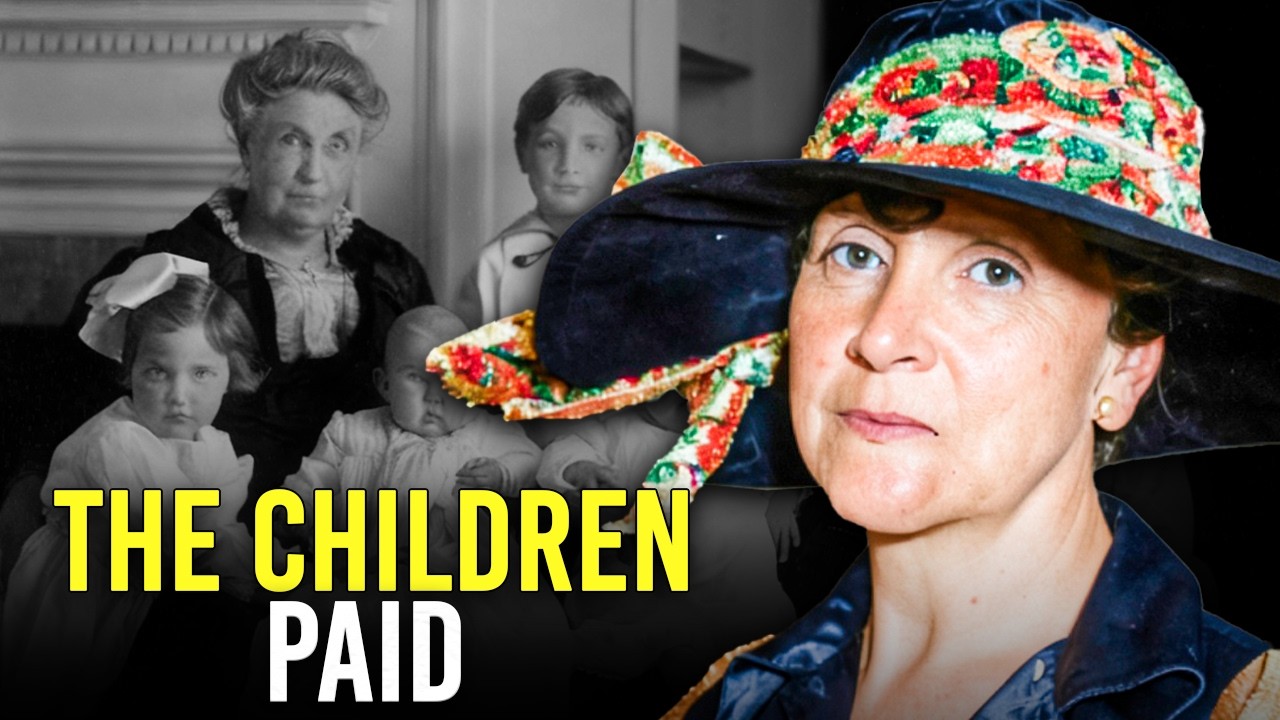
And what the museum considers the last family portrait taken together, around 1918: Edith and Muriel seated, Matilda, Fowler, and Harold standing. Five people, one pose, the last image of the household intact.
Anyone looking at that photograph now, knowing what followed, can see a family holding a pose it was about to abandon forever. The stillness in that image is not peace. It is the last moment before movement.
The movement, when it came, would scatter every person in that frame across different cities, different countries, different decades of managed wreckage.
The house on the bluff was magnificent. The gardens were immaculate. The civic contributions were generous and real. But the household inside those walls had been wrong for years, shadowed by two infant deaths that were mourned in public and managed in private.
By the early 1920s, later accounts would describe the pattern bluntly: Edith in Switzerland, Harold in downtown Chicago, and the children alternating between parents whose lives had already separated in everything but legal form.
The household existed in fragments long before the divorce made the fragmentation official. And at the center of it all was a family code that answered every crisis not with intimacy but with instruments: trusts, committees, separate residences, settlements drawn up by lawyers in language the children could not yet read but would spend their adult lives deciphering.
The children were not neglected in any visible sense. They were administered: fed, clothed, supervised, educated, accounted for, and administered. An administration, however well-funded and however carefully designed, is not love. It is the thing that replaces love when love has become too dangerous or too complicated to attempt.
Within three years of that last portrait, Edith would file for divorce in a proceeding so rapid that contemporaries remarked upon its efficiency. Within five, Matilda would be married to her Swiss riding instructor in a London registry office while the family's lawyers scrambled to manage a scandal they could not prevent.
Within a decade, the fortune itself would be diminished by debt and the crash. The trust structures would begin speaking louder than any surviving family member, and the children would discover that what they had truly inherited was not protection, not permanence, and certainly not freedom.
The house would stand for another generation. The family inside it would not.
For the children, the texture of those early years was different from the public spectacle. They lived inside the spectacle without possessing it. The nurseries at Villa Turicum were staffed by nurses and governesses. The routines were precise. The expectations were calibrated to the family's public position.
It was the kind of childhood that photographs well and that produces in the children who survive it a particular fluency in performance and a particular inability to describe what they actually felt.
Fowler, as the eldest surviving son after John's death, carried the name's weight most visibly. He was expected to be ready: ready for the business, ready for the board, ready to step into the role that the McCormick dynasty had prepared for him since before he was born.
Muriel, quieter by temperament, moved through the household with less friction and less attention. And Matilda, the youngest, born into a family already marked by loss, absorbed whatever atmosphere the house contained without the language to name it.
The happiness was not entirely false. Harold's enthusiasm for aviation was genuine, a wealthy man's passion certainly, but also a real delight in modernity, in the sensation of flight, in the future that machines were building.
Edith, too, during the early years, was not merely playing a role. Her support for civic institutions was driven by genuine intellectual ambition and a desire to make Chicago something more than an industrial capital. She wanted culture. She wanted justice.
The tragedy is not that these were hollow people performing happiness. The tragedy is that their forms of happiness were incompatible, and the household they had built together could sustain both only for a limited time.
Chicago in the early 1900s was a city in the process of inventing its own aristocracy, not through titles or lineage, but through the interplay of industrial wealth, cultural patronage, and real estate prestige. The McCormicks sat at the top of that pyramid.
Their circle included the Palmers, the Fields, the Swifts, the Armours, families whose names were attached to department stores and meatpacking empires and lakefront hotels. To be among them was to be visible. To be visible was to be watched. And to be watched was to understand, from childhood, that private feeling was secondary to public composure.
The McCormick children learned that lesson before they learned much else. They had no choice.
The seasonal rhythms of the household reinforced the lesson. Summers at Villa Turicum with the lake below and the gardens in full formality. Winters in the Chicago residence on Lake Shore Drive, with the social calendar dictating appearances, charity events, opera evenings, the machinery of upper-class obligation turning with the regularity of the Harvester Company's production schedules.
There were visits to Kykuit, to the Rockefeller estate where little John had died, visits freighted with the particular tension of a daughter's relationship with a disapproving father, conducted in a house that held the memory of a dead grandchild in its walls.
And there were the family occasions that required all the principals to appear as a unit: portraits, public events, moments when the fiction of a harmonious household had to be maintained with the discipline of a stage performance.
The children moved through all of this. They attended, they behaved, they posed, and underneath the posing, they absorbed a truth that no one was stating aloud. The family looked complete, but it did not feel complete. And the difference between looking and feeling was the central fact of their childhood.
One detail from the period stands as a kind of emblem. In 1913, when Matilda was eight years old, the Lake Forest museum preserves an image of her watching from the beach for her father's airplane.
It is a photograph of a child gazing upward, waiting for a father who is literally above her, suspended in the sky, modern, exciting, unreachable. The great house stands behind her. The lake stretches before her. She is surrounded by every material advantage the early 20th century could provide. And she is looking up, waiting.
That image could stand for the entire childhood of all three surviving McCormick children: surrounded by magnificence, waiting for something that was always just out of reach.
The first signs of genuine trouble arrived not as scandal but as distance. Edith's depression, documented in later accounts, was not a single episode but a recurring condition that deepened over years.
What the public saw was a brilliant woman expanding her interests, traveling, studying, engaging with intellectual movements that most of her social peers found bewildering. What was happening beneath the public image was a woman in genuine psychological distress, searching for systems of meaning that could contain what her marriage and her family's expectations could not.
By 1913, the search had taken physical form. Edith left for Zurich. She entered the orbit of Jung, at that time one of the most controversial and intellectually ambitious figures in European psychology. She did not simply visit. She stayed. She studied. She underwent analysis. She trained as an analyst herself.
That departure must be understood in its full complexity because it was not a simple abandonment and it was not a simple act of liberation. Edith was genuinely unwell. She was genuinely searching. And she was genuinely absent from her children for extended periods during years that mattered enormously to their development.
The household she left behind was Harold's household: ordered, conventional, staffed, maintained. The children grew up inside it with a father who was present in body and committed to routine, but who could not replace what a mother's presence might have provided.
The specific emotional atmosphere of a home run by a business executive who keeps the machinery of domestic life turning smoothly without the warmth or the chaos of the absent parent is a particular kind of childhood. It is not abuse. It is not neglect. It is administration. And the children knew the difference, even if they could not yet articulate it.
Meanwhile, the financial tensions that would later destroy the family's stability were already forming beneath the surface of apparently limitless wealth. Edith's relationship with money was profoundly different from her father's, and that difference was not merely a matter of personal temperament. It was a generational war conducted through expenditure.
John D. Rockefeller Sr. believed in thrift, control, and the careful stewardship of every dollar. He had built the greatest fortune in America on the principle that money was a moral responsibility, not a pleasure.
Edith believed in spending: on art, on causes, on real estate, on Jung, on the intellectual and cultural life she wanted to live rather than the managed, thrifty existence her father had designed for his children.
The rift between them widened with every expenditure. Rockefeller Sr. disapproved of his daughter's extravagance. He disliked her esoteric interests. He resented the way she spent money that he considered, even after giving it to her through trust, to be in some fundamental sense still his.
Edith, for her part, experienced her father's disapproval as a continuation of the gendered hierarchy she had grown up inside. The son received trust and autonomy. The daughters received money with conditions.
By the time she returned from Europe in 1921, Edith was burdened with more than $800,000 of debt and was borrowing against dwindling trust income. That figure deserves emphasis. $800,000 in 1921 was an enormous sum.
The fact that a Rockefeller daughter could accumulate such debt while still nominally possessing a vast fortune illustrates the distinction that would define her children's inheritance: the difference between wealth as a number on paper and wealth as actual freedom.
Edith's money was real. It was also controlled by trusts, by committees, by her father's legal architecture, by the terms of instruments she had not designed and could not easily modify. She could spend. She could borrow. She could not simply access.
That gap between theoretical fortune and practical cash would widen until it consumed her, and after her death, it would consume her children's relationship with one another.
The marriage, by this point, was a marriage in name only. Harold remained in Chicago. Edith remained in Zurich or in her own Chicago orbit upon return, surrounded by a circle of associates and interests that bore little resemblance to the world of International Harvester, board meetings, and Lake Forest social calendars.
The household that had once occupied Villa Turicum as a single unit now existed as fragments: separate residences, separate lives, separate loyalties, held together only by the legal fiction of a marriage that had lost its emotional substance years earlier.
The children moved between these fragments. They knew their mother and their father as separate worlds, and the passage between those worlds was managed not by family feeling but by arrangement. Visits were scheduled. Residences were assigned. Boundaries were maintained.
The family had become, in effect, a custody agreement that had not yet been formalized, and the children were its subjects before they were its witnesses.
And then the formal break came on December 28, 1921. Edith obtained a divorce from Harold in Chicago. Contemporary reports describe the proceeding as remarkably rapid, the kind of efficient, almost clinical legal event that the wealthy arrange when they want the public record to be as brief as the private agony has been long.
The decree included no provision for alimony, and the settlement architecture was designed to end open warfare while preserving whatever discretion could still be preserved. But discretion did not mean peace.
Edith's PBS profile indicates that Harold had threatened to sue for adultery and that the settlement terms deepened her already considerable debt.
What the public saw was a brief legal proceeding on a December afternoon. What was actually happening was the final dismantling of a household that had once represented the most powerful marriage in America, conducted not with grief or ceremony but with the brisk efficiency of a business closing its accounts.
The marriage ended not with catharsis, not with confrontation, not with the kind of dramatic scene that might have given the participants, and especially the children, some recognizable emotional shape to hang their loss upon. It ended with paperwork.
And that was exactly right for this family. Because in a household that had always converted feeling into structure, the dissolution of the marriage was simply the final structural rearrangement, the last trust instrument, the last legal allocation, the last managed transition from one administrative arrangement to another.
The children did not experience their parents' divorce as a sudden rupture. They experienced it as the formalization of a separation that had been their reality for years.
What changed was not the distance between their parents. What changed was that the distance now had legal language attached to it, and the legal language carried consequences that would reach forward through the rest of their lives.
But the divorce was not the only fracture of those years, and it was not even the most publicly devastating one. Running parallel to the disintegration of the marriage, and in many ways accelerating it, was the crisis of Matilda.
Matilda McCormick was 16 years old in 1921, and she was in love with Max Oser. Oser was a Swiss riding instructor, a man of no particular fortune and no particular social standing beyond what his competence with horses and his easy continental manner could provide. He was 44 years old. She was a teenager.
The gap between Matilda and Oser was not merely one of age. It was a gap of world, of experience, of power, of everything that the McCormick-Rockefeller name was supposed to protect its children from. And yet Matilda wanted him.
She wanted him with the fierce, unyielding certainty of a young woman who had spent her entire childhood watching other people's choices being managed and administered and controlled, and who had found in this one unsuitable attachment something that felt like it belonged to her.
She was the daughter of a mother who had spent years in Zurich pursuing her own form of rebellion against patriarchal management. She was the sister of a brother being groomed for corporate leadership and a sister who had already begun her quiet drift into managed adulthood.
Matilda had watched the family's code in operation for her entire conscious life: structure over feeling, arrangement over desire, committee over confession. And her response to that code was the most direct possible rejection of it. She chose a man the family could not absorb.
Not a fellow heir, not a suitable young American with the right schools and the right family connections and the right willingness to be folded into the dynasty's apparatus. She chose a riding instructor from Switzerland, 28 years older. It was not random. It was the logical product of a household that had offered her everything except the right to want something for herself.
The family's response was instructive because it revealed more about the family than it did about Matilda. It was not an outpouring of parental concern or an honest conversation about the risks of the relationship. It was a legal maneuver.
Reports from early 1922 indicate that Harold sought appointment of a guardian for Matilda in a way that Edith believed was designed to secure consent for a marriage or potentially to block the marriage under Swiss legal provisions. The mechanism was guardianship. The language was custody. The reality was control.
The youngest surviving daughter of one of America's most powerful households had become, in effect, a problem to be allocated by legal authority. Not a child to be listened to, not a young woman whose desires, however alarming, might be worth understanding. A problem to be solved by the same tools the family had always reached for: lawyers, courts, appointments, instruments.
The family's first major fracture was therefore not simply husband versus wife. It was parents versus child, and each parent was using structure differently. Harold to maintain control, Edith to resist it, with Matilda caught between them. Her romantic life turned into a jurisdictional question.
Matilda's choice was the child's version of her mother's lifelong resistance to patriarchal management. Edith had spent years fighting the family's control over her life, her money, her choices. Matilda, too young to fight through lawyers and trusts, fought through the only weapon available to her. She chose someone the family could not absorb.
The press naturally was ecstatic. An American heiress, a Rockefeller granddaughter, and her Swiss riding master. The story had everything the newspapers of the early 1920s demanded: wealth, youth, scandal, forbidden romance, the delicious spectacle of a great family unable to control its youngest daughter.
Coverage appeared across the United States and in European papers, and the tone was almost uniformly gleeful. Editors who had spent years printing flattering accounts of McCormick philanthropy now discovered that the family's dysfunction sold even better than its generosity.
The public that had admired the McCormicks for their grandeur now consumed the McCormicks for their failures. And the shift happened with the speed that only scandal can produce. One season, Edith and Harold were Chicago's first family. The next, they were a cautionary tale.
The children experienced that shift not as distant spectators but as its subjects. Fowler watched his youngest sister become an international scandal and understood, with the instinct of a son who had been groomed for corporate leadership, that his own composure would now be required to compensate for her rebellion.
Muriel watched the family name turn from asset to liability and retreated further into the quieter life that was becoming her pattern. And Matilda herself discovered something that every child of wealth eventually learns when they push against the boundaries of the system: wanting something outside the structure did not free you from the structure. It simply made the structure more visible, more punishing, and more determined to reassert itself.
Edith, newly divorced, her finances deteriorating, her relationship with her father strained past repair, continued living as if sheer will could outface humiliation. She announced plans to marry Edwin Krenn, the architect and intimate associate whose name would later appear so explosively in her will, then abandoned those plans without public explanation.
She drew press attention for increasingly esoteric public statements, including a claim of past-life connection to a child bride in the household of Tutankhamun. The temptation is to treat this material as evidence of eccentricity or decline, and the documentary should resist that temptation.
What was happening was something more complex and more painful than madness. Edith was constructing alternate systems of meaning at the very moment her marriage, her finances, and her authority as a mother were all collapsing simultaneously. She was reaching for a version of reality that could accommodate what she had lost.
Harold, meanwhile, remarried quickly and spectacularly, to Ganna Walska, a Polish opera singer whose own fame and temperament guaranteed that the private wreckage of the McCormick household would remain public entertainment for months and years to come.
Walska was glamorous, dramatic, and entirely unsuited to the role of corporate wife that Edith had occupied with such difficulty. Harold's choice of second wife was in its own way as revealing as Matilda's choice of Oser.
It suggested a man who had spent decades inside a marriage defined by duty and obligation and who now wanted something entirely different: something exciting, something beautiful, something that had nothing to do with committees and trusts and the carefully managed expectations of two industrial dynasties.
That the marriage to Walska would itself end in divorce only deepened the pattern. The McCormick men were no better at escaping the family's emotional architecture than the McCormick women. They simply escaped into different kinds of failure.
For the children, Harold's remarriage created yet another layer of displacement. They were already navigating between two separate parental worlds. Now they had to navigate a third: the world of their father's glamorous new wife, a world of opera and European society and public spectacle that had nothing to do with them and everything to do with Harold's determination to move forward.
Fowler, as the surviving son, absorbed a lesson that would define his adult life. Composure and continuity would be expected of him. He was the child who could still be placed in the dynasty's public role. He was the heir who could sit in a boardroom without scandal attached to his name.
That usefulness came at a cost: the cost of never being permitted his own form of rebellion, his own unsuitable attachment, his own departure from the script the family had written for him.
Muriel, less visible in the headlines, began the quieter pattern that would characterize her later years: a life shaped not by dramatic choices but by gradual absorption into managed structures, older attachments, and the slow accumulation of legal vulnerability that would eventually define her entirely.
And Matilda moved deeper into the scandal, deeper into the attachment the family could not accept, and closer to the London marriage that would settle nothing.
There is a particular cruelty in what followed, and it should be named plainly. The children did not step out of their parents' divorce into freedom. They stepped into administration. They moved from a household that was managed into a post-divorce landscape that was litigated.
Every significant decision about their lives, where they lived, how much money they received, who had authority over their choices, was now determined not by parental love or even parental preference, but by legal agreement, committee oversight, and the architecture of trust that their grandfather had designed decades earlier for purposes that had nothing to do with the emotional welfare of the grandchildren who now lived inside them.
The family's most enduring creation was not Villa Turicum. It was not the opera company or the zoo or the medical institute. It was the legal machinery that continued operating on its children long after any semblance of family life had ceased.
And the children could feel it. They could feel the difference between being cared for and being processed, between being loved and being allocated, between belonging to a family and belonging to a trust.
In April 1923, in a London registry office, Matilda McCormick married Max Oser. She was 18 years old. He was 46. The register recorded him as a soldier and her as a spinster of independent means.
Those two phrases, set beside each other on a government form, contained the entire story of what this marriage was and what it was not. Oser was not a soldier in any conventional military sense. The description was a courtesy, a social fiction, a way of giving a man with no particular social standing a title that would look respectable on a legal document beside the name McCormick.
And Matilda was not independent in any meaningful sense either. She had means, certainly, money that flowed through the Rockefeller trust structures and the McCormick settlement architecture. But independence was the one thing that money of that kind did not provide.
It came with oversight. It came with committees. It came with her uncle John D. Rockefeller Jr. and his careful eye on the family's collective interest. She could spend, but she could not escape the instruments that governed the spending.
She stood in that registry office thousands of miles from Chicago and Villa Turicum and the household that had produced her, and she was still, would always be, a McCormick. The name followed her across the Atlantic. The trust followed her. The consequences followed her.
She had not escaped. She had merely changed the location of her captivity. And the man beside her, 28 years her senior, could offer her affection and perhaps even love. But he could not offer her what she most needed: a life outside the reach of the machinery that had governed every significant decision of her childhood.
The family's reaction to the marriage was not surprise. They had seen it coming for more than a year and had attempted, through legal maneuver, guardianship petitions, and the combined weight of parental and institutional pressure, to prevent it. What they could not have anticipated was the permanence of its consequences.
Matilda's marriage to Oser was not a youthful episode that would burn out and be forgotten. It was the defining act of her life, the choice around which every subsequent event would organize itself.
Her children by Oser, Anita and Peter Max, would later appear in the trust litigation that followed Edith's death. Their names were written into legal documents as evidence of how far the family's original structure had been stretched by choices its architects never foresaw.
The teenage girl who had wanted only to love the wrong man had, in doing so, created a new branch of the dynasty that the old instruments would have to accommodate. And the accommodation would be neither smooth nor generous.
Even rebellion in this family eventually became subject to the machinery. Even love became a line item in a trust dispute.
The years between 1923 and 1932, the last decade of Edith's life, should be understood as a period of simultaneous fragmentation and display. The family was coming apart person by person, trust by trust, decision by decision. It was also still performing.
The McCormick name still appeared in newspapers. The Rockefeller connection still carried weight. The institutions Edith had helped create, the opera, the zoo, the civic programs, still functioned. But the household that had once given the name its domestic meaning no longer existed.
What remained was a set of individuals orbiting the same fortune at different distances, connected not by shared life but by shared legal instruments.
Edith, in particular, occupied a paradoxical position during these years. She was more publicly visible than ever, and she was more privately desperate than anyone outside her immediate circle could have known.
Her return to Chicago after the divorce had not brought the stability that a return home might suggest. It had brought a different kind of theater, grander in some ways, stranger in others, and increasingly disconnected from the social world that had once claimed her as its queen.
She established herself as a patron, a hostess, a figure of cultural authority in the Chicago of the 1920s, but the authority was increasingly eccentric and the patronage was increasingly funded by debt.
She backed unusual intellectual projects. She supported artists and thinkers whose work the Chicago establishment regarded with bewilderment. She made public statements about reincarnation and past-life connections that drew ridicule from the press and genuine alarm from her family.
In 1923, within days of Harold's remarriage to Walska, she drew headlines for claiming a past-life link to the household of Tutankhamun, a claim that, whatever its spiritual sincerity, could not have been more precisely timed to alarm a father whose entire philosophy of wealth rested on Baptist propriety and the careful management of public appearances.
The easy interpretation, that she was losing her grip on reality, is both reductive and unkind. What the evidence actually shows is a woman of genuine intellectual ambition who had exhausted the conventional frameworks available to her and was building new ones from the materials at hand.
Her marriage had failed. Her father disapproved of her. Her money was controlled by trusts she could not modify and overseen by committees she could not dismiss. Her children were growing up in a world she had helped create but could no longer govern.
The systems of meaning that had sustained her for decades, wealth, social position, family, the Rockefeller name, the role of patron and wife and mother, had all been revealed as insufficient. And so she turned to other systems: Jungian analysis, reincarnation, esoteric philosophy, mystical connection to ancient civilizations.
These were not the hobbies of a dilettante amusing herself between social engagements. They were the last resort of a woman who had run out of ordinary places to stand. The tragedy is not that Edith was strange. The tragedy is that the world she inhabited left her no conventional ground to stand on.
Her relationship with Edwin Krenn deepened during this period and became the subject of public speculation that the family found increasingly difficult to manage. Krenn was an architect, a business associate, and an intimate companion whose exact role in Edith's life resisted easy categorization.
He was not her husband. He was not, by any public account, her lover in any sense the press could confirm. But he was present. He was influential. And he would eventually appear in her will in terms that would shock her children and the public alike.
Every move she made during these years, every esoteric statement, every financial overreach, every public eccentricity, tightened the noose of family disapproval around her. And that disapproval was not merely emotional. It was administrative. The trust could be tightened. The committees could reduce her access.
Edith's eccentricity was not just embarrassing. It was expensive. And in this family, the line between moral judgment and financial consequence was drawn by lawyers.
Harold, during these same years, was pursuing his own version of post-divorce reinvention, and it was hardly more successful than Edith's, though it drew less ridicule because it conformed more closely to what the world expected of a wealthy man.
His marriage to Ganna Walska had taken place in 1922 with a speed that suggested a man determined to replace one grand narrative with another. What he got was a marriage that the public found endlessly entertaining and that would itself end in divorce, leaving him neither free nor settled, but merely older, with the pattern of failed intimacy now doubled.
For the children, their father's second marriage was another layer of displacement added to an already unstable architecture. Harold with Walska was not Harold the father they had known, the steady, conventional figure who kept the household running while Edith was in Zurich. He was Harold in pursuit of his own desire, his own escape.

The parent who had represented stability was not stable. He was merely better at managing the appearance of stability. And appearances, the children were learning, were the family's most reliable product and its most deceptive one.
Meanwhile, the children's lives were taking shapes that would have been legible to anyone willing to look closely, though what those shapes revealed was not comfort but repetition. Each child was in their own way reproducing the patterns of the household that had formed them, and none of them appeared to recognize it.
Fowler was moving into the business world with the quiet competence the dynasty required. He had not rebelled. He had not scandalized. He had not run off with a riding instructor or claimed spiritual communion with ancient Egypt. He had accepted the role that his birth order and his gender and his family's expectation had prepared for him since childhood.
He was filling it with the steady, unremarkable efficiency of a man who understood, perhaps better than either of his sisters ever could, that in this family being useful was the only form of safety available.
He joined the machinery of International Harvester as if stepping onto a conveyor belt that had been running since before his birth, waiting for the moment when the eldest surviving son would take his place. He moved through the ranks. He attended the meetings. He learned the language of corporate governance that was, for the McCormicks, also the language of family identity.
His marriage to Fifi Potter Stillman, which took place in 1931, confirmed the pattern that all three siblings would share: an older spouse already formed, already socially established, already carrying the weight of their own public history and private complication.
Fifi was a woman of considerable wealth and considerable notoriety, older than Fowler by a meaningful margin, previously married to James A. Stillman, the president of National City Bank, in a union that had produced one of the most spectacular and widely followed divorce cases in American history.
The Stillman divorce had involved allegations of adultery, questions of paternity, and the kind of tabloid coverage that leaves permanent marks on everyone it touches. Fifi had survived it. She had emerged scarred but standing, a woman who understood from her own experience what it meant to live inside a famous name.
That Fowler chose her, chose specifically a woman who had already survived her own version of the McCormick experience, says something important about what he was looking for in a partner. Not innocence, not simplicity, not escape from the world he knew. He was looking for familiarity.
The familiarity of someone who already understood without being told what it meant to maintain composure while the family around you fell apart. Fowler did not marry outside the pattern. He married deeper into it.
Muriel's trajectory was quieter but no less determined by the family's gravitational field. Her marriage to Elisha Dyer Hubbard, a man from an old Rhode Island family and considerably older than she was, placed her inside another version of the structured, socially legible world that the McCormick-Rockefeller name seemed to demand of its women.
The surface of Muriel's life was smooth. She was married. She was situated. She appeared from the outside to have navigated the family's dysfunction without visible damage. Underneath that surface, she was already becoming the family member whose existence would be most thoroughly processed by the legal machinery her grandfather had built.
She was not dramatic. She was not rebellious. She did not make headlines. She was accommodating, agreeable, present in the ways the family expected and absent in the ways that would have required confrontation. And in this family, accommodation was not safety. It was vulnerability.
The instruments of control operated most effectively on the people who did not fight them, because those people never developed the reflexes, the legal instincts, the financial cunning, the willingness to make public scenes that would be necessary when the machinery turned against them.
Muriel would discover that truth in the decades to come, in custody courts and trust disputes that would strip her life down to its legal skeleton. But during the 1920s, she was still young enough to believe that compliance was protection. It was not. It was merely the quietest form of surrender.
Matilda, in Europe with Oser, had chosen the opposite path and was discovering that opposition carried its own kind of imprisonment. She had fought. She had scandalized. She had married the man her family could not absorb. And the cost of that fight was becoming visible in the quiet arithmetic of her daily life.
She was not living the existence of a liberated woman who had broken free of dynastic control. She was living the life of a young mother in a European household, raising children named Anita and Peter Max, tied to a choice she had made at 18, increasingly distant from the American world that had produced her and increasingly dependent on the trust income that connected her, whether she liked it or not, to the family she had defied.
The irony of Matilda's position was almost unbearable. She had married Oser precisely because he represented something outside the McCormick-Rockefeller system, something human-scaled, something chosen rather than administered. But she could not sustain a life outside that system without its money. And the money came with strings that ran all the way back to her grandfather's office and her uncle's committee.
Every month, trust income crossed the Atlantic from New York to wherever Matilda was living. And every month, that income reminded her that the rebellion had limits. She could choose her husband. She could not choose her inheritance. She could live in Europe. She could not live free of the instruments that followed her there.
The riding instructor's wife was still a Rockefeller granddaughter, and the trust did not care about love. It cared about fractions, about corpus, about the legal definition of issue. Those words would catch up with Matilda eventually. They caught up with everyone in this family.
Max Oser himself occupied a strange position in this story: the outsider who had entered the system through desire and found himself trapped inside it almost as thoroughly as the people who had been born there.
He had married one of the wealthiest young women in America, but the wealth was not his to command. It was administered. It was supervised. It flowed through channels he had not designed and could not influence. He was the husband of a McCormick daughter, which meant he was adjacent to power without possessing it, connected to money without controlling it, bound to a family that had never wanted him and would never fully accept him.
His death in 1942, five years before Matilda's own, would mark another quiet subtraction from a family that was running out of people faster than it was running out of legal disputes.
The rebellion had not freed Matilda. It had relocated her. And the relocation had not brought peace. It had brought a different kind of confinement, smaller, more private, less gilded, but no less enclosing than the palazzo on the bluff where she had once watched for her father's airplane from the beach.
By the late 1920s, the architecture of the family's finances was under strain from a direction that no trust instrument and no family committee could have anticipated. The stock market crash of October 1929 did not destroy the Rockefeller fortune in the way that it destroyed lesser fortunes.
The trusts were too diversified, the institutional holdings too vast, the legal architecture too deeply embedded in the financial system to be swept away by a single market event. John D. Rockefeller Sr.'s genius had always been structural, and the structures he had built were designed to survive precisely this kind of shock.
But survival and immunity are not the same thing. The crash damaged the value of assets across every portfolio. It reduced income from investments that had seemed permanent. It tightened the terms on which money could be borrowed against future returns. And it accelerated the financial pressures that had been building around Edith for years.
She had been borrowing against trust income for the better part of a decade. She had been spending beyond what the trust could sustain. She had accumulated debt that no Rockefeller was supposed to accumulate in amounts that no Rockefeller daughter was supposed to require.
Now the crash had reduced the value of the underlying assets, shrinking the already inadequate gap between what she owed and what she could access to something close to crisis.
The newspapers, which had once described Edith as one of the wealthiest women in America, with a fortune estimated at roughly $40 million, began revising their assessments with the enthusiasm that the press always brings to the humiliation of the formerly exalted.
By 1931, the picture was stark. Edith could not obtain more money from her father, a man who was still alive, still in possession of one of the largest fortunes in the world, and who had decided that his daughter's spending was beyond the reach of his sympathy.
The trusts were producing less income. The debts were mounting with the remorseless momentum of compound interest on obligations that had been accumulating for years. And so she arranged through Cartier to sell some of her jewels, a transaction that for a woman of Edith's public stature amounted to an admission of financial distress more devastating than any public statement could have been.
These were not ordinary jewels being sold for convenience. These were the visible symbols of a Rockefeller-McCormick life, stones that had been worn at opera openings and society dinners, that had sparkled under the chandeliers of Villa Turicum, that had been purchased in the years when the money still felt limitless and the future still seemed secure.
Selling them was not a financial transaction. It was a public confession. The woman who had built Villa Turicum, who had funded opera companies and juvenile courts and zoological gardens, who had once moved through the highest rooms in Chicago with the serene authority of someone for whom money was atmosphere rather than concern, was liquidating the physical evidence of her former life to service debts that her father's fortune should have made impossible.
The gap between public image and private reality, which had been the central fact of this family's existence for three decades, had never yawned wider or more cruelly.
That financial collapse was the second great fracture in this family's story. The first had been the divorce, which shattered the household. The second was the crash and its aftermath, which shattered the illusion that the money at least was safe.
The children had already lost their family as a functioning unit. Now they were losing the certainty that the fortune would protect them from the consequences of that loss.
The trust still existed. The income still flowed, diminished but not eliminated. But the sense of limitless security, the belief that whatever else went wrong, whatever scandals erupted, whatever marriages failed or children rebelled, the money would hold, was gone.
And without that belief, the family had nothing left to organize itself around. Not love, which had been converted into legal language years ago. Not shared life, which had been fragmented across continents. Not even wealth in the simple, reassuring sense of having more than enough. Only structure, only the instruments themselves, running according to their own logic, processing the people inside them toward outcomes that no one had intended and no one could reverse.
Edith's health by the early 1930s was failing in ways that could no longer be managed or concealed. The cancer that would kill her was advancing. The woman who had once moved through Chicago society with the authority of someone whose name was synonymous with American power was now confined to a suite at the Drake Hotel.
Not Villa Turicum, not the Lake Shore Drive residence, not any of the grand settings the public associated with her, but a hotel room in downtown Chicago. That detail matters more than almost any other in this story because it completes the arc of the family's relationship with place.
Villa Turicum, the 44-room palazzo on the bluff, the formal gardens, the elm-lined mall, the terraces descending toward the lake, still stood in Lake Forest. It would stand for another 24 years before being demolished in 1956 after years of dormancy and vandalism. Its rooms emptied, its gardens overgrown, its purpose exhausted. But Edith was not there.
The great house that had been designed to embody permanence had outlived its usefulness to the woman who built it. She had no claim on it any longer. The divorce, the debt, the crash, the long erosion of her financial position had stripped away every grand setting the family had once inhabited. And what remained was a hotel suite: comfortable, adequate, impersonal, and rented.
The woman who had spent $5 million building a palace above the lake was dying in a room that any person with sufficient funds could have occupied for a night.
The children were now adults. Fowler was 33, Muriel 29, Matilda 27, and they were old enough to understand the full scope of what was happening. Not just the illness, which was visible and advancing. Not just the financial ruin, which had been building for years and was now beyond disguise. But the entire arc of their mother's life, visible now in its final compression.
The Cleveland childhood under Rockefeller discipline. The Chicago marriage to McCormick duty. The splendor of Villa Turicum. The Zurich years with Jung. The divorce. The esoteric public persona. The spending and the debt. The crash and the selling of jewels through Cartier. And now the cancer. All of it converging on a hotel room where the last Rockefeller daughter of her generation was dying with less practical freedom than she had possessed at any point since her adolescence.
They could see it all. They could feel the weight of it. And they could do nothing to change it. Because the instruments that governed their mother's money also governed their relationship to her estate. And those instruments were about to activate in ways that would determine the shape of their lives for decades to come.
What the children did not yet know, what they could not have anticipated even if they had read every trust document in their grandfather's files, was the specific shape that their inheritance would take.
They did not know that their mother's will would distribute her personal estate in fractions that read like a ranking of love. One-twelfth to Fowler. Two-twelfths to Matilda. Four-twelfths to Muriel. And five-twelfths, the largest single share, to Edwin Krenn, the architect, the intimate, the man who was not family and who had no legal claim on the name McCormick.
They did not know that the will would transform grief into insult, mourning into arithmetic, and the question of what a mother felt about her children into a problem for probate courts. That knowledge was still ahead of them, waiting in the paperwork that would follow the death that was now, in the summer of 1932, only weeks away.
One child would embody public continuity, stepping into the dynasty's corporate role with the composure of a man who had spent his entire life preparing for precisely this moment. One would drift deeper into the managed structures that had always defined her existence, her life becoming legible to history only through custody disputes and trust litigation and the dry language of California appellate courts. And one would die young at 42 in a state far from Chicago, having spent her adult life attached to the choice she had made at 18.
The family had money enough for everyone. What it no longer had, what it had perhaps never truly had, was a center. And without a center, what the children were about to inherit was not a fortune in the way that word is usually understood. It was a set of fractions administered by committees, contested by lawyers, measured in twelfths. And the most devastating fraction of all, the five-twelfths left not to any child but to Edwin Krenn, had not yet been read aloud.
By the summer of 1932, the machinery that had governed this family for decades was approaching its final operation. Edith Rockefeller McCormick was dying, and the systems that had managed her money, her marriage, her children, and her public image were about to perform their last function: the conversion of a mother's death into a legal event.
The trusts were waiting. The will was written. The fractions had been assigned. All that remained was the death itself, and the death was coming with the kind of slow, undeniable certainty that cancer imposes on those who watch it arrive.
The preceding months had stripped away the last pretenses of the life Edith had constructed. Her financial position, already devastated by years of overspending and the post-crash contraction, had deteriorated past any possibility of recovery.
The estate that the press had once valued at $40 million was now revealed as something far more precarious: a construction of real estate, furnishings, trust structures, and accumulated debt rather than the liquid freedom that the public associated with the Rockefeller name.
The properties that had defined her public image were either no longer hers or encumbered beyond their practical value. Villa Turicum, the 44-room palazzo and its 300-acre bluff, stood in Lake Forest like a monument to ambitions that the money could no longer sustain. The Lake Shore Drive residence was gone. The jewels had been sold through Cartier.
What remained was the income from her father's 1917 trust, reduced, supervised, allocated by committee, and the personal property she could still legally claim, and a body that was failing with the indifference that disease brings to every human distinction, including wealth.
The cancer had been advancing through the spring and into the humid Chicago summer. The diagnosis was not publicly detailed in the contemporary press with the clinical specificity that later decades would bring to the deaths of public figures. But the trajectory was unmistakable. Edith was weakening. She was confined increasingly to her suite at the Drake Hotel.
She was 60 years old. She had been born in Cleveland into the wealthiest family in America. She had married in Chicago into one of its most powerful industrial dynasties. She had built a house above a lake and imagined it as permanent. She had crossed an ocean to study the unconscious mind with one of the most original thinkers in European psychology. She had funded opera and juvenile courts and a zoological garden. She had divorced. She had borrowed against her father's structures. She had claimed lives she had not lived. She had been ridiculed and admired and pitied and envied in roughly equal measure. And now she was dying in a rented room.
The compression of that trajectory into a suite at the Drake is one of the story's most devastating details. Not because the Drake was degrading. It was a luxury hotel and the suite was comfortable. But because it was impersonal. It belonged to no one. It carried no claim to legacy. It was shelter, nothing more.
For a woman who had spent her adult life trying to build things that would outlast her, houses, institutions, intellectual systems, and a version of the self that could survive the body, dying in a space that would be cleaned and occupied by a stranger within days was the final commentary on everything she had attempted and everything the fortune had failed to protect.
The family began to gather in August. Reports noted John D. Rockefeller Jr. hurrying to Chicago to see his ill sister, a journey that carried its own emotional weight because the relationship between Edith and her brother had been defined for decades by the same imbalance that had shaped her entire life.
He was the son. She was the daughter. He had received the centrality and the trust of their father's world. She had received money with conditions. And now he was coming to Chicago not as the brother who had supported her through her difficulties, but as the family's representative, the committee chairman, the person whose administrative authority would continue operating on Edith's children long after her death.
The gathering of the original household was more emotionally charged still. It marked the first time the surviving members of the McCormick family unit had been together since the divorce in 1921. Eleven years had passed.
The marriage had ended. Harold had married Ganna Walska and divorced her too. Matilda had married Oser. Muriel had married Hubbard. Fowler had married Fifi. The family that had once posed together for the 1918 portrait, the last image of the household intact, had not occupied the same room in more than a decade.
And now they were returning, drawn not by reconciliation or desire, but by the simple overriding fact of impending death.
Harold came. The former husband, the man who had once threatened to sue Edith for adultery, who had secured custody advantages through lawyers and guardianship petitions, who had remarried and divorced again, who had remained the steady, conventional, publicly presentable face of the McCormick name throughout every crisis. Harold came to the Drake to see the woman he had married 37 years earlier.
What passed between them in that hotel room cannot be known with certainty. The historical record offers the fact of his presence, but not the words he spoke. What can be said is that he was there, and that his being there required him to occupy the same space as the consequences of decisions that both of them had made.
The three surviving children came. Fowler, the eldest, 33 years old, already moving into the executive role at International Harvester that would define his public life. Muriel, 29, married to Hubbard, quiet, present, the child whose defining characteristic had always been her willingness to appear where she was needed without making demands.
And Matilda, 27, the youngest, the one whose teenage rebellion had once made her the most famous of the three, who had married her riding instructor in London nine years earlier, and who now returned to Chicago from Europe to stand beside a dying mother she had not seen in the ordinary rhythms of daily life for years.
Each of them carried into that room the specific weight of what the family had done to them and what they had done to themselves in response. Fowler carried composure. Muriel carried compliance. Matilda carried the scar of scandal and the knowledge that her mother, whatever else she had been, had at least understood what it meant to want something the family could not approve.
They gathered. They waited. And in that waiting, in the hours and days when a dying woman's breathing fills a hotel room and the people around her have nothing to do but sit with one another and with the accumulated history of their shared life, something happened that should be acknowledged without overstating.
The family was together. Not healed, not reconciled, not restored to anything resembling the unit that had once inhabited Villa Turicum, that had once posed for the 1918 portrait, that had once existed in the public imagination as the most envied household in America. But together, physically, in the same room for the first time in 11 years.
The divorce had separated them. The scandal had scattered them. The trusts and committees and legal instruments had processed them into separate administrative categories, separate households, separate continents. And now death was pulling them back into proximity.
Not because death resolves anything, because it does not. But because death, unlike trust and custody arrangements and guardianship petitions, cannot be managed from a distance. You have to be present for it. You have to be in the room. You have to sit in a chair and listen to the breathing change and look at the faces of people you once lived with and have not seen in years.
What passed between them during those final days cannot be reconstructed with certainty. The historical record is generous with dates and legal details and financial figures, but it is silent on the specific words spoken in that hotel room, the gestures made, the silences that fell between people who had too much history and too little practice at intimacy.
What is known is that they were there. What is known is that the reunion came too late to repair what the preceding decades had broken. What is known is that the woman in the bed had once been the center of a household that the world envied, and that the people around her bed were the evidence of what that household had actually produced.
Not continuity, not happiness, not the successful transmission of love across generations, but three damaged adults who had arrived at their mother's deathbed carrying the specific forms of injury that the family's code had inflicted on each of them.
There were no grand speeches. There were no dramatic reconciliations. There was no moment when the family suddenly understood one another and forgave the accumulated damage of three decades. What there was, by every available account, was presence.
They sat with Edith. They watched the cancer do what cancer does. And they existed for a few final days in the same physical space, breathing the same hotel air, hearing the same sounds from Michigan Avenue below, sharing the particular helplessness that surrounds a deathbed when the dying person is someone you love and have also been hurt by and have also hurt.
On August 25, 1932, a Thursday, Edith Rockefeller McCormick died. She was 60 years old. She was in a bedroom at the Drake Hotel in Chicago, a room that looked out onto a city she had once helped shape and that had in turn shaped and broken and celebrated and pitied her in roughly equal measure.
Her former husband was present or nearby. Her three surviving children, the three who had made it through the scarlet fever and the infancy deaths and the divorce and the scandal and the trust disputes and the decade of fragmentation that had followed, were there.
The August heat of Chicago pressed against the hotel windows. The sounds of Michigan Avenue rose from below. And inside the room, the particular silence that precedes a death by illness settled over everything.
Time magazine would later describe the scene with the bluntness that characterized its period style, reducing the end of a life that had spanned Cleveland and Chicago and Zurich and Lake Forest to a few spare sentences about death arriving at the door of a hotel bedroom.
There was no confrontation. There was no revelation. There was no final act of will that redeemed or condemned. There was only a woman dying, surrounded by people who had once been her family and who had over the course of three decades been converted by the machinery of wealth and law and managed respectability into something else.
Something that still bore the name of family, but that functioned in practice as a set of legal relationships, financial obligations, and administered connections.
Edith died. That sentence should be allowed to stand on its own for a moment, because what followed would move so quickly and so relentlessly that the simple human fact of a woman's death risks being buried beneath the paperwork it triggered.
There was a beat of stillness. There is always a beat of stillness when someone dies. A moment suspended between the world in which the person existed and the world in which they do not. A moment when the room holds its breath and the living look at one another across the new absence and the fact of irreversibility settles over everything.
In that silence, before the telephone calls began and the solicitors were notified and the press learned what had happened and the public began composing its version of the story, the family existed in its most essential and most stripped-down form. Four people in a room with a body.
A former husband who had once threatened to sue for adultery and who had come to the Drake anyway. A son who had been trained since childhood to hold everything together. Two daughters, one quiet, one scandalous, who had spent their adult lives navigating the consequences of their parents' failures.
And the woman who had been wife and mother and patient and patron and rebel and eccentric and debtor and Rockefeller daughter and McCormick bride and Jungian analyst and, at the very end, merely a person dying of cancer in a city where she had once been the most celebrated woman in the room.
The stillness held for as long as stillness ever holds in families like this. Then it broke, and the machinery started.
The public response came first, or at least most visibly. Thousands would later come to Graceland Cemetery, the same cemetery where the great names of Chicago's plutocratic age lay beneath their monuments, drawn by the Rockefeller name and by the spectacle of a dynasty's most troubled daughter finally coming to rest.
The newspapers covered the death with the mixture of reverence and calculation that American journalism of the period specialized in. They acknowledged the philanthropy. They noted the eccentricities with the carefully restrained tone of obituaries that must be respectful while also being entertaining.
They calculated the estate, tried to, discovering in the process that the fortune once associated with Edith was far more diminished than anyone outside the family's inner circle had known. And they speculated about the will, because in America, as in all countries where wealth is worshiped and its distribution is treated as a public concern, the question of who inherits is never merely private.
The public version of Edith's life was already being composed before her body was cold. And it was, as all public versions of complicated lives inevitably are, a simplification. The Queen of Chicago society. The eccentric Rockefeller daughter. The woman who claimed past lives. The patron who went bankrupt.
Each phrase captured something real and missed something essential, and the woman who had spent six decades trying to construct a self that could contain all her contradictions was reduced in death to the two or three details that fit most neatly into a headline.
The private reality, the depression, the genuine intellectual ambition, the financial desperation, the children she had ranked in twelfths, was not yet part of the public story. It would take decades for the full picture to emerge, and even then it would remain incomplete.
But the private aftermath was where the real devastation began. Edith's will was read, and its contents detonated inside the family with a force that no legal instrument is supposed to carry.
The personal estate was distributed in fractions that read like a testament not of love but of hierarchy, resentment, and inexplicable loyalty. One-twelfth to Fowler. Two-twelfths to Matilda. Four-twelfths to Muriel. And five-twelfths, the largest single share, larger than any child's portion, to Edwin Krenn.
One-twelfth. That was what Edith left to her eldest surviving son, the man who had spent his adult life preparing to carry the McCormick name into the next generation, the child who had done everything the dynasty asked of him. One-twelfth, a fraction so small it felt less like an inheritance than a rebuke.

Two-twelfths to Matilda, the rebel daughter, the one who had married against the family's wishes. Slightly more favored than her brother, but hardly generously.
Four-twelfths to Muriel, the quiet one, the compliant one, receiving the largest share among the children, which might have read as preference, or might have read as recognition of vulnerability.
And five-twelfths to Krenn, the architect, the intimate, the man who was not family, and whose exact relationship to Edith had been the subject of years of private speculation and public gossip.
The children did not simply lose their mother on August 25, 1932. They were measured by her. They were ranked. They were told in the language of testamentary fractions exactly where they stood in her final accounting of what mattered and what did not.
And the man who stood above all of them, the man who received more than any child, more than any blood relative, more than any person who had borne the name McCormick or Rockefeller, was someone from outside the family, someone the dynasty had never wanted.
His presence in the will must have felt to those three children, sitting in the still-warm aftermath of their mother's death, like the final confirmation of something they had always suspected but had never been forced to confront in such arithmetical terms. They had never been enough.
The household they had grown up inside, for all its splendor and all its administration, had not produced the kind of love that a mother distributes equally among her children. It had produced fractions, and the fractions were merciless. One-twelfth to the son who had done everything right. Five-twelfths to the man who had done nothing the family approved of.
Whatever Krenn meant to Edith, companion, collaborator, the last person who made her feel understood, his presence in the will at that proportion was an act of posthumous violence against the three people who had grown up calling her mother.
It did not matter that the personal estate was diminished, that the real money lay in the Rockefeller trust, that the fractions applied to an estate already badly damaged by debt and depreciation. What mattered was the message, and the message was clear. In the final ranking of Edith Rockefeller McCormick's loyalties, her children came second to a man who was not family, not blood, not bound to her by any instrument that the Rockefeller-McCormick system recognized as legitimate.
Fowler absorbed the blow with the composure that had become his defining characteristic. He was the son. He was the heir. He had spent his adult life learning to absorb institutional demands without visible reaction, and the will, however painful, was simply another institutional demand to be processed and endured.
Muriel's response was different, and in the context of what would follow, more revealing. She objected. She sought a more favorable interpretation of the trust, an interpretation that would have given her a greater portion of the Rockefeller trust principal through the exercise of the power of appointment in Edith's will.
The legal arguments were technical. The emotional argument was not. Muriel, the quiet one, the compliant one, the child who had never made headlines, was fighting. She was fighting through the only means this family had ever provided: lawyers, courts, the language of trust instruments. And she was fighting against her own siblings.
Because in a family where love had been converted into legal architecture, sibling relationships were also legal relationships. And disagreements about love were also disagreements about money, and disagreements about money were resolved by judges.
The separate machinery of John D. Rockefeller Sr.'s 1917 trust activated, adding another layer of legal complexity to the grief. That trust, created by Edith's father 15 years before her death, had provided income to her during her lifetime and specified that upon her death the principal would be divided into equal shares for her surviving children, unless a valid exercise of the power of appointment in Edith's will displaced that default distribution.
The legal question was technical. Had Edith validly exercised the power? Did the terms of her will, with its startling fractions, override the trust's default equal division?
The emotional question was not technical at all. It was the question that had haunted this family from the beginning. Who controls the money? And what does that control mean for the people who live inside its reach?
Muriel objected, seeking a more favorable interpretation of the trust through her mother's will. The other children and the trustees resisted. The dispute moved into the courts, and a New York appellate decision laid out the competing claims with the kind of clinical precision that family pain assumes when it enters legal proceedings.
The emotions drained away. The relationships were reduced to definitions. The people were converted into parties. The love and resentment and grief and confusion were translated into the vocabulary of trusts and estates: issue, corpus, appointment, principal, income.
These were the words that now described the McCormick children's relationship to their mother and to one another. The language of family had been fully and irrevocably replaced by the language of law.
John D. Rockefeller Jr., Edith's younger brother, the only son, the one who had always received the privilege of centrality within the Rockefeller household, appeared in the aftermath not as a grieving sibling offering comfort to his nieces and nephew, but as a committee chairman.
Reports on the children's trust income specified a committee headed by him. That fact encapsulates the entire story in a single administrative detail. The children's uncle was also their administrator. The family elder was also the mechanism.
The person who occupied the role that in other families might have belonged to a warm avuncular figure offering guidance and consolation was, in this family, the person who controlled the flow of money, supervised the terms of distribution, and chaired the committee that determined how much the children received and under what conditions.
There was no separation between kinship and oversight. There never had been. And Edith's death did not create that collapse of roles. It merely made it permanent.
Edith's death ended the marriage story. It ended the story of a woman who had spent her life fighting for a form of autonomy that neither her father's world nor her husband's world could accommodate. It ended the Zurich years and the esoteric claims and the financial overreach and the selling of jewels through Cartier.
But it did not end the children's story. It activated it. Because everything that happened after August 25, 1932, the trust litigation, the custody disputes, the adoption controversies, the corporate ascent, the early deaths, the demolition of the house on the bluff, all of it flowed from this moment.
From a woman dying in a hotel room. From a will that ranked her children below her architect. From a trust that converted grief into legal arithmetic. And from a family code that had always believed structure could substitute for love, and that discovered at the end that structure was all it had left.
The trust litigation moved through the courts with the unhurried efficiency of legal proceedings that involve large sums of money and no urgency beyond the patience of the parties and the calendars of judges who have other cases to consider.
The dispute was technical in form, questions of trust interpretation, of testamentary powers, of the legal meaning of provisions drafted by John D. Rockefeller Sr. in 1917. But it was emotional in substance, because what the children were really arguing about beneath the legal language was what their mother had intended and what their grandfather had designed, and whether the two intentions could be reconciled.
By 1934 and 1935, newspaper reports and court records were making the resolution clear. The trust would be divided equally among the three surviving children, despite Muriel's sustained efforts to secure a more favorable reading through the terms of Edith's will.
That equal division, when it came, was narratively perfect in the most bitter possible way. After a lifetime shaped by hierarchy, a household in which the only son was privileged over the daughters, in which the father's approval was distributed according to gendered expectations that no one questioned aloud, in which the mother's will had ranked her own children in fractions that measured something other than equal love, the children received formal equality only through litigation.
The courts imposed what the family had never been able to produce on its own: an even distribution, one-third to each surviving child. Simple, clean, impersonal, the kind of arithmetic that ordinary families take for granted, and that this family had to fight for in courtrooms while lawyers billed by the hour and judges weighed the meaning of words written by a man who had never imagined that his grandchildren would need a court to tell them they were equal.
But even then, even after the courts had spoken and the division was settled, the principal remained under control. The income was supervised through the committee structure that John D. Rockefeller Jr. chaired. The money flowed, but it flowed through channels that the children had not designed and could not modify, governed by instruments they had not drafted and overseen by a committee whose chairman was their uncle.
Equal did not mean free. It meant equally administered. And administration, as this family had demonstrated across three decades and two generations and five children and two divorces and one death in a hotel room, was the substitute for love. Not its expression, but its replacement, offered when love itself had become too dangerous or too complicated or too honest to attempt.
By the mid-1930s, the dynastic center could no longer be described as a family in any intimate sense. It was a set of descendant lines, trusts, committees, and reputations moving on separate tracks through a world that was itself changing. The Depression giving way to war. The old industrial order giving way to new configurations of power.
The Gilded Age certainties that had built the Rockefeller and McCormick fortunes were giving way to a modernity that had less use for the kind of patriarchal, institutional, committee-governed family life that John D. Rockefeller Sr. had constructed. The machinery kept running, but the world around it was no longer the world it had been designed for.
And so the three surviving children of Edith Rockefeller McCormick and Harold Fowler McCormick moved into their separate futures, carrying the specific forms of damage the family had inflicted on each of them and the specific versions of the family code each had absorbed.
Their paths diverged not because they chose different lives, but because the family's machinery had assigned them different roles, and the roles determined the trajectories as surely as railway tracks determine the destination of a train. Fowler would carry the name. Muriel would carry the compliance. Matilda would carry the rebellion.
And each of them would discover across the decades that followed that the role the family had assigned was not a costume that could be removed at the end of the performance. It was the performance. It was the self.
The generational echoes of this family's dysfunction run too deep and too consistent to be left unmarked. Wealth as management rather than comfort. Every crisis in this family was met not with emotional response but with institutional action. Grief became memorial funds. Conflict became custody proceedings. Love became fractions in a will.
Female dependence inside enormous wealth. Edith grew up secondary to her brother, and her daughters later lived inside male-controlled legal structures despite possessing what the London registry called independent means.
The older spouse pattern. Fowler, Muriel, and Matilda all married partners significantly older than themselves, reaching for the formed authority that their own childhood had never provided.
Public grandeur and private fragmentation. The more magnificent the estate, and the more impressive the civic image, the more scattered and damaged the household became.
And beneath all of these, the inheritance that was not money. The inheritance of structure, of scrutiny, of the inability to form ordinary adult attachments, of the deep, unshakable knowledge that in this family you were not loved. You were allocated.
Fowler became outwardly the success story. In another family, a family less thoroughly documented in legal records and less comprehensively processed by the machinery of dynastic wealth, his trajectory might have been presented as triumph.
He rose through International Harvester with the inevitability of a man whose name was on the building and whose grandfather had built the machine that the building housed. He served as president from 1941 to 1946, taking the helm during the war years when the company's industrial capacity was directed toward military production.
He became chairman from 1946 to 1951, presiding over the postwar transition when International Harvester was still one of the most significant manufacturing enterprises in America and when the company's future was being reshaped by forces, labor relations, technological change, international competition, that the founder Cyrus McCormick could not have imagined.
Fowler navigated all of it. He occupied boardrooms with the quiet confidence of a man who had been rehearsing for those rooms since the day he was born. He made decisions that affected thousands of employees and millions of dollars. He carried the McCormick name into the mid-20th century with the composure and competence that three generations of industrial dynasty had demanded of their heirs.
And he never, not once, gave the world any reason to doubt that the name was in capable hands.
His marriage to Fifi Potter Stillman provided the kind of social establishment the family expected: a wife who understood wealth from the inside, who understood scandal from personal experience, who understood the exhausting gap between public image and private reality because she had spent years surviving her own version of it.
Together, Fowler and Fifi presented the world with the image of a McCormick household that functioned. Whether it functioned in the intimate, emotionally sustaining sense that the word usually implies is a question the record does not fully answer. What the record shows is a partnership between two people who had both been shaped by families that valued appearance over feeling.
But Fowler's success should not be mistaken for freedom. He was the child who could function in public, and that functionality was both his contribution and his confinement. He never rebelled. He never made headlines for the wrong reasons. He never chose an unsuitable partner or claimed a past life or accumulated debts that shamed a family.
He did everything that was asked of him, and what was asked of him consumed the space where a private self might otherwise have existed. The son who carries the dynasty forward does not carry it lightly. He carries it at the cost of whatever he might have been in the absence of the duty.
Fowler McCormick died on October 14, 1973, at the age of 74. He had outlived both his sisters. He had outlived both his parents by decades. He had outlived the house on the bluff, demolished 17 years before his death. And he had outlived, in some essential sense, the dynasty itself, because by 1973 the household that had once occupied Villa Turicum existed only as a legal afterlife: trust instruments, court decisions, archival photographs, and the fading memory of something that had once been called a family.
Harold Fowler McCormick Sr. died in 1941, nine years after Edith, at the age of 69. By then, the first-generation marriage had long since ended in every sense: legally, emotionally, physically, symbolically.
Harold's second marriage to Ganna Walska had also ended in divorce, proving that the McCormick men were no more capable than the McCormick women of building lasting domestic arrangements outside the dynasty's gravitational field.
Harold had tried. He had married twice. He had maintained his position at International Harvester through every personal crisis. He had kept a public face polished with the discipline of a man who believed, correctly within the terms of his own world, that public composure was the highest form of character.
But behind that polished surface was a man who had spent the second half of his life navigating the aftermath of a marriage that had defined him and a household that had broken around him.
He had been the father who stayed in Chicago while Edith went to Zurich. He had been the parent who used lawyers and guardianship petitions to manage what conversation could not resolve. He had been the husband who threatened adultery proceedings and then settled for a clinical divorce on a December afternoon.
And he had been, in the years after the marriage ended, a man looking for something, excitement, beauty, escape from the flatness of corporate propriety, and a second wife who could provide spectacle but not stability.
The children were left with a father who had been present and competent and administratively reliable, and who had never, by any surviving account, offered them the kind of emotional openness that might have countered the damage their mother's absences and eccentricities had inflicted.
Harold was a good executive. Whether he was a good father is a question the historical record cannot fully answer. And perhaps the most honest thing to say is that in a family where fathering was indistinguishable from administering, the distinction was never given the chance to matter.
Matilda's death came next, and it came early and it came quietly, which was perhaps the cruelest irony of all, given that her life had been defined by the loudest scandal the family had ever produced.
On May 18, 1947, Matilda McCormick Oser died in California. She was 42 years old.
The teenage girl whose romance with a Swiss riding instructor had once drawn international headlines, whose marriage in the London registry office had been reported in newspapers across two continents, whose rebellion against the family's control had looked for one bright defiant moment like the assertion of a self that the dynasty could not contain, had become a woman who lived quietly, raised her children, and remained attached to the choice she had made at 18.
Max Oser had died five years earlier, in 1942. Matilda had spent the last five years of her life as a widow at 37, connected to the McCormick-Rockefeller world by trust income and legal identity, and by the children whose names would later appear in the probate documents of a family they had entered through love rather than blood.
Five years, that is all the time Matilda had between her husband's death and her own. Five years in which she was, for perhaps the first time in her life, neither a daughter being managed by her parents' machinery nor a wife defined by a scandalous marriage. She was a widow. She was a mother. She was 42 years old in California, far from Chicago and the bluff above the lake and the registry office in London.
And then she was gone. Her death is not a second climax. It is evidence. It is the quiet proof of what the story has been arguing since the beginning: that none of the surviving children of Edith and Harold McCormick got the long, ordinary, self-determined adulthood that their name and their wealth and the grandeur of the house they grew up in seemed to promise.
Matilda's rebellion had been the most dramatic. Her departure from the family script had been the most complete. And her death was the quietest of all, a woman ending at 42, in a state she had not grown up in, having lived exactly the kind of short, geographically displaced, emotionally constricted life that the family's rigidity had made inevitable from the moment she first defied it.
She had not escaped the machinery. She had merely found a different location in which to be processed by it.
Muriel's later life was the longest and in many ways the most quietly devastating of the three surviving children's trajectories, because it demonstrated most completely what the family's machinery could do to a person who did not fight it.
After Elisha Dyer Hubbard's death in 1936, Muriel was a widow in her early 30s, young enough to build a different kind of life, wealthy enough in the managed, supervised, committee-governed way that Rockefeller trust beneficiaries were wealthy, and profoundly alone in the specific way that people who have never been taught to build independent lives are alone when the structures around them begin to thin.
Her husband was gone. Her mother was gone. Her father would be gone within five years. And the world she inhabited, the world of trust income and committee oversight and the McCormick-Rockefeller name, was not a world that rewarded the qualities Muriel possessed: quietness, compliance, the willingness to be present without making demands.
What followed was a life defined increasingly by legal proceedings and institutional conflict rather than by the domestic peace that Muriel's temperament seemed to seek. By the late 1940s, she and Fowler were in open court conflict over custody arrangements involving her adopted children.
The details of the dispute resist easy summary, but the shape of it is heartbreakingly clear. A brother and a sister, both damaged by the same household, both carrying the same inherited instinct for converting personal conflict into legal action, fighting each other in court over children who should have been beyond the reach of the family's administrative machinery, but who were not. Because in this family, nothing was ever beyond the reach of the machinery.
After Muriel's death on March 18, 1959, the legal system performed its final operation on her life. A California appellate court was tasked with determining whether her adopted children counted as issue under the Rockefeller trust instruments.
A trust of roughly $10 million terminated at her death, and its proceeds were to be distributed according to terms drafted decades before adoption was a common practice among the wealthy. The competing claims came from charities, which argued that adopted children were not issue in the sense the trust drafter had intended, and from the adopted children themselves, who argued that they were Muriel's children in every sense that mattered.
The question the court had to answer was, at its root, a question about what family meant when family was defined by legal instruments rather than by love.
Did Muriel's children, the children she had chosen, the children she had raised, the children she had loved in whatever way the daughter of Edith Rockefeller McCormick was capable of loving, count? Did they qualify under provisions written by a man who had been dead for more than 20 years as the kind of descendants he had intended to benefit? Were they family, or were they something else, something the trust could not accommodate?
It is difficult to imagine a cleaner demonstration of this story's thesis. Even motherhood, the most fundamental human relationship, the bond that in most families is assumed rather than argued, had become in the McCormick-Rockefeller world a legal question requiring judicial determination.
Muriel's last act as a mother, however unintentional, was to force a court to decide whether her children were real. And the court's answer, whatever it was, could not undo the fact that the question had been asked at all. No amount of legal reasoning could repair the damage of a family system in which a mother's love for her adopted children had to be validated by judges before it could be translated into dollars.
In terms of the family's cultural afterlife, there does not appear to be a major scripted film or television drama devoted specifically to Edith Rockefeller McCormick and her children. The strongest screen treatment is PBS's American Experience documentary on the Rockefellers, which situates Edith within the larger family saga but gives her story, and particularly the story of what happened to her children, the compressed treatment that a multigenerational survey necessarily imposes.
In print, the picture is richer. Clarice Stasz's The Rockefeller Women opened a door that had been largely closed, examining the lives of the Rockefeller daughters, including Edith, with a seriousness that the family's male-centered historiography had not previously allowed.
And Andrea Friederici Ross's Edith: The Rogue Rockefeller McCormick provided the first full biography focused on Edith herself, treating her not as an eccentric footnote in her father's story but as a figure of genuine complexity and genuine tragedy, whose intellectual ambitions and personal failures deserve to be understood on their own terms.
No principal figure in this story is alive now. Edith died in 1932, Harold in 1941, Matilda in 1947, Muriel in 1959, Fowler in 1973. The family that once posed together in the 1918 portrait, the five of them, composed and motionless, holding the shape of a household that was already fracturing beneath the formal surface, has been gone for more than half a century.
What remains is not a living dynasty or a surviving witness who can tell you what it felt like to grow up inside those walls. What remains is a physical and institutional afterlife scattered across the American landscape in fragments that are visible only to those who know where to look and what to look for.
Brookfield Zoo still stands on the land that Edith helped donate to the Forest Preserve District of Cook County, and her name survives in the institution's philanthropic culture, a legacy of genuine civic generosity that outlasted the woman who provided it and the household that produced her.
The zoo is real. The animals are real. The visitors who walk through its gates on summer afternoons in Chicago do not think about Edith Rockefeller McCormick or about the trust structures and personal catastrophes that lay behind her philanthropy. They think about the exhibits and the weather and the children pulling at their hands.
That is perhaps the kindest thing that can be said about Edith's legacy. Some of what she built escaped the family's emotional gravity and became simply useful, simply present, simply part of the city she once tried to shape.
The John Rockefeller McCormick Memorial and the infectious disease research it supported persisted for decades in medical and scholarly publications, carrying the name of a three-year-old boy who died of scarlet fever at Kykuit in 1901 into a world of laboratories and journals that he could not have imagined.
That memorial was the family's first conversion of grief into institution, and it lasted longer than almost anything else the household produced. The little boy who died before his fourth birthday outlasted, in institutional form, the house, the marriage, the fortune, and every adult who mourned him.
Villa Turicum itself did not survive. After Edith's death, the palazzo on the bluff sat dormant for years, the terrace gardens untended, the elm-lined mall neglected, the 44 rooms emptied of everything except dust and the particular melancholy that settles over great houses when the families that built them can no longer sustain the cost of inhabiting them.
Vandals came, as vandals always come to empty houses whose grandeur attracts both admiration and destruction. The weather came, working its slow, patient damage on stonework and plaster and the wooden frames of windows that no one was there to close.
And in 1956, 24 years after Edith's death and 17 years before Fowler's, the house was razed. The 44 rooms, the formal mall, the Italianate palazzo that Charles Platt had designed to last centuries and that Edith had built to embody the permanence her family could not achieve in feeling, all of it was demolished, reduced to rubble, and cleared from the bluff where it had stood for less than 50 years.
Portions of the gardens and terraces survived, restored by later owners who recognized something worth preserving in the landscape architecture even after the house that justified it was gone. The water course and the terraces and some fragments of the formal design still exist on that bluff above Lake Michigan, maintained now by people who have no connection to the McCormick or Rockefeller names, and who tend what remains because it is beautiful, not because it is meaningful.
That is the right closing image for the dynasty. Not total disappearance. That would be too clean, too final, too much like a lesson. Fragments. Terraces without a house. Gardens without a family. A zoo without the patron's story. A medical institute without the child whose death inspired it.
The physical remnants of an ambition that outlived the love, the marriage, the household, the money in its original form. And every person who ever stood on that bluff and looked out at the lake and believed that what they had built would last.
What this family's story finally reveals is not that money fails in some abstract moral sense. Not that wealth is a curse, or that the rich are punished for their excess, or that there is a cosmic price attached to the accumulation of too much.
It is something colder, more specific, and more difficult to reduce to a lesson than any of those formulations would suggest. The money succeeded. It succeeded brilliantly and completely at doing exactly what it was designed to do: preserve, structure, allocate, protect the name, outlast the individual, keep disorder at bay through trustees and committees and carefully drafted legal instruments that could operate for decades after the people who wrote them were dead.
What it could not do, what no system of trusts and no architecture of committees has ever been able to do, was teach the people inside it how to live ordinary emotional lives.
The children of Edith and Harold McCormick inherited billions in prestige and millions in administered wealth. But the more lasting and more damaging inheritance was administrative love. Care translated into institutions. Grief translated into memorial funds. Conflict translated into custody proceedings and trust language. Family feeling translated into fractions measured in twelfths and contested in appellate courts.
There is no neat moral to that. There is no lesson that wraps the damage in meaning and makes it bearable. There is just the image of a woman once surrounded by 44 rooms and formal gardens and an elm-lined approach, dying in a hotel bedroom with her children beside her, too late and too thoroughly damaged to become a family again.
And a will that ranked them below a man who was not blood. And a set of trusts that would go on processing them for decades after she was gone. And a house on a bluff above a lake that would stand empty for 24 years and then be torn down, because nobody was left who could bear to live inside what it represented.