For decades, Lawrence Welk was the face of wholesome American television—a soft-spoken immigrant whose on-screen persona seemed almost too innocent for the entertainment industry. But behind the bubbles, the accordion, and his famous “wunnerful, wunnerful” catchphrases was a man far more complicated than viewers ever saw. He built a fortune that extended far beyond music, fought battles that nearly destroyed his empire, and guarded parts of his life with remarkable determination. Born in 1903 in Strasburg, North Dakota, to German-speaking Catholic immigrants, Welk grew up in a sod house surrounded by the harsh realities of farm life.
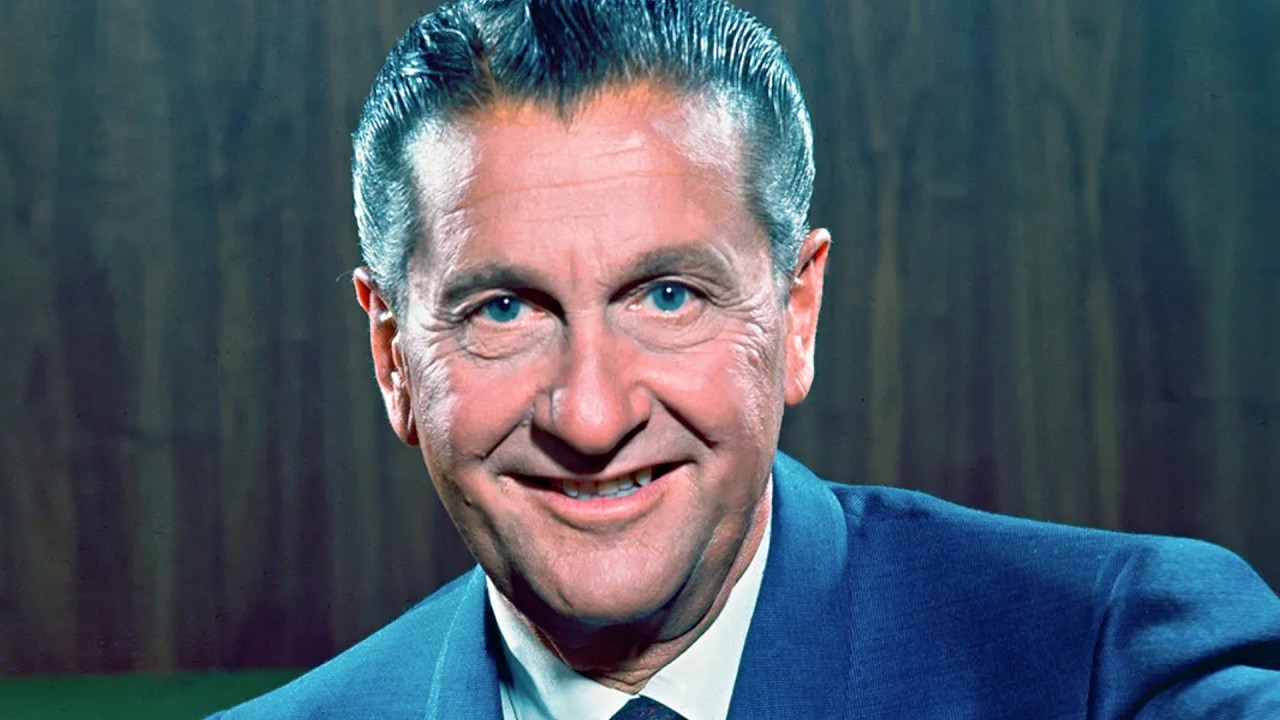
English was not his first language, and his distinctive accent would eventually become one of his most recognizable trademarks. Rather than hiding it, Welk turned it into part of his public identity, understanding that being memorable was worth real money in television. His childhood left a lasting mark. After a ruptured appendix caused peritonitis and interrupted his schooling, Welk developed a reputation for being disciplined, demanding, and intensely focused on work.
At 17, he negotiated an unusual agreement with his father: his parents would spend $400 on a professional accordion, and in return, Welk would labor on the family farm for four years. His musical earnings during that period went back to his family. On March 11, 1924, after honoring that agreement, Welk finally left home. He reportedly walked away with little more than his accordion and $3.
The contrast between that moment and the fortune he would eventually build was extraordinary. During the late 1920s and throughout the 1930s, Welk built a growing reputation through radio broadcasts, including appearances connected to WNAX in Yankton, South Dakota. Radio brought his orchestra directly into people’s homes and helped draw listeners to the ballrooms where he performed. He was not simply standing in front of an orchestra waving a baton—he was building a brand.
In 1951, Welk secured a residency at the Aragon Ballroom in Santa Monica, California. The location became one of the most important stages of his career, attracting significant attention in Southern California. In 1955, ABC picked up The Lawrence Welk Show nationally. For millions of viewers, it looked as though a new television star had suddenly arrived, but by then Welk had spent most of his adult life preparing for the moment.
The show developed one of the most loyal audiences in television history. Major corporations wanted access to that audience, and the program became a powerful advertising platform, with Dodge among its notable sponsors. Welk’s concept of “champagne music”—light, rhythmic, and deliberately pleasant—was designed to reassure viewers that whatever was happening outside their homes, his world would remain comfortably the same. The floating bubbles, created by specially designed mechanical equipment, became part of the ritual.
But behind the warmth he projected on television was a demanding leader. Welk maintained tight control over rehearsals, musical arrangements, schedules, and the overall sound of his orchestra. His philosophy was clear: the show was a privilege, and staying inside Welk’s world meant accepting its rules. One of the most significant clashes came with Pete Fountain, the celebrated jazz clarinetist whose musical instincts were built around improvisation.
Jazz thrives on freedom and spontaneous interpretation, while Welk’s orchestra operated under almost the opposite philosophy. Their differences became impossible to reconcile, and Fountain left the program. Money created another layer of tension. Welk was known for maintaining conservative salaries while expecting considerable loyalty from those within his organization.
Some long-serving performers reportedly felt that the enormous commercial success of the program was not reflected in their compensation. The most damaging chapter in Welk’s carefully controlled world did not begin with an argument over music. It involved something far more personal. In 1959, Alice Lon, the singer affectionately known as the show’s Champagne Lady, departed under circumstances that became a national talking point.
Contemporary newspaper reports quoted Welk saying that Lon had displayed too much knee during a broadcast and that he objected to clothing he considered inappropriate for his family-oriented program. Lon also cited disagreements over money and the deteriorating atmosphere within the orchestra. Viewers were furious, and letters poured into ABC demanding her return. The legend that Welk had fired her simply for crossing her legs on camera became part of television folklore, although the historical record shows the dispute involved more than a single gesture.
Perhaps the strangest scandal came in 1971, when Gail Farrell and Dick Dale performed Brewer and Shipley’s “One Toke Over the Line” on the show. The title itself referred to illicit substance use, making it an especially unusual selection for one of television’s most conservative programs. Welk introduced the number as a “modern spiritual. ” The performers sang it completely straight while Welk appeared oblivious to the double meaning that had become obvious to much of America.
The clip became one of the most enduring examples of the enormous cultural gap separating Welk’s protected television universe from the rapidly changing world outside his studio. By 1971, ABC had decided to cancel The Lawrence Welk Show as part of the broader transformation known as the rural purge. Networks were increasingly chasing younger, more urban audiences, and Welk’s older-skewing demographic suddenly looked like a liability to advertisers. The cancellation came despite the show’s continued strength with its audience.
Rather than surrendering, Welk turned to syndication. He established his own production and distribution operation and persuaded more than 200 independent stations to carry the program. The gamble worked—the show continued for another 11 years, remaining in production until 1982. Welk had transformed what looked like a humiliating corporate defeat into one of the most successful examples of independent television syndication of its era.
While audiences watched him conduct an orchestra, Welk was quietly building a financial empire. One of the most important pieces was Teledex, Inc. , a corporation he established in the late 1950s that managed his growing business interests, including investments connected to entertainment, publishing, recordings, and real estate. During the 1970s, he transformed himself into a major property developer in Southern California, with projects including Lawrence Welk Plaza at 100 Wilshire Boulevard in Santa Monica, a prominent high-rise development overlooking the Pacific.
Nearby developments, including the Champagne Towers and Wilshire Palisades, became physical symbols of a fortune built far beyond the television studio. His business interests expanded further through the Welk Resort Group, which developed vacation properties and resort communities, including the major Welk Resort near Escondido, California. By this point, Welk had created a diversified business empire that could generate income from television, music, property, hospitality, and other investments. His private life remained remarkably stable compared to many entertainment figures of his era.
He married Fern Renner in 1930, and their marriage lasted for more than six decades until his death. Together they raised three children while maintaining a family life that remained considerably more private than the lives of many around them. But the controversies never completely disappeared. Robert H.
Ralston had been Welk’s lead keyboardist and organist for more than 20 years. After the orchestra disbanded in the early 1980s, Ralston was arrested in 1984 after authorities discovered photographs during a search of his home. He was subsequently charged with offenses involving inappropriate behavior and ultimately received 5 years of probation. The case was horrifying precisely because of the contrast with the wholesome image the program had marketed for years.
Decades after Lawrence Welk’s death, another family battle brought the Welk name back into headlines. In January 2026, Lawrence Welk Jr. , the band leader’s son, filed a lawsuit against his own son Kevin Welk, his nephew Jonathan Frederick, and others connected to the Welk Group. The complaint accused them of improperly removing him from leadership of the family business and sought $30 million in damages.
The dispute centered on changes to company governance that effectively removed Welk Jr. from the leadership structure after he reached the company’s newly imposed age limit. The Welk Group responded with a counterclaim accusing Welk Jr. of financial misconduct, including alleged misuse of company funds and unauthorized expenses.
Welk’s health declined with age, and on May 17, 1992, he died from pneumonia at his home in Santa Monica, California. He was 89 years old. By then, the man who had once been dismissed by critics as old-fashioned had created something remarkably difficult to erase.