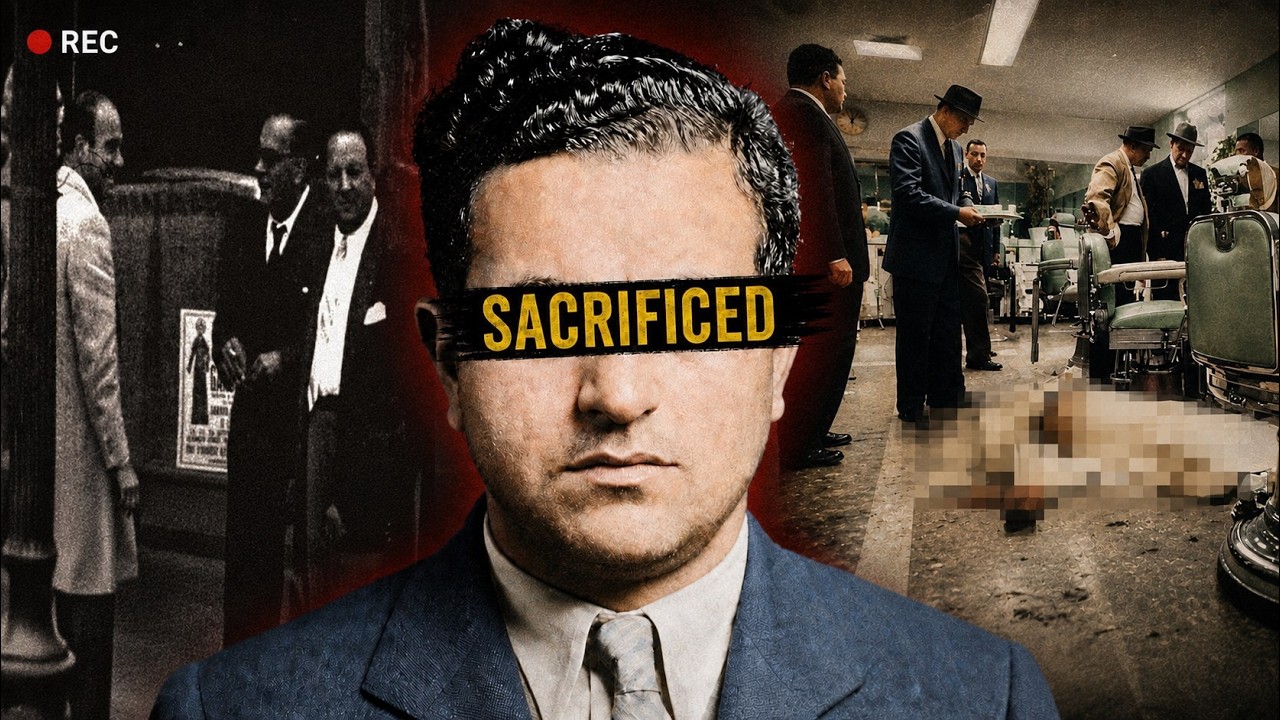
Just after 10:15 on the morning of October 25, 1957, two men with scarves over their faces walked into the barber shop off the lobby of the Park Sheraton Hotel in Manhattan.
Albert Anastasia, the most feared mob boss in America, sat in chair number four with a hot towel over his face. The men emptied their revolvers into him, dropped the guns, and walked out into the Seventh Avenue rush.
Fourteen people were in that room. Roughly a hundred detectives would work the case. One of the guns turned up in a trash can the next morning. No one was ever charged.
For twenty years, Anastasia had been the man who made witnesses disappear. The newspapers called him the Lord High Executioner. He ran the enforcement arm of the National Syndicate, the outfit that became known as Murder Incorporated, a contract killing operation later tied to somewhere between 400 and a thousand deaths.
He had built his standing on one fact about the courtroom: a case goes nowhere unless someone will sit in the box and point. Now he was dead in a public room with fourteen people looking on. Within a year, the detectives working his killing would hit the same wall he had spent his life building.
This is the file on the barber shop hit, worked from the side of the investigators rather than the men who ordered it. It is the record of everything the police had, and the reason none of it was ever enough to charge a single name.
Start with the scene, because that is where the case looked most winnable.
Anastasia had left his home in Fort Lee, New Jersey, around 7 that morning and had his car parked in a Manhattan garage by 9. He walked into Grasso's barber shop off the Park Sheraton lobby a little after 10:15 and took chair number four, his back to the door.
Joseph Puchino was cutting his hair. A manicurist worked his nails. A shoe shine boy the shop called Jimmy was down at his feet. His protege Vincent Squillante, a man who called himself Anastasia's godson, sat a few feet away.
This was not some back alley. It was a working hotel barber shop in the middle of Manhattan, hot towels and numbered chairs, staff and customers at the busiest hour of a Friday.
Two men came in from the lobby, short and stout, fedoras low, aviator sunglasses, scarves wrapped over their faces, and gloves on their hands. One of them told the shop owner to keep his mouth shut if he did not want his head blown off. Then they opened fire.
The reporting counts ten rounds fired, five of which struck Anastasia in the left hand, the right hip, the back, and the back of the head.
What the survivors described next has stayed in the record because it is strange. Anastasia came up out of the chair and lunged, but the mirrors on the wall confused him and he went for the reflections of the men who were shooting him. He fell dead between the chairs.
Squillante got out alive. So did the barber, shoved aside by a gun muzzle, and everyone else in the room.
The first thing the investigators had was also the first thing that went nowhere. Two revolvers, a .32 caliber and a .38, were recovered inside a day. One turned up in a vestibule of the hotel. The other was pulled from a trash basket beside a subway entrance the next morning.
On paper, that is physical evidence, the kind of thing a prosecution gets built on. In practice, it was worthless. A dropped, filed-down throwaway was standard tradecraft for a syndicate hit of that era. The gun was meant to be found and meant to be untraceable. They had left it behind precisely because it could not lead anywhere, and it did not.
The police did the work anyway, and the record shows how much of it there was. The shop was processed. The staff and the guests who had been in the room were held and questioned. Detectives pulled in the obvious underworld figures, men whose names sat near Anastasia in the files, and put them through hours of questions about where they had been that morning.
Every one of them had an answer, and none of the answers went anywhere a prosecutor could use. That is the shape of the whole file in miniature. Serious detectives put in the hours, and the killing had been arranged to outlast every one of them. The dragnet was real. The problem was never that the police were not trying.
Then there is the bodyguard, and the bodyguard is the thread every investigator pulled.
Anthony, the driver and muscle the shop knew as Cappy, dropped his boss that morning, parked the car, and was not there when the gunmen walked in. He surrendered for questioning that evening and told police he had arrived about forty minutes after the shooting, learned what had happened, and turned around.
Three days later, they picked him up on a vagrancy charge. He was acquitted within hours, and he walked straight out of the courtroom into the hands of detectives who took him back to the West 54th Street station for another round of questions.
Cappy's absence is the tell this whole case turned on, and the detectives never bought it as bad luck for a second. A bodyguard does not step out at the one moment his boss is exposed by accident. The men working the file clearly felt the same pull toward him. But they could never turn that suspicion into anything a court would hold. Whether Cappy was in on the plot or simply absent has never been established.
So the police had a scene, a weapon, and a suspicious absence. What they did not have was the one thing a case actually needs. This is where the barber shop killing stops being a whodunit and turns into something colder.
There were fourteen eyewitnesses in that shop and lobby. Roughly a hundred detectives were assigned. Six months later, there was still no arrest.
The wall they hit had nothing to do with a shortage of witnesses. It was that not one of the fourteen would put a name to a face in a way that would survive a courtroom. Fourteen people watched America's most feared boss get shot to death, and every one of them at the same moment had somehow seen nothing.
Look at what those fourteen actually gave the police, because it is a lesson in how far testimony can fall short of proof. They could describe the killing. Two men, short and heavy set, hats and dark glasses, scarves over the lower half of their faces, gloves, revolvers.
That description is useless because it describes a disguise. Every honest detail the witnesses could give was a detail the shooters had chosen precisely so it would fit any pair of men in the city. The masks worked in two directions. They hid the gunmen in the moment, and they handed the witnesses a truthful account that pointed at no one. A frightened barber can tell you about a scarf. He cannot tell you the face under it. The men who planned this knew that before they ever walked in.
The detectives working it already knew how this story ended, because they had watched it play out five months earlier on the same kind of evidence.
On the second of May 1957, a gunman walked into the lobby of an apartment building on Central Park West and shot Frank Costello in the head. The bullet grazed Costello's skull and he lived. The police did everything right. A doorman gave a description good enough to lead them to a suspect, and they charged Vincent Gigante with the shooting.
Then Costello took the stand at the trial and refused to identify the man who had tried to kill him, and Gigante walked out acquitted. That was the template sitting on every detective's desk the morning Anastasia died. Even with a named suspect and a good description, the case had collapsed the moment its one witness refused to talk.
There is a version of this story you have probably heard, and it moves fast and lands clean. In that version, the order came from Vito Genovese, backed by Anastasia's own underboss, Carlo Gambino, and the two of them carved up what was left.
It is very likely true. Genovese had spent that year taking the top of the Commission by force. The Costello shooting in May had pushed aside Anastasia's strongest ally at the peak of the organization. With Costello stepped back, Anastasia was the last man between Genovese and the whole board, and he had made himself easy to move against.
He had broken the syndicate's own rules in 1952 when he ordered the killing of Arnold Schuster, a young civilian whose only offense was recognizing the fugitive Willie Sutton on a subway and telling the police.
According to testimony Joseph Valachi gave a Senate committee in 1963, Anastasia had seen Schuster praised on a television broadcast for the tip and had given the order on the spot, saying he could not stand squealers and to hit that guy.

Schuster was nobody to the mob, a civilian with no tie to any family and no place in any dispute. Killing an ordinary man over a television appearance broke the one rule the bosses actually cared about: that heat should never come down for nothing. It frightened them. It handed Genovese not just a motive but a permission.
That is the story of who wanted him dead, and it is a good one. But it was never going to convict anyone, and the investigators knew that better than anyone.
The working conclusion that Genovese and Gambino sanctioned the hit was a theory of the order. It was never proven in a courtroom, and no order ever will be, because the men who could have testified to it were the same men who profited from it. A motive everyone agrees on still has to be proven by someone willing to say so under oath. No one ever was.
The leads only get thinner from here, and the reason they thin out is the whole point of the file.
The strongest thing the police ever got on the shooters was not evidence at all, just a boast. A police informant named Sydney Slater reported that Crazy Joe Gallo, a soldier in the Profaci family, had bragged about the job. Gallo, the story goes, told him he could just call the five of them the barber shop quintet.
The alleged team was Joe Gallo, his brother Albert, Joseph Gioielli, Carmine Persico, and an unidentified fifth man. Years later, Persico himself was reported to have joked more than once about being the one who shot Anastasia.
Sit with what that gave the file. Bragging about a killing costs a gangster nothing, and five men taking credit for a famous one proves nothing a jury could ever use. The Gallo crew's own words never became evidence because there was nothing to corroborate them. No print on the throwaway guns. No witness who could connect the boast to the room.
The record puts it flatly: the killers have never been conclusively identified. The men most likely to have pulled the triggers spent years telling people they had, and it made no difference to the file, because in a courtroom a confession you cannot corroborate is just talk.
There is a further layer that made a charge close to impossible, which is how the contract got built in the first place. By one account, the shooters did not come from either family that wanted Anastasia dead. Joe Profaci, aligned with Gambino, is said to have handed the job to Gallo and his crew. So a Profaci soldier ends up doing a Genovese and Gambino contract.
Think about what that does to a prosecution. One family decides, another supplies the hands, and every principal is walled off from the trigger by people who would never testify. None of that layering was accidental. It is the design of a professional hit, the way an order reaches a trigger through hands nobody can connect back to the men who gave it.
If all of that sounds like a case that never had a chance, here is the part that tells you it was doomed before the first shot. Anastasia's whole life was a demonstration of the exact failure that killed the case against his killers.
He had been charged with murder three separate times, in 1928, 1932, and 1933. Every time, the witnesses either vanished or refused to testify, and every time he walked.
The clearest case anyone ever built against him came in 1941, when a Murder Incorporated informant named Abe Reles started naming names to escape the electric chair. One of the names he was about to give the district attorney was Anastasia's.
On the twelfth of November 1941, before Reles could testify, he went out a sixth floor window of the Half Moon Hotel in Coney Island while under twenty-four-hour police guard. A grand jury called it an accidental fall from a bed sheet rope. Whatever it was, the case against Anastasia went out that window with him.
The mirror was the strange part of the scene. This is the stranger part of the whole file. The man who built his life on making witnesses melt away died in a room full of witnesses who then melted away themselves.
Sixteen years after Reles went out that window, the machinery Anastasia had perfected got turned around and used on him. And it worked just as well for his killers as it had ever worked for him. When the case you are working is the mirror image of the man you are working it on, you are not going to win it. The detectives on Seventh Avenue understood that within days.
While the file sat open, the killing did its job. This is the thing about the barber shop hit that sets it apart from an ordinary unsolved crime. It failed completely as a solvable case. At the very same time, it worked completely as a piece of organizational politics.

Carlo Gambino took the family, and in time his own name became its name: the Gambino crime family, which it still carries. Genovese consolidated the Commission. Not one principal paid a legal price for the killing, and every one of them advanced because of it.
That is a rare thing to be able to say about a murder with a hundred detectives on it. Everybody the police suspected of profiting from the crime did profit out in the open for years, and none of it could be turned into a charge.
Two and a half weeks after the barber shop, the whole reason the case would never close walked into a state trooper's field of view by accident.
On the fourteenth of November 1957, a New York State police sergeant named Edgar Croswell, tipped off by a suspicious block of hotel reservations, set up roadblocks around the estate of a man named Joseph Barbara in the small town of Apalachin. Inside were dozens of the most powerful organized crime figures in the country, gathered, most historians agree, to ratify the new order Anastasia's death had made possible.
When the police closed in, bosses ran through the fields in their expensive suits and lost their shoes in the mud. Of roughly a hundred men, fifty-eight were caught. Apalachin was the moment federal law enforcement could not pretend a national syndicate did not exist anymore. The murder that helped trigger that summit stayed unsolved while the summit itself rewrote the history of American organized crime.
The paper proves the file was never abandoned. Whatever else this case became, it was never one the police quietly gave up on. The New York County District Attorney's surviving files on Albert Anastasia run from 1954 to 1963. The office kept a working file on the man for years after his death, and the FBI kept its own.
The record does not show investigators giving up. It shows them holding a file open through the end of a decade, running the same leads into the same wall, and never once getting a charge past a grand jury.
The men in that file went on with their lives. Squillante, the protege who survived the shop, was marked for death by the family itself and vanished in late September 1960. His body was never found.
Joe Gallo, whose boast is the strongest named lead the case ever produced, was shot dead over a plate of food at a clam house in Little Italy while celebrating his own birthday in 1972.
Carmine Persico, who joked for decades about pulling a trigger in that barber shop, went on to run the Colombo family until he died in prison in 2019, eighty-five years old, and never charged in the Anastasia case. Not once.
Here is where the file comes down after everything it holds. The barber shop hit was not a case the police lost so much as a case nobody could have won. It was put together by men who had spent a generation studying how prosecutions come apart and then arranging a killing that failed on every one of those points at once.
The order came from one family, the hands from another. The guns were throwaways. The fourteen witnesses saw only cloth. And the one man, Cappy, who might have known too much, had stepped conveniently out of the room. You cannot indict a design, only a person. And there was never a person the evidence could reach.
So who really killed Albert Anastasia? The honest answer the file gives is that the investigators were fairly sure they knew and could never prove a word of it.
On one side of the ledger, they had a great deal. There was a scene and a recovered weapon and a bodyguard whose timing no one could explain. There was a plausible chain of command running from Genovese down to a borrowed Profaci crew. And there were men who bragged about the job for the rest of their lives.
What they never had was the only thing that would have counted in a courtroom: a witness willing to sit in the box, or a single piece of evidence that tied one hand to one gun.
The real question the barber shop hit leaves behind is not who did it. It is why a public execution of the most feared man in the country, in front of fourteen people, with a hundred detectives on it, could end in no arrests at all.
And the answer is the same one Anastasia had proven three times over. Knowing was never the same thing as proving. And a room full of people who saw everything is worth nothing if not one of them will say so out loud.
The barber chairs from Grasso's shop sit in a museum now. The storefront at 877 Seventh Avenue, where two men killed America's most feared boss in front of a room full of people and walked out into the morning, is a coffee shop today. The case on him was worked for years and closed by no one.