World War II hero Richard “Dick” Winters, the stoic commander of Easy Company whose story became the heart of HBO’s acclaimed miniseries “Band of Brothers,” once threatened to sever all ties with executive producer Tom Hanks in a furious dispute over profanity and a 𝒔𝒆𝒙 scene that he believed would desecrate the legacy of the men he led, according to accounts of the confrontation that have resurfaced in the years since the landmark series first aired.
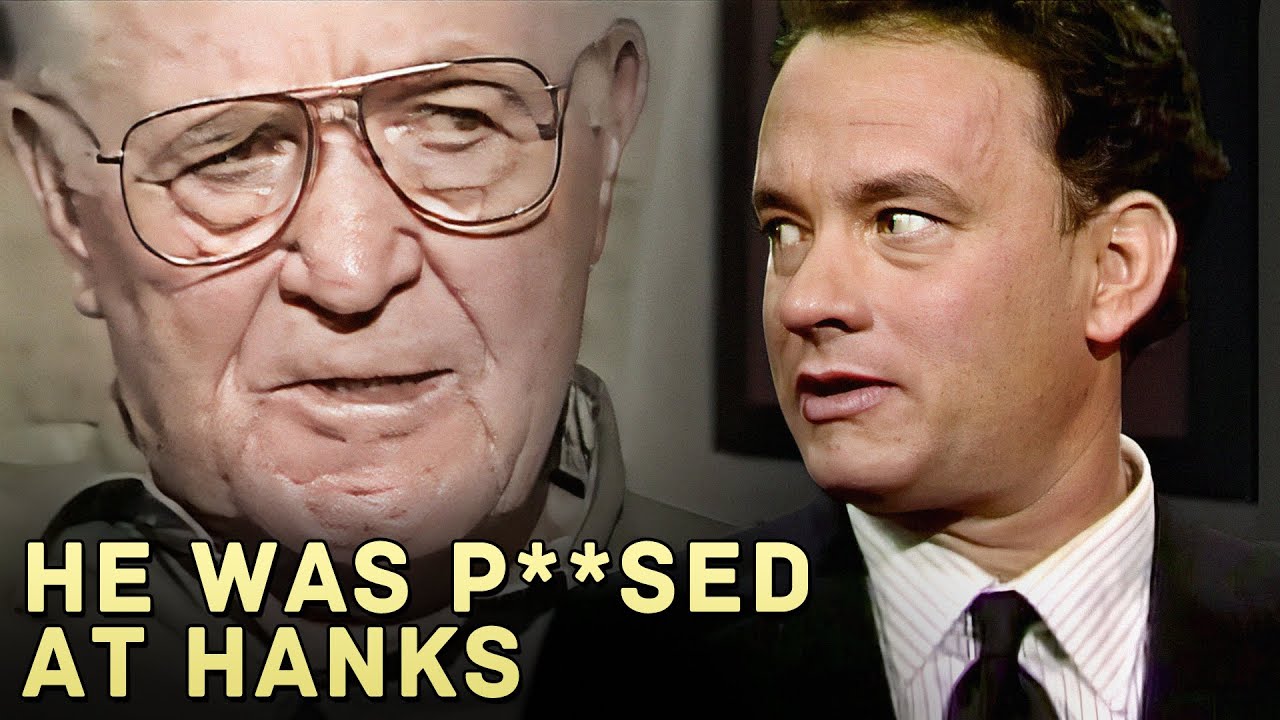
The extraordinary standoff, detailed in Winters’ biography “Biggest Brother” and in interviews he gave before his death in 2011, pitted the soft-spoken Pennsylvania native against one of Hollywood’s most powerful figures, and it ended with Hanks backing down and ordering changes to the script after Winters invoked the traditions of his Mennonite-influenced upbringing and declared simply, “I can shun you.”
The conflict began after Winters, who served as a technical advisor on the 2001 miniseries, read early drafts of the scripts and was alarmed by the volume of foul language and what he considered gratuitous content in a production he knew would be watched by families and schoolchildren across the country.
Winters, a devout Lutheran whose mother came from a Mennonite family in Lancaster County, Pennsylvania, had spent his life avoiding drinking, smoking, swearing and gambling, values that were woven into his character and that he believed were shared by the real men of Easy Company, the paratroopers who fought from Normandy to Hitler’s Eagle’s Nest.
In his memoir and in conversations with biographer Larry Alexander, Winters acknowledged that the soldiers of Easy Company were familiar with profanity and did use it, but he insisted they never used it with anything close to the frequency depicted in the HBO production, and he considered the difference a betrayal of the men he was trying to honor.
“The producers, writers, directors, and the actors were all contributing their little part,” Winters recalled in a 2003 interview. “And as far as I could see, the only part they were contributing was the F-word. And they kept using it more and more and more, and it was unforgivable.”
 Winters put his objections in writing, penning a stern letter to Hanks in which he argued that young viewers would come away from the series believing that profanity was acceptable, and he told head writer Erik Jendresen that the production would be entering people’s homes and would be shown to schoolchildren, and that there was no need to prove how tough the soldiers were through vulgarity.
Hanks responded by telephone, and the two men argued for nearly half an hour, with Hanks holding his ground and telling Winters that he disagreed and that the script would not be changed, a position that prompted Winters to deliver his quiet but devastating ultimatum rooted in the Mennonite tradition of shunning.
“I can shun you,” Winters told Hanks, explaining that in Mennonite country people do not sue one another or throw fits when something happens they dislike; they simply cut the other person off and have nothing more to do with them, a consequence that would have meant Winters withdrawing from the project entirely and never speaking to Hanks again.
Winters followed the phone call with a more strongly worded letter laying out his position, arguing that the harsh language was a distraction that undermined the ability of the series to tell the story of Easy Company effectively and to convey its message to the widest possible audience.
A week later, Hanks called back. “We’re going to make the changes you asked for,” he told Winters, and the profanity in the script was scaled back, particularly the use of the F-word, handing Winters a partial victory in a battle that was far from over.
Even after the language was softened, Winters discovered that the script for the ninth episode, “Why We Fight,” contained a scene depicting a sexual encounter with nudity, in which Private John Janovec, portrayed by Tom Hardy, was scripted to be in bed with a German woman played by Isabella Zybert.

Winters objected immediately and forcefully, telling Hanks that the episode was wonderful but demanding to know why, for the sake of ten or fifteen seconds, the production had included a 𝒔𝒆𝒙 scene that was completely out of place, and he argued that the episode could otherwise have been shown in any school, any place, any time, or any living room with children watching.
When Hanks reminded him that it was a true story, Winters was unmoved. “No matter,” he replied, insisting that for any normal person the scene ruined what had been a powerful and important hour of television, and he took his protest directly to Jendresen, but this time nobody budged and the scene remained in the final cut.
Winters did win one personal concession: not a single strong swear word was spoken by his own character, portrayed by Damian Lewis, throughout the entire ten-part series, with the worst language attributed to him being several uses of the word “damn,” including the moment during the liberation of a concentration camp when he tells Lewis Nixon, “Find Spears and figure out how the hell to get them some food.”
The dispute over profanity was not the only friction between Winters and the production. He also raised objections about various historical inaccuracies in the series, and he had previously pressed author Stephen Ambrose to minimize obscenity in the 1992 book “Band of Brothers” that formed the basis for the miniseries, telling the Patriot News that he tried to delete the obscenities and the F-word from the manuscript, and Ambrose largely obliged.
Winters’ religious convictions ran deep and were rooted in his childhood in Lancaster County, where church was always important to his parents and the family attended services together, and where the traditions of the Mennonite and Amish communities left an indelible mark on his character, as he acknowledged in “Conversations with Major Dick Winters” by Cole Kingseed.
“I never changed,” Winters said. “Religious services became the bedrock of my character.”

Despite the battles, Winters ultimately expressed satisfaction with the finished product, saying that while he objected to the amount of profanity and the one gratuitous 𝒔𝒆𝒙 scene when Easy Company arrived in Germany, he was very pleased overall, and he was particularly gratified that so many men finally received recognition for what they accomplished during the war.
The confrontation stands as a remarkable episode in the making of one of the most celebrated television events of the modern era, a moment when a quiet schoolteacher-turned-soldier from rural Pennsylvania stared down a Hollywood titan and, armed with nothing more than moral conviction and the threat of silence, won concessions that shaped how millions of viewers would experience the story of Easy Company.
Winters, who was awarded the Distinguished Service Cross for his actions on D-Day at Brecourt Manor and who led Easy Company through some of the war’s most brutal fighting, including the assault on the guns at Brécourt and the defense of Bastogne, remained throughout his life a man defined by duty, restraint and an unshakable sense of right and wrong, qualities that his confrontation with Hanks illustrated as vividly as any battlefield decision.
His willingness to walk away from a project he had helped inspire, and to end a relationship with one of the most influential filmmakers in the world, reflected a code of conduct he had carried from the fields of Lancaster County to the killing grounds of Europe and back again, a code that placed principle above celebrity and conviction above convenience.
The series that emerged from those tensions went on to win numerous Emmy Awards and is widely regarded as one of the finest depictions of combat ever produced for television, and Winters’ insistence on restraint in language and content, however partial its success, helped ensure that the story could be shared with the families and schoolchildren he had in mind when he first opened the script and recoiled at what he read.
For historians and admirers of the men of Easy Company, the episode offers a rare glimpse into the moral universe of a soldier whose leadership was defined not only by tactical brilliance under fire but by an unwavering commitment to the values he believed the war itself had been fought to defend, and it serves as a reminder that the battle over how history is remembered can be as fierce as any fought on the field.