When Lorenzo de’ Medici died in 1492, the physicians attending him could not explain the cause of his death. Modern medical researchers, however, now believe they have found the answer, and it points to a rare disorder that would have made his final years deeply uncomfortable. Born on New Year’s Day 1449, Lorenzo di Piero de’ Medici entered a world where his path was already set. The Medici were a Florentine dynasty whose political influence and vast wealth had been built over generations of banking success.
Lorenzo was expected to carry that legacy forward. In many ways, his adult life mirrored that of his grandfather, Cosimo de’ Medici. Cosimo was the first to lead both the Florentine Republic and the family bank at the same time, becoming one of the richest men in Europe. He also set a precedent for Medici patronage, pouring enormous sums into the arts and public projects.
Lorenzo’s father, Piero, continued that tradition and funded numerous artistic ventures himself, though he showed less interest in the family’s commercial affairs than either his father or his own son would. That responsibility fell largely to Piero’s brother, Giovanni. Lorenzo’s mother, Lucrezia Tornabuoni, was a gifted and intelligent woman who wrote sonnets and corresponded with philosophers at the local academy. The family’s money was not the only thing that made great art possible.
Botticelli drew inspiration from the Medici themselves, using them as models for several of his paintings. Lorenzo and other family members posed for masterpieces such as the “Madonna of the Magnificat” and the “Adoration of the Magi,” though the young man appeared in fewer paintings than his relatives. That may have been deliberate. Compared with the rest of his family, Lorenzo was not considered handsome.
He was described as plain-featured, with modest facial features and a flattened nose. He was of average height with a broad build and short legs. Even his voice was considered harsh. His appearance likely suffered further in contrast to his brother.
Giuliano, Lorenzo’s younger brother, was strikingly good-looking and regarded as the family’s golden boy. He appeared in Botticelli’s works far more often than Lorenzo, most notably as the attractive Mars in “Venus and Mars. ”
But Lorenzo possessed qualities his brother lacked. Despite his ordinary looks, he had a remarkable mind.
A close friend once noted that nature had been a merciful mother in everything she had created within his intellect. People also seemed genuinely fond of him, and he never appeared to resent his lack of beauty. His dark-complexioned face was said to carry great dignity, and he commanded respect from everyone who spoke with him. That may explain why his parents placed so much confidence in him.
Though Lorenzo was one of five children born to Piero and Lucrezia, he was seen as the most promising heir to the family legacy. His parents worked early to refine his talents. Lorenzo received instruction from some of the most distinguished teachers of his time, including Bishop Gentile de’ Becchi, a respected Florentine diplomat, and Marsilio Ficino, the leading humanist philosopher. His education was not limited to his native tongue.
During the Renaissance revival of Greek and Roman classics, Lorenzo trained in Greek with the influential scholar John Argyropoulos. His youth was not all work. Lorenzo enjoyed falconry, hunting, horse breeding, and fencing, with a particular passion for the latter. In 1469, the Medici family sponsored a major jousting tournament.
At just twenty years old, Lorenzo entered and won. The victory attracted considerable attention. The poet Luigi Pulci wrote about his performance, and Niccolò Machiavelli himself recorded the event. The young man’s fame was quickly put to use, as his father began sending him on important diplomatic missions, including a trip to Rome to meet the pope.
On February 7, 1469, Lorenzo married Clarice Orsini, a member of Roman nobility. The marriage was a diplomatic one. The couple had ten children, though only six survived to adulthood. The household later gained an additional member after the early death of Lorenzo’s brother, Giuliano.
The couple adopted Giuliano’s son, Giulio, who would eventually rise to the papacy as Pope Clement VII in 1523. Lorenzo finally assumed power in 1469. After the deaths of his uncle and then his father, he took a leadership role in Florence at just twenty years old. Left without elder family members to guide him, Lorenzo turned to his mother, Lucrezia, who became one of his closest advisers.
The Medici were not the official rulers of Florence, but their wealth gave them enormous influence over the city’s politics, making them de facto rulers. Lorenzo governed indirectly, like his grandfather and father before him, by paying off council members, persuading them to act as his representatives, and arranging strategic marriages to strengthen the family’s position. He also continued the family tradition of philanthropy, donating large sums, paying his fair share of taxes, and investing in Florence’s buildings. In 1471, he estimated that his family had spent about 663,000 florins on public works since 1434, equivalent to roughly 460 million US dollars today.
Lorenzo was content with that expenditure. He wrote that while many might prefer to keep such money in their own pockets, he considered it a great honor to the state and was completely satisfied that the money had been well spent. Not everyone welcomed his influence. Many rival families resented the Medici’s dominance over Florentine life and politics.
The Pazzi family, the largest and most dangerous of these enemies, began plotting against him. Lorenzo’s standing in Florentine society continued to rise. He earned the title “Lorenzo the Magnificent,” cementing his place among the city’s greats. He also became one of the most prominent and powerful patrons of the arts in all of Italy.
The vast sums he spent inspired other wealthy Europeans to do the same, fueling the Renaissance, particularly in Italy. His court of supported artists read like a who’s who of the era. It included painters such as Piero, Antonio del Pollaiuolo, Andrea del Verrocchio, and Domenico Ghirlandaio. He also continued to patronize Botticelli, showing no apparent grudge over the artist’s frequent use of his brother as a model.
But one artist rose above all others. Arguably the greatest artist under Lorenzo’s patronage was Michelangelo. Michelangelo actually lived with the Medici family for three years, often dining with them and engaging in philosophical discussions with Lorenzo and his teacher Ficino. Another young artist at the Medici court would also make a name for himself.
Lorenzo helped launch the career of a young man who would later become famous, though he played little role in that man’s most significant period of work. That man was Leonardo da Vinci. Lorenzo was not merely a patron and banker; he was an artist himself. His preferred medium was poetry.
He wrote numerous poems in his native Tuscan, celebrating life while acknowledging the melancholy of the human condition. He also wrote extensively about love and feasts. His passion for the written word influenced his philanthropy as well. His grandfather had been an avid collector of literature, and the books he gathered became the Medici library.
Lorenzo greatly expanded it during his rule, with agents recovering many classical works from the East. He also funded the copying and distribution of books throughout Europe. Influenced by his teacher Ficino, Lorenzo became a passionate supporter of humanist philosophy, which emphasized individual and societal potential and was a precursor to the Enlightenment. He supported his inner circle of humanist philosophers as they attempted to merge the ideas of Plato with Christianity, a move that displeased powerful church leaders.
During Lorenzo’s time in leadership, Italy was divided into several states under the Italian League of 1454. Pope Sixtus IV, however, had greater territorial ambitions and conspired against the Medici with the help of their rivals, the Pazzi family. The situation would end in tragedy. On April 26, 1478, the Pazzi conspiracy, with the pope’s collusion, reached its climax.
In Florence’s cathedral, Santa Maria del Fiore, Lorenzo and his brother Giuliano were attacked by three men, including Francesco de’ Pazzi and the Archbishop of Pisa. Giuliano was overwhelmed and brutally stabbed to death. Lorenzo fared better. The poet Poliziano and another banker, Francesco Nori, were also present during the attack.
The two men bravely defended Lorenzo, giving him time to escape with a minor neck wound. Nori, unfortunately, did not survive the encounter. News of the attack spread quickly. The people of Florence, who were generally fond of the Medici, were enraged.
Acting on their own initiative, residents executed several members of the Pazzi family as well as the Archbishop of Pisa. The pope’s plan had failed, and he was furious. Not only had Lorenzo survived, but the Medici found themselves in an even stronger position. The enraged Sixtus IV turned the church’s attention toward Florence’s rulers.
The Holy See seized all Medici assets it could find, excommunicated Lorenzo and the Florentine government, and placed the entire city-state under an interdict, barring them from church rites. Lorenzo was largely unaffected. The pope’s maneuvers had little impact on his standing or the Medici’s widespread popularity. So Sixtus turned to plan B.
He formed a military alliance with King Ferdinand I of Naples, and the two launched an invasion of the Florentine Republic led by the king’s son, Alfonso. Lorenzo had little experience in warfare, so he needed to change the game to suit his skills. He first tried to rally Florentine citizens against the invading forces, but the Medici received only scant support from allies in Bologna and Milan. The war remained at a stalemate.
Lorenzo then changed tactics. As a master of diplomacy, he traveled personally to the enemy stronghold in Naples, where he voluntarily surrendered himself as a prisoner to the king. Over several months, he persuaded the king to end the invasion, ultimately resolving the crisis. He emerged from enemy captivity stronger than when he entered it.
The ordeal actually strengthened Lorenzo’s position in Florence. As a result of his success, he negotiated constitutional changes within the Florentine Republic’s government, helping to consolidate his personal authority. He did not take his secure position for granted. After the invasion, Lorenzo was determined to establish peace in his corner of Europe.
He pursued balance-of-power policies among the northern Italian states while keeping other major European powers out of Italy. He also maintained good relations with the Ottoman Empire, a major trading partner for Florence and the Medici. But the good times would not last. When Lorenzo took power, his family’s assets were already strained by his grandfather’s ambitious building projects.
His reign only made things worse. Poor management, costly wars, political expenses, and a series of bad loans led to the collapse of the Medici’s finances, forcing the closure of several branches of the family bank. Desperate times called for desperate measures. Facing financial difficulties too great for a struggling leader to bear, Lorenzo saw only one path forward.
He embezzled money from funds meant for other purposes, including state funds, in an attempt to keep his finances balanced. His efforts largely failed. As Medici influence in Florence waned, the influence of the friar Girolamo Savonarola rose to fill the void. Ironically, Lorenzo had been partly responsible for bringing Savonarola to Florence in the first place.
As his power diminished, so did his health. Lorenzo’s health deteriorated until he finally succumbed on April 8, 1492, at the age of 43. His rival Savonarola visited his deathbed, amid rumors that the friar had cursed the ailing banker. Whether that happened or not, other strange events were reported around the time of his death.
Numerous reports described alleged signs and omens occurring at the moment of Lorenzo’s passing. One account claims lightning struck the dome of Florence’s cathedral. Another speaks of ghosts appearing. Yet another mentions a fight among the lions kept in a nearby zoo.
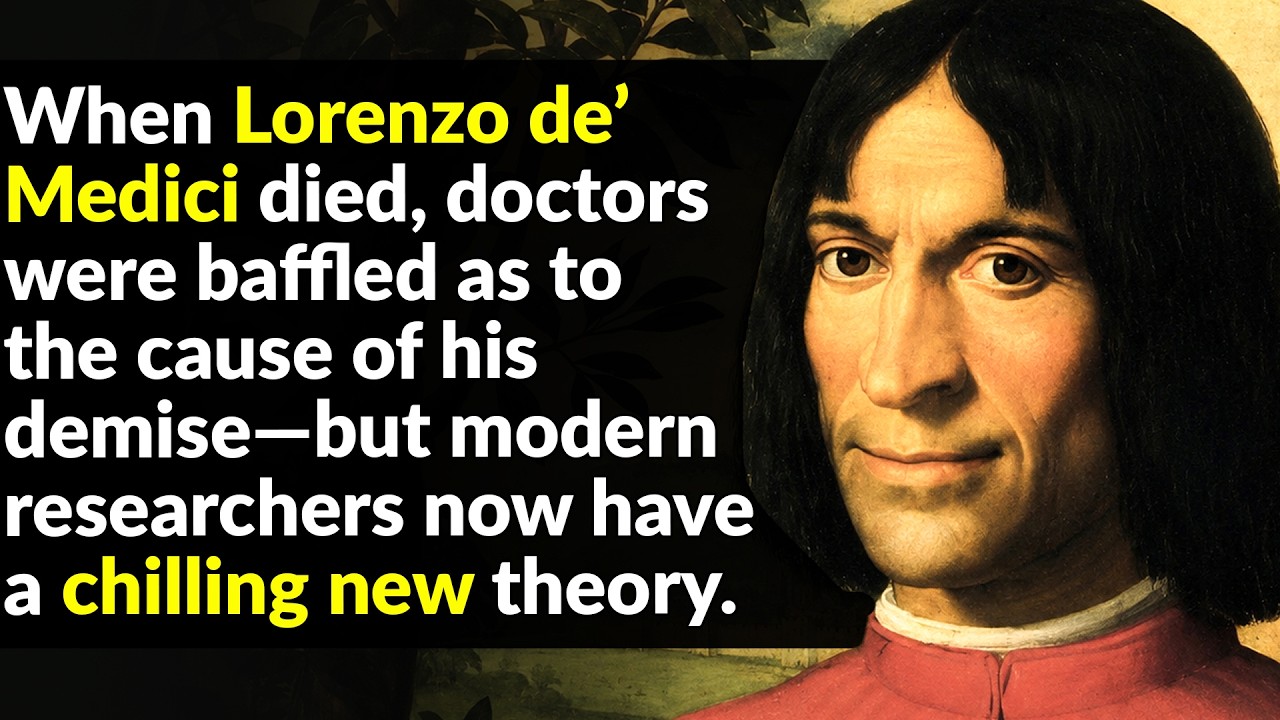
All these were mysterious events, but nothing was more mysterious to Lorenzo’s family than the circumstances of his death itself. The physicians of the time were baffled by the cause of his illness and death, but modern medical researchers have a theory. His reported symptoms, along with later analysis of his skeleton, point to an excessive secretion of growth hormone consistent with a rare disorder known as acromegaly. His final days were likely very uncomfortable, so his family made sure his final resting place was not.
Lorenzo was buried with his brother Giuliano in the family tomb in the Basilica of San Lorenzo, which was later expanded with structures that formed the Medici Chapels. Decades after his death, Lorenzo’s descendants decided to move his remains and those of his brother to a new tomb within the same basilica, one more befitting their lives of patronage. To this day, Michelangelo’s statue of the Virgin stands over the final resting place of the Florentine leaders. If Lorenzo found peace in the afterlife, he certainly did not leave it behind in this life.
Despite the turbulent final years of his life financially, he remained a steady diplomat to the end. He negotiated, supported, and maintained the Peace of Lodi of 1454, a treaty that kept Italy stable. But upon his death, that peace quickly collapsed.
His steady hand was lost, and his reputation has been remembered ever since.