In the early 1970s, inside a 20-room apartment at Kensington Palace, Princess Margaret opened the drawer where she kept her gloves and found a piece of paper her husband had left for her. It was a list. According to the biographer Anne de Courcy, who spent years interviewing the man who wrote it, the list was titled "Things I Hate About You" and ran to more than 20 items.
Another note, remembered by Anne Glenconner, who served the princess as lady-in-waiting for three decades, was shorter. It said, "You look like a Jewish manicurist and I hate you."
He did not hand her these notes. He did not say the words to her face. He tucked them into the glove drawer, or into a book on her bedside table, or inside the desk where she answered her letters. Then he went down to his workroom in the basement and shut the door.
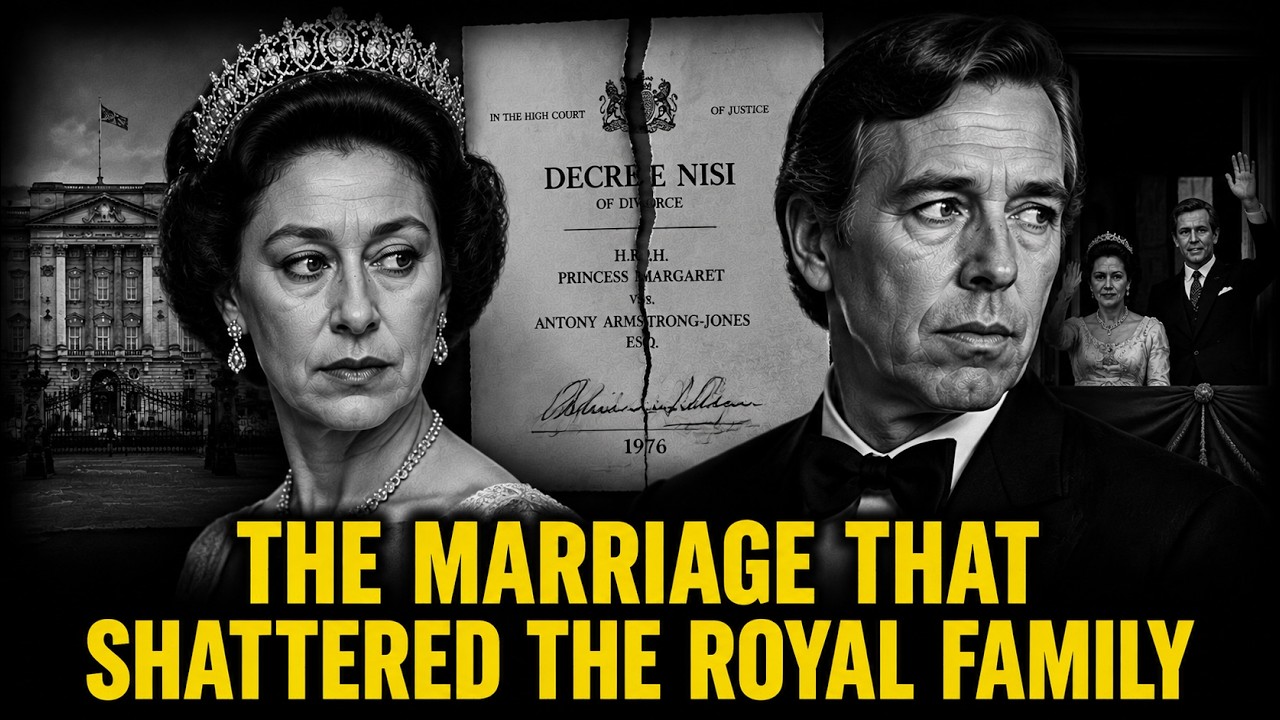
The wedding that began this marriage was watched by 300 million people, the first royal wedding ever carried on television. The divorce that ended it was the first in the senior royal family since Henry VIII. Between those two public events sat 18 years of private weather.
What separates this marriage from other unhappy Windsor unions is how little of it was ever shouted. Diana and Charles fought through the press, each briefing, each confessing on camera. Margaret and Tony almost never raised their voices where history could hear them. Their war was conducted in silence, in notes left in drawers, in a husband who stayed out until four in the morning and answered no questions, in a wife who sat up alone with whiskey and cigarettes.
The official version of Princess Margaret's marriage has been told so many times it has worn a groove. Girl loses the war hero she loved because the church and the government forbid the match. Girl marries a glamorous photographer on the rebound. Photographer turns out to be cruel and unfaithful. Girl takes a young lover to a Caribbean island. The tabloids catch her. The marriage ends in scandal.
Nearly every sentence in that tidy story hides more than it reveals. The rebound was timed with a precision that suggests something closer to revenge than heartbreak. The photographer was already a father when he walked down the aisle of Westminster Abbey, though he did not know it, and neither did the woman carrying the secret. The truth would take 44 years and a DNA test to surface.
The cruelty was real and documented, and worse than the official version admits. But it did not run in only one direction, and the servants who worked at Apartment 1A would spend the rest of their lives declining to say which of their employers had been harder to live with.
Even the divorce, the scandal that supposedly shattered the family, was in private something closer to a relief, negotiated between two people who understood each other far too well. They would go on in the decades afterward to a friendship that confused everyone who had watched the marriage burn.
Put the accounts of the people who were there together and a different marriage emerges. It was a marriage between two people who were more alike than any couple the royal family had ever produced, and whose likeness was the exact reason they could hurt each other so efficiently.
Both were second children overshadowed by a sibling. Both were performers who required an audience to feel real. Both were capable of enormous charm and sudden coldness, sometimes inside the same minute. One courtier who knew them well is said to have remarked that the trouble with the Snowdons was that they were the same person, and the person was impossible.
Consider the timing of the engagement, because the timing tells you almost everything about what this marriage was built on. In October 1955, Margaret stood in front of the country and renounced Peter Townsend, the divorced war hero she had wanted to marry, mindful, as the statement put it, of the church's teaching that Christian marriage is indissoluble.
The statement was drafted with Townsend himself. She was 25 years old, and she had just given up the only future she had planned. For the next four years she was the most photographed unmarried woman on earth, linked by the papers to a parade of eligible aristocrats she had no intention of marrying.
Then, in December 1959, a letter arrived from Brussels. Townsend, now living abroad, wrote to tell her personally before she could read it in a newspaper that he was engaged to a Belgian tobacco heiress named Marie-Luce Jamagne. She was 19 years old. People who saw her photograph could not help noticing a small dark-haired woman who looked rather like a younger Margaret.
Within days, Margaret accepted a proposal that Anthony Armstrong-Jones had already made some time earlier and that she had left unanswered. The engagement was announced in February 1960. She later told friends, according to more than one account, that she had received the letter and decided that afternoon.
The marriage began its life as an answer to a letter from another man, and nobody saw the groom coming, which was precisely the point of him. The press had spent four years staking out dukes and earls. Anthony Armstrong-Jones was a photographer who worked for a living.
He was the son of a barrister and a society beauty who had divorced when he was a boy. A small, quick, watchful man, he had survived polio at 16, coxed the winning Cambridge boat despite the damaged leg, and then built a career photographing actresses and debutantes from a studio in Pimlico.
He had been photographing the royal family for two years and courting Margaret in complete secrecy for most of that time, meeting her in a rented room in Rotherhithe overlooking the Thames. The room had no staff and no telephone. A princess could fry eggs and wash dishes there and pretend, for an evening at a time, to be nobody in particular.
Fleet Street, the most aggressive press corps on the planet, never got a whisper of it. When the engagement was announced, the shock in the newspapers was genuine. The palace old guard was appalled that the queen's sister was marrying a man who took pictures for money.
They had no idea yet how much more there was to be appalled about, because the secrets were already in the building. The proposal itself had taken place at a manor house in Wiltshire belonging to Jeremy Fry, one of Tony's closest friends, and Fry's wife, Camilla.
Weeks before the wedding at Westminster Abbey, Camilla Fry conceived a child. The daughter, Polly, was born one month after the honeymoon ended. For four decades she was raised as Jeremy Fry's child, and the question of her paternity stayed inside a very small circle. In 2004, a DNA test settled it. The father was Anthony Armstrong-Jones, first Earl of Snowdon.
The man who married Princess Margaret in front of 300 million people did so having just fathered a child with the wife of the friend who had sheltered the courtship. The bride knew nothing, and the marriage that would eventually die of infidelity had been seeded with it before the invitations went out.
None of this was visible on May 6, 1960. What was visible was the best show the monarchy had put on since the coronation. The abbey was filled with 2,000 guests. The bride wore Norman Hartnell silk, deliberately plain, because anything ornate would have overwhelmed a woman barely over five feet tall.
She wore a tiara she had bought for herself at auction the year before, as if she had somehow known she would need one. The streets were packed. The cameras, for the first time in the history of royal weddings, carried it live into hundreds of millions of homes. At the center of it was a couple who were for once exactly as dazzling as the coverage claimed.
For the first years, the Snowdons were the most fashionable couple in the Western world. They turned Apartment 1A into a salon where the old court system simply did not apply, where a footman announcing dinner might squeeze past Rudolf Nureyev, where Peter Sellers did impressions after midnight, and John Betjeman argued about architecture, and the princess sang at the piano until three.
The sixties were inventing themselves in London, and the queen's sister and her photographer husband sat at the exact point where aristocracy and bohemia collided. He kept working, which no royal husband had ever done. She was, by every account, wildly in love.
Their son, David, was born in 1961, days after the queen created his father Earl of Snowdon so that the boy would not be a commoner. Their daughter Sarah followed in 1964. There are photographs from those years, many of them taken by Tony himself, in which Margaret looks at the camera the way a woman looks at a man she cannot believe she was lucky enough to get.
One of them, taken in the bath at Kensington Palace, shows her wearing nothing visible but the wedding tiara. It is one of the most intimate photographs ever taken of a member of the British royal family. The marriage it documents had roughly five good years left.
What went wrong did not happen the way these things usually happen. There was no single betrayal, no discovered letter, no crisis. There was instead a long, patient withdrawal conducted by a man who was brilliant at absence, against a woman whose deepest terror, installed in childhood and never removed, was being left.
Tony began taking assignments that kept him abroad for weeks. When he was home, he worked in the basement and came up after she was asleep. The couple who had thrown the best parties in London began performing their marriage at other people's tables, and the performances turned poisonous.
Friends recalled him correcting her in public, mocking her figure, her mind, her voice, always lightly, always deniably. She gave as good as she got, cutting him down with the precision of a woman who had been condescending to people professionally since childhood. Guests who witnessed it described evenings that made their skin crawl.
Behind the closed doors of the apartment, the weapons got smaller and sharper. The notes in the glove drawer, the lists, the separate schedules, the separate friends, and eventually the separate bedrooms, his and hers, at a distance from each other in a home she had spent years and a public grant designing for the two of them.
The cold twin beds were not a metaphor invented by a scriptwriter. They were furniture. They existed. They were slept in alone for years, while the two people who occupied them met at breakfast like polite strangers and went out in the evening to be photographed as man and wife.
Every other royal marriage that failed in the 20th century failed outward, into the press, into rival camps, into war. This one failed inward. The two people inside it understood, because they were both intelligent and both institutionally trained, that the truth of their situation could never be spoken. So they built a life around the unspoken thing, and the unspoken thing grew until it filled every room of the apartment.
She took a lover, a fragile aristocratic pianist named Robin Douglas-Home. The affair ended within a month, and 18 months later he took his own life, and she carried that privately for the rest of hers. Tony took lovers with a discretion so complete that his wife sometimes learned of them years late.
In 1973, at a house party in Scotland, Margaret was introduced to a shy, sweet-natured garden designer named Roddy Llewellyn, 17 years her junior. Something in her that had been starving for a decade began, unwisely and unstoppably, to eat.
In February 1976, a photograph taken at a beach bar on the island of Mustique, a princess and a young man in swimming costumes at a wooden table, reached the front page of a Sunday tabloid. The silence that had held for 16 years broke in a single morning.
Within weeks, the palace announced the separation. Within two years, the divorce. On the day the separation became public, the husband, who had spent a decade and a half dismantling his wife in private, stood in front of television cameras at Sydney airport, gracious, wounded, faultless, and delivered a statement of such flawless public sympathy that the entire country's anger settled on her and stayed there for the remaining 26 years of her life.
He got the sympathy. She got the blame. The children got the corridor between the two cold bedrooms.
To understand any of it, you have to go back long before the abbey, before the letter from Brussels, before the photographer with the useful bedroom, to a castle in Scotland in the summer of 1930.
Margaret Rose was born at Glamis Castle on August 21, 1930, in the middle of a storm so violent that the local registrar had trouble reaching the castle to record the birth. Her father was Albert, Duke of York, the second son of the king, a shy man with a stammer who had built a small, warm, private family precisely because he expected never to matter very much.
Her sister Elizabeth was four years old, serious, tidy, obedient, already the kind of child who arranged her shoes in parallel before sleeping. Margaret arrived and was none of those things, and the family arranged itself around the difference almost immediately. Elizabeth was the good one. Margaret was the funny one.
The labels were affectionate, and they were also a sorting, and children understand sortings long before they can name them. For six years the sorting did not matter much, because neither girl was going to be anything in particular.
People who knew Margaret as a small child described a mimic of unsettling accuracy, a singer with real ability, a charmer who could hold a room of adults at five years old and knew it. Her father found her irresistible and did not hide it. Where Elizabeth was his pride, Margaret was his delight.
In December 1936, the invoice arrived for the whole family at once. Margaret was six. Her uncle David, briefly King Edward VIII, abdicated the throne to marry Wallis Simpson, and the crown fell onto the head of a stammering father who had never wanted it, and who wept on his mother's shoulder when it became unavoidable.
The family moved into Buckingham Palace, a building Margaret compared unfavorably to a barracks for the rest of her life, and the sorting that had been affectionate became constitutional. Elizabeth was now the heir presumptive. Tutors arrived to teach her constitutional law. Margaret was ten feet away, the same blood, the same nursery, and the tutors were not for her.
Her education, or the lack of it, became one of the quiet grievances of her life. She was plainly clever. Nearly everyone who dealt with her said so, usually with a wince, because the cleverness had nowhere to go, and so it went into wit, and the wit had an edge, and the edge got sharper every year.
The war compressed the family into Windsor Castle for five years, and the compression produced the closest thing Margaret ever had to an ordinary adolescence. Then the war ended. Her sister married Philip in 1947, and the space between the two girls widened into a corridor.
Into that corridor, in the last years of the reign, stepped a tall, decorated, married group captain named Peter Townsend, equerry to the king, 16 years older than Margaret, gentle, melancholy, and unhappy at home.
When the king died in February 1952, Margaret was 21 and undone by grief, and Townsend, newly divorced and the innocent party, was the steadiest presence in the building. By the coronation summer of 1953, they had told the queen they wished to marry.
For two years the church, the cabinet, the courtiers, and the newspapers debated whether the queen's sister could marry a divorced man. In October 1955, Margaret issued the statement renouncing him, citing the church's teaching and her duty to the Commonwealth.
What the public did not know until the relevant papers surfaced decades later was that a path had in fact been found. She could have married him, kept her title and most of her position, and lost only her place in the line of succession. The renunciation was at least partly a choice made by a woman who had discovered that she could not in the end give up being what she was.
Seven months before Margaret was born, on March 7, 1930, Anthony Charles Robert Armstrong-Jones was born in London into a family that looked secure from the street and was quietly coming apart indoors. His father Ronald was a successful barrister. His mother Anne Messel was one of the celebrated beauties of her generation.
When Tony was five, his parents divorced, which in 1935 carried a social stain, and his mother remarried quickly and spectacularly to the Earl of Rosse, becoming a countess with an Irish castle and a new life in which her first two children held a diminished place.
At his mother's grand parties, he was, by his own account, seated at the far end, or not invited. She addressed letters to her second son by his new courtesy title, while Tony remained plain "Master Armstrong-Jones." The most charming man in any room he ever entered spent his childhood auditioning for a woman who had already given the part to someone else.
At Eton he was a promising athlete, and then in 1946 he contracted polio. He spent months in a Liverpool hospital, and the account he gave of it later was precise and terrible. His mother, he said, did not visit. His uncle Oliver sent theatrical friends instead. The boy in the bed learned that glamour could be a substitute for love if you handled it correctly.
He emerged with a permanently weakened leg, a limp he taught himself to disguise so well that many people who knew him for years never noticed it, and a decision never stated but visible in everything he did afterward: that he would not be pitied, and he would not be left out.
He went to Cambridge to read architecture, failed his exams, and coxed the winning boat in the 1950 Boat Race. A small man steering eight larger men to victory, which is as clean a metaphor for his later life as anyone could design.
Then he found the camera, and the camera solved him. Photography in 1950 was a trade, not a profession, something the upper classes hired and did not do. Tony apprenticed himself to the society photographer Baron, set up on his own in a studio in Pimlico, and within a few years had made himself the most fashionable portraitist in London.
He discovered the great advantage of his position, which is that the man behind the camera is present at every intimate moment and responsible for none of them. He controlled how other people were seen while remaining unseen himself.
By his late twenties he ran a life of compartments: the studio, the bedroom he called useful, a room he kept in Rotherhithe on the south bank of the Thames for disappearing, and a private address book that crossed every social frontier in England. Nobody had all of him. That was the design.
In February 1957, he photographed the queen and her children. And at a dinner party in Chelsea given by Lady Elizabeth Cavendish in 1958, he was introduced to the guest of honor, the queen's sister, at exactly the moment in her life when the palace had concluded she was safely, permanently on the shelf.
What Margaret saw at that dinner was a man unlike any man the system had ever put in front of her. He did not defer, and he did not grovel. He teased her lightly within the forms, which nobody did. He was small, quick, beautifully dressed, and completely unimpressed. Being unimpressed, to a woman who had spent her whole life watching people rearrange their faces as she entered a room, was the rarest currency there was.
The courtship that followed was invisible, and its invisibility was Tony's masterpiece. Through 1958 and 1959, while Fleet Street chased Margaret around a list of titled suitors, she was slipping away to the room in Rotherhithe, a small white room with a bed, a table, and a window filled entirely with the river and the passing ships.
There was no staff. Margaret cooked eggs, wore no jewels, did the washing up in a basin, and was, by the account of everyone who glimpsed that period, happier than she had been since her father died. It was the second time in her life she had tested ordinary life, and this time the test was rigged, because the ordinariness came with the certainty of the palace waiting behind it.
He proposed in the last weeks of 1959 at a house in Wiltshire belonging to Jeremy Fry, and she did not say yes. She kept him waiting, fond, undecided, in no hurry. Then the letter from Brussels arrived. Townsend, announcing his engagement to a 19-year-old who looked like her younger self. The waiting ended the same day.
On February 26, 1960, the palace announced the engagement of Her Royal Highness the Princess Margaret to Mr. Anthony Armstrong-Jones, and the country was astonished, and the court was appalled, and two people who each believed they had finally won something began the process of finding out what it was.
The engagement lasted ten weeks, and in those ten weeks the two Englands that were about to be married got their first look at each other. A photographer, a man in trade, a man whose parents were divorced, whose uncle designed stage sets, whose friends included actors. The queen's private secretary's circle regarded the match as a calamity.
The court's business is reading people, and the court read Tony correctly. Charming, gifted, and unknowable, a man whose compartments could not be inspected. One senior courtier quoted anonymously in more than one account remarked that the trouble was not that they knew things against him. The trouble was that they could not find out anything at all.
The queen herself said yes, and the yes deserves attention. Elizabeth had watched the Townsend affair consume her sister for five years and had signed off on the machinery that ended it. Whatever the constitutional logic, she carried the private knowledge that her reign had cost her sister the man she wanted.
When Margaret arrived with a second choice, a commoner, a photographer, a man the court distrusted on sight, the queen did not repeat the exercise. She consented. She gave the couple a wedding at Westminster Abbey. She gave them an apartment at Kensington Palace. And a year later, she gave Tony an earldom. Some of that was affection. Some of it, the people closest to the sisters believed, was repayment.
The wedding took place at Westminster Abbey on May 6, 1960, and it was designed knowingly as a piece of national theater, the first royal wedding ever broadcast live on television. Three hundred million people watched, a number no royal event had ever approached.
The bride wore Norman Hartnell, but a Hartnell stripped of everything Hartnell was famous for. No embroidery, no pearls, a sheath of white silk organza cut clean, because the groom, a professional, had understood that on a small woman inside a vast gray abbey, simplicity would read as radiance.
On her head was the Poltimore tiara, tall Victorian, bought at auction the year before on her behalf, before there was any engagement to justify it. She had refused to wait for the institution to crown her. She had bought her own.
The honeymoon was six weeks in the Caribbean aboard the royal yacht Britannia. In the middle of it, the couple anchored off a scrubby, waterless island called Mustique, recently bought by Margaret's old friend Colin Tennant. Tennant offered a wedding present: jewels or a plot of land. Margaret, who already owned jewels, took the land, ten acres on a headland, and thought little more about it. The island would return to this story 16 years later and detonate underneath it.
While Britannia idled through the islands, a woman in Wiltshire was some weeks pregnant, and the child she carried was the groom's. Nobody aboard knew. Camilla Fry gave birth to her daughter, Polly, one month after the newlyweds returned to London.
They came home to a temporary set of rooms at Kensington Palace that Margaret, with a curl of the lip, called the doll's house, while the real prize was gutted and rebuilt around the corner. Apartment 1A, 20 rooms on four floors, had been damaged in the war and occupied by age.
Margaret and Tony rebuilt it from the studs with the theater designer Carl Toms at the drawing board and £85,000 of public money in the budget, a sum the press converted into outrage on a regular schedule. What emerged was the most personal royal interior of the century, a house that was really a stage.
There was a dining room that sat guests under Margaret's monogram, a drawing room in her favorite kingfisher blue, a garden Tony redesigned himself, and in the basement, at his insistence, a workshop and darkroom where a royal husband could descend and become a working photographer again. Two floors and a world apart.
For roughly five years, the show inside that house was the best in London. The guest lists survive in memoirs and they still glitter. Nureyev fresh from his defection. Peter Sellers, who fell half in love with Margaret and filmed home movies with the couple. The Aga Khan, John Betjeman, Mary Quant, Cleo Laine, cabinet ministers seated next to set designers, a mix no royal drawing room had ever attempted.
David was born in November 1961, Sarah in May 1964. Tony had been created Earl of Snowdon a month before David arrived, so that the queen's nephew would not be born plain mister, an elevation Tony had publicly said he did not want and privately, his biographers concluded, minded less than he said.
He joined the Sunday Times as artistic adviser in 1962 and did real work there for decades, war reporting among it. Photo essays on mental hospitals and loneliness and disability that won awards and were, everyone conceded, genuinely good. He designed an aviary for London Zoo that still stands. The husband had refused to become an ornament. It was the thing she had loved him for. It was also the door he would leave through, a few assignments at a time.
Somewhere between 1964 and 1966, the temperature in Apartment 1A began to drop. The reasons were structural before they were personal. Tony's entire self had been built on independence, on compartments, on being the unseen man who controls the frame, and he was now the second most photographed husband on earth, walking two steps behind his wife.
Margaret's entire self had been built on precedence, on being royal to her fingertips, and royalty was the one subject on which her husband declined to be impressed. In the early days, his refusal to defer had been the aphrodisiac. Inside the marriage, it became the battleground.
The engagements made it worse. Royal life is a machine for making one person the point of every room, and the machine does not care that the other person in the car won awards last month. Witnesses from those years described Tony sitting through provincial openings and charity galas with a fixed charm that curdled year by year, and then simply not coming, pleading work, and the work was real, which made the plea unanswerable.
The assignments got longer. India, Japan, Venice, weeks at a stretch. Margaret, whose original wound was abandonment, responded to the absences exactly as her history dictated. She telephoned the Sunday Times picture desk, demanding to know where her husband was. She turned up at the airport. She interrogated his colleagues, who were embarrassed for her, and the embarrassment traveled through London at dinner-party speed.
What is beyond dispute, admitted in outline by Snowdon himself late in life, is that he was unfaithful early and often, with a discretion so professional that specific names attached themselves only decades later. Margaret heard the music without being able to name the tune, and her jealousy, already primed, went off like a car alarm at intervals for the rest of the decade.
In November 1965, the Snowdons toured the United States for three weeks, and America, which had been reading about the glamorous royal couple for five years, lost its collective composure. Crowds mobbed them in San Francisco. Hollywood turned out en masse at a dinner where the guest list read like the walls of a studio commissary.
At the White House, President Lyndon Johnson threw them a dinner dance that ran hilariously off schedule. The president dancing with the princess past midnight, the princess singing at the piano. The whole event so visibly enjoyed by all parties that the British press, unable to fault the diplomacy, faulted the expense instead.
The American reels are worth watching for a different reason. Watch the two of them work a room in 1965. The choreography is faultless. He peels off. She holds the center. He reappears at her shoulder with the next introduction already warmed. She delivers the line. He delivers the topper. The room laughs. They move. It is a double act at the top of its powers.
And it was performed by two people who were at that exact moment losing each other at home. The performance was not a lie draped over the marriage. The performance was the marriage, the best of it, the last shared country, and they could summon it at will for a president or a camera long after they could no longer summon it for each other across a breakfast table.
His name was Robin Douglas-Home, and he enters this story in 1966, carrying more fragility than anyone realized. He was a nephew of the former prime minister, a nightclub pianist and sometime writer, handsome in the underfed aristocratic way, twice divorced, and known in his circle as a man of great sweetness and no armor at all.
He met Margaret on the London circuit at the moment when Tony's absences had become geography, an assignment abroad stretching through the winter. What began as piano and sympathy at Kensington Palace became, in the early weeks of 1967, an affair. It lasted about a month.
She ended it, by every account, because she still believed the marriage could be recovered, and possibly because she understood that Robin was in deeper than she was, and deeper than was safe. The letters survived. Margaret wrote to him after the break, and they are among the most unguarded things she ever put on paper. She promises her love in them. She begs for patience, for secrecy, for understanding that her position made everything impossible.
In October 1968, 18 months after the affair ended, Robin Douglas-Home took his own life at his house in Sussex. He was 36. No single cause explains a suicide, and his friends cataloged debts, depression, drink, and a decade of losses. But Margaret, according to the people who were near her then and later, carried it as hers. She kept his photograph. She spoke of him rarely, and stopped. It was the first death inside the marriage, and the marriage absorbed it the way it absorbed everything by then, silently, and got a degree colder.
Every unhappy marriage develops its own technology. What makes the Snowdon marriage historically unusual is how much of its technology was documented by eyewitnesses who later wrote things down. Which means we can reconstruct, room by room, how two of the most charming people in England made each other miserable without ever quite having the argument.
Tony's basement workshop became a sovereign territory where the princess did not go and staff learned that a message could sit at the top of those stairs for hours. He installed himself there through evenings, emerging after she slept. She retaliated with the calendar, filling the diary with engagements he was expected to attend, and noting publicly when he did not.
He retaliated with the one thing she could not control: real work, real deadlines, a real world that wanted him. The apartment developed borders. His floor, her floor, his friends, her friends. And along the borders, the staff moved like neutral couriers, carrying trays and messages between two heads of state who no longer held summits.
Then the notes. They have become the most famous artifacts of the marriage, and they deserve to be treated carefully because they come to us through specific witnesses. Anne Glenconner described finding Margaret in tears over the message tucked in the glove drawer, the one comparing her to a manicurist, and wrote that such notes were not rare.
The biographer Anne de Courcy, who interviewed Snowdon at length for the book he cooperated with, recorded the list titled "Things I Hate About You," left where his wife would find it. Christopher Warwick, Margaret's authorized biographer, and Craig Brown, whose portrait of her collected 99 perspectives, both gathered variants from the household.
Taken together, the accounts agree on the method. He did not shout. He wrote, and hid the writing in her private places, her gloves, her books, her desk, so that the wound would arrive when she was alone and could be denied if ever mentioned. Intimate, deniable, patient.
She, for her part, fought in her native medium, which was rank. She pulled precedents on him in front of guests, corrected his manners, reminded rooms whose house it was. He came to dinner in polo-neck jumpers precisely because she required black tie. She began, friends noticed, referring to him as the earl in a tone you could chill wine with.
Neither of them would give the other the satisfaction of a raised voice. Voices can be answered. The dinner parties from these years read in the memoirs like theater reviews of a play running long past its closing date. Guests describe Tony baiting her across the table, wondering aloud who dressed her, mimicking her pronouncements a half-beat after she made them, all of it at a pitch calibrated for the room to hear and the target to be unable to answer without seeming humorless.
They described Margaret giving it back with interest, dismissing his world as trade, keeping the party at table until three because protocol said nobody could leave before she did, and she knew he knew it. One frequent guest said afterward that you accepted an invitation from the Snowdons the way you accept a seat at a prize fight.

By 1970, the sleeping arrangements had followed the battle lines. Separate bedrooms, hers on the second floor with the blue drawing room she loved, his apart, and the word that staff and biographers used for the corridor between them was the word this film took its title from. Cold.
There is no scandal in separate rooms. Half the aristocracy slept that way. The scandal, if that is the word, is what the rooms meant here. Two performers who had married each other's audiences and lost them, lying awake at opposite ends of a stage set they had built together with public money, each waiting for the other to be the one who finally said it out loud. Neither said it. Saying it was the one weapon neither of them would use, because saying it ended the show, and the show by then was the marriage.
The early 1970s are the least filmed stretch of Margaret's life, and the most important for understanding what came next. Public Margaret was in her forties now, and the country's affection for her had corroded into something crueler. A princess who did 400 engagements in a good year got no credit for them because the papers preferred the other ledger: the holidays, the parties, the civil list.
In Parliament, the Republican MP Willie Hamilton made her his personal cause, standing up year after year to call her expensive and idle in language no politician had ever used about a royal woman. The palace answered with silence, its answer to everything. Margaret read every word.
Private Margaret was drinking Famous Grouse through the evenings and smoking 60 cigarettes a day through an ivory holder and holding court later and later at Kensington Palace with a shrinking cast. Because London had quietly divided into his people and her people, and his people were younger and more fun, and he was more fun. That was the unbearable arithmetic of it.
The answer arrived through the least likely door imaginable, and it opened in Scotland in September 1973 at a house party. Colin Tennant and his wife Anne had a guest list problem: a spare princess and no spare man. Anne Glenconner was dispatched to find one.
The one she found was the younger son of a Welsh baronet, a would-be gardener with gentle manners, no money, and no idea what he was walking into. His name was Roddy Llewellyn. He was 25 years old. Margaret was 43. The last act of the marriage had just been cast.
They met at the Cafe Royal in Edinburgh over lunch before driving to Glen, the Tennants' Scottish house, and by the accounts of those present, the princess and the young man were laughing within minutes in a way nobody had seen her laugh in years.
Roddy Llewellyn was not clever in her husband's way, was not ambitious, was not crucially cruel. He was sweet-natured, a little lost, the overshadowed son of a famous showjumping father, a young man who had drifted through jobs and had recently drifted through a breakdown of his own. He sang around the piano with her. He was kind, and kindness, after 13 years in the apartment, appears to have hit Margaret with the force of an exotic substance.
Within weeks he was at Kensington Palace. Within months he was on Mustique. Because Mustique now enters the marriage properly, and it enters as what it had become, which was Margaret's sovereign territory, the one place on earth her husband had no claim on.
Colin Tennant's wedding-present plot had become a house, finished in 1973 of all years, named Les Jolies Eaux, the Pretty Waters, a modest villa by royal standards, five bedrooms above a private bay, and the only property Margaret ever owned in her own name. Tony had never wanted the island, had visited early, disliked the Tennant set, and stayed away.
So the geography of the marriage completed itself. He had the basement and the Sunday Times. She now had an island. The twin beds at Kensington Palace had been scaled up to the size of the Atlantic.
For two years the arrangement functioned exactly as such arrangements had functioned in the aristocracy for three centuries. The husband had his companion in London, and by 1974 Tony did, a young production assistant named Lucy Lindsay-Hogg, whom he had met on a film shoot, herself recently divorced. The wife had her companion on the island. Nobody was deceived, and nobody said anything.
But the arrangement had two flaws. The first was that Margaret could not do detachment. She fell genuinely, hungrily, embarrassingly in love, and the people around her watched with the particular dread of friends who can see the whole board. Roddy was 25 and fragile. Twice in those years, the pressure of being a princess's secret sent him spiraling.
The second flaw was arithmetic. Too many people now knew, and the price of the story was rising, and Fleet Street in 1975 was not Fleet Street of 1965. Editors who would once have buried the story now merely needed a photograph.
And in February 1976, at the beach bar Colin Tennant had built at Basil's on Mustique, a New Zealand-born reporter named Ross Waby, working for the News of the World, got one. It showed nothing scandalous. A table, drinks, the princess in a swimsuit, the young man beside her. It did not need to show anything. Its existence was the story.
The News of the World ran the picture on February 22, 1976, cropped, as it happens, to remove the other people at the table, so that a group lunch became a private idyll. London ignited, and in the ignition you can see with terrible clarity the double standard that had been waiting in the wings of this marriage for 16 years.
Tony had conducted affairs since before the wedding. Tony was at that moment in an established relationship with a woman 15 years his junior. Not one word of any of it had ever been printed. Margaret sat at a lunch table in a swimsuit next to a younger man, and the country lost its mind.
Tony saw the photograph and recognized it for what it was, which was the door he had been waiting for since roughly 1967. He did not rage. He gathered himself, consulted lawyers, and moved with the speed of a man executing a plan long since drawn.
Within three weeks, Kensington Palace announced on March 19, 1976, that the Earl and Countess of Snowdon had agreed to live apart. There was no mention of Lucy Lindsay-Hogg. There was no mention of a decade of infidelities. There was only the photograph hanging in the public mind as the obvious cause.
Tony was in Australia for an exhibition of his work when the separation was announced, and the press met him at the airport. A crumpled, quiet, wounded man stepped in front of the cameras, hesitated as if mastering emotion, and delivered three sentences. He was desperately sad, he said, for what had happened. He asked for understanding for his children. He thanked her, wishing her every happiness, praising the queen for her kindness to him through the years.
Then he stopped, eyes bright, and let the silence do the rest. It was perfect. It was, in the judgment of nearly everyone who has written about him since, a performance, the finest of an entire life spent controlling the frame, and it worked completely. The sympathy of the English-speaking world went to the abandoned husband in the raincoat, and the blame, all of it, settled on the woman with the island and the gardener.
The word divorce did not appear for another two years, and the delay was institutional. No senior royal had divorced since Henry VIII. The queen was head of a church that barely tolerated the concept, and the palace machinery hoped, as it always hoped, that stillness would substitute for resolution.
What forced the issue in the end was the thing that had started it, which is that both parties had somewhere to go. Tony wanted to marry Lucy, who had waited discreetly through the entire firestorm without her name once surfacing. Margaret wanted the truth on the record, or as much of it as the family could bear.
In the spring of 1978, after a stretch in which Margaret was seriously ill, hospitalized with hepatitis, gaunt in the papers, written about with open cruelty as a woman reaping what she had sown, the palace announced that the marriage would be dissolved. The decree came through in May 1978 on grounds of two years' separation, uncontested, no evidence aired.
In December of the same year, five months and change after the decree, Tony married Lucy Lindsay-Hogg at a register office in Kensington, and their daughter Frances was born the following July. The arithmetic was not lost on Margaret, and those close to her say the speed of it hurt more than the divorce had. He had not simply left. He had been all along already arrived somewhere else.
The settlement itself was almost gentle, and its gentleness is one of the strangest and most revealing facts in this whole story. There was no war of lawyers, no fight over the children, who stayed based at Kensington Palace with their mother while moving freely to their father's houses.
Margaret reportedly, with family help, provided the money with which Tony bought a house in Kensington, an arrangement biographers have described with slightly disbelieving care: the wronged and blamed wife of the public story, quietly housing the husband whose leaving had been managed at her expense.
One term was never written anywhere because it did not need to be, and it was the most important. Neither would ever speak. Not to the papers, not in memoirs, not on television, not for money, not for sympathy. In an age that was about to monetize royal confession on an industrial scale, the two of them concluded the most spectacularly failed royal marriage of the century with a mutual vow of silence and kept it, both of them, to the grave.
Lucy Lindsay-Hogg has moved through this story in glimpses, which is how she moved through the events themselves. She was born Lucy Davies, daughter of a film industry family, worked in television production, married and divorced the director Michael Lindsay-Hogg, and met Tony on a documentary shoot in the middle 1970s, a colleague before she was anything else.
Everyone who described her reached for the same register: quiet, kind, capable, unperforming. She asked for no attention and arranged her life around not receiving it. Through the two years before the separation, when her existence was Fleet Street's best-kept secret. Through the firestorm, when a single leak would have rebalanced the entire national verdict, and no leak came.
And then the pattern found her, too. The compartments Tony had operated all his life did not close for the second marriage any more than they had for the first. In 2000, when the news of his son by another woman became public, Lucy, nearing 60, ended the marriage with the same absence of theater with which she had conducted it.
Set her beside Margaret, and the experiment almost designs itself. One wife fought the withdrawal with every weapon rank and voltage could supply and was destroyed in public. The other wife asked nothing, performed nothing, provoked nothing, and the withdrawal proceeded anyway at its own pace to the same terminus. The variable was never the wife.
The people who understood the marriage best were never the guests. They were the staff, and staff see everything. The household of Apartment 1A left, over the following decades, a scattered but consistent testimony.
The princess ran on royal time: up late morning, breakfast in bed, a vodka pick-me-up at midday by the famous account of one of her chefs, engagements in the afternoon, and then the long candlelit evenings that ended when she said they ended. The earl ran on Fleet Street time: early, fast, out.
The staff consensus comes to something like this. She was harder to work for. He was harder to know. She would flay you at lunch for a wrong fork and remember your daughter's birthday in the same afternoon, and the people who stayed with her stayed decades and wept at her funeral. He was unfailingly charming, never raised his voice, remembered everyone's name, and left no fingerprints on anything.
The testimony that cuts deepest comes from Anne Glenconner, because she was there for all of it, from the wedding where she was a guest to the deathbed where she was holding the diary, and because when she finally wrote her memoir at 87, she had outlived the need to be careful.
Her portrait of the marriage is precise. Tony, she wrote, could be enchanting to everyone else and venomous to his wife in the space of an hour, and the venom was administered in private, in writing, in the drawer, where no witness could contradict the public charm. She recorded Margaret's response, too, which was not innocence. It was escalation. Rank pulled like a weapon. Contempt returned with compound interest.
But Glenconner's verdict, delivered gently and repeated in interviews since, was that of the two of them, the one who set out to wound patiently and with craft was him. Craig Brown's great mosaic of Margaret collects the counter-testimony: the London hostesses and bruised guests for whom Margaret was the monster of the age. Both books are true.
This was not a marriage of a victim and a villain. It was a marriage of two gifted, damaged, theatrical people who chose each other because nobody else could match them, and then discovered that a person who can match you can also reach you, and a person who can reach you can hurt you. Neither of them had ever once in their lives been taught what to do with hurt except conceal it, weaponize it, or leave.
Buckingham Palace's press machinery in the 1960s and 1970s was small, patrician, and built on a single principle: that the private lives of the family were not a legitimate subject, and that no question about them would receive an answer of any kind.
Applied to the Snowdon marriage, the principle produced a decade of statements that were one by one technically true and collectively a portrait of a marriage that did not exist. The earl is abroad on assignment. Her Royal Highness is resting. The couple's diaries did not permit. There are no plans.
Fleet Street's senior editors knew the truth in outline from at least 1967, and printed none of it. Partly from the last habits of deference, partly because proof was unphotographable, and partly through the unspoken exchange that governed the whole era: access for silence.
When the Mustique photograph finally broke the surface in 1976, the shock that swept the country was genuine, and the shock itself was the press office's monument. Sixteen years of catastrophe, and the audience never heard a floorboard.
The years immediately after the divorce were, by the reckoning of the people who loved her, some of the happiest Margaret ever had, which is not the story the newspapers told. Roddy remained. The relationship that the world treated as her disgrace lasted in total about eight years, longer than the functional part of her marriage, and the island framed the best of it.
At Les Jolies Eaux she was a different organism. Guests describe her barefoot in cotton caftans, snorkeling off the bay, leading expeditions to Basil's bar, singing until the small hours under a sky with no photographers in it. The house was hers in a way nothing else ever was. Bought land, built to her instructions, willed to her son. Roddy planted the garden. The colony protected her.
The relationship wound down at the start of the 1980s without a single hostile briefing. When Roddy told her he intended to marry a woman his own age, Margaret's response, recorded by Glenconner, was to host the engaged couple and stay friends with both for the rest of her life.
She never considered remarrying. She said so dryly more than once. What she kept instead was the court, the small evening world of Kensington Palace, the ballet and opera patronages she genuinely worked at, the friendships with theater people who did not bore her, the daily hours with her sister on the telephone, two voices that needed no preamble with each other for 70 years.
She kept the habits, too. Sixty cigarettes a day, the whiskey in the evening, the late hours, the refusal, magnificent and suicidal, to be advised. Her health began sending invoices in the mid-1980s. A portion of her left lung was removed in 1985, the operation that finally made her stop believing she was indestructible without making her stop smoking for long.
Tony flourished, which has to be recorded with the same honesty. The second marriage gave him a daughter and, for a long while, a settled base. The work never slowed. In 1981, it was Snowdon who was chosen to take the engagement pictures of the Prince of Wales and Lady Diana Spencer.
Then came the part of the story nobody who watched the marriage would have predicted. They became friends. Not polite acquaintances managing shared children, but friends, and by the testimony of both families, close ones. It began within a few years of the divorce and deepened for the rest of their lives.
Tony was invited to and attended the family occasions, the birthdays, the children's weddings, Christmas gatherings. He and Margaret spoke on the telephone. They made each other laugh, which had been, before anything else, the original transaction between them in 1958, and which turned out to be the one part of the marriage that had never actually died.

Their son David has said publicly that his parents were better friends after the divorce than at any point he could remember inside it. Anne Glenconner went further, writing that in the last years they were on the phone constantly and that the affection was real.
The marriage failed because each of them was the only person who ever fully saw the other, and being fully seen, for two people built on performance, was unbearable at close range. Divorce restored the range. At a distance of two households, the sight became bearable again, then precious, then at the end necessary.
In the 1990s, both of their bodies began failing in earnest. His polio-damaged leg collapsed into decades of pain and eventually a wheelchair. Her strokes began at Les Jolies Eaux in 1994. The scalding accident in the bath on Mustique in 1999 ruined her feet and effectively ended her independence. Further strokes took her sight and put her, too, in a wheelchair.
At the 100th birthday celebrations for the Queen Mother in the summer of 2001, the photographs show Margaret pushed in her chair, dark glasses wrapped against the cold she now permanently felt, and near her, stooped over sticks, her first husband, come to sit with her.
Witnesses to those last visits describe him arriving at Kensington Palace, being wheeled in as she was wheeled in, the two chairs angled together in the blue drawing room, and the two of them talking low and laughing at things no one else caught. Two people who could not share a corridor at 40, sharing an afternoon at 70.
Princess Margaret died at King Edward VII's Hospital in London at 6:30 in the morning on February 9, 2002, after a final stroke, with her children beside her. She was 71. The obituaries were kinder than her press had ever been while she could read it, which she would have noted with the appropriate acid.
The funeral was held at St. George's Chapel, Windsor, on February 15, and the date was not an accident. It was 50 years to the day since the funeral in the same chapel of her father, the king whose delight she had been, the man whose death had knocked the compass out of her hand half a century earlier.
She had planned the service herself, down to the music, and she had made one more choice that broke with the family's entire history. She chose cremation, the first senior member of the royal family to do so, because she wished her ashes to lie in the vault beside her father, where there was no room for a coffin. Beside her father is where they were placed.
Tony came to the funeral. He was 71 and frail, and the photographs of him that day, gaunt in his black coat among the pews, were studied by everyone who had followed the 42-year story and gave away, of course, nothing. Those who spoke to him privately in the following months found him, they said, diminished in a way that surprised them. One friend put it simply. He had lost the person he performed for.
Seven weeks after Margaret, the Queen Mother died at Royal Lodge at 101, and the country's mourning for the mother swallowed the mourning for the daughter. One last precedence pulled. One last room in which Margaret was not the point.
Anthony Armstrong-Jones outlived his first wife by 15 years, and the 15 years were in their way the strangest chapter of all, because they were the years in which the compartments finally opened one by one in public, while the man himself sat in the middle of the disclosures like a cat in sunlight, declining to be embarrassed.
The second divorce had come in 2000, when the existence of his young son by another woman reached the papers. The Polly Fry confirmation came in 2004, rewriting the very first week of the marriage. In 2008, he cooperated on tape over years with Anne de Courcy's biography, and the book that resulted, published with his blessing, contained the glove drawer, the lists, the affairs, the mechanics of the withdrawal, all of it confirmed and outlined by its own subject.
He kept working nearly to the end. The eye undimmed, the leg gone, the wheelchair permanent. An old man photographing the great-grandchildren of people he had photographed in 1955. He died at home in London on January 13, 2017, aged 86.
At his memorial service that spring in St. Margaret's Church beside Westminster Abbey, of all addresses, the family he had married into in 1960 filled the front pews. The whole apparatus turned out for the photographer from Pimlico. David gave the address. Sarah sat with Lucy. The institution had now buried both halves of its first broken marriage with full honors.
Because both principals cooperated in the end with their chroniclers, the Snowdon marriage is now among the best-documented private catastrophes of the 20th century. And the shelf of verdicts disagrees in instructive ways.
Anne de Courcy's book, built on the man's own tapes, renders a Tony whose cruelty was real but reactive, a working artist suffocated by an institution and a wife who demanded worship. Anne Glenconner's memoir, built on 30 years at Margaret's side, renders the same years as a sustained campaign of intimate sabotage conducted by a man who could not forgive his wife for being the more royal performer.
Craig Brown's mosaic declines to render a verdict at all and instead prints the contradictions side by side, the monster and the wit, the bully and the wounded girl, 99 Margarets, and lets the reader discover that every single witness is describing the Margaret they themselves provoked.
Whatever judgment you carry out of this story about either of them, weigh it against 4,000 mornings. Twelve years of corridor. Twelve years of performing at dinner. Twelve Christmases. Two doors opening at opposite ends of a passage. Two people composing their faces before walking down to be married in front of the staff. Endurance of that length is its own fact about both people.
The institutional consequences of this marriage outlasted everyone in it. When Margaret and Tony dissolved their marriage in 1978 and the sky declined to fall, the family learned and filed the lesson that divorce was survivable. The lesson was retrieved in 1992, the year the queen called her annus horribilis, when Anne divorced and remarried, Andrew separated, and Charles and Diana began the public dismemberment that consumed the decade.
Every one of those ruptures walked through the door Margaret had been blamed for opening. It is one of the standing ironies of the family's history that the sister punished all her life for nearly marrying a divorced man became the relative whose own divorce made her nephews' remarriages, and therefore the present reign, constitutionally thinkable. The scapegoat cleared the path. Nobody thanked her for it.
The deeper legacy concerns silence. The Snowdon marriage was the institution's masterpiece of concealment, 16 years of catastrophe conducted behind flawless joint appearances, and the concealment worked, and its success became doctrine. Say nothing, deny nothing, perform the marriage regardless of its contents.
Twenty years later, the same doctrine was issued to a nervous 20-year-old bride at the same address, Apartment 1A, having passed, with its ghosts, down the family line. Diana broke the doctrine into pieces on international television, and the institution has been negotiating with the wreckage ever since.
Set the two Kensington Palace marriages side by side, and you can watch the doctrine fail across a generation. Margaret swallowed the silence, and it very nearly killed her privately. Diana refused the silence, and it killed her publicly. The house learned from neither woman what either had to teach: that the performance of a marriage is not load-bearing, that corridors do not hold forever, and that the cold, wherever it is stored, eventually comes for the whole building.
In the very years the corridor was at its coldest, the two of them pulled off some of the most conspicuous public successes of their lives. The largest was Welsh. In 1963, Tony had been made constable of Caernarfon Castle, a piece of pageantry that most holders treated as a costume. He treated it as a commission.
When the investiture of the Prince of Wales was scheduled for July 1969, the design of the entire ceremony, the staging of a medieval rite for the television age, was handed to the Earl of Snowdon. Five hundred million people watched. The man had staged the monarchy itself, framed it for the lens, and the monarchy had never looked more like the thing it claims to be.
His wife attended in the stands, watching her husband direct her family. At home, they were not speaking beyond logistics. The greatest performance of the marriage's middle years was produced by its two principals for an audience of half a billion from opposite ends of a corridor, and nobody watching saw anything but triumph.
Margaret's own working record in those same years is the other suppressed file. The caricature, the idle princess, was assembled by counting her holidays and ignoring her diary. She was president or patron of dozens of organizations and treated a core of them as jobs. Above all the Royal Ballet, where her involvement was not ribbon-cutting but decades of informed, backstage, name-knowing attention that dancers and directors testified to for the rest of their lives.
In the cold years, she did not reduce the diary. She increased it. Staff noticed that the emptier the apartment, the fuller the schedule. Engagement stacked on engagement. The red dispatch of duty deployed as anesthetic, which is a family trait she would have denied sharing with her sister.
To understand what the apartment was like when it was alive, and therefore what its death subtracted, you have to spend a moment with the court Margaret actually kept, because it was like no other royal circle before or since. The core was theatrical in every sense.
Peter Sellers, then the most famous comedian alive, attached himself to the Snowdons in the mid-1960s with an intensity that his own biographers describe as infatuation. Around Sellers orbited the rest: the designers and dancers, the writers, Nureyev with his shirt open, the visiting Americans, a young David Frost, the composers who would find themselves at the piano at one in the morning with a princess turning the pages and correcting their tempo.
Court is the right word for it. She was not hosting. She was reigning over the only kingdom the succession had left available to her, the kingdom of after-dinner, and by every account she reigned well, generous to the shy, murderous to the pompous, and the alumni of those evenings spent the rest of their lives telling stories about them.
The subtraction, when it came, was therefore not just the loss of a husband. It was the loss of the co-monarch of that kingdom, because the court had been built by both of them, his people and hers braided together, and the divorce cut the braid. The theatrical world had two invitations now and had to choose, and much of it, being professionally attuned to power and to fun, chose him.
Of everything the marriage took from her on its way out, the people who loved her said that was the theft that showed. He got the audience. She got the theater. And a theater with the audience removed is not a smaller version of the same thing. It is a different thing. It is where you store the sets.
Buildings keep the stories people leave in them. Margaret lived in Apartment 1A alone, in gradually diminishing rooms of it, until her death in 2002. It stood, was renovated at a cost that made its 1960s bills look quaint, and was granted a decade later to another royal couple beginning another marriage under another avalanche of public attention.
The stage outlives every cast. The apartment was there before the Snowdons, hosted their whole catastrophe without recording a syllable of it, and moved on to the next occupants with its walls wiped, because that is what the institution is at bottom: a set of walls that outlast their occupants and disclose nothing.
Les Jolies Eaux still stands on its headland above the bay. A luxury rental now, bookable by anyone with the money. Its provenance is the first line of the listing. Honeymooners fly in. The staff point out the plaque, the garden Roddy planted, the room that was hers.
On the other side of the world, in a vault whose location nobody publishes, the Poltimore tiara sits in the dark, last worn in public before most of this audience was born. And in the vault of St. George's Chapel, Windsor, a small container of ashes rests against the wall nearest a king's coffin, closer to George VI than his wife, closer than his heir. The second daughter first at last, in the only ranking she had ever actually wanted, which was proximity to the one person whose delight in her had come without terms.
Strip away the palaces and the titles and look at the mechanism, because the mechanism is recognizable, and its recognizability is why this story has never let go of the public imagination. Two people met in early middle youth, each carrying the same wound in different wrapping.
Each had been the second child, the one sorted out of the inheritance. She by primogeniture. He by his mother's remarriage. Each had converted the wound into a performance. She into royalty performed at maximum voltage. He into charm performed from behind a lens.
Each recognized the other's machinery on sight, which felt, as such recognition always feels, like being understood for the first time. And each made the oldest mistake in the book, which was to believe that a person who understands your armor will never use the gaps in it.
They married their mirror. For five years the mirrors faced outward together, and the combined light was blinding: the salon, the tours, the photographs, the best show in Europe. Then the world's attention settled permanently on her, because the world's attention was contractually hers, and his mirror was left facing his.
Two performers locked in a 20-room apartment discovered that each was the other's only remaining audience, and neither had ever learned to applaud. Everything else follows from that discovery. The absences were his refusal to be an audience. The scenes at the picture desk were her demand for one. The notes in the drawer were reviews. Bad reviews delivered by the only critic whose opinion she could not dismiss.
The affairs, his and hers, were attempts to hire new audiences, and they worked as such hires always work: briefly, expensively, and with collateral damage that outlived the engagements. And the strange piece at the end, the wheelchairs and the laughter, was what became possible when the production finally closed, when there was no longer any role to review.
It would be dishonest to end without making seriously the case that this marriage was more than its wreckage, because the case exists and the evidence for it is unusually good, being photographic. Go back to the pictures from 1960 to 1965 and not only the famous ones. The contact sheets and the offcuts that have surfaced over the decades show a courtship and a young marriage of unmistakable, unposed happiness.
She is laughing in frame after frame, and the laughter reaches her eyes, and the man holding the camera is the reason. He took her out of palaces on the back of a motorcycle, her face hidden in a helmet, and rode her through London traffic, past subjects who had no idea. She called those rides, friends said, the closest she ever came to invisibility, which for her was the rarest luxury on the market.
Even in the Arctic period, the staff saw things that did not fit the war. He kept all his life, in every house he subsequently occupied, photographs of her at every age, and visitors to his studio decades after the divorce noted them without being invited to. She kept, in the desk where some of the notes had been left, letters from the Rotherhithe years, and Glenconner records that she reread them.
None of this cancels the drawer. That is the whole point. Nothing cancels anything in marriages of this depth. The love and the cruelty were not phases, one succeeding the other. They were concurrent, braided, drawn from the same well of total mutual knowledge, because the person who knows exactly where to put the knife knows it only because they were once shown in trust where everything was kept.
So we end where the title always knew we would end: with the silence. Because the silence was the true third party in this marriage, present before the wedding and outliving the divorce, and every institution and person in this story served it.
The palace served it with press officers who deflected for 16 years. The staff served it with the discretion that was the price of their employment. Fleet Street served it selectively, printing her silence's contents and protecting his. The queen served it because her office is silence wearing a crown. The children served it and turned it to their permanent credit, into privacy rather than repression, which are not the same thing.
And the two principals served it most faithfully of all, to the end. He put his confessions in a book but never in an interview gave the unguarded sentence. She went to her grave without one public word of complaint about her marriage, her press, her position, or her husband. Seventy-one years of provocation, zero replies.
She had been handed at six years old a life she did not choose, in a role with no lines, second in a hierarchy that never once let her forget it. And she played the role for 65 years without dropping the mask in public a single time. The mask cost what this story has spent its length counting, and she paid it every installment in private, in silence, in full.
The beds are the last image, so let them be exact. Twin beds were nothing unusual in that world, and separate rooms less so. What was unusual, what the household never forgot and the memoirs could not leave alone, was the cold. The specific, cultivated, decade-long cold of a corridor between two people who each lay awake knowing the other was awake.
Thirty feet and one locked language apart, each waiting for a knock neither would ever risk, because the knock could be refused, and refusal was the one wound that could not be survived. And so it was never risked. And so the cold held, night after night, 4,000 nights, while the world outside the windows sang about the fairy tale.
Whatever you came into this story believing about Princess Margaret, the spoiled sister, the tragic romantic, the monster of the anecdotes, the martyr of the revisionists, the woman who emerges is smaller and larger than all of it. A woman lying in the dark in the most famous address in the world, listening to the silence she had helped build, unable to cross a corridor.
Every marriage has its architecture. Theirs was simply grand enough to see from the street, and cold enough in the end to name a film for.