In February 1952, Philip was resting at Sagana Lodge in Kenya when his aide, Commander Michael Parker, received a coded telephone message. The pre-arranged signal, "Hyde Park Corner," had been relayed from Sandringham to Buckingham Palace, confirming the death of King George VI. Parker found a wireless set, positioned it away from Elizabeth, and switched it on. The BBC confirmed the news. Parker then went to Philip, who, in Parker's later words, looked "absolutely flattened," as if the world had collapsed on him. Philip covered his face with a copy of The Times, composed himself, and went to find his wife. By the time Elizabeth came back inside the house, she was queen.
The question of who ranked where in the new arrangement did not wait long. By September 1952, the London Gazette recorded it in issue 39657, with the warrant itself dated around the 15th of that month by some sources. A formal royal instrument was issued and gazetted. Its operative sentence stated that HRH the Duke of Edinburgh "shall have, hold and enjoy place, pre-eminence and precedence next to the Queen," except where provided otherwise by an Act of Parliament. The royal household website would later describe this as giving Philip a position normally reserved for the heir to the throne.
An order of precedence is not a metaphor, and not a tradition in the vague sense. It is a maintained document consulted at state dinners, ceremonial occasions, and formal entrances. It determines who walks through a door first, who sits where at a formal table, and who defers to whom when a room fills with people who all outrank ordinary citizens but still require ranking against each other. The Lord Chamberlain's office oversees its maintenance. Specific positions are set or altered by Royal Warrant, a formal written instrument gazetted in the London Gazette as part of the public record. When the warrant changes, the table changes.
Before February 1952, the hierarchy near the top of that document was settled: the king, then the queen, then the heirs, then other royals in their approximate order. Elizabeth's mother was Queen Consort, second in the country. When George VI died at Sandringham during the night of 5 February, everything shifted. The structural novelty of 1952 had no clean precedent. Britain had had queen regnants before, Victoria and Anne among them, but none had a living mother who was herself a former crowned queen consort. Queen Mary, the widow of George V, was still alive in early 1952 and would survive until March 1953. She was a Queen Dowager. The new Queen's mother was also now a Queen Dowager, with the title Queen Elizabeth, the Queen Mother, created specifically to avoid confusion between them.
Philip, as the husband of a reigning queen regnant, occupied a position that British constitutional law had never definitively settled. Sir William Blackstone had observed in the 18th century that the husband of a queen is her subject and may commit high treason against her. He is not a co-sovereign. His precedence required specific action because there was no standing rule that resolved it. The Queen took that action in September 1952.
The warrant placed Philip immediately after herself, not below the Queen Mother, but above her. The heraldic analyst François Velde, whose Heraldica reference site traces the British order of precedence with meticulous sourcing, sequences the 1952 arrangement explicitly: the Queen, then the Duke of Edinburgh under the September 1952 warrant, then the Prince of Wales, then the Queen's younger sons, and then further down, the Queen Mother. The Heraldic commentary on the same period is direct: it is unclear whether the Queen Mother precedes the Duke of Edinburgh, but the guess offered is that she does not.
The picture was complicated by overlapping systems. Philip's warrant gave him general precedence immediately after the sovereign. A separate female precedence table placed the Queen Mother immediately after the Queen among women. Two systems, different ceremonial contexts, different results, and no single document resolving every case. That ambiguity was itself a source of friction. The awkwardness in 1952 was genuine and structural: two legacy systems meeting a situation neither had anticipated. But in the general order, the formal document gave Philip precedence over her.
The 1957 letters patent are where confusion traditionally compounds. On 22 February 1957, the London Gazette published a brief notice. The Queen had been pleased, it read, by letters patent under the Great Seal of the Realm, bearing date 22 February 1957, to give and grant unto His Royal Highness the Duke of Edinburgh the style and titular dignity of a Prince of the United Kingdom of Great Britain and Northern Ireland. Alongside it, a declaration: Philip would be known henceforth as His Royal Highness The Prince Philip, Duke of Edinburgh.
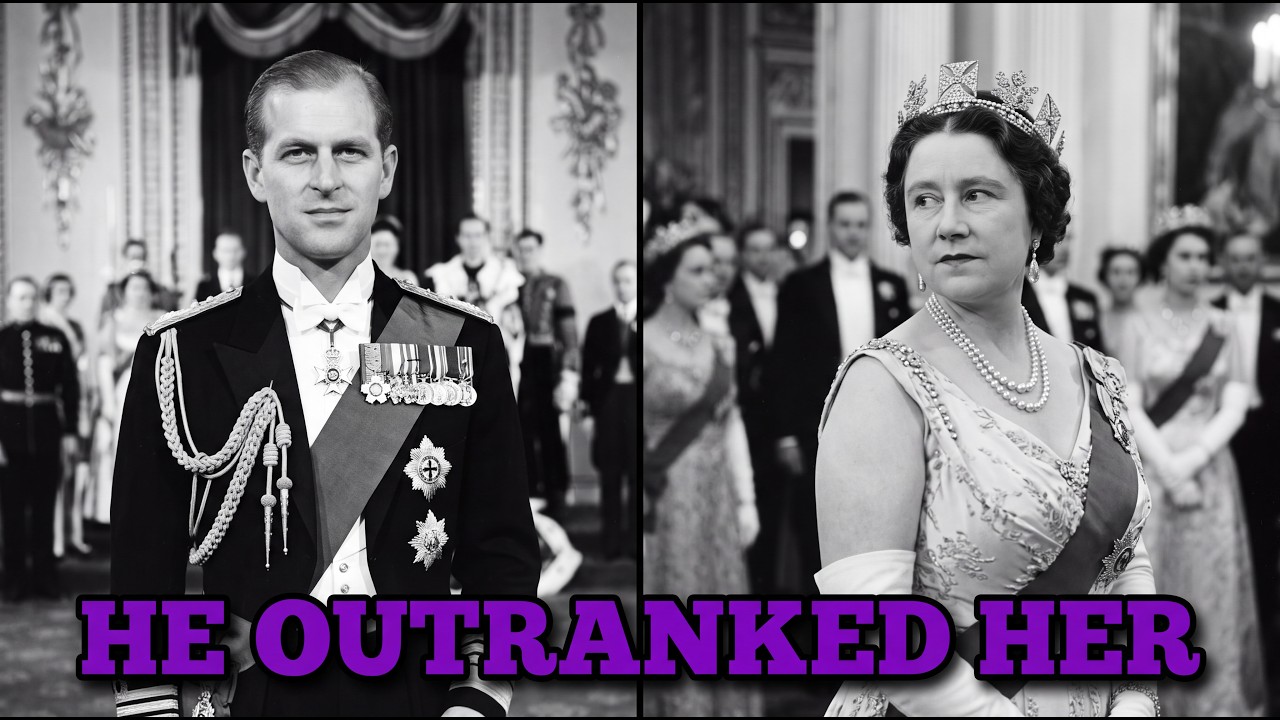
The 1957 instrument is about his title, nothing more. When Philip naturalised as a British subject in 1947, he surrendered his Greek and Danish princely titles. The Duke of Edinburgh creation that same November gave him a British peerage but not the British style of prince. The 1957 letters patent restored that. It contains no language about place, pre-eminence, and precedence, and no clause altering his position relative to the Queen Mother or anyone else. The New York Times reported on it the following morning, 23 February 1957, and was explicit: Prince Philip's new title did not affect his income from the Civil List or his precedence at social affairs. Two instruments, two dates, two purposes. The 1952 warrant for precedence; the 1957 letters patent for title.
The conflict between Philip and the Queen Mother was real, even if its formal precedence dimension was more complicated than often described. To understand why it was real, one has to understand what the household actually looked like. Buckingham Palace has 775 rooms. In the early 1950s, its footmen wore scarlet livery, an ornate coat, waistcoat, breeches, and decorative trim that made them, as one exhibition on household service noted, the most visually defined of all servants in a royal establishment. Their uniform announced something: a ranked household was in motion.
The royal household's own archive description of the Master of the Household's department lists their functions. Footmen act as messengers, look after visitors staying in the royal residence, and assist with the serving of meals. A former personal footman described in a 2007 account carrying messages, serving and clearing meals, and riding on royal carriages when ambassadors were driven to and from the palace. Before the wider adoption of internal telephone use, the principal means of communication between royal apartments was a footman carrying a note or verbal instruction on foot from one set of rooms to another.
Brian Hoey, writing about palace life, noted "as much adherence to precedence and protocol below stairs as above." Every communication that passed through a footman passed through a ranked human intermediary. His journey from one apartment to another was not incidental. It was the mechanism, the visible daily enactment of how hierarchy moved through the building. The footman in scarlet livery walking a corridor was not a neutral delivery system. He was information about the social structure of the room he had just left and the one he was entering.
Philip had spent the years from 1949 onwards either in Malta, where he commanded the frigate HMS Magpie out of Valletta with Elizabeth joining him for extended periods, or at Clarence House in London, the home he and Elizabeth had lived in since their marriage in November 1947 and which he had renovated himself. Naval command culture is meritocratic and efficiency-oriented in ways that ceremonial household hierarchy is not. Rank in the Royal Navy is real and strict, but it exists to achieve outcomes. Ceremonial hierarchy enacted through physical performance rather than functional necessity would have been foreign to his professional formation.
When Churchill pressed for the move to Buckingham Palace, reportedly encouraged by the Queen Mother according to accounts Giles Brandreth sourced to John Brabourne, Philip complied. He did not want to leave Clarence House. He came, and he stayed. In Brandreth's account of his stated philosophy, he summarised his approach to the constraints of the role: "I just had to get on with it. You do, one does." That is not a man experiencing defeat. It is a man managing a situation that is not to his preference and moving on to the next adjustment.
His approach to the palace staff from the early 1950s was consistent across multiple accounts. Personnel Today, in a 2021 profile, described it as operating almost as a quasi head of HR and facilities, a corporate-style approach to staff structure and working practices. He was the first member of the royal family to have computers in his office at Buckingham Palace. He reorganised the royal estates at Balmoral and Sandringham. Smithsonian magazine described him as the first royal family member to use a computer, someone who picked up the phone but also wrote all his own emails. The telephone campaign was not an isolated instinct. It was one expression of a systematic approach to modernising an institution he had been reluctantly installed in.
At the coronation on 2 June 1953, he knelt before Elizabeth and spoke aloud: "I, Philip, Duke of Edinburgh, do become your liege man of life and limb, and of earthly worship, and faith and truth I will bear unto you to live and die against all manner of folks. So help me God." That was the formal record. What was happening in the corridors of the building away from the ceremony was considerably more contested.

In the early 1950s, Philip pushed for greater use of internal telephones for communication within the palace. The precise framing matters here. Telephones were not invented for Buckingham Palace by Philip. The Museum of London holds a private branch exchange switchboard from the palace whose catalogue states it was installed in 1930 in a room off the Court Post Office and remained in use until the late 1960s. The palace had a telephone system. What Philip fought for was the practice of using it, calling directly from one apartment to another rather than summoning a footman to carry a note or a verbal message across the building.
Personnel Today's 2021 profile is the sharpest summary: Philip thought against the Queen Mother during his successful campaign to have telephones installed in the palace. She preferred using footmen for the passing of messages. The historian Sarah Gristwood, in later press coverage, described Philip's reforms as including ending the powdering of footmen's wigs and preferring house phones over sending messages verbally across the palace. Robert Lacey, in commentary for a 2019 documentary about the Queen Mother, described the conflict as Philip in the 1950s having removed the footmen who used to take messages from one royal to another.
Lacey's "removed" is stronger than the full evidence supports. Footmen were not abolished. The royal household in the modern period still describes footmen carrying out messenger duties alongside other service roles. What Philip reduced was the footman's function as the exclusive mechanism of internal communication. Once a telephone sits on a desk and anyone in the building can dial anyone else directly, one of the footmen's primary functions is made functionally redundant for the people with access to the phone. The hierarchy embedded in the message-carrying system does not disappear on the written table. It just loses its daily physical enactment. The footman walking a corridor carrying a note is a visible, legible performance of the building's structure. A telephone call is private, direct, and unobserved by anyone except the two people speaking.
Robert Lacey, speaking in commentary for that same 2019 Channel 5 programme, characterised the Queen Mother's orientation this way: "There she was, unashamedly harking back to when Britain had an empire, charming, aristocratic, frankly snobbish, no pretence of actually living in the 20th century." That characterisation belongs in Lacey's mouth. He is the historical consultant to The Crown, the author of multiple Queen Mother biographies, and that sentence is his documentary commentary, not a passage from any of his books. "Charming" is Lacey's word, offered as part of a string of adjectives that also includes "frankly snobbish." He is not complimenting her. He is describing a coherent worldview.
Professor Jane Ridley, speaking in the Smithsonian Channel documentary The Private Lives of the Windsors, put the dynamic directly: "The Queen Mother viewed him as rather an enemy, and in fact, one would see those early years as being a tug-of-war and a tussle for the ear of the Queen." Ridley is characterising the relationship from her own perspective as a historian. She is not quoting the Queen Mother directly. This comes from documentary commentary, not from her biography of George V, whose chronological scope ends well before this period.
Neither Philip's documented statements on this specific conflict nor the Queen Mother's are available in clean primary source form. No letter or diary entry specifically about the telephone dispute has surfaced in the accessible record on either side. What is documented is the pattern of each person's instincts: Philip towards efficiency and functional modernisation, the Queen Mother towards continuity and ceremonial form. The telephone campaign played out across those fault lines, and it is recorded consistently across multiple independent biographical and journalistic accounts as a campaign Philip fought and won.
Christopher Warwick, one of the most respected royal biographers of his generation, who died in March 2022, characterised this period of the Philip–Queen Mother relationship as never arriving at a productive understanding. That phrasing is weaker than "never forgave," and it is what the evidence supports. They shared a building for less than a year before she left it. They shared a family for seven more decades. They never reached anything that could be described as understanding.
The Queen Mother moved to Clarence House in May 1953, before the June coronation. Multiple biographers describe her as having been pressed into the move. One account uses the phrase "practically carried." She reportedly described the prospect as "loathsome." Clarence House, while entirely comfortable, was the house Philip and Elizabeth had renovated and inhabited as their home from 1949 to 1952. She lived there from 1953 until her death in 2002, 49 years in the house that had been Philip's.

Philip stayed at Buckingham Palace from the summer of 1952 until he retired from public duties in August 2017. It was his primary London residence. He died at Windsor Castle in April 2021, aged 99. The received version of this conflict, that the Queen Mother won and that Philip was somehow displaced or defeated, is contradicted by the simple geography of where each person ended up and how long they remained there. He stood his ground. He held the building. He held the formal precedence by Royal Warrant from September 1952 onwards.
One detail from the Brandreth-sourced account is worth noting. It was reportedly Churchill, encouraged by the Queen Mother, who insisted that Philip and Elizabeth move from Clarence House into Buckingham Palace in the first place. If that is accurate, she pressed for a move that placed Philip inside a building from which she would later have to leave. The evidence for this is one removed from a primary source and should be held carefully. But the end point needs no such qualification. She left Buckingham Palace in May 1953. Philip remained.
What neither of them won was the relationship. "Never arrived at a productive understanding" is the correct formulation. They were bound to each other by the woman they both loved. They were fundamentally incompatible in how they believed the institution should function. The Queen, Elizabeth II, navigated between them for seven decades, and if she ever expressed a preference between their competing instincts, it did not reach the public record. She stayed above it. Both of them deferred to her even when they could not defer to each other.
One argument Philip lost, and one he won in the wrong direction. In May 1961, the Queen Mother wrote that Eton was ideal for one of his character and temperament, meaning Charles, then 12 years old. She warned that Gordonstoun would leave him "terribly cut off and lonely in the far north," and stated plainly that if he went there, he might as well be at school abroad. Her argument was practical. Eton was close to Windsor. Charles could see his parents. The environment suited a sensitive boy.
Philip had attended Gordonstoun himself, enrolled there in 1934 after its founder, Kurt Hahn, a German Jewish educator who had fled Nazi persecution, established the school in Scotland. Philip became head boy. He argued Eton was too close to London and too exposed to media attention, that the physical demands of a remote Scottish school would be constructive for a shy boy, and that the remoteness would give Charles privacy. Lord Mountbatten, Philip's uncle, supported Eton alongside the Queen Mother. Philip prevailed anyway. On 1 May 1962, Philip flew Charles to RAF Lossiemouth and drove him to Gordonstoun himself. Le Monde covered the outcome and stated it without equivocation: Charles would attend Gordonstoun, his father's school, and not Eton, despite the Queen Mother's wishes, because Philip decided otherwise.
Charles's experience at Gordonstoun is documented with some complexity. In a 1975 speech marking the launch of the Prince's Trust, Charles said he was glad he had attended, that the toughness had been exaggerated, and that the school demanded more of you as an individual than most other schools did, mentally or physically. Ross Benson's biography of Charles describes a boy who detested Gordonstoun and was bullied cruelly and without respite. Both things can be true across different years of the same experience.
What is documented clearly is the relationship that formed in the aftermath. The Queen Mother wrote to Charles: "You have made your desiccated old grandmother laugh immoderately, and long may you continue to do so." Multiple biographers describe her as the person in the royal family who most intuitively understood Charles's temperament: the sensitivity, the emotional complexity, the need for warmth and encouragement that Gordonstoun was not designed to provide. She had argued in 1961 that this temperament made Eton the right choice. She lost the argument. She then became the person who provided what the winning choice did not. When Charles had children of his own, William and Harry went to Eton.
Philip won the school decision. The emotional outcome was the opposite of what a Gordonstoun toughening argument would predict. He sent his son to a school his son found difficult and found his son's closest ally in the grandmother who had argued against that school. She understood Charles. She had told Philip what kind of boy Charles was and what kind of environment he needed. She was right. Philip won the argument. She won what came after it without even contesting it.
The order of precedence still exists. It is still maintained, still consulted, still settles who goes through a door first at a state dinner in London tonight. What no longer exists is the thing that made it matter inside Buckingham Palace in the early 1950s: a household in which rank had to be physically carried from room to room by a person on foot in livery because there was no other way to move a message. Philip did not argue with the table. He made the table irrelevant to daily life by expanding the use of a device that let anyone in the building speak to anyone else without a ranked human being in between.
She objected to the telephones the way she objected to the smaller house, and for the same reason. Both were reclassifications. Clarence House was not Buckingham Palace. A telephone extension was not a footman in scarlet livery. Each change reduced the physical machinery through which her position had been enacted, not on paper, but in the actual corridors and rooms of a building where she had been queen. She understood immediately what they meant.