More than half a century after the end of the Vietnam War, a former American soldier still wakes some nights with the same question haunting him since 1970. What happened to the woman he loved and the daughter he never had the chance to hold? For John Caputo, time never erased that love. It only made the silence harder to bear.
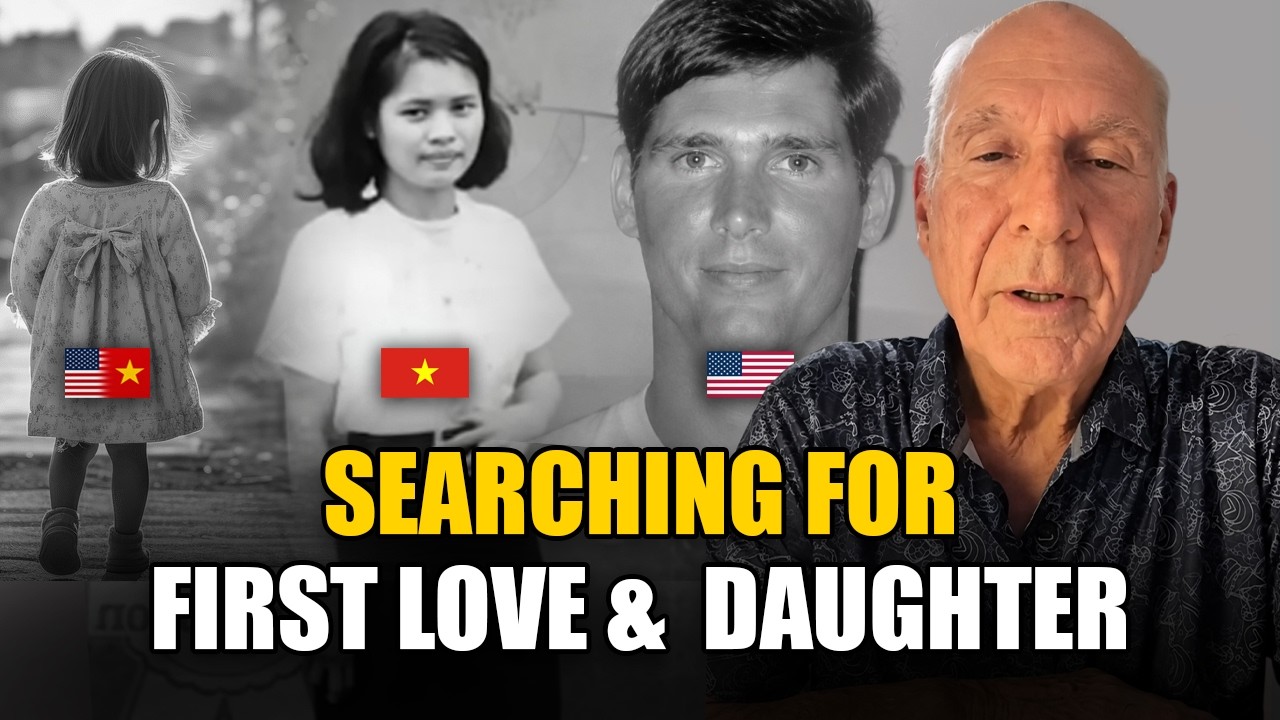
John was a young American soldier stationed at Long Binh, one of the largest U. S. military bases in South Vietnam, during the early 1970s. His duties sometimes took him from Long Binh to Saigon, where the crowded streets offered a brief escape from military routine.
On one of those trips, everything changed. On Tu Do Street, today known as Dong Khoi Street, John met a young Vietnamese woman named Nguyen Thi Mai. She was about seventeen years old and worked at a bar in the heart of Saigon. The meeting seemed ordinary at first, just another passing encounter between two people from completely different worlds.
Yet something about Mai stayed with him. To this day, John treasures an old black-and-white photograph of her. The paper has faded with time, but the memories attached to it have not. In the picture, Mai’s shoulder-length black hair frames her delicate face.
She looks directly at the camera with soft eyes that seem to carry both innocence and quiet sadness. It is one of the few pieces he managed to keep for more than 50 years. As the weeks passed, their relationship deepened. The world around them continued, but when they were together, the outside world seemed to fade away.
They did not talk much about the future, because in wartime, tomorrow was never guaranteed. John knew surprisingly little about Mai’s family and childhood. All he knew was that she came from a village outside Saigon and lived in a small upstairs room above the bar where she worked. Looking back today, he realizes how little he truly knew about her life.
Yet sometimes love is not measured by how many facts two people know about each other. Sometimes love grows from shared moments, quiet conversations, and the comfort of simply being together in a troubled world. Then their lives changed forever. Mai became pregnant.
For John, this was not just a fleeting wartime romance. He wanted something much bigger. He dreamed of taking Mai to the United States, marrying her, and raising their child together. But history had other plans.
In November 1970, as Mai approached her due date, John’s military service in Vietnam came to an end. Military regulations prevented him from taking her home with him. Because Mai was still seventeen, immigration procedures made it nearly impossible for her to leave Vietnam. Facing this painful reality, John searched for the safest solution.
Before boarding the plane back to America, he brought Mai to a Catholic orphanage so she could stay safe until the birth. It was the hardest decision he ever made, but he believed it was temporary. He was completely confident they would be reunited one day. He had no idea that goodbye would turn into a separation lasting more than half a century.
After returning to the United States, John was determined not to lose contact with Mai and their unborn child. Despite the vast ocean between them, he continued sending money to support them, believing they would meet again someday. John believes Mai gave birth to their daughter at Gia Dinh Hospital. The news reached him through Sister Maria, a Catholic nun who worked at the Bao Tinh orphanage.
She wrote to tell him that Mai had delivered a healthy baby girl. The child was named Nguyen Ngoc Linh. In English, her name was Catherine. For John, the letter was both joyful and heartbreaking.
He had become a father, yet he was thousands of miles away, unable to hold his daughter or even see her face. Supporting them from afar was the only role he could play, and he accepted it without hesitation. Mai’s life after the birth was not easy. She returned to work quickly to earn a living, leaving Catherine in the orphanage’s care during the day before picking her up each evening.
Through Sister Maria, John sometimes received letters from Mai describing their lives. Those letters became his only window into the family he longed to live with. Then, sometime around 1972, the letters stopped arriving. John waited for another envelope, believing the silence would be temporary, but months passed with nothing coming.
Around the same time, Sister Maria was transferred to another assignment. Before leaving, she warned him not to send more money because she could no longer guarantee it would reach Mai and Catherine. That conversation marked the end of his last remaining connection to Vietnam. As the years passed, John carried an increasing burden of unanswered questions.
He wondered repeatedly whether Mai had survived the difficult years after the war, whether Catherine had grown up knowing anything about her American father, or whether they simply believed he had abandoned them. That thought haunted him for decades because it was the opposite of the truth. People around him encouraged him to move on with his life, and in many ways he did. But there remained an unfinished chapter he could never close.
The world around him changed, yet his memories of Mai and the daughter he never met stayed as vivid as ever. In 1978, John decided to search again, hoping official records might still exist. He contacted the International Red Cross and asked for help locating Mai, Catherine, or the orphanage where they had stayed. After about six months, a reply finally arrived.
The news was devastating. The organization’s office in Vietnam no longer existed, and the records that might have led him to his family had disappeared. Once again, his search hit a dead end. Still, John refused to accept that the story was over.
When DNA testing became available decades later, he saw a new opportunity. In 2015, he submitted his DNA sample, hoping that his daughter, or perhaps one of her children, would one day take a test and match the result he had been waiting for. Year after year, he checked for updates. More than a decade passed without a biological match, but he never removed his data from the database.
As long as it remained there, he believed there was a chance Catherine might one day find him. In June 2026, John shared his story publicly through the YouTube channel “Tuan Vy Ket Noi Yeu Thuong,” hoping someone in Vietnam might recognize the names or circumstances. With great emotion, he said: “I never forgot you two, you and our daughter. I never stopped searching for both of you.
There were countless nights I stayed awake crying because I didn’t know what had happened to either of you. ”
He also shared the memories he had carried in his heart for more than 50 years. “I want you to know that I never stopped searching for you,” he said. “My daughter is now about 54 or 55 years old.
I want both of you to know I never forgot you. There were many nights I cried because I didn’t know what happened to them. She is a part of me and she is the woman I loved. I wanted to marry her.
”
John admits he has tried again and again to move past the past. After more than half a century, he knows the chances of finding Mai and Catherine are uncertain. Yet every attempt to forget ended the same way. The hope of seeing them again never faded.
Today, his search continues not because he is trapped in the past, but because he still believes the people he loves deserve to know a simple truth. They were never forgotten.