On October 29, 1997, inside a federal courtroom in Brooklyn, an old man in a wheelchair sat slumped with his mouth open, staring at the wall. He was unshaven, his hospital gown wrinkled, and a nurse stood behind him holding an oxygen tank. As the prosecutor read charges of racketeering, murder, conspiracy, and extortion, the man did not react, did not speak, and did not seem to know where he was. The jury watched him drool, then returned a verdict: guilty, 12 years in federal prison.
What the jury did not know was that the bathrobe was a costume, the wheelchair was a prop, and the man inside the act was the most powerful crime boss in America. His name was Vincent Gigante, known as Chin, and he was 70 years old that day in court. A former boxer from the West Village, he had run the Genovese crime family since 1981.
While five other New York bosses were locked up, killed, or flipped, Chin sat untouched at the top of the most disciplined mafia organization on the planet. The FBI estimated his family pulled in over 100 million dollars a year from construction, garbage, the Fulton Fish Market, the Javits Center, and the waterfront unions. He gave every order while shuffling around Greenwich Village in a ratty bathrobe, talking to himself, pretending to be insane.
Chin did not just fool the FBI. He fooled his neighbors, doctors, and federal judges for almost three decades. The system he built—the phone booth rotation, the whisper rule, the bathrobe walks—was so airtight that for 30 years not a single recording of his voice giving an order ever made it into a courtroom.
To understand the act, you have to understand the man before the act. Vincent Louis Gigante was born March 29, 1928, on Bleecker Street in Greenwich Village. His parents were immigrants from Naples; his father was a jeweler and his mother a seamstress. There were five Gigante boys, all raised in a cold water tenement where the rent was $19 a month.
Vincent was the third son. He got the nickname Chin from his mother, who called him Vincenzo, shortened to Chinzino, which the neighborhood kids cut down to Chin. The name stuck for the rest of his life.
The Gigante boys were tough, but they were not the same. Mario became a truck driver, Pasquale joined the Air Force, Ralph became a school teacher, and Louis, the youngest, became a Roman Catholic priest. Father Louis Gigante would become important later.
But Chin was the fighter. By 16, he was a professional light heavyweight boxer with a record of 21 wins and four losses. He fought at Madison Square Garden and sparred with future champions. Somewhere in his boxing career, he met a man named Vito Genovese.
Vito was the boss, the man the family was named after. He saw something in Chin that the boxing trainers had missed: discipline, loyalty, and a complete absence of fear. By the early 1950s, Chin had hung up the gloves and become Vito's driver, bodyguard, and shadow.
On the night of May 2, 1957, Vito gave him the assignment that would change everything. The target was Frank Costello, the most respected mafia boss in America. Vito wanted him dead so he could take over the family. The contract went to Chin, who was 29 years old.
The plan was simple. Costello lived at the Majestic apartment building at 115 Central Park West. Chin waited in the lobby. When Costello walked in just before 11:00 p.m., Chin stepped out from behind a column, raised a .38 caliber revolver, and shouted, "This is for you, Frank." He fired one shot.
The bullet grazed Costello's scalp. Costello dropped to the floor, alive but bleeding. Chin ran, thinking he had killed him. He had not. That one missed bullet became the foundation of everything that came next.
Costello survived and retired rather than retaliate. Vito Genovese took over the family. And Chin, the kid from Sullivan Street, was suddenly a made man with a reputation. He was acquitted at trial. Costello refused to identify him, and the doorman developed sudden amnesia.
Chin walked free, but he had learned something in that courtroom that would shape the rest of his life. Witnesses forget. Cops make mistakes. The system has cracks. And if you know where the cracks are, you can live inside them forever.
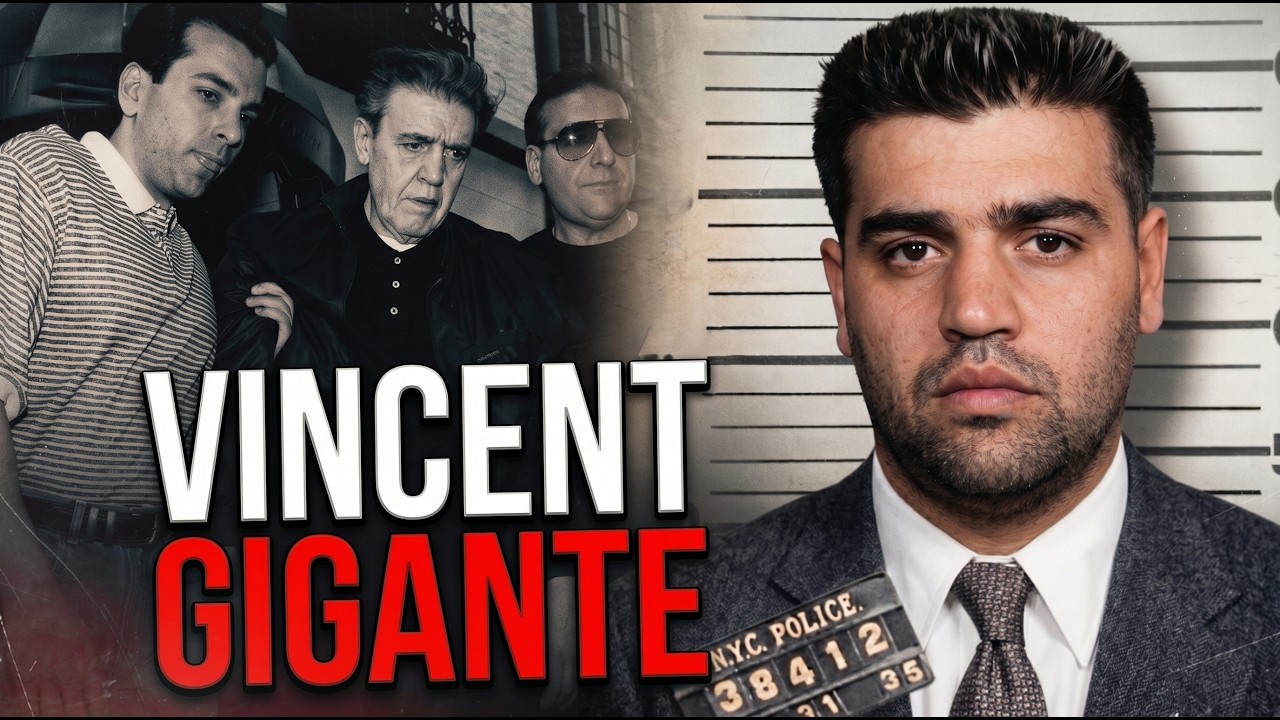
Through the 1960s, Chin climbed. He became a capo, then a consigliere. He ran loan sharking out of the Triangle Civic Improvement Association at 208 Sullivan Street, a storefront social club with a steel door and a buzzer system. The Triangle had no sign, no menu, and no phone listed in any directory.
Inside, men played cards, drank espresso, and discussed which teamsters local needed a new president and which judge needed an envelope. The Triangle was the nerve center. And by 1969, Chin had started doing something that nobody understood. He started acting crazy.
It began small. He stopped wearing suits and started showing up at the Triangle in pajamas. He muttered to himself and stopped showering. His own crew thought he had cracked under the pressure. But Chin had been arrested in 1969 on bookmaking charges, and his lawyer floated an insanity defense.
Doctors examined him and diagnosed schizophrenia. The case fell apart, and Chin realized something nobody else in the mafia had figured out. If you are legally insane, you cannot stand trial. If you cannot stand trial, you cannot be convicted. If you cannot be convicted, you cannot go to prison.
The bathrobe was born that year. He wore it for the next 30. Every morning around 10:00 a.m., Chin would shuffle out of his mother's apartment at 225 Sullivan Street. He lived with her well into his 60s.
He wore the same outfit: a faded terrycloth bathrobe, sometimes blue, sometimes brown, always stained, with pajama bottoms, slippers, and sometimes a wool cap pulled down over his ears. He needed a shave. He talked to parking meters. He urinated in the street. He stood on corners staring at nothing.
The neighbors called him the Oddfather. Tourists took photographs. Cops watched him and shook their heads. But the bathrobe walks were not random. They were operational. Every step was choreographed. Every conversation was business. And the FBI, which had been watching Chin since the Costello hit, was missing the entire thing.
This is how it actually worked. Chin would shuffle out of the apartment around 10:00 a.m. and walk three blocks to the Triangle. He would sit inside for an hour drinking coffee, saying nothing out loud. Orders were passed through written notes that were burned in an ashtray within minutes of being read.
Then he would leave the Triangle and begin what the FBI eventually called the walk. He moved through the West Village in a specific pattern, always different, never repeated two days in a row, but always touching the same set of locations. At certain corners, at certain times, he would stop at a payphone.
There were 13 of them. The FBI documented every one. A booth on the corner of Sullivan and Bleecker. Another on West 3rd Street. One outside a bakery on Carmine. One near the corner of Houston and MacDougal. Thirteen public phones across a roughly 12 block radius.
Chin rotated between them on a schedule only he and his closest captains knew. He never used the same phone twice in one day. He never used a phone at the same time on consecutive days. The reason was simple. The FBI could only tap a phone if they knew which phone to tap. By the time they got the warrant, Chin had moved on.
And he never spoke into the receiver himself. That was the whisper rule. Chin would shuffle up to a booth. A captain, usually Dominick Cirillo, who they called Quiet Dom, would already be inside or waiting nearby. Chin would lean in close and whisper. Cirillo would pick up the phone and relay the order.
The conversation never used names. Family members were referred to as the guy with the nose or the kid from Brooklyn or our friend on the avenue. Murders were called pieces of work. Money was called documents. Construction extortion was called the asphalt thing. Every word was code and every code rotated.
The FBI tried everything. They put parabolic microphones on rooftops aimed at the booths, but the street noise drowned out the whispers. They tried lip readers, but Chin held his hand over his mouth. They tried bugging the booths themselves, but he stopped using booths that had been visited by phone company workers. They tried photographing him, but he kept his head down and his hood up.

For close to 20 years, the most surveilled man in American organized crime did not generate a single piece of usable audio evidence. By 1981, the family had a problem. The official boss, Funzi Tierri, was dying of cancer. The commission needed a new boss. There were three obvious candidates, and then there was Chin, the lunatic in the bathrobe.
Most observers thought he had no chance. The commission picked him anyway. Why? Because while everybody else was getting indicted, Chin was getting committed to mental hospitals. He was untouchable. He was invisible. And when the bathrobe came off behind closed doors, he was the sharpest strategist in the room.
The first thing he did as boss was pull off the greatest deception in Mafia history. He ordered every captain in the family to deny he was the boss. The official boss, on paper, was a man named Anthony Salerno, a cigar-chomping 70-something everybody called Fat Tony.
Salerno operated openly. He held meetings at the Palma Boys Social Club in East Harlem. He spoke on tapped phones. He gave orders that the FBI recorded. And in 1986, Salerno was indicted in the commission case, convicted, and sentenced to 100 years in federal prison.
The FBI celebrated. They thought they had taken down the Genovese boss. They had not. They had taken down a decoy. The real boss was still walking around Sullivan Street in a bathrobe.
The schemes Chin ran during this period were extraordinary in their scale. The construction industry in New York was almost entirely under Genovese control. Concrete pouring, drywall, demolition, window installation—every major project in Manhattan paid a tax.
Here is how the concrete club worked. Any pour of concrete worth more than $2 million required approval from the family. Six approved contractors split the work. The price was inflated by 2%. That 2% flowed back to the family as cash every Friday in shopping bags delivered to Sullivan Street. On a single Midtown skyscraper, the take could exceed $7 million.
Across the city and across years, the concrete club generated tens of millions annually for Chin alone. The Fulton Fish Market was another machine. Every truck that delivered fish paid a parking fee to a man on the street. That fee was $4 per truck. There were over 1,000 trucks a day.
The math was simple. $4,000 in cash every single day, six days a week, for decades. That was just one corner of one operation. The Javits Convention Center on the West Side was even bigger. Every exhibitor who set up a booth had to pay union laborers, controlled by the family, to plug in a lamp or hang a sign. A single trade show generated hundreds of thousands of dollars in fake labor charges. Chin took a cut of all of it.
And here is the humanizing detail. He didn't spend any of it. Chin lived with his mother. He drove a beat-up Chevy. He wore the same bathrobe for years. His daughters went to Catholic school. His wife, Olympia, lived in a separate house in New Jersey. And he kept a long-time girlfriend, Olympia Esposito, with whom he had three more children, on the Upper East Side.
Two families. Two houses. And he still slept on Sullivan Street most nights in his mother's apartment, in a bedroom he had used since he was a child. The money disappeared into the family. Into envelopes for soldiers, into payoffs for judges and union officials, into the machine. Chin himself owned almost nothing in his own name. That was the discipline. That was why he could not be touched.
But the act was getting harder to maintain. By the late 1980s, the FBI had brought in psychiatrists who specialized in malingering, the clinical term for faking mental illness. They watched hours of surveillance video and noticed things. The way Chin would shuffle in public but walk normally inside the Triangle. The way his speech was incoherent in front of cameras but sharp in wiretapped conversations between his captains. They started building a case not just against his crimes but against the act itself.
Then came the betrayals. In 1991, a Genovese soldier named Peter Savino, who was wearing a wire, recorded a captain named Venero Mangano talking openly about Chin being the boss. The tape was the first crack. In 1995, Sammy "the Bull" Gravano, the Gambino underboss who had flipped on John Gotti, told prosecutors that the entire Mafia knew Chin was running the Genovese family and that the bathrobe was theater.
Then came the most devastating witnesses of all. Salvatore Vitale and Alphonse D'Arco, both former family administrators from rival borgatas, sat down with the FBI and described in detail sit-downs they had attended where Chin gave orders, lucid and commanding, while wearing a suit and tie inside a private apartment. The dam was breaking.

In 1990, a federal judge had ruled Chin too mentally incompetent to stand trial. By 1996, prosecutors had a new theory. The act itself was a racketeering crime and obstruction of justice that had stretched across decades. They brought in Dr. Daniel Martell, a forensic psychologist, who reviewed the entire body of surveillance and testimony and concluded what the FBI had believed all along. Vincent Gigante was not insane. He was the most disciplined performer the bureau had ever encountered.
And then came the moment nobody saw coming. The moment that finally broke the act in the public eye. It came from inside the family. Not the crime family. The Gigante family. His own brother.
Father Louis Gigante had defended Chin for decades. Father G, as the South Bronx called him, was a beloved priest and community activist. He ran the Southeast Bronx Community Organization. He built thousands of units of affordable housing. He had a radio show. And every time a reporter asked him about his brother, Father Louis said the same thing. Vincent is sick. Vincent is mentally ill. Leave my brother alone.
He testified at competency hearings. He met with prosecutors. He pleaded with judges. And the public believed him because he was a priest and priests do not lie. But in 1997, during pretrial proceedings, prosecutors revealed they had evidence that Father Louis had been carrying messages back and forth between Chin and his captains for years. The priest, the family's most credible defender, had been functioning as a courier. He denied it under oath.
The act held in court. But behind closed doors, the strategy collapsed. In 2003, after Chin had already been convicted and was serving time, something extraordinary happened. Inside a federal courthouse, facing a new round of charges, Chin himself, sitting next to his lawyer, finally said the words. He admitted, on the record, that he had been faking his mental illness for the previous 30 years. He pled guilty to obstruction of justice. The bathrobe came off. The act was over.
According to multiple accounts from people inside the family, Chin's son, Andrew, who had become a captain, had pushed his father to admit it, arguing that the continued performance was costing the family more than it was protecting. Father Louis did not publicly confirm any of this. But the moment the courtroom admission happened, the entire mythology of the Oddfather, built over three decades of bathrobes and phone booths and muttered nonsense, evaporated in a single afternoon.
The conviction in 1997 had given Chin 12 years. The 2003 obstruction plea added three more. He was sent to the Federal Medical Center in Springfield, Missouri, then transferred to the United States Penitentiary at Fort Worth, Texas. His health was failing. Heart disease, diabetes. The years of pretending to be sick had, by some accounts, actually made him sick.
He died in federal custody on December 19, 2005. He was 77 years old. His funeral mass was held at St. Anthony of Padua Church on Sullivan Street, two blocks from the Triangle, two blocks from the apartment where he had lived with his mother, two blocks from the corner where every morning for 30 years he had begun the walk.
The aftermath was quieter than anyone expected. The Genovese family did not collapse. That was the genius of what Chin had built. He had structured the family so that no single arrest could topple it. The succession was already in place. Quiet Dom Cirillo, the captain who had whispered into the phone booths for decades, became the new street boss.
The construction rackets continued. The fish market scams continued until the city finally privatized Fulton in 2005. The concrete club broke up only after federal prosecutors pursued individual contractors. But the Genovese family today remains by most estimates the strongest of the five families. The discipline Chin instilled outlived him.
What does this story actually reveal? It reveals something the FBI took 30 years to understand. The mafia was never beaten by guns. It was beaten by language. Every conviction in the modern era—John Gotti, Anthony Salerno, Sammy the Bull—every one of them came from words on tape. The boss who said too much went to prison. The boss who said nothing died free or close to it.
Chin understood that before anyone else. He understood that the modern mafia would not be killed by violence. It would be killed by recordings. And he built a system, a costume, a routine, a phone booth rotation designed for one purpose: to make sure his voice never ended up on a federal tape.
The strangest part of the whole story is this. The bathrobe worked. The phone booths worked. The whisper rule worked. For three decades, the most powerful organized crime boss in the United States walked freely down Sullivan Street and nobody—not the cops, not the press, not the tourists who pointed and laughed—knew what they were looking at.
He died in prison, but he died as boss. Of the five New York family heads who held power in the 1980s, he was the only one to keep his throne until the end. The others were dead, indicted, or running for their lives. Chin was still in his bathrobe and still giving orders until the day he finally said the words himself.
There is a lesson buried in this story and it is not the romantic one. It is not about loyalty or family or honor. It is about the price of disappearing. Chin Gigante won his 30-year war by refusing to exist as a person. No suits, no quotes, no public face, no personality the world could see.
He erased himself completely so the FBI would have nothing to convict, and in doing that, he became something stranger than a gangster. He became a ghost wearing a bathrobe, walking the same 12 blocks for three decades, ordering murders through whispered codes, owning nothing, saying nothing, leaving no trace.
The most powerful mafia boss in America spent 30 years pretending he was nobody. And the terrifying thing is that by the end, even his own family was not entirely sure where the act ended and the man began.