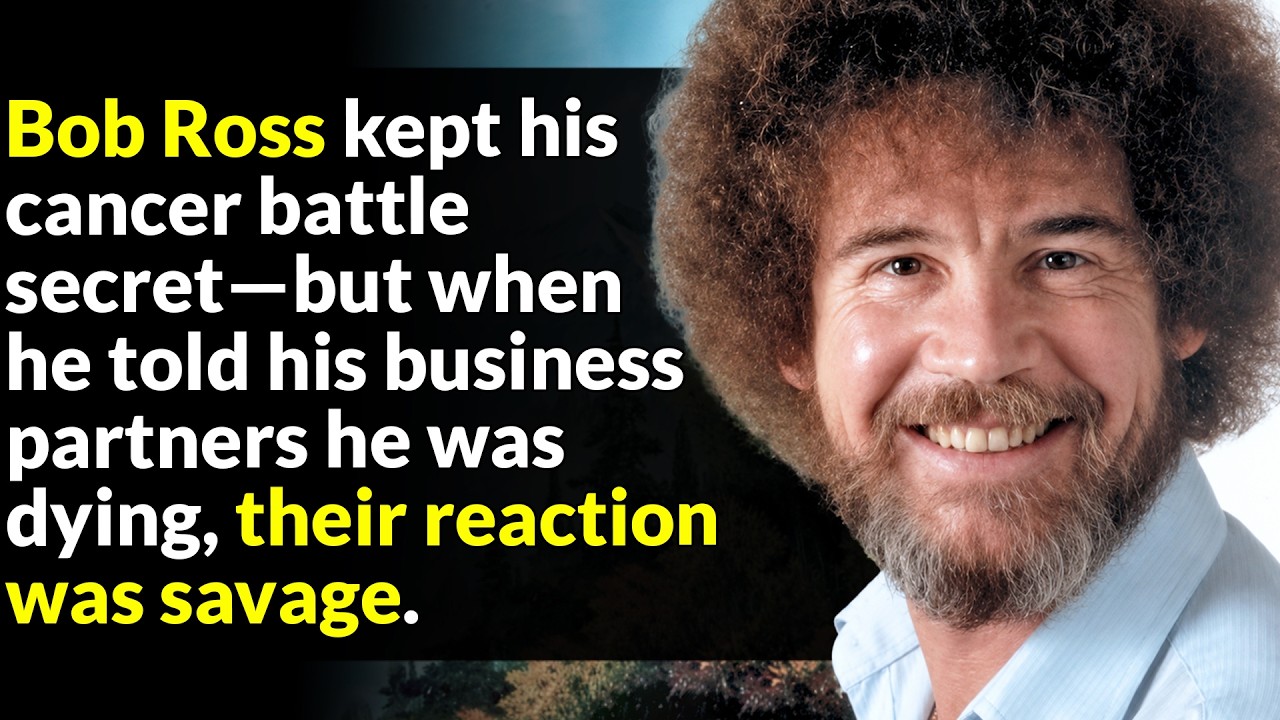
Bob Ross kept his battle with cancer largely private, revealing his diagnosis to only a handful of people. But when he finally told his business partners he was dying, their reaction was far from supportive. Ross became one of the most beloved figures in television history through his show “The Joy of Painting,” yet his path to that success was marked by unexpected turns, personal loss, and a final legal battle over his legacy. Born in Florida in 1942, Ross grew up watching his father, Jack, work as a carpenter.
He eventually began helping his father, developing hands-on skills that would later prove useful. But even as a teenager, he showed a different side of his character. When he wasn’t assisting his father, young Ross was caring for injured animals he found, including more dangerous creatures like snakes and alligators. His compassion for wildlife would remain with him throughout his life.
While helping his father one day, Ross lost control of a saw and cut off part of his left index finger. The accident didn’t stop him from pursuing his ambitions. In 1961, Ross joined the U. S.
Air Force. He had hoped to become a pilot, but due to flat feet and his height of six feet two inches, he was deemed unfit for flying. Instead, he served as a medical records technician and slowly rose through the ranks. Ross was eventually stationed in Alaska, where he worked surrounded by the stunning mountain and snowy forest landscapes that would later heavily influence his painting subjects.
During his time in the military, Ross was not the calm and gentle man audiences would come to know. He later admitted that his sharper, more volatile demeanor earned him the nickname “Bobby the Wrecker,” describing himself as the guy who would shout at you for being late to work. His life changed when he attended a U. S.
O. art class in Anchorage. He fell in love with painting immediately and began practicing on his own whenever his work schedule allowed. Ross sought out instructors to refine his craft but found himself disappointed with most of them, as they focused primarily on abstract painting.
His desire to learn other styles meant he rarely agreed with their approach. While working part-time as a bartender, Ross watched a television program called “The Magic of Oil Painting” hosted by painter Bill Alexander. The show demonstrated a 16th-century technique known as “wet-on-wet” painting, and Ross realized this was exactly what he had been searching for. He studied the technique diligently until he became proficient, eventually selling his natural scenes painted on gold-panning supplies as a side business.
By this point, Ross had already started a family. He married his first wife, Vivian Ridge, in 1965, and they had a son named Robert Stephen Ross, known to most as Steve. The marriage ended in divorce in 1977, with some accounts suggesting Ross’s infidelity was the cause, though this was never confirmed. As Ross continued his military career, he kept painting in his free time and selling his work.
He became so successful as an artist that he realized he was earning more money from painting than from his Air Force salary. Ross retired from the military in 1981 to devote himself fully to his art. He also decided to make a fundamental change in his approach to life. He had grown tired of the harsh, authoritarian attitude he had adopted in the Air Force and swore he would never raise his voice again, creating the gentle persona the world would soon come to love.
After learning the wet-on-wet technique from Bill Alexander’s show, Ross returned to Florida and contacted his mentor directly. He joined Alexander’s company, Alexander Magic Art Supplies, to further refine his style under the artist’s guidance. While training with Alexander, Ross began teaching his own art classes. One attendee was television producer Annette Kowalski, who believed he had what it took to start his own company.
With her husband Walt’s help, she convinced Ross to partner with them and establish Bob Ross Inc. Annette had been drawn to Ross’s noble, calm personality for heartbreaking reasons. She had tragically lost her son in a car accident, and Ross had worked wonders to help her cope with her grief. In 1982, Ross allowed a Virginia television station to record one of his classes.
After the lesson aired, he received offers from around 60 PBS affiliate stations. He eventually accepted an offer from WIPB in Indiana, particularly valuing their promise of complete creative freedom. “The Joy of Painting” followed a simple format. Ross would paint a scene from his imagination in about 30 minutes, teaching viewers his technique as if giving a private lesson.
Ross’s distinctive appearance became part of his iconic image. He always wore a light-colored button-up shirt with jeans. His famous curly afro, however, was originally a cost-cutting measure. When he was struggling financially to establish his company, he chose the hairstyle because it was cheaper to maintain.
By the time he could afford different haircuts, his face was already on the company logo, and he felt he could not change it. Ross also became known for his catchphrases and soothing manner of speaking. He would refer to the trees he painted as “happy little trees” and reassure viewers with sayings like, “We don’t make mistakes, just happy accidents. ”
His work ethic was remarkable.
Ross typically painted three versions of each painting for every episode: one beforehand as a reference, one during the episode, and a more detailed version for his instructional books. Ross never forgot his roots. In the first episode of season two, he dedicated the show to Bill Alexander, saying, “I feel like you gave me a precious gift and I would like to share that gift with you. ”
Unfortunately, the feeling was not mutual.
By the 1990s, the two were no longer speaking, and Alexander claimed Ross had betrayed him by finding greater success with the technique he had taught him. Ross’s son Steve followed in his father’s footsteps and became a painter himself. He appeared as a guest on “The Joy of Painting” several times and worked alongside his father on multiple occasions. Bob Ross Inc.
became extremely successful. Along with the show’s popularity, the company launched a new line of video lessons and painting supplies, eventually growing into a $15 million enterprise. While Ross became as famous as many of history’s greatest artists, his work never received comparable recognition in the global art world. Still, he maintained a loyal fan base willing to pay significant sums for an original Ross painting.
Ross never abandoned his love for animals. He spent his free time in the wilderness and enjoyed photographing wildlife rather than painting it. He continued to help any injured or sick animal he found. Growing up in the American South, Ross developed a love for country music.
In 1987, he attended a Hank Snow performance, and Snow invited him on stage to a standing ovation. As thanks, Ross agreed to give Snow a private painting lesson. Ross enjoyed hosting “The Joy of Painting” so much that he would have continued forever if he could have. He earned no money directly from the show itself, but he was happy to film it without pay because his company generated substantial profits.
His second marriage, to Jane, lasted 15 years before she developed a severe case of cancer and died in 1992. Ross’s own health was also declining. After a lifetime of smoking, he was eventually diagnosed with lymphoma. He knew it would ultimately take his life, and although those close to him knew as well, he chose to keep his struggle out of the public eye.
Among the people Ross confided in were Annette and Walt Kowalski, trusting that his company would be in safe hands after his death. The contract in place at the time stipulated that if any partner died, that partner’s shares would be divided equally among the others. This should have been sufficient for the Kowalskis, but they wanted more. Seeing how successful the company had become with Ross’s face on it, they wanted the rights to his estate as well.
Rather than negotiating with tact, they became hostile toward Ross and his family, pressuring him to sign over the rights before he passed away. Ross never accepted the Kowalskis’ unprofessional and cruel behavior. In response, he removed them from his will entirely, leaving all rights to his property, name, and likeness to his half-brother, Jimmie Cox, and his son Steve.