Less than 24 hours after President John F. Kennedy was assassinated in Dallas, the new president, Lyndon B. Johnson, received a phone call in the Oval Office that raised the possibility of a conspiracy.
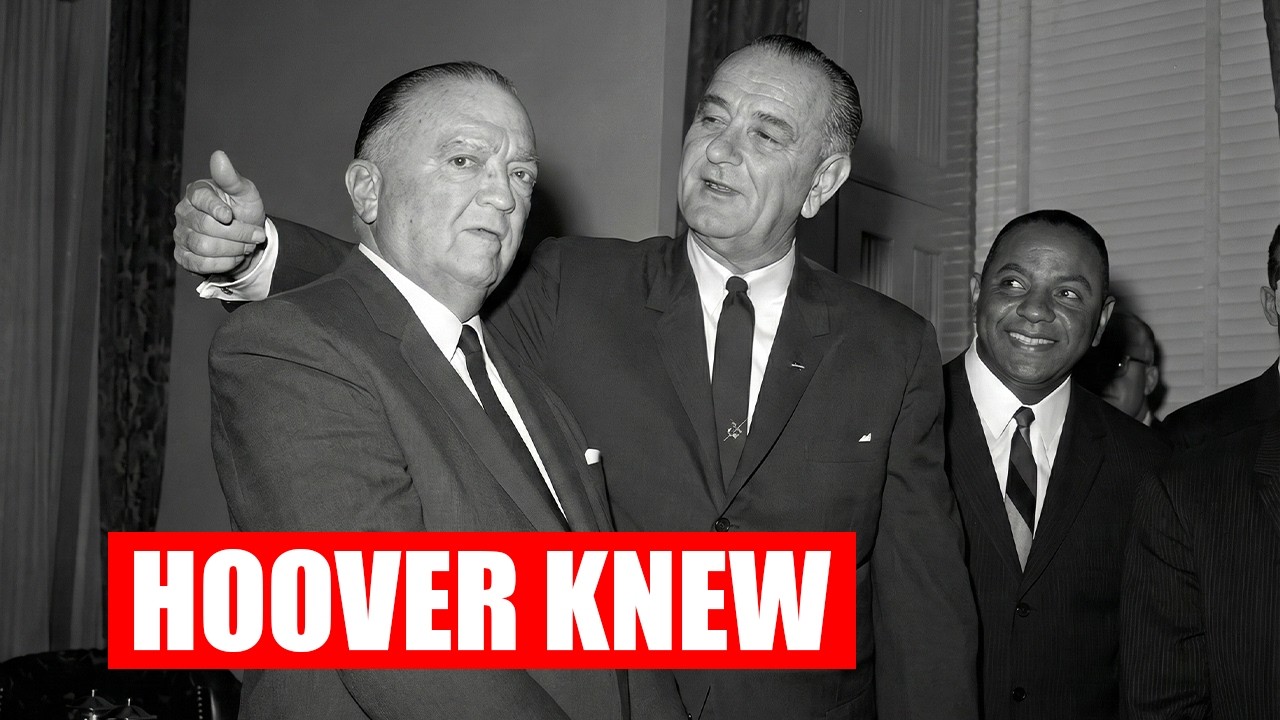
The call came at 10:00 a.m. on November 23, 1963, from J. Edgar Hoover, the director of the FBI and the most powerful law enforcement official in the country.
Hoover was calling with an update on the investigation. What he told Johnson would cast doubt on the official story from its very first day.
According to the transcript preserved at the LBJ Presidential Library, Johnson asked Hoover whether investigators had established anything more about a visit to the Soviet Embassy in September.
Hoover replied that it was "one angle that's very confusing." He explained that the FBI had obtained a tape and a photograph of the man who had been at the Soviet Embassy using Oswald's name.
Then came the revelation. Hoover said the picture and the tape did not correspond to Lee Harvey Oswald's voice or his appearance.
In other words, it appeared that a second person had been at the Soviet Embassy in Mexico City using Oswald's name.
This was not speculation on Hoover's part. The CIA had sent the tape and photograph to FBI headquarters, and Hoover's agents had analyzed them.
Their conclusion was that the man in Mexico City was not Lee Harvey Oswald.
The same day, Hoover sent a formal memo to the White House and the Secret Service. The memo stated that the CIA had advised that on October 1, 1963, an extremely sensitive source reported that an individual identifying himself as Lee Oswald had contacted the Soviet Embassy in Mexico City.
Special agents of the FBI who had conversed with Oswald in Dallas had observed photographs of the individual and listened to a recording of his voice. Those agents were of the opinion that the individual was not Lee Harvey Oswald.
The agents who reached that conclusion knew Oswald. They had interrogated him in Dallas. They knew his voice and his appearance.
Their finding pointed to impersonation, a setup, and someone creating a false trail linking Oswald to Soviet intelligence before the assassination.
The timeline of Oswald's Mexico City trip is central to the story. According to the Warren Commission, Oswald traveled by bus from New Orleans to Mexico City, arriving on September 27, 1963.
His goal was to obtain visas to visit Cuba and the Soviet Union. He visited the Cuban Embassy multiple times, spoke with officials, and applied for a transit visa to Cuba.
He also visited the Soviet Embassy and tried to expedite his Soviet visa application, meeting with consular officials.
The CIA, running an operation known as LIENVOY, had the Soviet and Cuban Embassies under total surveillance. Phone taps and hidden cameras recorded everything.
When Lee Oswald called the Soviet Embassy, CIA tapes captured his voice. When he visited the embassies, CIA cameras photographed him.
The problem was that the man on the tapes did not sound like Oswald, and the man in the photos did not look like him.
The implications were enormous. Before November 22, someone had impersonated Oswald at the Soviet Embassy, creating a record linking him to communist intelligence.
After November 22, that false record could have been used to suggest Oswald was a Soviet agent, to blame communist governments, and to justify retaliation, possibly even war.
Except the evidence was fake, and the impersonation proved it.
The operation would have required advance knowledge of Oswald's itinerary, the ability to plant an impersonator at the Soviet Embassy, and the capacity to create false intelligence records. That pointed toward the CIA, anti-Castro Cuban exiles working with the CIA, or someone inside U.S. intelligence.
This is what Hoover realized on November 23, and it was a realization with terrifying implications.
What should have followed was the biggest manhunt in FBI history: find the impersonator, identify who sent him, and expose the conspiracy.
What actually happened was that Hoover buried it.
By November 25, just two days later, the FBI's Dallas office cabled headquarters requesting the Mexico City tapes for laboratory analysis. The CIA responded that the tapes had been erased and reused.
The most important evidence, audio recordings pointing to an Oswald impersonator, had suddenly disappeared.

The story grows more troubling still. In 1964, Warren Commission staff members William Coleman and David Slawson visited the CIA's Mexico City station.
They later testified that they listened to the tapes. The tapes existed in April 1964, yet the CIA claimed they had been erased in November 1963.
Either the CIA lied about the erasure, or Coleman and Slawson lied about listening to the tapes. Either way, it pointed to a cover-up.
Then there is the phone call itself. The LBJ-Hoover conversation on November 23 was automatically recorded by the White House taping system, which captured every presidential phone call.
The audio of Hoover telling Johnson about the Oswald impostor has been erased. Only the transcript survives, preserved in memo form at the LBJ Library.
Researcher Rex Bradford, founder of the Mary Ferrell Foundation, discovered this in the 1990s while analyzing LBJ's phone recordings. He called it the 14-minute gap, a reference to Nixon's famous 18-minute gap during Watergate.
Someone had deliberately erased the most explosive conversation in the investigation, the conversation in which Hoover told the president there was evidence of conspiracy.
Why would Hoover bury it? Exposing the truth threatened the FBI's reputation and Hoover's own power.
If Oswald was a patsy set up by U.S. intelligence, then the FBI had failed to detect the operation, failed to prevent the assassination, and failed to protect the president. Hoover could not admit that.
So a deal was made. Hoover would deliver the lone gunman conclusion, with no conspiracy and no foreign involvement, closing the case quickly to calm public fears. In return, he received job security.
On May 8, 1964, Johnson signed Executive Order 11155, exempting J. Edgar Hoover from mandatory retirement at age 70. Hoover, who would have been forced to retire, now had a job for life.
The deal was sealed and the evidence buried. Hoover stayed in power until his death in 1972.
The pattern of evidence destruction is striking. On November 23, Hoover told Johnson about the Oswald impersonator. The phone call audio was later erased.
On November 25, the CIA claimed the Mexico City tapes had been erased and reused. In April 1964, Warren Commission staff listened to the supposedly erased tapes.

In 1976, the Church Committee discovered suppressed evidence of the impersonator, and a staff report noting the cover-up was only recently released.
Every piece of evidence pointing to conspiracy was systematically destroyed or hidden. And Hoover, the man who knew about the impersonator on day one, led the cover-up.
The Mexico City impersonation is not speculation. It is government documentation.
Hoover's November 23 memo exists. The LBJ transcript exists. The FBI agents' official conclusion that the man was not Lee Harvey Oswald is undeniable.
Yet the Warren Commission sold the lone gunman narrative. Admitting an impersonator meant admitting a conspiracy, and admitting the government could not protect its own president.
For Hoover and Johnson, it was better to protect the institutions than to expose the truth.
J. Edgar Hoover died on May 2, 1972, still FBI director, never retired and never forced out. The deal he made with Johnson in November 1963 lasted nine years.
The lone gunman story he helped create remains the official account six decades later.
The tapes are gone. The phone call is erased. The evidence is destroyed. But the documents survive.
Hoover's memo, the transcript, and the proof that on November 23, 1963, the FBI director knew there was an Oswald impersonator and knew there was a conspiracy, all remain.
When the FBI director tells the president there is evidence of conspiracy, and that evidence suddenly disappears, someone incredibly powerful wanted it gone.
The question that remains is whether Hoover was simply protecting the FBI's reputation, or whether he was taking orders from the very people who orchestrated the assassination.
On November 23, 1963, J. Edgar Hoover demonstrated a terrifying reality: the most dangerous weapon a government possesses is not the ability to find the truth, but the power to make it disappear.
And the cover-up began before Oswald was even buried.