By the late 1980s, Pablo Escobar controlled as much as 80 percent of all cocaine entering the United States. His personal fortune was estimated at $25 billion, and Forbes magazine listed him among the richest people on the planet.
His approach to authority became a philosophy known across Latin America as "plata o plomo" — silver or lead. Every judge, police officer, or official was given a choice: take the bribe or take the bullet.
One man refused to choose. Rodrigo Lara Bonilla, Colombia's Minister of Justice, publicly exposed Escobar's ties to drug trafficking and got him expelled from Congress. In 1984, cartel gunmen killed him in his own car on the streets of Bogotá.
His assassination led to the passage of Colombia's extradition treaty with the United States — the exact thing Escobar feared more than anything else. Over the following years, Escobar waged a full-blown war against his own government.
In 1989, on his orders, an Avianca passenger plane was bombed, killing 107 people on board. The target was a specific presidential candidate who, in the end, never boarded that flight.
Facing trial in America meant the end of all his influence and an almost guaranteed life sentence, with no chance to bribe or intimidate his way out. So in 1991, the king of cocaine struck a deal with the Colombian government that would seem unthinkable to the rest of the world.
He voluntarily surrendered and agreed to serve five years in exchange for an ironclad guarantee that he would never be extradited to the US. And that was not even the strangest condition of the deal.
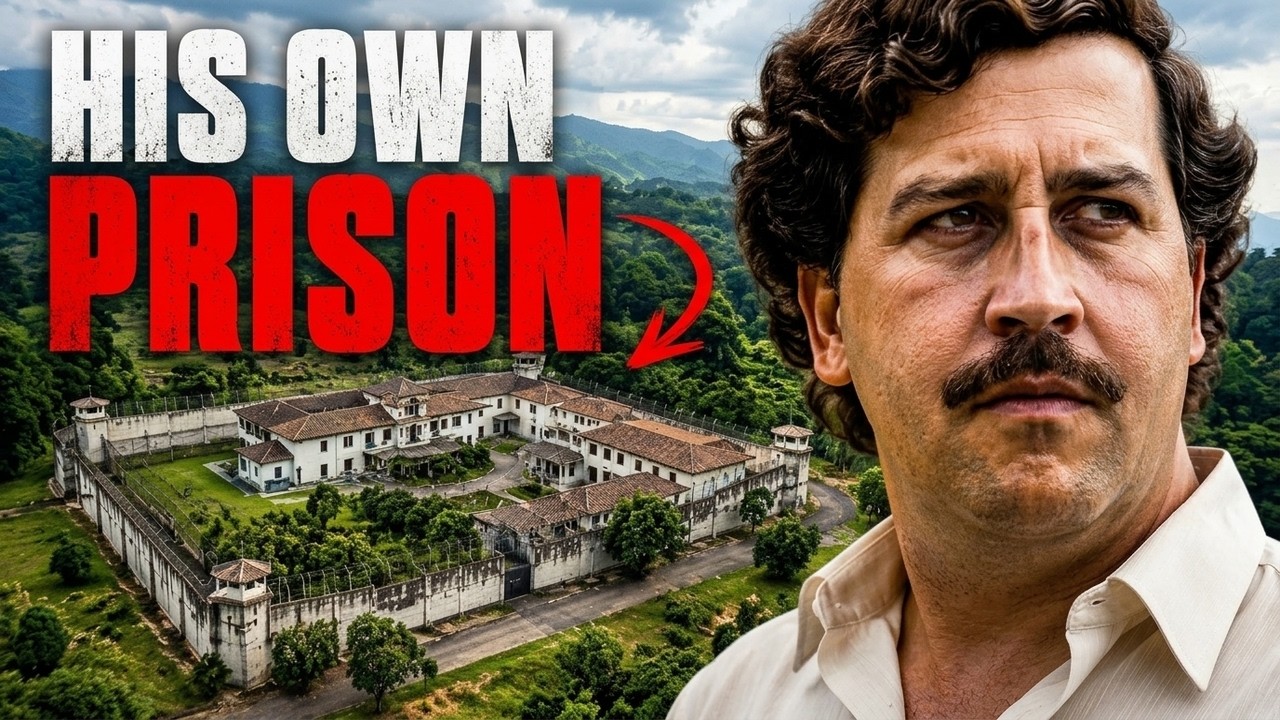
Escobar personally designed the prison known as La Catedral, perched on a mountaintop overlooking his own hometown of Medellín. It included a soccer field with real professional-grade goalposts, where he personally organized matches with invited Colombian football stars.
There was a jacuzzi and sauna built directly into his personal quarters, a full casino and nightclub for parties he threw for his men, and a waterfall running down the slope right outside his bedroom window. That same bedroom held a rotating bed, which journalists later called the most absurd detail in the most absurd prison in history.
Phones, fax machines, and computers let him keep running the cartel without ever leaving his quarters. The prison's guards were entirely staffed by his own men.
During his time there, Escobar hosted more than 300 unauthorized guests, including, by some accounts, soccer stars, musicians, and women. But while some enjoyed his hospitality, two old partners were about to become his victims.
Fernando Galeano and Gerardo "Kiko" Moncada were two of Escobar's closest partners in the cartel. Galeano was responsible for the colossal sums of cash the cartel had stashed around the country, and rumor had it some of it simply rotted away in buried barrels while he kept his own private ledger.
Moncada oversaw the cartel's overseas shipments and was considered one of the few men Escobar trusted with the financial side of the business. Suspecting both of skimming money for themselves, Escobar summoned them to his prison for a conversation in July 1992.
The conversation ended in tragedy. Both partners were subjected to a brutal fate right there on the prison grounds.
Both men's widows went to the press, and word of what happened inside the prison the government itself had approved became public. The Colombian authorities' patience finally ran out.
On July 22, 1992, Colombia's deputy minister of justice personally traveled to La Catedral to inform Escobar that the government had decided to move him to a regular prison. Eduardo Mendoza held that post and personally volunteered to go negotiate, with no idea he would end up a hostage of his own visit.
That day, he went from negotiator to human shield — the man Escobar hid behind for the next several hours. Escobar flew into a rage, took Mendoza hostage, and one of his closest bodyguards openly pointed a rifle at the official while Escobar decided what to do next.
He ordered his guards to open fire on anyone who tried to enter the compound and forced his hostage to call President Gaviria personally to deliver a threat. If the troops did not pull back from the prison's perimeter, there would be serious consequences.
Meanwhile, a 4,000-strong Colombian army brigade simply surrounded the prison's perimeter and did nothing. Hour after hour passed.
As would later come to light, President Gaviria secretly suspected the brigade's commanding general from Medellín might be on Escobar's side — a suspicion that would later be confirmed. The general would be removed from his post over suspected cartel ties.
The defense minister proposed sending in a negotiating team to save the hostage. The president refused and instead authorized a special forces assault.
After several hours of fruitless waiting, 250 special forces troops, four helicopters, and seven K9 units finally arrived at the prison. A real battle broke out between Colombian special forces on one side and the prison's guards alongside Escobar's own personal gunmen on the other.
The hostage was rescued unharmed. But while special forces stormed the main building, Escobar himself, along with three trusted men, had already been moving in the opposite direction for some time — toward that exact section of wall poured with deliberately weakened concrete back when the prison was built.
A full year before that night, during the actual construction of La Catedral, Escobar had personally ordered one specific section of the 12-foot outer wall to be poured with intentionally weak, watered-down concrete instead of the real thing. From the outside, the section looked no different from the rest of the wall, but structurally it could not even compare to ordinary brickwork. Breaking through it took just two solid kicks.
While special forces stormed the main building searching for Escobar, he and nine other people, including his own brother Roberto, were already moving toward the perimeter fence at that exact prepared section. Reaching the fence, Escobar gave one final order.
One of his bribed guards cut the power to the entire prison, plunging the compound into total darkness. It was in that darkness that the escapees kicked open the hole in the wall and disappeared into the mountains.
The most unbelievable detail of that night would not come out until later. On their way to the edge of the compound, Escobar's group ran into a handful of Colombian soldiers.
Recognizing who stood in front of them, the soldiers — by one account out of fear of his reputation and possible retaliation — simply let him walk past without even attempting to stop the most wanted man in Colombia.
Coming down the mountain, the 10 fugitives made their way to a pre-arranged farm called El Salado. According to Escobar's own son, within just a few hours of the escape, the drug lord himself was calmly swimming in that farm's pool.
Meanwhile, the soldiers who had stormed La Catedral would need about 12 more hours just to realize the man they had surrounded the mountain for was long gone. By the time the smoke finally cleared and special forces reached Escobar's personal quarters, there was no one there — just a hole punched through the wall leading straight into the mountains behind the prison.
By the next morning, the news was on front pages around the world. New wanted posters went up on walls across Colombian cities, offering double the previous reward for his capture. The Colombian government declared a state of emergency in the Antioquia region.
In Washington, an official response was already being prepared at the White House level. The press secretary to US President George H. W. Bush, Marlin Fitzwater, issued an official statement that same day, noting that Escobar had escaped when Colombian authorities attempted to move him to a more secure facility and calling it unfortunate at a time when President Gaviria was trying to control the prison and put an end to Escobar's criminal activities.

Escobar's escape became a genuine political scandal for all of Colombia. Weeks later, at a public press conference, President Gaviria acknowledged his own responsibility for what happened, saying he was ashamed of the corruption between prisoners and guards and the intimidation that made it possible, but that he would not hide and would continue making decisions and answering for them.
One of the largest manhunts in the history of Latin America began. A special unit of the Colombian police called the Search Bloc was given a single task: find and neutralize Escobar, backed by American DEA and CIA agents and later Delta Force.
According to available reports, Escobar personally put a bounty on the head of every Search Bloc officer killed. Over the 16 months of the manhunt, more than 600 police officers would die.
At the same time, Escobar continued his campaign of terror against the civilian population, setting off car bombs across the country to pressure the government. Persistent rumors circulated that part of the Colombian Army's top command was secretly taking bribes from him in exchange for information on the search team's movements.
Leading the hunt was a man for whom this case would become something close to his life's work. Colonel, later General, Hugo Martínez was a career police officer who would devote literal years of his life to catching a single man. His own son, Lieutenant Hugo Martínez Jr., would later personally take part in the final operation to track down Escobar's hideout.
In early 1993, another force entered the picture. An armed vigilante group called Los Pepes — short for "People Persecuted by Pablo Escobar" — drew together enemies of the drug lord from every direction: the rival Cali cartel, aggrieved former partners, and relatives of people he had killed.
Leading this force were two brothers with personal scores to settle. Los Pepes were led by Fidel and Carlos Castaño, both of whom had personally lost their father to Escobar's men. Fidel, the elder brother, was by then already an experienced paramilitary field commander known for his extremely brutal methods.
Carlos, the younger, took on the financial and organizational side of the revenge campaign and years later, after his brother's death, would become one of the central figures in Colombia's paramilitary politics.
The group received funding from the Cali cartel, and their methods were every bit as brutal as Escobar's own. They killed his lawyers, accountants, and attorneys one by one, systematically dismantling his empire's entire financial infrastructure.
Alongside the killings, Los Pepes methodically destroyed the physical empire Escobar had built. His lavish estate, Hacienda Nápoles, with its private zoo and classic car collection, was looted and abandoned.
His beach house, La Manuela, was completely wiped off the map by an explosion using nearly 200 kilograms of dynamite planted directly in the bathroom. Several ranches belonging to his own mother were also burned to the ground.
Even the famous Monaco building in Medellín, where his whole family once lived, was badly damaged in a bombing that left his young daughter, Manuela, permanently deaf in one ear. Later, once everything was over, declassified CIA documents would reveal that a high-ranking Colombian police general had been personally sharing intelligence with the leader of Los Pepes — meaning the state had in effect been secretly collaborating with the very lynch mob methods it officially condemned.
By late 1993, Los Pepes had all but wiped out Escobar's inner circle. Twenty-six of his closest associates were dead, including his own brother-in-law, and his children's teacher was murdered simply for her ties to his family.
On November 11, the Search Bloc nearly caught Escobar himself at a remote farmhouse. He slipped away just minutes before the raid, leaving behind suitcases full of clothes and a letter from his 9-year-old daughter, Manuela, saying she missed him a lot and wished she could see him.
In that same suitcase, they found a letter in his own handwriting to his mother. Escobar admitted he was tired of hiding and willing to surrender, but did not believe the government would accept his terms.
Fearing for the safety of the family he had left, on November 27 Escobar put his wife and children on a Lufthansa flight to Frankfurt, a desperate attempt to secure political asylum in Germany. German authorities held the family for four hours of questioning at the airport, then denied them entry and deported them back to Bogotá.
None of his family was with him at that moment. But there was one woman who had shared every year of this life on the run with him. Maria Victoria Henao had been Escobar's wife since 1976 and the mother of his two children.
In the weeks that followed, she became the family's voice in a desperate search for any country willing to take them in. After Germany, Mozambique turned them away too, and only Argentina would eventually grant the family asylum — though that would not happen until after Escobar's own death.
Escobar was furious. He called a radio station in Medellín and read out a public statement. According to witnesses and reporters at the time, his words amounted to roughly this: there had been a total lack of solidarity by the German government; his family came to them for protection and they turned them away without mercy; if anything happened to his wife or children because of this decision, the German government and its embassy would pay the consequences.
That emotional outburst would become the first of two fatal mistakes that would lead to his death just days later.
December 1, 1993, was Pablo Escobar's 44th birthday. Hiding in a modest two-story house in an ordinary Medellín neighborhood called Los Olivos, just a couple of blocks from a sports complex, he spent the day on the phone with his children, singing them songs and laughing.
But that day, there was only one person by his side. The only person with him was a bodyguard nicknamed El Limón, a former taxi driver and pimp who for a while had even worked as a personal driver for Escobar's own brother before becoming his last remaining protector.
Escobar normally made sure no phone call ran longer than two minutes — the amount of time he calculated authorities needed to triangulate a signal. But on his birthday, he seems to have let his usual caution slip.
The next day, December 2, he called his son again. This time, the call ran longer than usual.
The Search Bloc's electronic surveillance team, which had spent months setting up radio direction-finding equipment across Medellín, finally got what it had been waiting for the whole time. The intersecting signals pointed precisely to a specific two-story house on a quiet street in Los Olivos.
Police surrounded the building. Escobar and El Limón tried to escape across the rooftops of neighboring houses — the same tactic that had saved him more than once before in this very city. Not this time.
The bodyguard was shot in the leg on a staircase and died from further gunfire on the roof. Minutes later, Escobar himself fell barefoot in jeans, with wounds to the leg and back and a fatal shot to the area of his right ear.
The official version says Escobar was shot dead by Search Bloc soldiers, with Sergeant Jorge Armando Guerrero Pacana personally credited with firing the fatal round from an assault rifle. But the photo of his body on that rooftop, which traveled around the world, immediately sparked disputes that continue to this day.
CIA documents declassified in 2008 hint at possible coordination between senior Colombian police leadership and the leaders of Los Pepes on the day of the operation. Escobar's own brothers insisted for years that the wound to his temple was not from a police bullet at all, but from his own hand — that in their telling, Escobar chose death over capture.
Hundreds of thousands of ordinary Medellín residents lined up for blocks at his funeral, many seeing in him not a monster but a man who had once built entire neighborhoods for the poor with his own money.
Years later, Escobar's son, who took the new name Sebastián Marroquín to finally break with his father's legacy, would publicly make an even more unexpected claim about that fateful final phone call. He said that one day his father asked to talk to his mother and sister and identified himself to the operator with his two names and surnames, and that the call was to say goodbye — that he prolonged it as much as possible with the clear intention of being located.
If this version is true, Escobar did not just let his guard down that day. He deliberately let himself be found, worn out after 16 months on the run, choosing the time and place of his own death on his own terms.
There will likely never be an official answer to this question. Too many interested parties — the police, Los Pepes, American intelligence services, Escobar's own family — were all willing to vouch for whichever version served them best.