Carl Hanke was born on August 24, 1903, in the small Silesian town of Lauban, then part of the German Empire and today the Polish town of Luban. His father, Wilhelm Robert Hanke, was a railway engineer. During the First World War, Carl's older brother was killed, but Carl himself was too young to fight.
After finishing local gymnasium-level schooling, he volunteered in 1920 for a year of service with the Reichswehr, the German army limited by the Versailles Peace Treaty. The shrunken postwar army offered more drill than opportunity, yet it gave him a taste for uniform hierarchy and the hard, direct language of commands he would use for the rest of his life.
After his demobilization in 1921, he went to work in a trade business. He attended the German Miller's School and earned a qualification as a milling engineer. For several years he moved between Silesia, Bavaria, and Tyrol, managing small mills, patching worn machinery, and learning both thrift and ambition.
In these provincial posts he noticed that technical skill alone did not guarantee advancement. One needed connections, conviction, and above all a cause that promised movement in a stagnant nation.
Hanke later moved to Berlin, the city of noise, neon lights, and endless talk. He completed a course at a pedagogical institute, receiving a degree that qualified him to teach milling at technical schools. He then became an instructor at a technical school in Berlin.
By day he lectured apprentices on flour quality and the proper use of mill machinery. By night he wandered through smoky taverns where angry men debated the unfairness of the Treaty of Versailles and the political situation in Europe.
On November 1, 1928, he joined the German Nazi Party, receiving membership number 102,66. Brownshirt meetings thrilled him. Here, he felt, action replaced excuses. He quickly volunteered as a speaker, then as an organizer of factory cells in Berlin, and promotions followed.
By 1929 he wore the uniform of the Nazi paramilitary organization, the SA, and slowly rose through the ranks of Hitler's party structures in Berlin. His gift was urgency. He spoke fast, set impossible deadlines, and expected obedience. Many grumbled, yet results appeared, and results impressed his superiors.
In spring 1931, the Prussian authorities, alarmed by his political agitation, dismissed him from his teaching position. Joseph Goebbels, the fiery regional leader of the Nazi Party in Berlin, noticed the young organizer. Goebbels appointed him to organize the party in Berlin and later made him his personal adjutant and adviser.
Hanke showed no regret when he was kicked out of his job. For him, full-time party work seemed like a promotion. When Goebbels needed headquarters worthy of his ambitions, Hanke recommended the then little-known architect Albert Speer and supervised the conversion of a villa in Grunewald in Berlin.
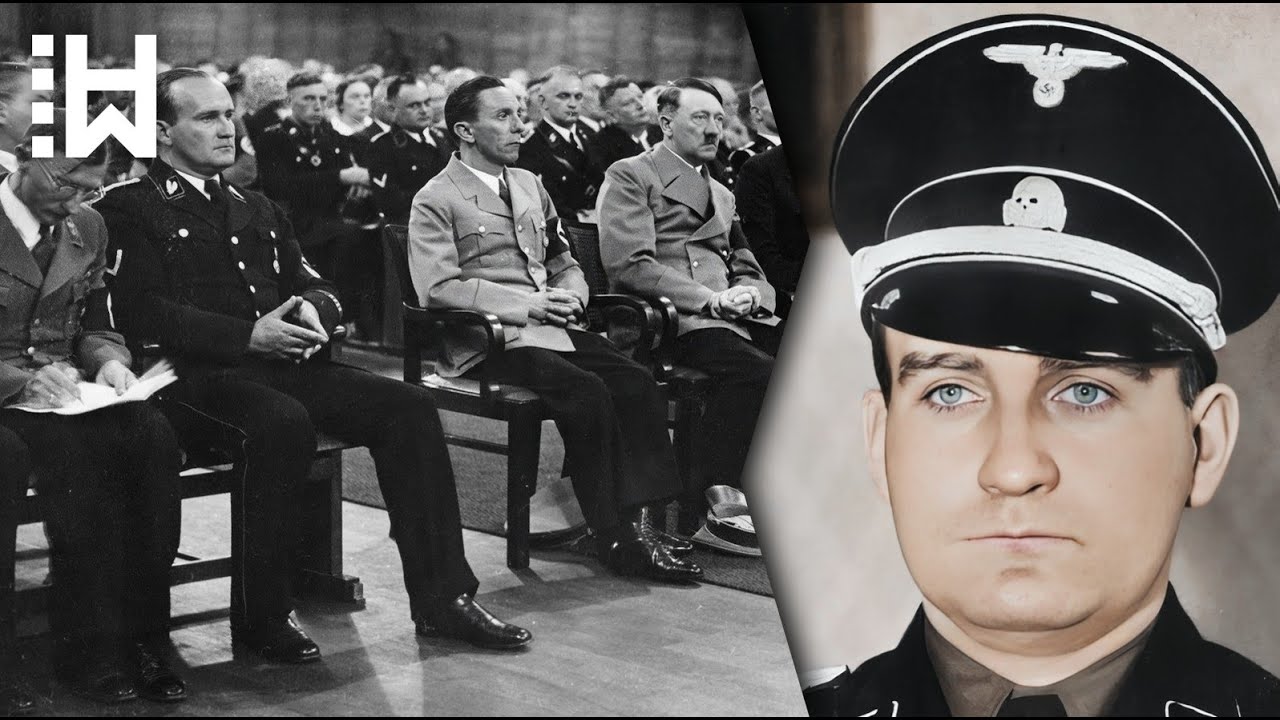
Speer remembered Hanke's energy and his impatience when delays occurred. They became friends, and in July 1932 Hanke secured another task for Albert, having him build a headquarters for the Berlin Nazi Party in the center of the German capital. Under Goebbels's patronage, the doors of German government swung open for Hanke.
In April 1932, Hanke had become a Nazi Party delegate to the Prussian State Parliament. In November he won a seat in the Reichstag, the German Parliament, representing the Nazi Party.
The Nazi seizure of power in January 1933 lifted Hanke even higher. Goebbels soon created the Reich Ministry for Public Enlightenment and Propaganda on March 13, 1933, and became head of the new institution. Hanke followed him as his private secretary, then as head of the minister's personal secretariat.
At the time, Hanke was a favorite of Goebbels and accompanied his boss on official visits to Italy and Poland. The reality that Hanke joined the SS in February 1934 also helped. At receptions, foreign diplomats saw a slim, alert official at Goebbels's elbow, ready with figures on press clippings or cinema attendance.
Hitler himself liked Hanke's sharp answers and tireless manner, and occasionally invited him to consultations. Yet the Goebbels household hid storms. Goebbels collected extramarital affairs the way other men collected postcards.
In 1937 he fell in love with the Czechoslovak film actress Lida Baarova and was thinking about divorcing his wife Magda Goebbels. Magda, with wounded pride and fury, found a friend in Hanke. The secretary, who already admired the minister's wife and perhaps hoped for more, listened, advised, and finally with her help compiled a list of 36 actresses who had shared Goebbels's attentions.
Together they presented the document to Adolf Hitler. The Führer, protective of Magda and of the image of party purity, ordered Goebbels to end the relationship with Baarova. A truce followed, but the marriage remained cold.
In 1939, Magda confessed to her husband that since October 1938 she herself had taken Hanke as a lover. Goebbels erupted, and Hitler again intervened, commanding the couple to remain together for the good of the Reich. Goebbels exiled Hanke to an indefinite vacation and never reinstated him at the ministry.
Exile, however, lasted only weeks. In July 1939, Hanke was called up for active army service, wearing the shoulder straps of a reserve officer's commission obtained two years earlier.
The Second World War began on September 1, 1939. With the Third Panzer Division, Hanke rolled into Poland, relishing the clarity of military orders after propaganda intrigue. In May 1940 he served under General Erwin Rommel in the famous Seventh Panzer Division, nicknamed the Ghost Division during the blitz through France.

Rommel appreciated the political officer who could brief journalists and still be active during battle. Hanke earned the Iron Cross, first and second class. Yet a clash of tempers ended the idyll.
At an officers' mess, he hinted that his influence in Berlin could alter commands and even suggested it was possible for him to remove Rommel from his position as commander. Rommel, intolerant of political boasting, filed a sharp report and secured Hanke's removal.
When Hanke left the Wehrmacht in January 1941, he was decorated, experienced, and ambitious for a new arena. Hitler provided one for him. On January 27, 1941, the Führer appointed Hanke as a regional leader, a Gauleiter, of the newly created Gau Lower Silesia with headquarters in Breslau, today's Polish Wroclaw.
On February 1, 1941, he became Oberpräsident of the Prussian province, uniting party and state authority in his hands. On February 9, 1941, he acquired the post of Reich Defense Commissioner for Military District 8.
Hanke ruled by decree and by example of ferocity. He ordered mass arrests, approved over a thousand executions, and boasted that fear was the beginning of obedience. Locals soon gave him a new title: the hangman of Breslau.
Hanke also knew about the extermination camp at Auschwitz and other sites created by Nazi Germany. When his friend Albert Speer planned an inspection trip to the territory of Upper Silesia in 1944, Hanke privately warned him never to go. What he had seen there, he said, could not be described.
On January 30, 1944, Himmler promoted him to one of the highest ranks in the SS. In this murderous organization he became SS Obergruppenführer, equivalent to lieutenant general.
Amid the terror he created, Hanke also sought legitimacy in front of the local population, at least in front of local Germans. In November 1944 he married Baroness Freda von Fircks, daughter of a Baltic noble family and mother of his year-old daughter. The wedding, hastily arranged in Breslau, displayed silk banners and silver SS runes but could not mask the thunder of Soviet artillery approaching from the east.
The Red Army crossed the Oder River in January 1945. Hitler declared Breslau a fortress city to be held at any cost and appointed Hanke its battle commander. Hanke mobilized young boys and gray-haired old men, scraped bricks together from ruins for new barricades, and transformed basements into execution cells for, in his language, cowards. In reality, those were people who were tired of war and hoping to survive the battle for Breslau.
On January 27, 1945, Hanke arrested the city's mayor, Wolfgang Spielhagen, for alleged defeatism and had him shot before dawn. Requisitioned loudspeakers broadcast Hanke's vow that Breslau would stand or burn.

Joseph Goebbels noted in his diary on April 3, 1945, that Hanke received extraordinary praise from the Führer at the briefing. Hitler said he deserved it, calling him an outstanding leader among the fighting Gauleiters and militantly committed to an extent that unfortunately could not be said of the others.
The siege of Breslau lasted 82 days. Civilian casualties reached 30,000, and Soviet losses were around 60,000. On April 12, 1945, Hitler awarded Hanke the German Order, the Nazi Party's highest decoration.
Seventeen days later, in the political testament dictated in the Berlin bunker, Hitler named Hanke Reichsführer SS and chief of German police, dismissing Heinrich Himmler for his talks with the Allies. In Hitler's view, it was treachery.
The promotion reached Breslau by radio on May 5, 1945. Hanke acknowledged it, but the city, turned into a fortress, was already cracking under Soviet pressure. On May 6, 1945, General Hermann Niehoff capitulated and Breslau surrendered. It was the last major city in Germany to surrender.
Destruction by Soviet aerial and artillery bombardment, along with acts of destruction committed by the SS and Nazi Party members, brought almost 90 percent of Breslau to ruin. Hanke had flown out of Breslau on May 5, 1945, three days before the end of the Second World War in Europe.
The fugitive landed near Prague. To conceal his identity, Hanke dressed himself in the uniform of an SS private and attached himself to the 18th SS Volunteer Panzer Grenadier Division Horst Wessel. He relied on anonymity. Only a handful knew that the slender private was nominally head of the entire SS.
The division, pressed by Czechoslovak resistance fighters and Soviet units, attempted to reach American lines but found roads blocked. They hoped to get into American captivity rather than Soviet capture. They knew what they had done in the Soviet Union and what retribution would await them. Their hopes were in vain.
On May 6, they surrendered near Nové Ves in today's Czech Republic. Czechoslovak captives, unaware of their prize, herded 65 SS prisoners into a temporary prisoner of war camp. The Czechoslovak guards decided to move them all by foot on June 8, 1945.
When a train passed the march route, the 41-year-old Hanke and several other prisoners of war attempted to escape, clinging to the train. The guards fired and injured Hanke. After shooting, they dragged him down and beat him with rifle butts until he fell silent and died.
Thus the last Reichsführer SS died anonymously a few weeks after Germany's surrender, on a muddy Czechoslovak road. News of his fate only surfaced months later. When the Czechoslovak guards struck him down in June 1945, the Reich he served had already crumbled into dust, and the city he vowed to save lay in ruins behind the new Polish frontier.
The hangman of Breslau left no tombstone, only rubble and memories of fear. To this day, the story of Carl Hanke warns that loyalty to a brutal cause offers no refuge, only a longer drop.