Hélène Cordet was born into a world that was already collapsing. Her family were Greek royalists, displaced when the monarchy fell, and they raised their children inside a small emigre circle that clung to the manners and connections of a court that no longer existed.
In that same circle moved a boy named Philip, a prince of Greece and Denmark by blood but a refugee in every practical sense. In 1922, when he was not yet eighteen months old, a gunboat carried him out of Greece in a cot improvised from a wooden fruit crate.
His uncle had abdicated. His father had been arrested, tried, and banished. The family scattered across Europe, living in borrowed houses and depending on the kindness of relatives. Much of Philip's early childhood was spent in a villa in the Paris suburb of Saint-Cloud, housed by his formidable aunt, Princess Marie Bonaparte.
Among the families who took the exiled royals in were the Foufounis, Greek royalists who were themselves displaced and devoted to the same lost cause. They kept a holiday house in the south of France, remembered by some biographers as near Marseille and by others at Le Touquet.
There were three Foufounis children who mattered to this story. A son, Yanni, became Philip's inseparable companion. And a daughter, Helen, born in 1917, was about three and a half years older than Philip.
She was old enough to stand a little apart from the boys, to mother them and tease them and remember. In later years she described Philip with the unsentimental affection of an older sister, complaining that her own mother paid the little prince altogether too much attention, while allowing that he was, after all, a very nice little boy.
Philip's own home life was coming apart. His mother, Princess Alice, was descending into a mental illness that would see her placed in a psychiatric clinic for years. His father drifted away to the Riviera. His four sisters married into German nobility and were gone.
By the time Philip was ten, he had effectively no settled family of his own and was passed into the care of his Mountbatten relatives in England. Against that loneliness, the steadiness of the Foufounis household meant something. They were not grand. They simply kept turning up, holiday after holiday, year after year.
The Foufounis family eventually washed up in England, like so many of the displaced. London in the 1930s knew how to absorb the titled and the once wealthy from the broken empires of the continent. The family opened a restaurant in Mayfair and named it La Belle Helene, after the daughter who had grown into a striking young woman.
She was dark, poised, fluent in several languages, and entirely at ease in a society that prized exactly those qualities. She had the emigre's gift of seeming both exotic and perfectly at home.
In 1938, at the age of twenty, she married. The groom was an Englishman named William Kirby, known to everyone as Bill. The marriage took place on the 30th of March, 1938, at Caxton Hall in Westminster, a registry office that had become fashionable for society weddings conducted with style but without the full machinery of a cathedral.
Standing up as best man, holding the ring, was Prince Philip of Greece. He was sixteen years old, a cadet or about to become one at the Royal Naval College at Dartmouth. He was still, in every sense that the world measured, a nobody.
You do not ask a passing acquaintance to be your best man. You ask the person who has been, in all the ways that matter, family. To Helene, Philip was the boy she had half raised. To Philip, Helene was one of the last living threads to a childhood that had otherwise scattered to the winds.
The marriage itself would not be a success. Within a few short years the war would come, and it would do to the Kirby marriage what it did to so many. Bill Kirby was posted abroad. The distance hardened into estrangement. And Helene, still in her twenties, still legally a wife but in practice a woman alone, found the structure of her life dissolving around her just as the bombs began to fall on London.
The Second World War fell on her generation like a blade, cutting lives cleanly into a before and an after. Husbands vanished into uniforms and were posted to the far corners of the conflict. Wives were left to hold together households, nerves, and marriages across distances that letters could not bridge.
By the early years of the war, Helene was, in everything but the cold legal paperwork, a single woman. The divorce lagged far behind the reality, as divorces did in those years, when the law moved slowly and the war made everything slower still.
Wartime London was a place of blackouts and sirens, of nights spent in shelters and mornings spent counting which streets still stood. It was also, famously, a place where the ordinary rules of life loosened. Death was close and constant, and people lived accordingly.
The war ran for six years, from 1939 to 1945. Millions of British men were posted away from home, many for years at a stretch, some never to return. Marriages made in haste before the call-up dissolved in the long silence of separation, and the divorce rate, which had crept along at a few thousand cases a year before the war, would balloon to more than ten times that figure in the years immediately after it.
Helene was not an exception to her age. She was a small and vivid example of what the war did to tens of thousands of marriages, the difference being only that her circle of friends happened to include a future king.
In the middle years of the war, she gave birth to a son. A little later, she gave birth to a daughter. She was still, on paper, married to a man who was not present and was plainly not the father. And when the children were registered, the space where a father's name should go was left blank.
That blank space is the true beginning of the scandal. In an age obsessed with legitimacy, a child registered with no named father was a quiet act of defiance or of necessity or of protection, depending on how you chose to read it. It announced that there was a story here that the mother was not prepared to tell.
She would not say who the father was. Not then. Not for the rest of her long life. She gave the world a mystery and refused to give it a solution.
Into this silence, a name would eventually be supplied by the gossips. And it was the most extraordinary name imaginable. Among the small circle of people closest to Helene in these years was a young naval officer who was rising fast, a man whose own life was about to change beyond all recognition.
He had been the boy of sixteen at her wedding. He was now a grown man, a serving officer in the Royal Navy, handsome and charismatic and unmarried. And in a very few years, he would be standing in Westminster Abbey marrying the woman who would become queen of England.
The boy was born in 1943. The world would later receive two different dates for his arrival, and the disagreement is worth noting because in this story even the simplest facts have a habit of slipping their moorings. He was given the name Max. Two years later, in 1945, came a daughter, Louise.
This was a society that had not yet loosened its grip on the old certainties about marriage and birth. Illegitimacy still carried a heavy and lasting stigma, the kind that could follow a child through school, through work, through every form that asked for the names of both parents.
For a woman to bear a child outside marriage was to invite a particular and unforgiving judgment. And yet here was Helene doing it not once, but twice, and declining, with what looks from this distance like real steel, to offer the world the explanation it demanded.
In 1947, she married again. The man was a Frenchman named Marcel Boisseau, described in the accounts as an officer who had served with the Free French Forces during the war. With the marriage, the two children acquired a surname at last. Max and Louise became Max and Louise Boisseau.
The marriage to Marcel Boisseau was not only a romance, it was an act of protection, a roof of respectability raised over two children who would otherwise have stood in the rain. But a surname acquired at the age of four does not silence a question about the years before it.
What is documented, beyond any dispute, is that Helene bore two children to no named father during the war years. What is documented is that she married Marcel Boisseau in 1947 and that the children took his name. What is documented is that Max Boisseau himself, throughout his life, named Marcel as his father and rejected every other claim.
What is not documented, what has never been documented, what no birth record or letter or confession has ever established, is the identity of the man who actually fathered those wartime children. Everything beyond the blank space on the page is inference.
On the 20th of November, 1947, Prince Philip of Greece, newly created Duke of Edinburgh, married Princess Elizabeth in Westminster Abbey. The penniless refugee child from the fruit crate had arrived at the very center of British life.
From that day forward, every friendship he had ever made would be examined under a lamp of a brightness that no private person could imagine. And among those associations was Helene Cordet and her two fatherless children.
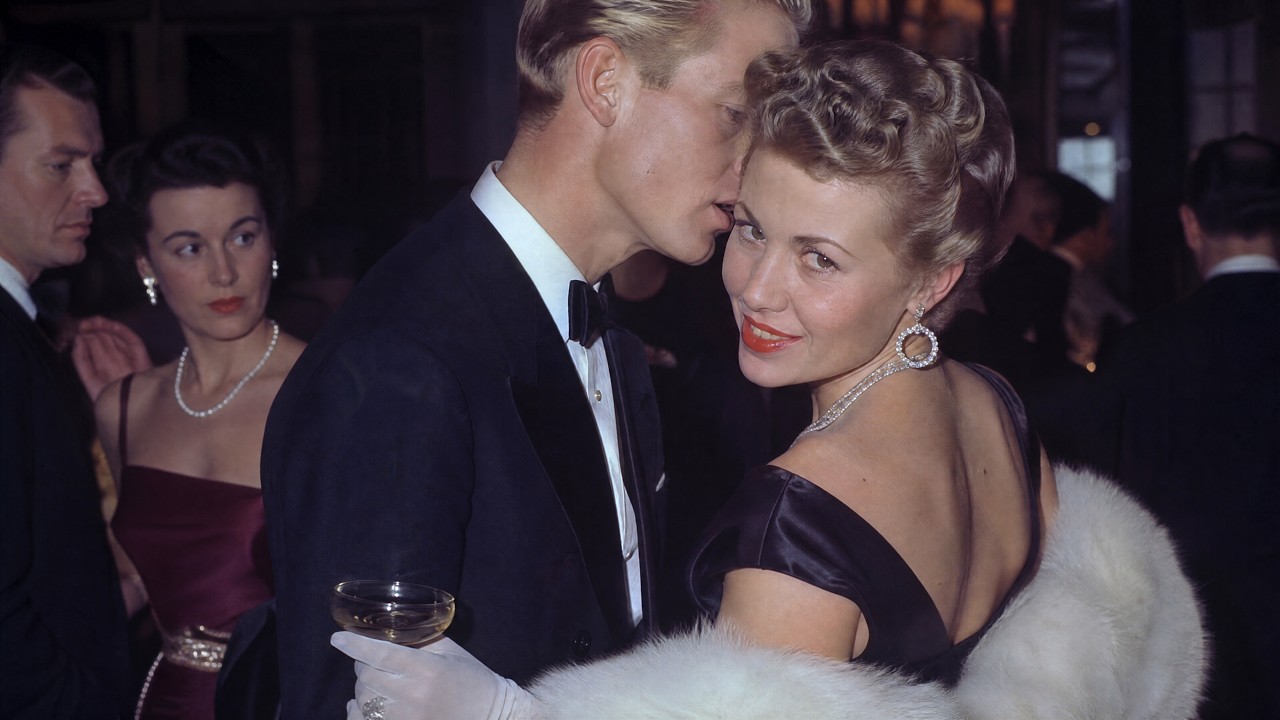
What Philip did next is the hard, documented core of the whole mystery. He became godfather to both of Helene's children, to Max and to Louise. A more cautious man, a man with a careful eye on appearances, would have kept his distance from exactly this kind of association. Philip did the opposite.
And then he did more. He paid for Max's education. He sent the boy to Cheam, the preparatory school he himself had attended. And then he sent him on to Gordonstoun, the austere Scottish school that had shaped Philip's own character, the school he believed in so completely that he would later send his own sons there.
Of all the schools in Britain, Philip chose for Helene's son the two that had made him. He took the fatherless boy and ran him through the same forge that had forged the Duke of Edinburgh.
The best man at her wedding in 1938, the godfather to both her children in the 1940s, the payer of school fees at his own two schools through the 1950s. Three acts spread across two decades, each one a deepening of a bond, each one perfectly innocent on its own. And each one, when laid beside the others, forming a pattern that the public would find impossible to read as mere friendship.
There is another reading of these same facts, and it is at least as strong. Philip was a man who had been raised on the kindness of others. He had spent his childhood in the borrowed houses of relatives and friends, schooled on money that was not his family's, taken in by households that owed him nothing.
He knew, better than almost any man of his rank, exactly what it was to be a child dependent on the generosity of grown-ups who chose to care. And here, in front of him, was the fatherless son of the family that had taken him in during his own hardest years. To pay that debt forward was not the act of a guilty father. It could just as easily be the act of a loyal man with a long memory.
Both readings fit the facts. That is the engine of the whole story, and it never stops turning. The kindness is real and beyond dispute. What the kindness means is the one thing no document can establish. And Philip, characteristically, said nothing to settle it, then or ever.
A man with a guilty secret, a man hiding a child, would have every reason to keep his distance. Philip did the reverse. He pulled the boy close into his own schools, into the documented record, into exactly the places where curious eyes were certain to fall. Either he was a man with nothing to hide behaving with the open generosity of an old friend, or he was a man of quite breathtaking nerve.
Max Boisseau grew up moving through the same institutions that produced princes. He wore the uniform Philip had worn. He ran the same Scottish hills. And a boy does not pass through Gordonstoun on the personal account of the Duke of Edinburgh without his school fellows noticing and talking.
The rumor did not begin in the gutter press. It began, as these things often do, in the corridors and dormitories where the children of the powerful compare notes on one another. By the time Max was a young man, the question had been asked so many times in so many quiet rooms that it had hardened into a kind of folklore.
If Helene Cordet had been content to live quietly, the rumor might have stayed a private matter. But Helene was not built for quiet. And the postwar years handed her a stage of a kind that had never existed before.
Television was coming to Britain. Helene Cordet, with her dark looks, her continental polish, and her complete ease in front of any audience, was exactly the sort of figure the infant medium was hunting for. She was discovered by a producer at the British Broadcasting Corporation, a man named Henry Caldwell, who saw in her the makings of a host.
She was given a program called Cafe Continental, and it made her, for a time, one of the most recognizable women in Britain. The format was pure escapist glamour, a make-believe evening at a chic continental cabaret beamed into the gray front rooms of a country still bound by rationing and recovering from war.
It ran for years through the late 1940s and into the early 1950s and placed her among the genuine pioneers of British broadcasting. She was one of the first women ever to host a program of her own on British television, a fact that has been almost entirely buried beneath the noise of the scandal that followed her.
She tried her hand at film as well, picking up a clutch of roles in the early 1950s in pictures that have mostly faded from memory. But it was the television work that mattered because it put her face week after week into millions of homes. It made her public property, and a woman who is public property cannot keep a private mystery private forever.
The more famous Helene became, the more valuable her secret grew. A blank space on an obscure birth certificate is of interest to no one. A blank space on the birth certificate of a celebrated television hostess whose children's godfather is the husband of the Queen is worth a great deal indeed to a certain kind of newspaper.
Her fame did not protect her. It illuminated her. It turned the quiet dormitory rumor into a story with a market. And the British press of the 1950s was nothing if not a market.
To understand why the Cordet question exploded when it did, you have to understand the atmosphere of 1956 and 1957. The rumor did not detonate in a vacuum. It detonated inside a far bigger drama that the press was already running at full volume, a drama about whether all was well inside the most scrutinized marriage on Earth.
In the autumn of 1956, the Duke of Edinburgh left on a long tour. He sailed aboard the Royal Yacht Britannia on a voyage that would keep him away from his wife and his young family for the better part of five months, taking in distant corners of the Commonwealth and the opening of the Olympic Games in Melbourne.
To the press of the day, a married man choosing to spend that many months at sea away from a young wife who happened to be the Queen was an invitation to speculate. The papers began to talk of a royal rift. They began to talk about his roving eye.
The speculation found a focus in a London institution called the Thursday Club. It was a raffish lunchtime and evening gathering of actors, photographers, writers, and well-connected men about town which met in a private room in Soho and prided itself on wit, drink, and discretion. Philip attended it in the company of his close friend and private secretary, an Australian named Mike Parker.
To the men who belonged, it was harmless fun. To the newspapers, hungry for an explanation of the royal rift they had already decided existed, it became something darker, a den of wild parties and worse.
Then the focus sharpened to a single human casualty. Mike Parker, Philip's friend and secretary, resigned in early 1957. The real reason was painful and private. His own wife had filed for divorce, and a man at the heart of the royal household could not be seen to be the subject of divorce proceedings.
But the press read the resignation through the lens of the story they were already telling. Parker was the bad influence, they decided, and his departure was the proof. Parker himself later remembered that the Duke was incandescent about the reports, very, very angry, and deeply hurt.
The pressure grew so intense that the palace did something it almost never does. It broke its silence. The Queen authorized her press secretary to issue a flat public denial, stating that it was quite untrue that there was any rift between the Queen and the Duke.
For an institution whose entire doctrine is to never explain and never complain, this was extraordinary. A measure of how serious the threat to the marriage's public image had become.
But the denial was a narrow thing. Aimed at one target and one only. It said that there was no rift between the Queen and the Duke. It said nothing whatever about the older question, the one concerning a television hostess and her two fatherless children and the godfather who paid the school fees.
That question, the palace left exactly where it had always left it, in the dark, untouched, neither confirmed nor denied. And in the strange logic of scandal, the very act of denying the rift seemed to confirm that Philip was a man surrounded by smoke.
Once the press had decided that the Duke of Edinburgh was a man with a roving eye, every old rumor about him was suddenly worth dusting off and printing. The story of the glamorous television hostess and her fatherless children with the Duke himself standing as godfather and paying the school fees was the most irresistible of them all.
In 1961, Helene wrote her life down and the most important fact in it was the one she left out. She published an autobiography called Born Bewildered, a title with a wry edge, the words of a woman who had spent her whole life being swept along by forces larger than herself.
The book was a genuine memoir, a real telling of an extraordinary life. It ran to nearly 200 pages and carried more than 30 pages of photographs. In it, she wrote warmly and at length about the childhood friendship with Philip, about the lost Greek summers and the bond between the families. She did not hide the friendship. She celebrated it.
And on the question of her children's paternity, the question that was, by 1961, the entire reason a publisher wanted her book at all, she was silent. Pointedly, deliberately, immovably silent. She told the story of her life and stepped around its central mystery as though it were a hole in the floor.
Her private line, repeated to friends over the years, captured the same strategy in miniature. When the subject of the children's fathers was raised, she would say simply that Philip and Marcel had both been wonderful to the children.

It acknowledges both men. It praises both men. It places Philip and Marcel side by side in the children's lives. And it settles absolutely nothing.
She could have sold the story. There is no doubt that a frank confession in either direction would have commanded an enormous sum from any newspaper in Fleet Street. She never did. She could have used the rumor, hinted and teased and traded on the suggestion of royal blood to lift her own fame. She never did that, either.
She did nothing with the secret except keep it, which was the one course that brought her no profit and no relief, only the steady weight of being talked about for the rest of her days. Her silence was the last territory she controlled completely, and she defended it to the end of her life.
But silence is a strategy with a cost. And the cost is rarely paid by the person who chooses it. Helene could keep her secret and live with the consequences because she had chosen the secret and understood the bargain. Her son had chosen nothing. He had simply been born into the blank space.
It would be a mistake to leave Helene Cordet frozen as a woman defined only by a rumor. The truth is that she was one of the great reinventors of her age, a woman who remade herself completely every decade or so.
In 1961, the same year her autobiography appeared, she opened a nightclub. It stood just off Park Lane in Mayfair, and it has a fair claim to be the first true discotheque in London, the place where the modern idea of a club with recorded music, rather than a live band, first took proper hold in the capital.
She called it the Saddle Room, and she gave it a theme of horses and hunting, all sober tack and show jumping prints, a wink of old money respectability wrapped around something genuinely new. There was a horse-drawn brougham carriage kept on hand to carry favored guests home.
By the account that survives, the club opened with a starting stock of just 50 records, and onto those few discs it built a phenomenon. The fashionable young of London came to dance to the earliest sounds of the Beatles and the Rolling Stones in a room decorated like a country squire's tack room, and the contrast was the whole point.
Helene liked to tell a story, true or polished, that the demand was so fierce the comedian Bob Hope was turned away at the door three nights running because the room was simply too full to take him.
In 1961 it was close to revolutionary in a city where a night out still meant a band, a dance floor, and a set of rules left over from before the war. Helene took the stiff formality of the old supper club and replaced it with something looser, younger, and cheaper. In doing so, she helped invent the template that would define the Swinging London of the decade to come.
She sold her stake toward the end of the 1960s, and a plan to spread the Saddle Room into a chain across Europe came to nothing. But the original outlasted her by years, surviving well into the 1980s before it finally closed its doors.
Refugee, wife, mother, actress, broadcaster, nightclub impresario. Almost no one lives that many lives. She kept tearing up the script and writing a new one. And yet for all her genius at reinvention there was one thing Helene Cordet could not remake. She could not change her son's face.
Every few years the newspapers printed the same two photographs side by side and let the reader do the rest. There is a particular cruelty in the way this story was told, and it lay in the fact that it required no words at all.
The newspapers did not need to make an accusation which might have been libelous. They needed only to print two photographs next to each other and trust the reader to supply the conclusion. On the left, a young Prince Philip, fair-haired and handsome, the dashing naval officer of the 1940s. On the right, Max Boisseau as a young man.
What the readers were invited to see was a catalog of shared features, the same long jaw, the same deep-set eyes beneath a high, clear forehead, the same fair coloring, the same set of the head. Side by side, the two faces seemed, to a public primed to find it, to tell a story that no caption needed to spell out.
But a face is not a birth certificate. Resemblance is the weakest evidence there is. And the human eye is the least reliable judge of it because the human eye sees what it has been told to look for. Show a person two faces and tell them the faces are related and they will find the resemblance every time.
The jaw, the eyes, the forehead. These are common features shared by countless men of northern European descent who have no connection to one another at all. The side-by-side photograph proved precisely nothing. What it did was far more powerful than proof. It planted a certainty in the mind that no mere fact could later dislodge.
And there is a further point, often forgotten in the excitement of the comparison. Max Boisseau did have a documented connection to the same European aristocratic world that Philip came from. The emigre circles of displaced continental families were small and intermarried, threaded through with shared ancestry going back generations.
In a world that closed, a resemblance between two people need not mean what the gossips wanted it to mean. It might mean only that the old families of Europe had been marrying one another for centuries, and that a certain kind of face recurred among them like a returning tune.
The resemblance was real. Its meaning was anyone's guess. The newspapers understood this perfectly. They did not need to prove anything. They needed only to arrange the two pictures and step back.
And so the comparison became a ritual, returning to the newspapers every few years like a comet on a fixed orbit. Each time a new generation of readers met the paired faces for the first time. And each time, the same wordless verdict settled in.
Max Boisseau did not age out of it. He aged into it. He was, in the most literal sense, a marked man, marked by his own face. And there was nothing he could do to wash it off.
For all the decades that the press spoke about Max Boisseau, it rarely troubled to let Max Boisseau speak. He was a face in a photograph, a silent piece of evidence, an object of speculation rather than a participant in the conversation about his own life.
But Max was not silent by nature. He was an articulate and formidably intelligent man, and when he did address the rumor directly he did so with a clarity that should have ended it.
He said that he had heard the rumors all his life and that they were ridiculous. He said that his father, his real father, lived in Paris and that it was silly to suggest otherwise. He traced the whole thing back to its actual root, the childhood friendship between Philip and his mother, and he insisted correctly that there was nothing more to it than that.
It was not an evasion. It was not a careful non-denial of the kind his mother had perfected. It was a flat, unambiguous rejection of the central claim from the one person with the most right to make it. Marcel Boisseau, Max insisted, was his father. The Frenchman who had married his mother in 1947, who had given him a name and a home, who lived out his life in Paris.
The world was offering Max Boisseau a kind of glamour, the suggestion of royal blood, a place in the most famous family on Earth. He turned it down plainly and repeatedly in favor of the truth as he knew it and the man he called dad.
That refusal is more remarkable than it first appears because the temptation ran the other way. Most people offered the chance to be secretly royal would find the idea hard to resist. Max Boisseau could have leaned into it, could have worn the ambiguity like a fine coat. He did the opposite. He pushed the crown away with both hands.
But a denial, however firm, runs into the same wall that every other element of this story runs into. Max could say what he believed. He could not prove it. Any more than the gossips could prove the opposite. Because the only documents that might have settled the matter were the very ones that had been left blank in the first place.
And there was a further maddening asymmetry. Max could deny it until he was hoarse. But the two people whose word would actually have carried weight, his mother and the Duke himself, never spoke to the point at all. Helene kept her elegant silence. Philip kept his absolute one.
Here is the great irony of Max Boisseau's life, the fact that the photographs never carried. While the world was busy reducing him to a resemblance, a silent exhibit in a royal mystery, Max was quietly becoming one of the most interesting minds in his field.
He became a scholar, and not a minor one. Max Boisseau rose to be a professor of strategic management, a thinker who moved easily between the worlds of business, economics, and the deep theory of how knowledge itself works.
He held positions of real standing. He was associated with IESE, the distinguished business school in Barcelona. He spent years in China running a pioneering management program in Beijing in the 1980s, when the country was just beginning to open to the world, a posting that put him at the frontier of one of the great economic transformations of the century. He taught in London at Birkbeck, the college built for serious students.

His real subject was knowledge. He spent his career thinking about how information moves through organizations and societies, how it is created and hoarded and shared, how an idea becomes valuable, and how that value can slip away. His major work on the subject, published toward the end of the 1990s, set out a framework for understanding what he called the information economy, and it is still read and cited by scholars today.
There is a strange and almost poetic symmetry in it. The man whose own origins were the great withheld secret of his age spent his working life studying the way secrets and knowledge flow, the way some information is locked away and some is set free.
It is tempting, and probably right, to see the shape of his childhood in the shape of his thought. A boy who grows up as the keeper of an unanswerable question about himself, who learns young that some facts are guarded and never released, might very naturally grow into a man fascinated by exactly that.
His career carried him across the world. Barcelona, Beijing, London. The great centers of learning and commerce. He was respected by colleagues on three continents, invited and cited and built upon. The very picture of a successful international academic.
And not one of those achievements ever displaced the single sentence that the public attached to his name. To them he remained the prince's rumored son. The scholar lived a large and consequential life. The tabloid figure was the only version of him most people ever knew.
Max Boisseau died in September of the year 2011. He was 67 years old. The end came quickly, only weeks after he was diagnosed with cancer, a sudden close to a life that had so much more thinking left in it.
And he died as he had lived, holding to his own account of himself, his real father in Paris, his own name his own, the rumor rejected to the last. Whatever the truth of his origins, he carried it out of the world exactly as his mother had carried it, intact and unspoken.
There is a way these long mysteries are supposed to end, a deathbed confession, a sealed letter opened at last, a document discovered in an attic. The public half expects that the truth, suppressed in life, will leak out in death.
In this story, it never happened. The remarkable thing about the silence around Helene Cordet's children is that every single person who could have broken it chose instead to carry it into the ground.
Helene went first. She died in 1996 at the age of 78. The accounts disagree, as they so often do in her story, on the exact place and day of her death. A final, fittingly uncertain footnote to a life that resisted being pinned down.
She had spent more than half a century being asked, in one form or another, the same question. She had never answered it. And she did not answer it at the end. She took her secret, whatever it was, into the grave with her.
There would have been, in those final years, a hundred easy occasions to let the truth slip. A memoir revised. A confession to a daughter or a trusted friend. An interview given in old age, when the stakes had softened. Helene permitted herself none of it.
Max followed his mother into the same silence in his own fashion. He had not kept a secret, exactly, for he had always said plainly what he believed. But he had held to his version with the same unbending steadiness, never wavering, never trading it for comfort or for cash.
Mother and son, the keeper and the denier, ended in the same place, each having refused, across an entire lifetime, to give the public the resolution it craved. Between them, they had absorbed seventy years of pressure and let none of it crack them.
Then came the long wait for the only other person whose word would have settled everything. Prince Philip lived on and on into great old age, the longest-serving royal consort in British history. Through all of it, across more than half a century of the rumor, he never once addressed it.
Not a confirmation, not a denial, not a hint, a wink, or a stray remark. The man who had been the boy of sixteen at Caxton Hall maintained, on this one subject, a silence so total and so unbroken that it became a kind of monument in itself.
Philip died in April of the year 2021, just short of his 100th birthday. And with his death, the door that had stood ajar for seventy years swung quietly shut. The question locked permanently on the far side of it.
The three people at the center of the mystery, Helene, Max, and Philip, were now all gone. The mother who kept the secret, the son who denied the rumor, the prince who said nothing. Each had taken the same nothing with them. There was no longer anyone alive who could speak to it with authority.
So what is left when all of them are gone and the question can never be settled? What remains is the record. And the record holds two things at the same time and will not choose between them.
The first thing is documented, certain, beyond any dispute. The second thing is unproven, unprovable, and almost certainly now unknowable. And the whole meaning of the story lies in the gap between them.
What is documented is the love, not love in the narrow sense the gossips wanted, but love in the broad and sturdy sense that the facts actually support. A boy of sixteen who stood up at a young woman's wedding because she had been family to him in exile. A man who became godfather to her fatherless children when caution would have counseled distance. A prince who took her son and paid to send him through his own old schools.
That is the documented record. And it is a record of loyalty. Of a debt remembered and repaid. Of a childhood bond that held firm through everything the adult world threw at it. Whatever else is true, that much is real.
What is not documented is the blood. The claim that Philip was Max's biological father has never been proven, was firmly denied by Max himself, and rests entirely on three things that prove nothing on their own. The timing of two wartime births, a resemblance in a face, and a silence that the public chose to read as guilt.
None of these is evidence in any sense a court would accept. And against them stands the plain alternative that a loyal man was kind to the child of the family that had once been kind to him. And that a face is only ever a face.
It is worth asking why the public wanted the second thing so badly. Why a nation chose the thrilling fiction over the sturdy fact year after year for the better part of a century? The answer says more about the audience than about the people in the photographs.
A secret royal child is a story that flatters everyone who tells it. It suggests that the polished surface of the monarchy hides something human and scandalous underneath. That the great are not so different from the rest of us. The rumor was never really about Helene Cordet or her son at all.
The deeper truth this story reveals has little to do with whose blood ran in Max Boisseau's veins and everything to do with the machinery of silence and who it crushes. When the powerful decline to speak, the silence does not protect a reputation so much as preserve a mystery, and it keeps the door ajar forever.
Philip's stature was never touched by any of it. He died revered, a hundred years almost behind him, the rumor no more than a colorful footnote to a monumental life. Helene too found a way to live inside the question and even to master it.
The one who could not escape it, the one who paid the real and daily price, was the ordinary man in the middle. Max Boisseau did nothing but get born. And for that, he was sentenced to a lifetime as a public riddle. His real achievements buried beneath the resemblance. His own clear word forever drowned out by a silence that was not his to break.
That is the cost of a secret the great choose to keep. It is never paid by the great. It is paid by whoever happens to be standing next to them.
And so the story returns to where it began. To two children of a fallen throne thrown together in the borrowed houses of exile. Bound by a loss they were too young to understand. Everything that followed, the wedding and the christening and the school fees and the photographs and the seventy years of silence, grew from that single root.
From the simple fact that a lonely refugee prince had once been taken in by a family who asked nothing of him. And never forgot it. Perhaps that is the whole of it. Perhaps the bond the world spent half a century trying to turn into a scandal was only ever what it always looked like.
The lifelong loyalty of a man to the people who had been kind to him when he had nothing. Or perhaps it was something more. Sealed behind a silence that three people carried faithfully all the way to the grave. The record holds both and refuses to choose.
Some questions are not meant to be answered. They are only meant to be kept.